Key takeaways
- Six vendors describe software that acts, not only suggests, on their own pages: Ramp, Tipalti, AppZen, Medius, Vic.ai and Hypatos. None of the six pages says an agent releases payments with no person involved.
- The top-ranking lists are vendor-written and each ranks its author first, so no ranking in this post is a ranking. We read each vendor's own pages in November 2026 and report what they say, with 'not on the page' where they are silent.
- Use five checks: does it act, does it span steps, does it handle exceptions, does it state where approval sits, does it leave an audit trail. A page that cannot answer all five is software with AI in it, not yet an agent.
- Narrow agents are still agents. BILL's named agent collects and enters W-9s, and Microsoft's Payables Agent drafts invoices but 'doesn't post either document type'. Ask which AP steps are covered.
- Two sources disagree on Gartner: ChatFin cites a 15 percent figure for AP tools with agentic capability, while AppZen says Gartner publishes no adoption figure for AI agents. We could not trace the 15 percent, so we do not rely on it.
Which AP vendors provide real AI agents? On their own pages in November 2026, six describe software that acts inside accounts payable, not only suggests: Ramp, Tipalti, AppZen, Medius, Vic.ai and Hypatos. None of the six says an agent pays invoices with no person involved. This guide gives a five-check test for 2027 buyers, reads each vendor against it and says plainly what we could not verify.
For the work itself, read our intelligent invoice processing guide. For how AI assists versus acts, see our AP copilot vs AI agent post.
What is a real AI agent for accounts payable?
It is software given a goal in AP that acts inside limits you set and records what it did. AppZen gives a clean test: "A copilot suggests a value, a code, or a reply. A person confirms every item, and the system carries none of the outcome. An agent takes an objective, acts inside a boundary you set, and records why it acted. The action takes effect whether or not a person looked."
ChatFin states the same split in AP terms: "AP software moves an invoice along a path someone configured: capture, match, route, approve, pay. An AP agent is given the job of getting the invoice resolved." Anthropic draws the engineering version: workflows follow predefined code paths, while agents direct their own process and tool use. Three sources, one idea: who decides the next step.
So "AI-driven AP software" and "AI agent" are different claims. The first says AI is inside the product. The second says the product acts toward a goal. Our AP automation guide covers the software side.
Why do vendor lists disagree about who has real agents?
Because most lists are written by a vendor that ranks itself first. Ramp's "4 Top-Rated AI Agents for AP Automation in 2026" lists Ramp Bill Pay first and says "Ramp is one of the first platforms to launch agentic AI for AP." Ema's list of ten has "1. Ema: Best for End-to-End Autonomous AP Workflows". ChatFin ranks itself first in its own comparison. Tipalti's explainer is written by a vendor it covers.
Ema's table rates each tool's "Autonomy level" as low, medium or high without stating a method, for example "Medium to high" for Ramp's agent and "Medium" for Medius. We cannot reproduce those ratings, so we do not use them. ChatFin also says "Gartner estimates only 15% of AP automation tools currently offer true agentic capabilities". AppZen says "Gartner publishes no adoption figure for AI agents", so "any agent percentage you see quoted measures something else". We could not trace the 15 percent to Gartner, so we do not rely on it.
The honest reading: no independent test of AP agent behaviour appears in anything we opened. That is why this post tests what each vendor's own page claims, and why you should test the product on your own invoices. Our best accounts payable software post and automated invoice processing software post compare the broader market.
What are the five checks in the 2027 buyer's test?
They are five questions you can answer from a vendor's page or a demo, and each has a pass that is concrete. We built them from AppZen's agent definition, ChatFin's software-versus-agent split and the approval limits that Tipalti and Microsoft document.
| Check | Question to ask | A pass looks like |
|---|---|---|
| 1. Acts | Does the AI take an action, or only suggest? | A named action that takes effect, such as coding an invoice or answering a supplier |
| 2. Spans steps | Does it cover more than one AP step? | Intake, coding, matching, routing or payment named together |
| 3. Handles exceptions | What happens to an invoice that does not fit? | A stated rule: flag, route or escalate to a person |
| 4. States the approval limit | Where does it stop and who decides? | A named approver or threshold, in writing |
| 5. Leaves an audit trail | Can you trace what it did and why? | Logs of each action with inputs and outcome |
BufferSol view: a vendor that passes check 1 and fails check 4 is the risky case, because it acts and does not say where it stops. A vendor that passes check 4 and fails check 1 is a copilot with a good approval screen, which may be what you want. Our human-in-the-loop guide explains how to set the limits.
- 011. ActsDoes the AI take an action that takes effect, or only suggest?
- 022. Spans stepsDoes it cover more than one AP step, such as intake, coding, matching and routing?
- 033. Handles exceptionsWhat happens to an invoice that does not fit: flag, route or escalate?
- 044. States the approval limitWhere does it stop, and who decides above that line?
- 055. Leaves an audit trailCan you trace every action, its inputs and the reason?
BufferSol Technologies · buffersoltech.com
What changes in 2027 for AP agent buyers?
Buyers will have more claims and fewer ways to compare them, so test behaviour, not labels. Vendors are adding agents quickly: Ramp (published 3 November 2025) says "A growing number of providers now offer AI agents built specifically for accounts payable. Capabilities vary across platforms, but a few have launched more complete solutions." That page is more than a year old, and its list has already changed.
Also in 2027, the question shifts from "does it have an agent?" to "what is the agent allowed to do unattended?" Tipalti (updated 13 November 2026) describes a "Spectrum of autonomy" from semi-autonomous to fully autonomous "based on your policies", and has a section headed "Why fully autonomous finance is unrealistic". AppZen defines six levels, from manual to full autonomy within a defined scope.
BufferSol view: in 2027 the useful buyer question is the autonomy level for each step, not for the product. An agent that codes invoices unattended but only suggests approvals is a normal and sensible design. Our intelligent invoice processing case study follows that shape.
1. Is Ramp's AP agent a real agent?
Partly yes, by Ramp's own description. Ramp's AP page says its AP agents are "agentic AI systems—autonomous agents that can analyze context, make decisions, and take action with little human intervention—built into Ramp Bill Pay". It lists four: an auto-coding agent that "applies that logic to new invoices automatically", a fraud prevention agent that "Flags suspicious activity" before payment goes out, an approval agent that gives approvers context "and suggest approval or rejection", and an automatic payment agent that "can fill card details directly into vendor portals".
Against the five checks: it acts (coding, card details), spans steps (coding, fraud, approval, payment), handles exceptions (flags before payment) and states the limit: "your team retains visibility and control over approvals, exceptions, and payment decisions". The page also lists "Built-in audit trails: Role-based permissions, approval histories, and detailed activity logs". So the approval agent is a suggestion step, and the coding and payment-method agents act. Ramp's own comparison page, which ranks Ramp first, calls Ramp Bill Pay "an autonomous AP software system that processes invoices end-to-end", a claim we cannot test from a page.
Choose it if your AP already runs on Ramp's cards and bills, since the agents work inside that product. Skip it if your ERP and approvals live elsewhere and you want the agent to work across them. Our AP automation software vs custom AI agent post covers that trade-off.
2. Is Tipalti's AP Agent a real agent?
It is a coordinator with the approval left to people, which Tipalti says openly. Tipalti's AI page says "AP Agent coordinates connected invoice work from intake through review and approval, with your team retaining control over approval decisions", and that "Task agents perform specific jobs, such as capturing invoice data, recommending coding, or guiding ERP sync resolution." It lists three kinds: an AI Assistant for questions, task agents and the AP Agent.
By the five checks: acts (captures invoice data), spans steps (intake through review and approval), handles exceptions (guides ERP sync resolution), states the limit (approval decisions stay with your team) and audit trail: "Use audit trails to trace recorded workflow actions and approval activity". Note the verbs: "recommending coding" is a suggestion. In its explainer, Tipalti defines agentic AP as "specialized AI agents that understand, plan, and execute AP tasks" and lists "Autonomous execution: it completes tasks without constant human intervention, using policies you create".
Choose it if you want a supervised coordinator with a clear approval boundary and you pay suppliers globally. Skip it if you need agents that act across your own ERP workflows beyond Tipalti's platform. Our invoice approval workflow post shows how to set the approval limits.
3. Is AppZen's AP Inbox Service Center a real agent?
Yes for supplier-facing email work, and the page says the scope is that narrow. AppZen's launch post says the service is "powered by an agentic system designed to execute supplier-facing work for accounts payable (AP) teams", and that "we deploy a team of AI Agents to action every email and every task". The work it names: reconciling vendor statements, detecting duplicate invoices, and handling "payment inquiries, tax requests, and supplier communications".
On control, the page says "Every action taken by an Agent follows a defined standard operating procedure (SOP). Every decision is traceable and auditable". It also claims humans and agents can "reduce manual effort by up to 90%", a vendor claim with no method on the page. By the five checks: acts (actions every email), spans steps within the inbox, follows an SOP for exceptions, and has traceable decisions. The approval limit is not on the page we read. AppZen's own levels page, linked above, is the best definition of the control each level needs.
Choose it if your AP team drowns in supplier email and the shared inbox is your biggest queue. Skip it if your main need is invoice coding and matching inside an ERP. Our AP automation guide and workflow exception handling post cover the neighbouring work.
4. Is Medius's agentic AI a real agent?
Its homepage says so and gives one clear example. Medius leads with "Autonomous AP, powered by agentic AI" and says it "understands, learns, and acts across invoice-to-pay so your team spends less time processing and more time controlling spend". The concrete product it names is Supplier Conversations, which "combines generative AI with governed, agentic workflows. It understands supplier emails, pulls the right data, and responds automatically to supplier invoice and payment inquiries without compromising compliance or control."
By the five checks: acts (responds automatically to supplier inquiries), spans steps (the page claims invoice-to-pay, but names only the supplier conversation in detail), exceptions and approval limits are not on the page we read, and logging appears in its fraud product: "all risk is automatically flagged, mitigated and logged across the AP lifecycle". The Medius page also lists a separate Medius Copilot, so the same vendor sells both. Ema's table rates Medius "Medium" and says "AI assists more than it executes", but Ema is a rival and gives no method, so we do not use it.
Choose it if you want a mid-market to enterprise suite with a supplier-inquiry agent. Skip it if you need the approval boundary documented before a demo, since the page does not state it. Ask for it in writing.
5. Is Vic.ai's Victoria a real agent?
Vic.ai calls it one, and the homepage says little beyond the label. Vic.ai says "Meet Victoria, our agent-powered AP inbox for Accounts Payable", and it lists "VicAgents" in a CEO piece on "the future of autonomous finance". The headline claim: "Autonomous invoice processing that minimizes errors and speeds up the month-end close".
By the five checks: the label is clear, and the page we read does not describe an action, an exception rule, an approval limit or an audit log. That is not a finding that the product lacks them. It means the buyer must ask. Because the homepage names an AP inbox agent, a fair first test is the same supplier-email slice AppZen and Medius describe: send ten messages and score the replies.
Choose it if you want an AI-first AP platform and will run a live trial on your inbox. Skip it if you need written autonomy limits before you start. Vic.ai's page is a product homepage, not documentation, so our reading is limited to what it states.
6. Are Hypatos's agents real agents?
They describe a lot of agent actions, with escalation to a person built in. Hypatos says its "GBS Workforce handles every step - capture, matching, coding, approval, compliance". Its catalogue of agent tasks includes "AI Agents route documents to the right agent or escalate to a human operator", "AI Agents flag errors before they disrupt downstream processes" and "AI agents get transactions in front of the correct approver instantly - determined by authority matrix, spend thresholds, and policy".
By the five checks: acts (routes, rejects with reason codes, enriches), spans steps (capture to compliance), handles exceptions (escalates to a human operator) and states the approval rule (authority matrix and thresholds). Audit: its VAT item says "with full reasoning you can audit". Note the verb on approval: agents get transactions "in front of" the approver. They route to approval, they do not approve. The page also says "An invoice can take 70+ actions to post", a vendor statement we did not verify.
Choose it if you run a shared-services or global business services team with many entities and want a catalogue of narrow agents. Skip it if you want a simple tool for a small AP team. Our three-way match automation post covers the matching step in detail.
How do the six compare against the five checks?
Here is each vendor's own page against the five checks, as read in November 2026. "On the page" means we found it; "Not on the page" means we did not, which is not proof the product lacks it. This is a reading of marketing pages, not a test of products.
| Vendor | 1. Acts | 2. Spans steps | 3. Exceptions | 4. Approval limit | 5. Audit trail |
|---|---|---|---|---|---|
| Ramp | On the page: auto-codes, fills card details | On the page: coding, fraud, approval, payment | On the page: flags before payment | On the page: team keeps approvals and payment decisions | On the page: activity logs |
| Tipalti | On the page: captures data | On the page: intake through approval | On the page: guides ERP sync resolution | On the page: team keeps approval decisions | On the page: audit trails |
| AppZen | On the page: actions every email | Within the supplier inbox | On the page: follows an SOP | Not on the page | On the page: traceable and auditable |
| Medius | On the page: replies to suppliers | Claimed across invoice-to-pay | Not on the page | Not on the page | Partly: risk logged |
| Vic.ai | Label only | Label only | Not on the page | Not on the page | Not on the page |
| Hypatos | On the page: routes, rejects, enriches | On the page: capture to compliance | On the page: escalates to a human | On the page: authority matrix and thresholds | Partly: reasoning you can audit |
BufferSol view: the table shows a gap, not a winner. Every vendor passes some checks on its page and none passes all five in plain words. Take the blank cells into your vendor questionnaire.
Which vendors use agent language but show a narrow or assistive feature?
Several, and a narrow agent is still useful if you know its scope. We read each vendor's own page in November 2026.
| Vendor page | What the page says | Our read |
|---|---|---|
| BILL | "BILL's AI autonomously emails your vendors to collect and enter W-9s with 95+ accuracy"; "Think of an AI agent as a digital coworker" | A named agent, scoped to W-9 collection and entry; the page offers "a complete audit log of every AI action" |
| Basware | "Governed Autonomy"; "Autonomy you can defend" | A brand term; the page we read names no agent and does not list unattended actions |
| Stampli | "Billy performs on average 89% of the work based on how your business codes, routes, matches, and approves" | A vendor-measured claim with no method on the page; does not say whether a person confirms each action |
| SAP Concur | "AI-powered expense, travel, and invoice solutions"; an "Agentic AI assistant" for travel | The agentic wording sits on the travel product; the invoice text is not agent language |
| Brex | "AI-powered automation of invoice entry, approval, and payments" | AI automation wording; no agent language found in the text we read |
| AvidXchange | "AI that takes care of the routine" | AI-powered AP; no agent claim on the page we read |
| Microsoft Payables Agent | Reads mailboxes and shows drafts to supervisors; "The agent doesn't post either document type" | An honest agent that stops before posting, with limits such as 100 emails and 500 invoices a day |
The pattern is useful. The vendors that publish their limits, as Microsoft does, are easier to trust than the vendors that publish only a label. Our copilot vs agent post goes deeper on Microsoft's agent.
Why does the supplier inbox keep appearing as the first AP agent?
Because email is where AP work starts and where it piles up. AppZen's launch post says suppliers "send invoices, ask about payment status, submit tax forms, request bank changes, reconcile statements, and more", and that "Most of this work originates in a shared inbox, where every email becomes a task". Medius built Supplier Conversations for the same inquiries, and Vic.ai names an "agent-powered AP inbox". BILL's named agent also works by emailing vendors.
That is three vendors and one pattern: the first AP agents are inbox agents. It makes sense as a first slice. The input is text, the replies can follow a script, and a wrong reply is easier to catch than a wrong payment. BufferSol view: if you pilot an agent, start with the supplier inbox, with a person approving every outbound reply for the first weeks. Our AI email automation post and accounts receivable automation post cover the sister workflows on the other side of the ledger.
What verbs do vendors use for approval, and what do they mean?
Read the verb. "Suggest", "route", "get in front of" and "decide" are four different promises. We pulled the approval wording from each page we read.
| Source | Words on approval | What the verb means |
|---|---|---|
| Ramp | Approval agent gives context and "suggest approval or rejection" | Suggests; a person decides |
| Tipalti | "your team retaining control over approval decisions" | Person decides; agent coordinates |
| Hypatos | Gets transactions "in front of the correct approver" | Routes by rule; approver decides |
| ChatFin | "approval is where they should stop" | Advice, not a product claim |
| Microsoft | "The agent doesn't post either document type" | Drafts only; the ERP approves and posts |
| AppZen (Level 5) | "decides and posts across a bounded scope" | Decides; needs a kill switch and rollback |
None of the vendor product pages describes the Level 5 pattern for its own product. That tells you something about where the market sits in November 2026: agents act on the work around approval, and people keep the decision. Our invoice approval workflow post explains how to write the limits.
Which AP steps does each named agent say it covers?
Fewer than the labels suggest. The table lists the steps each page names, in the vendor's own words where short.
| Vendor | Intake and reading | Coding | Matching | Routing and approval | Supplier communication | Payment |
|---|---|---|---|---|---|---|
| Ramp | Not on the page | "auto-coding agent" | Approval agent summarises "PO matching" | Approval agent suggests | Not on the page | "automatic payment agent" |
| Tipalti | "capturing invoice data" | "recommending coding" | "matching POs" | "recommending coding and approvers" | Not on the page | Not on the page |
| AppZen | Inbox emails | Not on the page | Statement reconciliation | Not on the page | "supplier communications" | Not on the page |
| Medius | Not on the page | Not on the page | Not on the page | Not on the page | "Supplier Conversations" | Not on the page |
| Hypatos | "Information Extraction" | VAT and tax coding | "PO Matching" | "Approver Enrichment" | Not on the page | Not on the page |
| BILL | W-9 data entry | Not on the page | Not on the page | Not on the page | Emails vendors for W-9s | Not on the page |
Use this as a prompt, not a verdict. A vendor's blank cell may be a gap in the page, not in the product. But if your biggest pain sits in a column that says "Not on the page", ask before you sign. Our intelligent invoice processing guide and three-way match automation post cover the steps in depth.
| AI-driven AP software | AP agent | |
|---|---|---|
| Who decides the next step | A path someone configured | The agent, inside limits you set |
| What the AI does | Reads, suggests, scores | Acts toward a goal and records why |
| Exceptions | Land in a queue | Handled by rule or escalated with a summary |
| Source for the definition | ChatFin: moves an invoice along a path someone configured | AppZen: takes an objective, acts inside a boundary you set, and records why it acted |
Source: ChatFin and AppZen pages as read in November 2026.
BufferSol Technologies · buffersoltech.com
What can go wrong when an AP agent is wrong?
The costly errors are the quiet ones. AppZen's page lists "The failure modes nobody puts in the demonstration". We summarise three below and add the test for each, which is BufferSol's own.
| Failure | What AppZen says | Test before you trust it |
|---|---|---|
| Currency read wrong | A symbol that is "ambiguous or absent" turns one currency into another and surfaces at bank reconciliation, "weeks later" | Include a foreign-currency invoice with no symbol in the ten-invoice test |
| GL code in the wrong period | The agent picks the right account and the wrong period near a cutoff, and "No exception fires" | Include an invoice dated across a period end and check the period |
| High confidence on a new layout | "Confidence describes the model's own output rather than the truth" | Send first invoices from a new supplier through human review |
AppZen also says the agent that codes an invoice "should not be the agent that releases the payment run", and that an agent needs "its own identity in the enterprise resource planning (ERP) system". Both are vendor guidance, but they are good buyer questions for any vendor. Our human-in-the-loop guide covers sampling and review.
What should you ask each AP agent vendor in writing?
Ask for the five checks as written answers, with the limits. Use this list, which draws on the sources above:
- State which actions take effect without a person, listed by AP step (AppZen's test: the action "takes effect whether or not a person looked").
- Name the approval limit, who owns it and whether the agent can raise it (Tipalti, Hypatos).
- Describe what happens to an invoice outside its rules (Hypatos: escalate to a human operator).
- Show the log for one invoice, with inputs, action and reason (BILL says "a complete audit log of every AI action").
- Give the agent's identity in your ERP and its permissions (Microsoft documents its own limits).
- Document the per-day limits and file types it handles (Microsoft: 100 emails and 500 invoices a day).
- Quote the cost per processed invoice at your volume, exceptions included, in writing.
- Provide two customers on your ERP and at your volume, and what they let the agent do unattended.
Our AI vendor security questionnaire post and DPA checklist list the data questions.
What do the top-ranking pages cover, and what do they miss?
They cover definitions, lists and approval stance. They miss a test. We compared five search results for the question in November 2026: Ramp, Tipalti, ChatFin and Ema; a fifth, from Meow, returned an empty page. All four we could read are written by a vendor that appears in its own list.
They agree on three points: define the agent against AP software, keep humans on approval and ask vendors about ERP integration. They do not give a pass-or-fail test, a primary source for their analyst figures or a 2027 view. This post adds the five checks, the ten-invoice script and the sourced "not on the page" reading. Our AP automation guide and AP automation vs custom agent post cover the wider choice.
Can an AP agent approve or pay invoices without a human?
Technically yes, but the pages we read keep a person on approval, and that is the safe default. ChatFin's FAQ answers: "Technically they can, but a sensible setup lets the agent prepare the payment batch and leaves release with a named approver. Teams usually widen the agent's authority only after reviewing its work for a while." It adds that "Matching, duplicates and GL coding are where AP agents differ, and approval is where they should stop."
Tipalti says "The Best AP AI Systems keep humans in control". AppZen defines its top level as an agent that "decides and posts across a bounded scope with no per-item review", and lists the controls that level needs: a scope approved like a policy, a tested kill switch and a rollback path. Our touchless invoice processing post explains why "touchless" should be defined in a contract.
How do you test an AP agent on your own invoices?
Run ten invoices through a live trial and score each against the five checks. ChatFin suggests the idea: "Run it on a past month of invoices, including the odd ones, and compare its coding, matches and flags with what your team did." This is BufferSol's verb-first script.
- Pick ten real past invoices: one clean, one duplicate, one with no PO, one with a changed bank account, one split across cost centres, one in a foreign currency, one with a new vendor, one with a tax error, one above your approval limit and one blurry scan.
- Send them through the agent's normal intake, not a special demo path.
- Record what the agent did on each: coded, matched, flagged, routed or paid.
- Compare each outcome with what your team did, and note every difference.
- Check where each approval landed, and whether the agent tried to act above its limit.
- Open the log for three invoices and confirm you can see inputs, action and reason.
- Count the exceptions the agent handled and the ones it escalated, with the reason.
- Score each of the five checks as pass, partial or fail, with the evidence.
Our AI agent development guide explains how agents are built, our AI agent vs chatbot post separates them from chat tools, and our AI agent evaluation guide shows how to build a larger case set, and our AI invoice processing post covers the reading step.
What does an AP agent not do?
It does not remove the need for approval limits, and it does not fix messy data. ChatFin says "Matching, duplicates and GL coding are where AP agents differ", so the same label hides different capability. Microsoft's agent processes only emails with PDF attachments and no more than 100 emails a day, which shows how a documented limit looks.
A page does not prove behaviour. Vendor claims such as Stampli's 89 percent, AppZen's up to 90 percent and Ema's benchmark figures are the vendors' own. Treat them as questions to ask, not facts to budget. For the buyer side of the broader market, see our AP automation vs custom AI agent post.
Which AP vendors could we not verify?
Three, and we say so. Coupa's AI page returned a bot-check page, so Coupa is not assessed. Meow's guide returned an empty page, so its list is not used. The Gartner 15 percent figure appears only through ChatFin, and AppZen says Gartner publishes no such adoption figure, so we do not use it. The Ardent Partners and Basware survey figures in Ema's article are also secondhand. Ema's own site describes "Every agent decision captured and traceable, with configurable Human-in-the-Loop approval chains", but we did not test it and it ranks itself first in its own list.
We also did not read vendors' documentation behind logins, any independent analyst report or customer reviews. If you rely on an analyst ranking, check the method and who paid for it.
How should you choose between these vendors?
Choose by the control you need and the stack you already run, not by the label. Use this decision table, which is BufferSol's synthesis of the pages above.
| If your priority is | Look first at | Why | Source |
|---|---|---|---|
| One platform for cards, bills and approvals | Ramp | Agents live inside the same product | Ramp |
| Global supplier payments with a clear approval boundary | Tipalti | Team keeps approval decisions; audit trails on the page | Tipalti |
| A supplier email inbox that never clears | AppZen or Medius | Both describe agents that act on supplier messages | AppZen, Medius |
| Shared services with many entities and tax rules | Hypatos | Catalogue of agents with an authority matrix | Hypatos |
| An AI-first AP stack with an inbox agent | Vic.ai | Label is clear; ask for limits and logs | Vic.ai |
| ERP-native drafting with strict limits | Microsoft Payables Agent | Published limits; does not post | Microsoft |
Our AI bookkeeping post covers smaller teams, and our AI accounting software post covers the ledger side.
When is a custom-built AP agent better than a vendor's agent?
When your ERP, approval rules or supplier mix do not fit a packaged product. A vendor's agent works inside that vendor's product and limits. Microsoft's, for example, handles PDF attachments and no more than 100 emails a day, per its own page. A custom agent connects to your own mailbox, ERP and bank files and follows your approval limits.
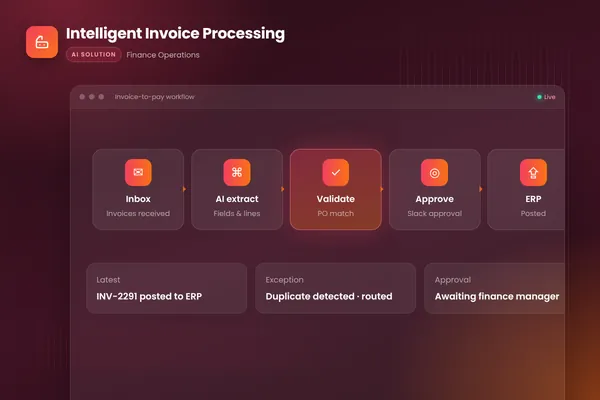
BufferSol builds these through its AI agents service and autonomous workflows service. Our intelligent invoice processing case study shows the pattern, our autonomous workflows service describes the delivery and the ready-made version is the invoice processing Done For You automation, live in 3 to 6 weeks. BufferSol view: a custom agent wins when you want your own system, your own audit log and no per-seat fees, and when you need one agent to act across systems a single vendor does not cover. A packaged agent wins when your stack already lives inside that vendor. See our AI automation agency pricing post for custom-build costs and our AI agent pricing research for checked prices.
What does a custom AP agent do, step by step?
It reads, checks, acts within limits and hands off. This is the agentic version BufferSol builds for invoice processing, in plain steps.
- 01ReceiveThe agent watches the AP mailbox and picks up the invoice and any attachments.
- 02Read and checkIt extracts the fields and checks them against the vendor record, the PO and past invoices.
- 03Decide inside limitsIt codes, matches and routes only what its rules allow, and flags duplicates and mismatches.
- 04EscalateAnything outside its rules, or above an approval limit, goes to a named person with a short summary.
- 05Post after approvalAfter a person approves, it creates the entry in your ERP or prepares the payment batch.
- 06LogEvery action, input and reason is written to a log that your team and your auditors can read.
BufferSol Technologies · buffersoltech.com
The tools are ordinary: a mailbox connection, document extraction, your ERP API and bank file formats, and a queue for the person who approves. Our single agent vs multi-agent post explains when to split the work, and our AI agent architecture post covers the parts.
What does a 30-day pilot deliver for an AP agent?
In 30 days you get a working AP agent on your real invoices, with your team approving what matters. The plan follows the delivery model on our autonomous workflows service page:
- You bring: read access to the AP mailbox and ERP, 100 to 200 recent invoices including the odd ones, your approval limits and one reviewer who can decide within a day.
- We build, in about two weeks: a prototype that reads, codes, matches and flags on a first slice, scored on 20 to 50 of your cases against the five checks.
- We launch, in the final stretch: a live pilot on one supplier group or one entity, with a person approving every action, logs, an exception report and a plan for widening the agent's authority.
BufferSol delivery data: a working agent on your real data inside 30 days, with Done For You automations live in 3 to 6 weeks. These are our commitments, not an industry benchmark. Success is measured on your baseline: share of invoices handled without correction, exceptions caught, time to approval and review hours saved. Our free AP automation savings calculator and AI agent ROI calculator turn volume and handle time into a monthly figure, and our how long to build an AI agent post gives timing. A pilot is not the full rollout. It shows what a full rollout needs.
Is this right for you?
Check these signs. Three or more means a pilot is worth scoping.
- Your AP team spends more time chasing supplier emails and exceptions than approving invoices.
- You have been shown several "AI" AP demos and cannot tell which ones act and which suggest.
- Your approval limits are written down, but your tools do not enforce them.
- Invoice volume is steady, and most invoices follow a handful of patterns.
- You want an audit log you control, not a vendor's dashboard.
The matching ready-made automation is Invoice Processing (Accounts Payable), a Done For You build for finance teams that want invoices read, coded, matched and routed with approvals, live in 3 to 6 weeks. Browse the Done For You catalogue for others. Related reading: AI invoice processing, invoice scanning software vs AI invoice agents and our AI workflow automation guide. If finance beyond AP is on your list, see our finance IT solutions guide, financial close automation post and AI readiness assessment. For examples outside finance, see AI workflow automation examples and AI workflow automation vs RPA. If you are weighing a partner, read what an AI automation agency does and our AI automation agency guide.
Is there anything we did not re-check?
Yes. Facts we did not re-check: facts checked November 2026 against the vendor pages named in this post. Vendor claims (Stampli's 89 percent, AppZen's up to 90 percent, Hypatos's 70 actions, BILL's 95 plus accuracy and Ramp's "one of the first") are the vendors' own and have no method on the pages. Coupa's page was blocked and Meow's was empty, so neither is assessed. The Gartner 15 percent figure, Ema's autonomy ratings and its Ardent Partners figures could not be traced to a primary source. The top-five comparison used search results, not a verified Google ranking. Re-check each vendor's current page and product before you buy.
If you want to know what an agent can safely do on your invoices, we recommend asking BufferSol for a scoped estimate of a 30-day pilot now, so you can test the five checks on your own data before your 2027 AP budget is set.
Frequently asked questions
Which vendors provide real AI agents for accounts payable?
On their own pages in November 2026, Ramp, Tipalti, AppZen, Medius, Vic.ai and Hypatos describe agents that act inside AP workflows. None of the pages we read says an agent pays invoices with no person involved. 'Real' depends on your test: acts on its own, spans steps, handles exceptions, states where approval sits and logs what it did. Test any vendor on your own invoices.
What is the difference between AI-driven AP software and an AI agent?
AI-driven AP software uses AI inside a fixed workflow, such as reading an invoice. An AI agent is given a goal, acts inside limits and records why. ChatFin puts it this way: AP software moves an invoice along a path someone configured, while an AP agent is given the job of getting the invoice resolved. AppZen adds that an agent's action takes effect whether or not a person looked.
Can an AI agent approve or pay invoices without a human?
Technically yes, but the vendor pages we read keep a person on approval. ChatFin says a sensible setup lets the agent prepare the payment batch and leaves release with a named approver. Tipalti says its AP Agent leaves approval decisions with your team. Microsoft's Payables Agent drafts invoices and does not post them. Widen authority only after reviewing the agent's work.
How do I test an AP agent before I buy?
Run it on your own past invoices, including the odd ones. ChatFin suggests a past month and a comparison of its coding, matches and flags with what your team did. BufferSol's version uses ten invoices: a clean one, a duplicate, a missing PO, a changed bank account, a split invoice, a foreign currency invoice and an invoice with no vendor record, then scores each against the five checks.
Are AP agents only for large companies?
No. The pages we read describe products for different sizes, from Ramp's card-and-bill-pay stack to Basware's global enterprise focus. Size matters less than volume, rule clarity and who owns exceptions. A team with steady invoice formats and written approval limits can test an agent on one slice, such as a supplier inbox, without replacing its ERP.
When does a custom AP agent beat a vendor's agent?
When your ERP, approval limits or supplier mix do not fit a packaged product, or when you want your own audit log and no per-seat fees. A packaged agent works inside the vendor's product and limits. BufferSol builds custom agents that connect to your mailbox, ERP and bank files, with a person approving what you choose.
How much do AP AI agents cost?
The vendor pages we read do not publish prices for their agents, so we state none. Ask each vendor in writing for the cost per processed invoice at your volume, including exceptions, and what changes when volume doubles. BufferSol's AI Agent Pricing 2027 research page lists the prices we have checked against vendor pages, with dates.
Sources
- 4 Top-Rated AI Agents for AP Automation in 2026, Ramp
- Ramp accounts payable software, Ramp
- Agentic AI for Accounts Payable: What it is and How it Works, Tipalti
- Tipalti AI: AI Agents for Finance Teams, Tipalti
- Why we built the AppZen AP Inbox Service Center, AppZen
- Agentic AI for accounts payable: What actually changes, AppZen
- Medius: AP Automation and Global Payment Software, Medius
- Vic.ai: AI-First Invoice Processing, Vic.ai
- Hypatos: Agentic GBS Workforce for Invoice Processing, Hypatos
- Increase Efficiency and Accuracy with AI in BILL, BILL
- Basware: AI-Driven Invoice Lifecycle Management, Basware
- Stampli: Procure-to-Pay Platform for Finance Teams, Stampli
- SAP Concur: Spend Management Software, SAP Concur
- Payables Agent Overview in Business Central, Microsoft Learn
- AI Agents for AP Automation, ChatFin
- Agentic AI for Accounts Payable, ChatFin
- 10 Best AI Agents for Accounts Payable in 2026, Ema
- Building effective agents, Anthropic
Cite this article
BufferSol Editorial Team (2026). AI Agents for Accounts Payable Providers in 2027: Which 6 Vendors Pass a Real-Agent Buyer's Test?. BufferSol Technologies. https://buffersoltech.com/blog/ap-ai-agent-providers-2027
BufferSol Editorial Team
AI & software engineering team
Senior engineers, AI specialists and product leads at BufferSol Technologies who design, build and run AI agents, autonomous workflows and custom software for companies in the US, UK and Europe.
Reviewed by Sufyan K., Senior Writer, BufferSol Technologies.