Key takeaways
- An AI automation agency designs, builds and runs AI agents and automated workflows for your business. Judge it on systems running in production, not on demos.
- Before you contact any agency, write down the problem, the process owner, the data involved and how you will measure success. Good agencies will test all four.
- Start with a short, fixed-price discovery or prototype on your own data. It is the cheapest way to compare agencies and to get a real estimate.
- Your contract should give you ownership of code, prompts and evaluation data, and include a data processing agreement that covers what UK GDPR Article 28 requires.
- The clearest red flags are no production references, no evaluation plan, vague answers on security, and pricing that ignores running costs.
Before hiring an AI automation agency, a business should know which process it wants to improve, who owns that process, what data the work depends on and how success will be measured. With those four answers, you can compare agencies on evidence: systems they run in production, how they test quality, how they handle security and data, and what the work will cost to build and run. This guide covers each step.
We are an AI automation agency ourselves, so read this with that in mind. We have tried to write the guide we would want a client to read before talking to anyone, including us. Where we describe how BufferSol works, we say so.
What does an AI automation agency do?
An AI automation agency designs, builds and runs software that uses AI to do work your team currently does by hand. The work usually falls into four groups:
- AI agents that complete tasks across your systems, such as resolving support tickets, researching leads or screening applications. See our AI agent development service and the guide to AI agent development.
- Automated workflows that run a business process end to end, with AI handling the steps that need reading or judgment, such as invoice processing or order updates. Our guide to AI workflow automation explains how these are built.
- Generative AI features inside your products and tools, such as knowledge assistants, copilots and document summaries. This is our generative AI and LLM practice.
- Advice and enablement: finding the right processes to automate, building the business case, and training your team to run and extend what was built.
The label covers a wide range of firms. Some are workflow-tool specialists who connect apps in no-code platforms. Some are software engineering firms with an AI practice. Some are strategy consultancies that hand the build to others. None of these is wrong, but they suit different problems, and you should know which kind you are talking to.
What separates a good agency from a weak one is everything around the model. Anthropic's engineers, in Building effective agents, recommend finding "the simplest solution possible, and only increasing complexity when needed." An agency that follows that advice will sometimes tell you that you need a plain integration, not AI, which is a good sign.
Do you need an agency, an in-house team or a freelancer?
There are three common ways to get AI automation built. Each fits a different situation.
| Agency | In-house team | |
|---|---|---|
| Time to first result | Weeks: the team and methods already exist | Months: hiring and onboarding come first |
| Breadth of experience | Patterns from many clients and industries | Deep knowledge of your business and systems |
| Cost shape | Project or monthly fees; scales up and down | Salaries and tools; a fixed cost that persists |
| Continuity | Depends on contract and handover quality | Knowledge stays inside the company |
| Best when | AI is new to you, or demand is uneven | AI is core to your product and demand is steady |
| Common pattern | Build the first systems, then hand over | Take over and extend after a documented handover |
BufferSol Technologies · buffersoltech.com
A freelancer can be a good choice for a small, well-defined job with low risk, such as one workflow between two common apps. The trade-offs are capacity and cover: one person cannot do design, engineering, security and support at the same time, and the work stops if they are unavailable.
An agency makes most sense when the work spans several skills (process design, integrations, AI, security, operations), when you need results in weeks rather than months, or when your demand for AI work will rise and fall. An in-house team makes sense when AI is part of what you sell and you have years of steady work for several specialists.
Many companies use both in sequence. The agency builds the first systems and sets up evaluation and monitoring. The internal team then takes over with documentation, training and a support period. If that is your plan, say so at the start, because it changes how the agency should document and structure the work.
Before you talk to any agency: prepare these five things
The UK government's Guidelines for AI procurement were written for public bodies, but their advice applies to any buyer. One line sums up the approach: "Tell suppliers about the situation or challenge, and let them propose a solution that meets your needs." The same guidance treats data as a prerequisite, to be assessed before you go to market.
In practice, prepare these five things before the first call:
- The problem, in one sentence. "Our finance team keys several hundred supplier invoices a month by hand and approvals take too long" is useful. "We want to use AI in finance" is not.
- The process owner. The person who runs the process today and can decide how it should work. Without an owner, nobody can approve the rules or accept the result.
- The systems and data involved. Which tools hold the data, whether they have APIs, and whether you can share sample data under an NDA.
- Current numbers. Volume, time per item, error or rework rate and cycle time. Rough figures are fine. They become the baseline for measuring the return.
- Constraints. Data residency, regulatory requirements, security reviews, budget range and any deadline.
With these, a good agency can give you a meaningful response after one or two conversations. Without them, every proposal will be a guess, and you will not be able to compare one with another.
How to choose an AI automation agency: a scorecard
Score each agency you speak to on the same criteria. We suggest weighting the first three most heavily, because they predict whether your system will reach production.
| Criterion | What good looks like | Warning signs |
|---|---|---|
| Production evidence | Systems running today, with named metrics and a reference you can call | Only demos, prototypes or screenshots |
| Evaluation approach | Builds a test set from your real examples before building, and reports against it | "We'll test it" with no method or metric |
| Security and data handling | Clear answers on permissions, prompt injection, logging, data residency and a DPA | Vague answers, or "the model provider handles that" |
| Process understanding | Asks about your process, exceptions and owners before discussing models | Leads with tools and model names |
| Fit of skills | Has done work like yours: similar systems, data types and risk level | Generic AI claims across every industry |
| Commercial clarity | Clear pricing model, running-cost estimate, ownership terms and exit plan | Prices only the build; unclear on IP |
| Communication | Named team, regular demos, overlap with your working hours | Account manager only; engineers hidden |
The UK guidelines add a point worth copying: they ask buyers to make explainability "one of your design criteria," partly to avoid depending on a black box from a single supplier. In agency terms, that means you should be able to see how the system makes each decision, in logs your own team can read.
Questions to ask an AI agency, and what good answers sound like
Ask every agency the same questions, in the same order, and write down the answers.
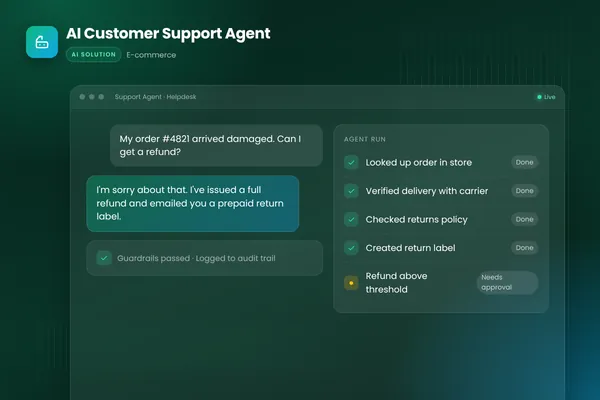
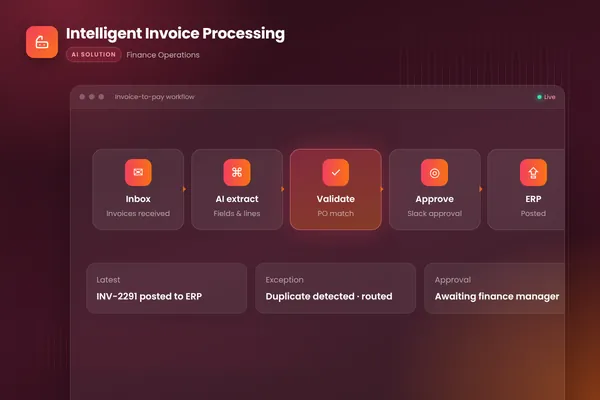
1. Can you show us a system you built that is running in production today? Good answers name the system, what it does, how long it has run and what it measures. Better ones offer a client reference. Our own case studies, such as the AI customer support agent and intelligent invoice processing, describe what each system does and where people stay in control.
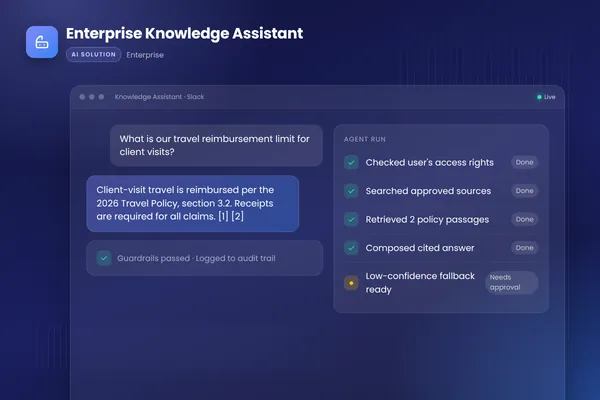
2. How will you measure whether the system works? Look for an evaluation set: real examples from your business with the correct outcome for each, used to score the system before every release. In our enterprise knowledge assistant, an evaluation suite measures answer accuracy before each release. "We'll do user acceptance testing at the end" is not enough.
3. Which actions will need human approval? OpenAI's practical guide to building agents says actions that are "sensitive, irreversible, or have high stakes" should trigger human oversight, with examples such as canceling orders, authorizing large refunds or making payments. A good agency will name the approval points for your process and explain how they are enforced in code.
4. How do you protect the system from prompt injection and misuse? Prompt injection is first on the OWASP Top 10 for LLM applications, and excessive agency, meaning a system with more permissions than its job needs, is sixth. Expect specifics: least-privilege credentials, input and output checks, logging and testing with hostile inputs.
5. What will it cost to run, per task or per month? The build is only part of the cost. Model usage, hosting, monitoring and support continue for as long as the system runs. A good agency estimates these from a prototype and explains how it will keep them down.
6. Who owns the code, prompts and evaluation data at the end? The answer should be "you," in writing. See the contract section below.
7. Who will actually do the work, and how will we see progress? Ask to meet the engineers, not only the sales lead. Ask how often you will see working software. BufferSol, for example, works in two-week sprints with weekly demos.
8. What happens if we want to stop or switch provider? A confident agency has a clear handover process: documentation, access transfer and a support period. If they hesitate, expect lock-in.
Red flags when hiring an AI development company
Many problems with AI projects are visible before the contract is signed. Watch for these:
- No production references. Every agency has demos. Ask for systems that real users rely on today.
- Model-first conversations. If the agency talks about which model to use before it understands your process, it is selling technology rather than solving your problem.
- Promises without measurement. Accuracy claims with no evaluation method, or guaranteed savings before anyone has seen your data.
- Everything is an agent. Some tasks need an autonomous agent. Many need a plain workflow or a single model call. An agency that never recommends the simpler option is optimizing for its own billing.
- Security as an afterthought. No clear answer on permissions, logging, data retention or prompt injection.
- Unclear ownership. Contracts that license you the system rather than transfer it, or that keep prompts and evaluation data with the agency.
- Running costs left out. A proposal that prices the build but says nothing about what the system costs each month in model usage and hosting.
- No exit plan. No documentation commitments, no handover process and credentials held only by the agency.
If you see several of these together, look elsewhere.
How AI automation agencies price their work
The pricing model decides who pays when scope changes, so compare models as carefully as prices. These are the common ones.
| Model | How it works | Works well for | Watch out for |
|---|---|---|---|
| Fixed-price discovery or prototype | A short, fixed fee to scope the work and test it on your data | Comparing agencies and getting a real estimate | Make sure it produces a working prototype, not just a report |
| Fixed-scope project | Agreed deliverables for an agreed price | Clearly defined systems with known integrations | Change requests; scope must be precise |
| Time and materials | You pay for time spent, usually against an estimate | Work where scope will change as you learn | Needs close tracking and regular demos |
| Dedicated monthly team | A team works for you each month on a rolling plan | Ongoing programs with several systems | Make sure every month has agreed goals |
| Retainer for run and improve | A monthly fee for monitoring, support and updates | Systems already in production | Define response times and what is included |
At BufferSol we offer fixed-price discovery and prototypes, fixed-scope projects and dedicated monthly teams, and we recommend starting with discovery. A short discovery on your own data is the cheapest way to find out whether an idea works, what it will cost to build and run, and whether you enjoy working with the agency, before you commit to a larger contract.
Whatever the model, ask for the total cost of ownership over two or three years, not just the build fee. That includes model usage at your expected volume, hosting, monitoring, support, model upgrades and the internal time your team will spend reviewing exceptions and maintaining rules.
What a good discovery sprint includes
A discovery sprint is the first paid piece of work with an agency. It should answer one question with evidence: can this process be automated well enough, at a cost that makes sense?
- 01Process mapThe current process step by step, with volumes, systems, hand-offs and pain points.
- 02Success measuresAgreed metrics and targets, such as accuracy, time saved and straight-through rate.
- 03Evaluation setReal examples from your business with the correct outcome for each.
- 04Working prototypeA system running on your real data, scored against the evaluation set.
- 05Cost estimateBuild cost plus running cost per task or per month, based on the prototype.
- 06Go or no-go planA recommendation to build, adjust scope or stop, with the evidence behind it.
BufferSol Technologies · buffersoltech.com
At the end, you should have a working prototype, numbers from your own data and a costed plan. If an agency offers discovery that ends with a slide deck and no running software, ask why.
Contracts, IP and data protection
Have your legal team check these points in the contract.
Ownership. You should own the source code, prompts, configuration, evaluation sets, documentation and any training data created for you. If the agency reuses its own components, they should be licensed to you permanently and free of charge. Models from providers such as OpenAI or Anthropic stay with those providers under their terms, so the API accounts and keys should be in your name, not the agency's.
Data processing. If the agency will handle personal data on your behalf, UK GDPR and EU GDPR require a written contract between controller and processor. The ICO's guidance on what needs to be included in the contract lists the minimum terms under Article 28(3): processing only on your documented instructions, a duty of confidence, appropriate security, rules on sub-processors, helping with data subjects' rights, assisting you as controller, end-of-contract provisions and audits. For an AI project, also confirm which model providers act as sub-processors, where data is processed and whether inputs can be used for model training.
Security and access. Agree who holds credentials, how access is granted and removed, how incidents are reported and what logging is in place.
Acceptance. Tie acceptance to the evaluation set and success measures agreed in discovery, not to a subjective sign-off.
Support and exit. Define response times for production issues, what ongoing improvement is included and the handover steps if the contract ends.
Regulation. Ask how the agency's process maps to the frameworks that apply to you. In the US, the NIST AI Risk Management Framework is voluntary but widely used as a shared vocabulary, with four functions: govern, map, measure and manage. In the EU, the AI Act sorts AI systems by risk, and lists uses such as CV-sorting for recruitment and credit scoring as high-risk. If your system could fall into a high-risk category, the agency should raise it in discovery, not after launch.
| Must have | Nice to have | |
|---|---|---|
| Ownership | Code, prompts, configs, evaluation sets and docs assigned to you | Escrow or repository mirror in your own account |
| Data | Article 28 DPA, sub-processor list, processing regions, no training on your data | Data retention schedule per system |
| Quality | Acceptance tied to the agreed evaluation set | Quality reports with every release |
| Security | Least-privilege access, logging, incident reporting | Prompt injection test results before launch |
| Support | Response times for production issues | Scheduled model and cost reviews |
| Exit | Documented handover and access transfer | Paid knowledge-transfer sessions for your team |
BufferSol Technologies · buffersoltech.com
Location, time zones and working across borders
Many buyers in the UK, Ireland and the EU work with agencies based elsewhere, and many US companies do the same. Location matters less than three practical questions.
Overlap. How many working hours does the agency share with your team each day? You need enough overlap for a weekly demo, quick answers on rules and exceptions, and a real person on call when something breaks in production. BufferSol is based in New York and plans its working hours to overlap with UK and European business days for clients there.
Data. Where will your data be stored and processed, and by which providers? For UK and EU personal data, the data processing agreement should name each sub-processor and processing region, and your legal team should confirm how any transfer outside the UK or EU is covered. Often the simplest answer is to run the system in your own cloud account, in the region you choose, with the agency working inside it.
Accountability. Who signs the contract, which law governs it, and how are disputes handled? A small agency abroad can be an excellent partner, but you should know exactly which company you are contracting with and what insurance it holds.
After launch: support, model updates and drift
AI systems need ongoing maintenance after launch. Three things change, and your agreement with the agency should cover each.
Your process changes. New products, policies, suppliers and document formats appear. Someone needs to update the rules, prompts and evaluation set when they do, and re-run the evaluations before each change goes live.
The models change. Providers release new models and retire old ones. A model upgrade can improve quality and cut cost, but it can also change behavior in ways nobody expected. Ask how the agency tests a model change before switching, and who decides when to switch.
Quality drifts. The mix of inputs shifts slowly over time, and accuracy can slide without anyone noticing. Monitoring should track the agreed metrics continuously and alert someone when they fall below the line. The UK procurement guidelines make the same point for public buyers: plan for "lifespan testing, not a one-time decision."
Agree in writing who watches the dashboard, how often you review it together, what response times apply to production issues, and what a monthly run-and-improve service includes. If you plan to take the system in-house later, schedule the handover and training now rather than at the end of the contract.
Working with an AI agency: the first 90 days
This is roughly what the first three months should look like, and it is the plan we propose to BufferSol clients. We can usually start discovery within a week of agreeing scope, and AI agent and automation projects typically reach a working prototype in about two weeks (BufferSol experience).
Source: BufferSol experience
BufferSol Technologies · buffersoltech.com
Days 1 to 30: discovery and prototype. Map the process, agree success measures, build the evaluation set and get a prototype running on real data. End the month with a go or no-go decision based on numbers.
Days 31 to 60: build and harden. Connect the production systems, add approvals, permissions, logging and monitoring, and test against the evaluation set and against hostile inputs. Train the people who will review exceptions.
Days 61 to 90: staged rollout. Run in shadow mode, where the system proposes and people decide, then hand over a growing share of live work. Review the exception queue weekly and track the agreed metrics on a dashboard.
By day 90 you should have at least one process live or in supervised production, a dashboard your process owner checks, and a clear view of what to automate next. If you do not, the reasons should be visible in the numbers, not a surprise.
Your side of the work matters as much as the agency's. Keep the process owner available for an hour or two a week, give access to systems and sample data early, and come to the demos. Delays in system access or decisions slow any project, and they are in your control.
Getting started
- Write the one-sentence problem, name the process owner and collect rough baseline numbers.
- Shortlist two or three agencies whose production work looks like your problem.
- Ask each the eight questions above and score them on the same scorecard.
- Run a fixed-price discovery with your preferred agency and decide with evidence.
- Before the build starts, sign a contract that covers ownership, data processing, acceptance, support and exit.
If you would like us to be one of the agencies you compare, our teams for AI agents, autonomous workflows and generative AI can start with a fixed-price discovery and prototype on your own data. You can talk to an engineer about the process you have in mind, and we will tell you plainly if a simpler option would serve you better.
Frequently asked questions
What does an AI automation agency do?
It finds business processes that AI can speed up, then designs, builds and runs the systems that do the work: AI agents, automated workflows, document processing and AI features inside existing software. A good agency also handles the parts around the model, such as integrations, security, evaluations, monitoring and training your team to own the result.
How much does an AI automation agency cost?
Cost depends on scope, the number of systems involved, data quality and how risky the automated actions are. Most agencies offer a small fixed-price discovery or prototype first, then a fixed-scope build or a monthly team. Ask every agency to estimate running costs too, such as model usage and hosting, because those continue after the build is paid for.
Should we hire an AI agency or build an in-house AI team?
An agency gets you a working system faster and brings experience from many similar projects, which helps when AI is new to your company. An in-house team makes sense when AI is core to your product and you have steady, long-term work for several specialists. Many companies start with an agency and plan a handover to an internal team.
How do I know if an AI agency is any good?
Ask to see a system they built that is running in production today, and what it measures. Ask how they build evaluation sets, which actions need human approval and how they test for prompt injection. Strong agencies answer with specifics and examples. Weak ones talk about models and features but cannot show results or explain how they measure quality.
Who owns the code and models when an agency builds an AI system?
That depends entirely on the contract, so settle it before work starts. Ask for ownership of the source code, prompts, configuration, evaluation sets and documentation, with any reused components licensed to you permanently. Model weights from providers such as OpenAI or Anthropic stay with the provider, so make sure you hold the API accounts and keys yourself.
How long before we see results from an AI agency?
A good agency should show a working prototype on your real data within a few weeks of starting discovery, scored against agreed success measures. Production systems take longer because of integrations, security review and staged rollout. By the end of the first 90 days you should have at least one process live or in supervised production, with numbers to show for it.
Sources
- Guidelines for AI procurement, Department for Science, Innovation & Technology and Office for Artificial Intelligence (UK)
- What needs to be included in the contract?, Information Commissioner's Office
- AI Act, European Commission
- AI Risk Management Framework, NIST
- 2025 Top 10 Risk & Mitigations for LLMs and Gen AI Apps, OWASP Gen AI Security Project
- Building effective agents, Anthropic
- A practical guide to building agents, OpenAI
Cite this article
BufferSol Editorial Team (2026). AI Automation Agency Guide: How to Choose, Hire and Work With One (2026). BufferSol Technologies. https://buffersoltech.com/blog/ai-automation-agency-guide
BufferSol Editorial Team
AI & software engineering team
Senior engineers, AI specialists and product leads at BufferSol Technologies who design, build and run AI agents, autonomous workflows and custom software for companies in the US, UK and Europe.