Key takeaways
- An AI automation agency finds work that AI can take over, then designs, builds, launches and runs the systems that do it: AI agents, automated workflows and AI features inside existing tools.
- Most of the engineering is around the model: integrations, permissions, validation, evaluation sets, monitoring and the exception path for people.
- Every stage should end with something you can see and keep, such as a process map, an evaluation set, a working prototype, production code or a monitoring dashboard.
- A delivery team usually combines process analysis, AI engineering, integration engineering, quality and evaluation, and project leadership.
- The work does not stop at launch. Processes, models and inputs change, so a good agency plans for monitoring, updates and a handover from the start.
What does an AI automation agency do? It finds work in your business that AI can take over, then designs, builds, launches and runs the systems that do it. Those systems are usually AI agents that complete tasks across your tools, automated workflows that run a process end to end, or AI features inside software you already use. A good agency also handles everything around the model: integrations, security, testing, monitoring and the hand-off to your team.
This post explains what that looks like in practice: the services, the stages of an engagement, what you should receive at each stage and who does the work. For advice on choosing an agency, see our guide to hiring an AI automation agency.
The services an AI automation agency offers
Most of the work falls into four groups.
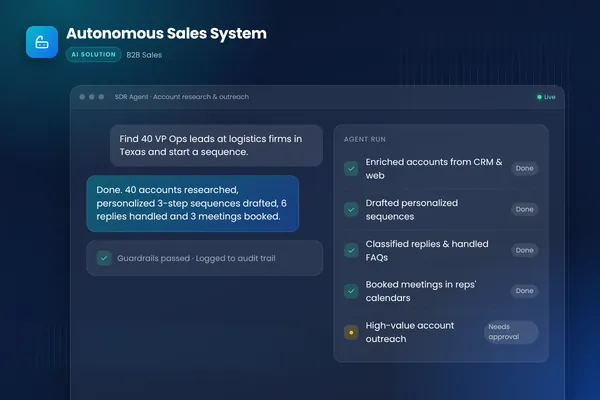
AI agents. Software that works toward a goal using your systems: resolving support tickets, researching sales leads, screening job applications or reconciling invoices. Our AI agent development practice builds these, including multi-agent systems such as the autonomous sales system, where one agent researches accounts, another writes outreach and a third handles replies.
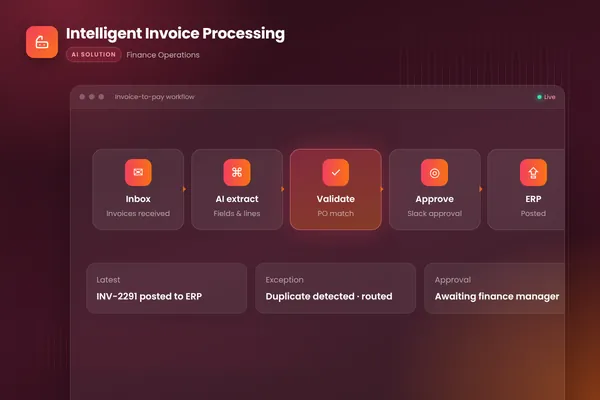
Automated workflows. Business processes run end to end by a workflow engine, with AI handling the steps that need reading or judgment. Our intelligent invoice processing build is a typical example: it watches an inbox, extracts invoice data with document AI, matches it to purchase orders, routes approvals in Slack and posts approved invoices to the accounting system. This is our autonomous workflows practice.
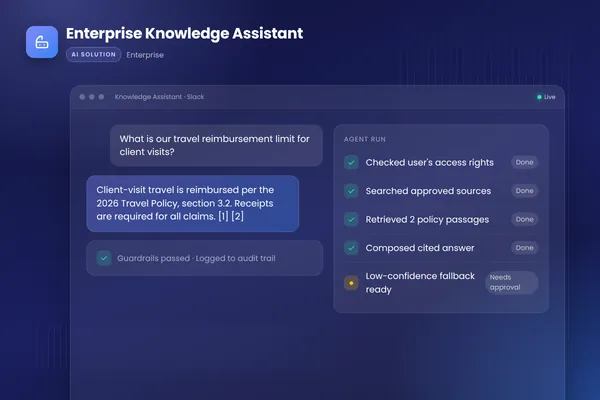
Generative AI features. Assistants and AI functions inside your products and internal tools, such as a knowledge assistant that answers staff questions from approved documents with citations. Our enterprise knowledge assistant is one, delivered through our generative AI practice.
Advice and enablement. Choosing which processes to automate, building the business case, and training your team to run and extend what was built.
The common thread is that the agency is accountable for a working result, not just a recommendation. Anthropic's engineers advise in Building effective agents to find "the simplest solution possible, and only increasing complexity when needed." A good agency applies that to its own proposals, which means it will sometimes recommend a plain integration instead of AI.
The engagement lifecycle, stage by stage
Every agency names its stages differently. This is how a BufferSol engagement runs for an AI agent or workflow, with what you should receive at the end of each stage.
- 011. Job mappingPick one high-value job, document the steps, systems and rules, and agree success metrics. You receive: a process map and agreed measures.
- 022. PrototypeA working system on your real data, scored against an evaluation set for accuracy and cost. You receive: the prototype, test results and a costed plan.
- 033. Harden and integrateGuardrails, approvals, permissions, single sign-on, logging and production integrations. You receive: production-ready code in your repository.
- 044. Staged launchShadow mode first, then a growing share of live work, with people reviewing outcomes. You receive: a live system and a monitoring dashboard.
- 055. Run and improveMonitoring, tuning from real cases, model updates and regular reviews. You receive: reports, updates and a runbook.
- 066. Handover (when planned)Documentation, access transfer and training for your team. You receive: everything needed to run it yourselves.
BufferSol Technologies · buffersoltech.com
1. Job mapping
The agency works with the person who owns the process to write down every step, system, rule and exception, along with current volumes and pain points. Together you agree how success will be measured, for example accuracy against real examples, time saved per item, or the share of items completed with no human touch.
2. Prototype
The agency builds a working version on your real data. Alongside it, it builds an evaluation set: real past examples with the correct outcome for each, used to score the system. At BufferSol, AI agent and automation projects typically reach a working prototype in about two weeks (BufferSol experience). The prototype also gives the first real estimate of running cost per task.
3. Harden and integrate
This is where most of the engineering happens. The agency connects the production systems, scopes each credential to what the job needs, adds checks on every AI output, builds approval steps for risky actions and sets up logging. Security work belongs here too. The OWASP Top 10 for LLM applications ranks prompt injection first and excessive agency sixth, and both are design problems the agency should address before launch, not after.
4. Staged launch
The system first runs in shadow mode, proposing outcomes that people compare against their own decisions. Then it takes over a growing share of live work. The people who review exceptions are trained, and the agreed metrics go on a dashboard the process owner actually checks.
5. Run and improve
After launch, the agency monitors quality, cost and exceptions, tunes the system from real cases and tests model updates before switching. The UK government's Guidelines for AI procurement make the same point for public buyers: plan for "lifespan testing, not a one-time decision."
6. Handover
If you plan to run the system yourselves, the agency hands over documentation, access and training. Plan this from the start, because it changes how the code, prompts and runbooks should be written.
Who is on an AI automation agency's team?
The UK procurement guidelines note that "Developing, evaluating and delivering AI projects will be more effective with diverse teams." That is true on the agency side as well. A typical delivery team covers these roles, sometimes with one person holding two:
| Role | What they do |
|---|---|
| Process analyst or product lead | Maps the process, agrees success measures and owns priorities with your process owner |
| AI engineer | Designs prompts, retrieval, model choice and the AI steps, and keeps cost per task down |
| Integration engineer | Connects your CRM, ERP, helpdesk, inbox and other systems, with retries and error handling |
| Quality and evaluation | Builds and runs the evaluation sets, tests edge cases and hostile inputs |
| Delivery lead | Runs the plan, demos and risks, and keeps you informed |
| Support engineer (after launch) | Watches monitoring, handles incidents and applies updates |
If you only ever meet a salesperson and an account manager, ask to meet the engineers. They are the people who decide whether the system works.
On your side, the agency needs a process owner who can make decisions, someone from IT who can grant system access, and the people who will review exceptions once the system is live. A few hours a week from each of them during the build is usually enough, and it has a large effect on how quickly the work moves.
What an agency should never leave out
These are the parts buyers most often forget to ask for, and the parts weak agencies quietly skip:
- An evaluation set built from your data. Without one, nobody can say whether the system is accurate enough to trust.
- The exception path. A clear queue for items the system cannot handle, with the reason and evidence attached, and a named person to review them.
- Human approval for risky actions. Payments, large refunds, cancellations and anything that significantly affects a person.
- Logs you can read. Every decision and action recorded, so any outcome can be explained later.
- Running-cost estimates. Model usage, hosting and support, not just the build fee.
- Governance that maps to a framework. In the US, the NIST AI Risk Management Framework gives a shared vocabulary of four functions (govern, map, measure and manage) that security and legal teams recognize.
- Ownership in writing. Code, prompts, configuration, evaluation sets and documentation assigned to you.
How to tell whether an agency is doing the job
At each stage, ask to see the deliverable rather than hear about it. After job mapping, ask for the process map and the agreed measures. After the prototype, ask for the evaluation results on your data and the cost per task. Before launch, ask to see the approval points, the permissions each credential has and the logs. After launch, ask for the dashboard.
An agency that is doing the work will show you these things without hesitation. If you want to see how we would approach a process in your business, our AI agents and autonomous workflows teams can walk you through it, or you can talk to an engineer directly.
Frequently asked questions
Is an AI automation agency the same as an AI consultancy?
Not quite. A consultancy mainly advises: strategy, use-case selection, business cases and vendor choice, and it often hands the build to someone else. An AI automation agency builds and runs the systems, from integrations to monitoring. Some firms do both. Ask any provider whether the people who scope your project will also write the code and support it in production.
What should I receive at the end of an AI agency project?
At minimum: the working system in production, the source code and configuration in your own repository, the prompts and evaluation sets, documentation of how each decision is made, a monitoring dashboard, and a runbook for handling incidents and exceptions. If personal data is involved, you should also have a signed data processing agreement and a record of where data is processed.
Do AI automation agencies only work with no-code tools like Zapier and Make?
Some do, and that suits small, low-risk flows between common apps. Others, including BufferSol, write custom code on durable workflow engines when the process is long-running, high-volume or business-critical, and use no-code tools where they fit. Ask which approach the agency recommends for your process and why, and who will be able to maintain it afterwards.
Sources
- Guidelines for AI procurement, Department for Science, Innovation & Technology and Office for Artificial Intelligence (UK)
- AI Risk Management Framework, NIST
- 2025 Top 10 Risk & Mitigations for LLMs and Gen AI Apps, OWASP Gen AI Security Project
- Building effective agents, Anthropic
Cite this article
BufferSol Editorial Team (2026). What Does an AI Automation Agency Actually Do? Services, Deliverables and the Engagement Lifecycle. BufferSol Technologies. https://buffersoltech.com/blog/what-does-an-ai-automation-agency-do
BufferSol Editorial Team
AI & software engineering team
Senior engineers, AI specialists and product leads at BufferSol Technologies who design, build and run AI agents, autonomous workflows and custom software for companies in the US, UK and Europe.