Key takeaways
- At BufferSol, a working prototype on real data usually takes about two weeks once the job is clearly defined, and most production agents take 6 to 16 weeks (BufferSol delivery data).
- The model is rarely what takes the time. Integrations, permissions, guardrails, evaluation and security review decide where a project lands in that range.
- Agents that touch payments, health data, personal decisions or many systems sit at the upper end. A narrow, read-mostly agent on systems with good APIs sits at the lower end.
- The fastest projects start with one narrow job, an evaluation set written before the prompts, and a process owner who can make decisions every week.
- Launch is a stage, not a date: shadow mode and a staged rollout come before the agent works on its own.
How long does it take to build an AI agent? In BufferSol projects, a working prototype on your real data usually takes about two weeks once the job is clearly defined, and a production agent takes 6 to 16 weeks from the start of the build (BufferSol delivery data). Discovery, where the job is defined and tested, adds 2 to 3 weeks before that. Where a project lands depends on integrations, risk and data, not on the model.
This post breaks that range into phases, shows what you should have at the end of each one, and explains what pushes a project toward either end. For the wider picture, see our guide to AI agent development.
The short answer, by phase
Source: BufferSol delivery data
BufferSol Technologies · buffersoltech.com
The prototype is fast because it only has to prove one thing: that the agent can do the job well enough on real examples. Production takes longer because everything around the agent has to be built properly: connections to live systems, permissions, guardrails, approvals, logging, monitoring and a rollout plan.
Phase by phase: what happens and what you get
Discovery and job mapping (2 to 3 weeks, including the prototype)
The team picks one high-value job, documents the steps, systems and rules, and agrees how success will be measured. It also collects real past examples with the right outcome for each. Those become the evaluation set, which is the most useful single thing a project can produce early, because every later decision is measured against it.
You should have: a process map, agreed success measures, an evaluation set and access arranged to the systems the agent needs.
Prototype (about 2 weeks once the job is defined)
The team builds a working agent on your real data and scores it on the evaluation set for accuracy, cost per task and speed. It is deliberately narrow. OpenAI's practical guide to building agents recommends maximizing a single agent's capabilities first, because more agents add "complexity and overhead", and Anthropic's Building effective agents advises starting with the simplest solution that works.
You should have: a prototype you can try, its scores on the evaluation set, a cost-per-task estimate and a costed plan for production.
Harden and integrate (most of the 6 to 16 weeks)
This is where the calendar goes. Each production system is connected with credentials scoped to what the job needs. Every tool call is validated. Approval steps are added for risky actions, logging and monitoring are set up, and single sign-on is connected where staff use the agent. Security testing belongs here too: the OWASP Top 10 for LLM applications puts prompt injection first and excessive agency sixth, and an agent that reads customer emails or web pages must be tested for both before it acts on anything.
You should have: production-ready code in your own repository, documented permissions, an approval flow and passing results on the evaluation set.
Staged launch (part of the build window)
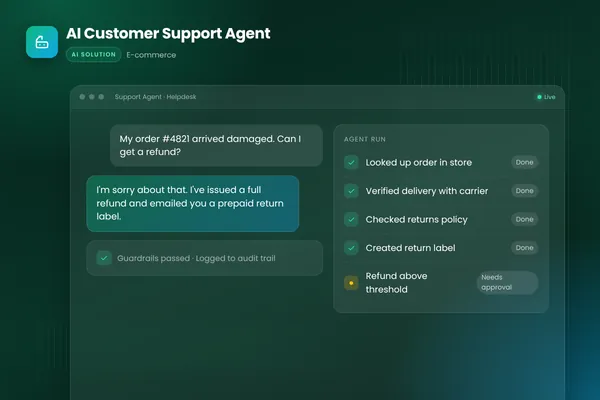
The agent first runs in shadow mode, proposing actions that people review against their own decisions. Then it takes on a growing share of live work. In our AI customer support agent, the agent looks up orders and creates return labels on its own, while refunds above a set threshold go to a person with a summary. Approval points like that are part of launch planning, not an afterthought.
You should have: a live agent, a dashboard for the agreed measures and trained reviewers for the exception queue.
Run and improve (ongoing)
After launch, the team monitors quality, cost and handovers, adds new cases to the evaluation set and tunes the agent from real conversations. This does not have an end date, but it should have a rhythm, such as a monthly review.
Why the gap between prototype and production surprises teams
A prototype that works in week two can make the rest of the plan look padded. It is not. The prototype runs on a sample of real examples, with a developer watching, using test credentials and no real consequences. Production is a different job.
In production, the agent meets inputs nobody put in the evaluation set: forwarded email chains, attachments in odd formats, customers who ask three things at once, and occasionally text written to manipulate it. It acts on live systems, so every action needs the right permissions, a check and a log. Some actions need a person to approve them, which means building the review screen and training the reviewers. Someone has to be alerted when quality drops or costs rise. And security, legal and data protection teams need to see the design before they sign off.
None of that is model work, and all of it decides whether people trust the agent after launch. Plan for it from the start and the timeline holds. Treat the prototype as nearly finished and this work arrives later, when it is slower to add.
What puts a project at 6 weeks or at 16
| Factor | Toward 6 weeks | Toward 16 weeks |
|---|---|---|
| Scope | One narrow job | Several jobs, or several cooperating agents |
| Integrations | One or two systems with good APIs | Many systems, legacy tools or no APIs |
| Actions | Read-only or easily reversed | Payments, refunds, records that are hard to undo |
| Data | Clean, accessible, already in one place | Scattered, inconsistent or sensitive |
| Regulation | Low-risk internal use | Health data, financial decisions, hiring or other decisions about people |
| Decisions | Process owner available every week | Unclear ownership, slow approvals |
| Security review | Started in week one | Started after the build |
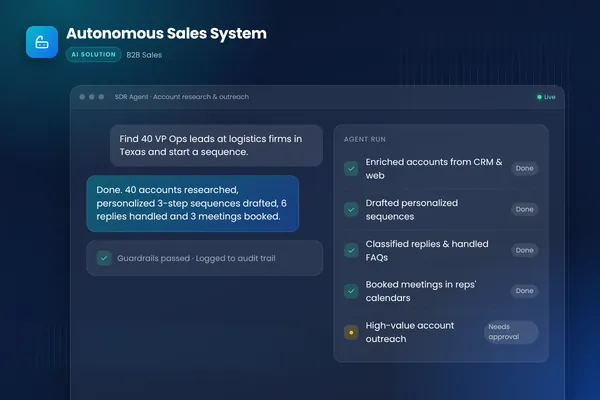
Multi-agent systems usually sit higher in the range. Our autonomous sales system uses separate agents for account research, writing outreach and handling replies, plus approval queues for high-value accounts, and each agent has its own tools and tests.
Regulation matters too. Under the EU AI Act, uses such as CV-sorting for recruitment and credit scoring are listed as high-risk, with stricter obligations. If your agent could fall into a category like that, plan the compliance work into the timeline from the start.
How to get to production faster
- Pick one narrow job. "Answer order-status and returns questions" ships much faster than "handle customer service".
- Write the evaluation set first. Fifty to a hundred real examples with known outcomes let you measure progress every day instead of arguing about it.
- Arrange access in week one. Credentials, test accounts and API keys are a common source of delay, and they are entirely in your control.
- Name a process owner. Someone who can answer "what should happen here?" within a day.
- Start security and legal review early. Share the design, permissions and data flows during discovery, not after the build.
- Plan the rollout before you build. Decide which actions need approval and who reviews exceptions, so launch is not held up by those decisions.
The OpenAI guide sums up the approach well: "Start small, validate with real users, and grow capabilities over time."
Getting started
If you have a job in mind, our AI agent development team can start discovery, usually within a week, and show you a prototype on your own data before you commit to the full build. You can also talk to an engineer about your timeline.
Frequently asked questions
Can an AI agent be built in a few days?
A demo can. A simple agent that answers from documents or calls one read-only API can be shown working within days. An agent you can trust with real work takes longer, because it needs connections to production systems, scoped permissions, checks on its actions, an evaluation set and a staged rollout. In BufferSol projects that work takes 6 to 16 weeks.
What slows down AI agent projects the most?
Usually not the AI. The common delays are waiting for system access and credentials, unclear ownership of the process, messy or scattered data, systems without APIs, and security or legal reviews that start late. Starting those conversations in the first week, alongside discovery, saves the most time.
Is it faster to use an off-the-shelf agent platform?
For standard jobs inside one tool, such as a support assistant built into your helpdesk, yes: you can often start within days. A custom agent takes longer because it is built around your systems, rules and edge cases. The trade-off is fit and control, so compare how much of your process the platform actually covers before choosing on speed alone.
Sources
- A practical guide to building agents, OpenAI
- Building effective agents, Anthropic
- 2025 Top 10 Risk & Mitigations for LLMs and Gen AI Apps, OWASP Gen AI Security Project
- AI Act, European Commission
Cite this article
BufferSol Editorial Team (2026). How Long Does It Take to Build an AI Agent? A Week-by-Week Timeline. BufferSol Technologies. https://buffersoltech.com/blog/how-long-to-build-an-ai-agent
BufferSol Editorial Team
AI & software engineering team
Senior engineers, AI specialists and product leads at BufferSol Technologies who design, build and run AI agents, autonomous workflows and custom software for companies in the US, UK and Europe.