Key takeaways
- There is no standard price for AI automation. Cost depends on scope, the number of systems, data quality, the risk of the actions and how much testing that risk demands.
- Every quote has three layers: the build, the running cost (model usage, hosting, monitoring) and the cost of maintaining the system as your process and the models change.
- Agencies charge in five common ways: fixed-price discovery, fixed-scope projects, time and materials, dedicated monthly teams and run-and-improve retainers. Each puts the risk of scope change in a different place.
- A short fixed-price discovery on your own data is the most reliable way to get a real number, because it measures the job before anyone prices the build.
- Compare quotes on total cost over two to three years and on what is included, not on the build fee alone.
AI automation agency pricing depends on what you are automating, not on a rate card. The main cost drivers are the number of systems involved, the quality of your data, the risk of the actions the system will take and the testing that risk demands. Agencies usually charge through a fixed-price discovery, fixed-scope projects, time and materials, a monthly team or a retainer, and the system keeps costing money to run after it is built.
This post explains how to read an AI automation quote, how the pricing models differ, and how to compare two proposals fairly. For the wider buying process, see our guide to choosing an AI automation agency.
The three layers in every AI automation quote
A quote that only shows a build fee is showing a third of the picture.
1. Build. Discovery, design, integrations, the AI steps, guardrails, approvals, testing and the staged launch. Most of this is engineering around the model: connecting systems, validating outputs, setting permissions and building the exception queue.
2. Run. Model usage for every item processed, hosting, the workflow engine, logging and monitoring. Model usage scales with volume and with how much text each task sends to the model, so a long document costs more to process than a short email.
3. Maintain. Your process changes, suppliers change their document layouts, and model providers release new models and retire old ones. Someone has to update prompts, rules and evaluation sets, and test each change before it goes live. The UK government's Guidelines for AI procurement make the point directly: "lifespan testing, not a one-time decision, is required."
- 01DiscoverMap the process, collect real examples, build a prototype and measure accuracy and cost per item.
- 02BuildIntegrations, AI steps, validation, permissions, approvals, logging and tests.
- 03LaunchShadow mode, staged rollout, reviewer training and dashboards.
- 04RunModel usage per item, hosting, workflow engine and monitoring, every month.
- 05MaintainUpdates for process changes, new document formats and model upgrades, each re-tested.
BufferSol Technologies · buffersoltech.com
What drives the cost up or down
| Driver | Lower cost | Higher cost |
|---|---|---|
| Scope | One narrow process | Several processes or open-ended goals |
| Systems | One or two with good APIs | Many systems, legacy tools, no APIs |
| Inputs | Structured or consistent documents | Many formats, scans, free-text emails |
| Actions | Read-only or easily reversed | Payments, refunds, records that are hard to undo |
| Risk and regulation | Internal, low-impact use | Personal data, health, finance, decisions about people |
| Testing | Small, stable evaluation set | Large evaluation sets and formal sign-off |
| Volume | Low to moderate | High volume, peaks, long documents |
Two of these deserve a closer look because buyers often underestimate them.
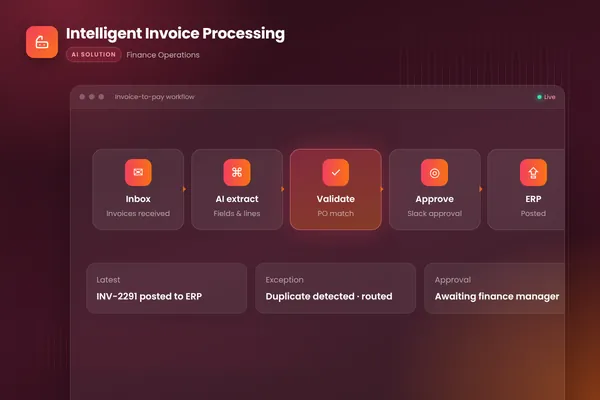
Integrations. Connecting systems is often a larger share of the build than the AI step. In our intelligent invoice processing build, the AI step reads invoices, but the workflow also has to watch the inbox, match lines to purchase orders, route approvals in Slack and post to the accounting system, each with error handling.
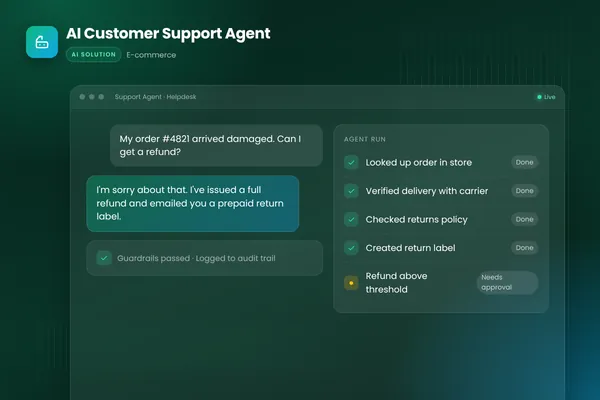
Risk. Every action the system can take on its own needs checks, and higher-risk actions need human approval. In our AI customer support agent, returns within policy are automated, but refunds above a set threshold go to a person. Designing and testing those limits is part of the price, and it should be.
The five pricing models, compared by who carries the risk
| Model | You pay for | Who carries scope risk | Best for |
|---|---|---|---|
| Fixed-price discovery | A short, defined piece of work with a prototype | Agency | Getting a real estimate and comparing agencies |
| Fixed-scope project | Agreed deliverables | Agency, within the written scope | Clearly defined builds with known integrations |
| Time and materials | Time spent, usually against an estimate | You | Work where scope will change as you learn |
| Dedicated monthly team | A team's capacity each month | Shared | Ongoing programs with several systems |
| Run-and-improve retainer | Monitoring, support and updates | Shared | Systems already in production |
BufferSol offers fixed-price discovery and prototypes, fixed-scope projects and dedicated monthly teams. We recommend starting with discovery for one reason: it measures the job on your data before anyone prices the build, so the build estimate rests on evidence rather than assumptions.
Watch for two failure modes. A fixed price on a vague scope leads to arguments about change requests. Time and materials without a cap or regular demos leads to surprises on the invoice. Whatever the model, ask to see working software every one or two weeks.
How running costs are estimated
Running cost should be measured, not guessed. During the prototype, the agency runs real examples through the system and records the model usage and time for each one. Multiply cost per item by expected volume, including peaks, and add hosting and monitoring.
There is usually room to bring that number down. OpenAI's practical guide to building agents recommends building the prototype with the most capable model to set a quality baseline, then swapping in smaller models where they still perform well, and lists "Optimize for cost and latency by replacing larger models with smaller ones where possible" as a core principle. Routine steps such as classifying an email or extracting fields often run well on smaller, cheaper models.
Spending limits matter too. The OWASP Top 10 for LLM applications includes "Unbounded Consumption" as a risk category. In plain terms, a loop, a spike in volume or an attack can run up model costs if nothing stops it. Ask the agency how usage is capped and who is alerted when spending rises.
The internal costs that never appear on the quote
Some costs sit on your side, and they belong in the business case too. Your process owner needs a few hours a week during the build to answer questions and approve rules. Your IT or security team needs time to grant access and review the design. After launch, someone reviews the exception queue every day, and someone owns the dashboard. None of this is large, but leaving it out makes the return look better on paper than it will be in practice.
How to compare two agency quotes
Put both proposals side by side and check each line:
- Scope. Do both cover the same process, the same systems and the same exceptions? Write the differences down.
- Discovery. Does the price rest on a measured prototype or on assumptions? If assumptions, are they written down?
- Running costs. Is there an estimate per item or per month, at your volume, with the method explained?
- Maintenance. What happens when your process or a model changes? Is that included, priced separately or not mentioned?
- Quality. Is acceptance tied to an evaluation set built from your data?
- Security and approvals. Are permissions, approval points, logging and prompt-injection testing included?
- Ownership. Do you own the code, prompts, configuration, evaluation sets and documentation?
- Exit. Is there a documented handover if you stop or switch provider?
- Total cost. What is the combined cost of build, run and maintain over two to three years?
A cheaper build that leaves out evaluation, security or maintenance is not cheaper. It moves the cost to later, usually at a worse time.
Getting a real number
The fastest way to an honest price is a short discovery on your own process and data. Our AI agents, autonomous workflows and generative AI teams run discovery at a fixed price and finish with a prototype, measured accuracy, a cost-per-item estimate and a costed build plan. You can also talk to an engineer to scope the process you have in mind.
Frequently asked questions
Why won't AI agencies give a price up front?
Because the biggest cost drivers are unknown until someone looks at your process and data: how many systems are involved, whether they have APIs, how messy the inputs are and how risky the actions are. A responsible agency either gives a wide range with assumptions written down, or proposes a short fixed-price discovery that measures those factors and produces a firm build estimate.
Is fixed price or time and materials better for AI projects?
Use fixed price where the scope can be written down precisely, such as a discovery sprint or a well-defined build with known integrations. Use time and materials, with a cap and regular demos, where the scope will change as you learn. Many projects combine them: a fixed-price discovery, then a fixed-scope build for the first workflow, then a monthly arrangement for improvements.
What are the ongoing costs of an AI automation system?
Model usage, which grows with volume and the size of each task, hosting and workflow-engine costs, monitoring and logging, support, and the work of updating prompts, rules and evaluation sets as your process changes or new models arrive. There is also internal time: the people who review exceptions and own the process. Ask any agency to estimate each of these.
Sources
- Guidelines for AI procurement, Department for Science, Innovation & Technology and Office for Artificial Intelligence (UK)
- A practical guide to building agents, OpenAI
- 2025 Top 10 Risk & Mitigations for LLMs and Gen AI Apps, OWASP Gen AI Security Project
Cite this article
BufferSol Editorial Team (2026). AI Automation Agency Pricing: How Agencies Charge and What Drives the Cost. BufferSol Technologies. https://buffersoltech.com/blog/ai-automation-agency-pricing
BufferSol Editorial Team
AI & software engineering team
Senior engineers, AI specialists and product leads at BufferSol Technologies who design, build and run AI agents, autonomous workflows and custom software for companies in the US, UK and Europe.