Key takeaways
- An AI financial reporting assistant turns a plain-English question into a query on your ERP data and returns an answer; the opened vendor pages describe this but none gives a measured accuracy rate.
- Microsoft's Power BI page says Copilot can 'Provide the underlying DAX query and data table used to generate a response', which gives a reviewer something to check, and also says 'Copilot can't currently answer questions that require generating new insights, such as anomaly detection, forecasting, or finding key influencers.'
- Oracle's AskFinance guide shows a text-to-SQL design ('an open-source NL2SQL model specifically designed for SQL generation') and does not say how ERP permissions are enforced; ask every vendor whether queries run as the signed-in user.
- Test with questions whose answers you already know: Microsoft's docs say to 'Compare the responses with known, validated results', and 'Don't interpret no result as zero.'
- Hallucination remains a research problem: an arXiv preprint on finance tables says it is 'a critical challenge for deploying Large Language Models (LLMs) in finance', so keep a person on any figure that leaves the building.
AI financial reporting means asking your ERP a question in plain English, such as "what did we spend on freight last month?", and getting an answer drawn from your own ledger data. This 2027 guide compares seven ways to set it up, using vendor pages read in November 2026, and shows how to test the answers before the numbers reach a board pack.
For the wider picture, read our finance IT solutions guide. For the process view, see our financial close automation post and our AI accounting software post.
What is financial reporting automation with a plain-English assistant?
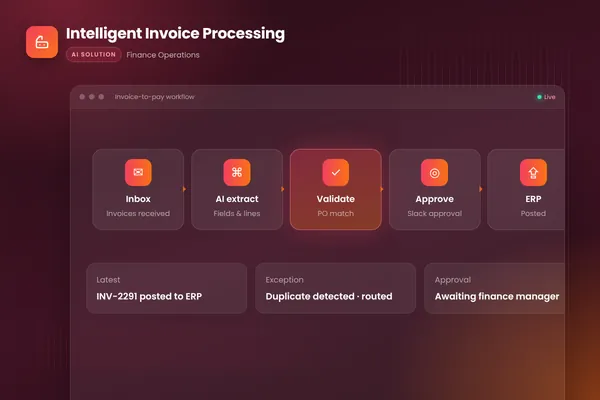
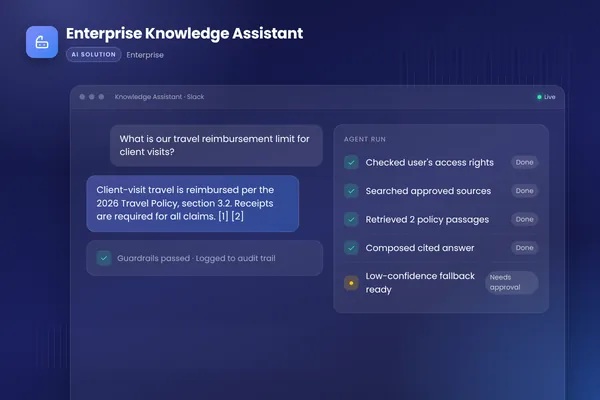
It is financial reporting automation where the user types a question instead of building a report. The assistant maps the words to fields in your data, builds a query, runs it and shows the result. BufferSol built the same read, answer and escalate pattern in its enterprise knowledge assistant case study, and the finance-side pattern in its intelligent invoice processing case study.
Microsoft Learn (updated September 2026) states the basic idea: "Copilot for Power BI lets you ask natural-language questions about your data and summarize report content." Oracle's AskFinance guide (October 2024) says "both technical and non-technical employees can run queries, enabling them to instantly fetch and analyze their company's finance data." The detail that matters is the middle step, the query, and whether anyone can see it.
- 011 ReadTake the question and the user's identity from the chat
- 022 MapMatch the words to reviewed measures and fields in the governed model
- 033 QueryBuild a read-only query, as SQL or DAX, and keep a copy
- 044 RunExecute as the signed-in user so ERP permissions apply
- 055 AnswerShow the number, the query, the period and the data used
- 066 GateHold anything bound for a board pack or filing for a person to approve
BufferSol Technologies · buffersoltech.com
Which seven ways can you ask an ERP questions in plain English?
Each way below is a real route, with what its page says, what it does not show and a "choose it if" line. The table gives the short version first, with facts as of November 2026.
| Way | What its page says | What the page does not show |
|---|---|---|
| 1 | Ask Oracle: questions in natural language inside NetSuite | Human review or accuracy |
| 2 | Power BI Copilot: questions over a semantic model, with the DAX shown | Forecasting, anomaly detection |
| 3 | Microsoft semantic model guide: prepare reviewed measures first, then ask | An accuracy figure |
| 4 | Oracle AskFinance: NL2SQL over E-Business Suite, PeopleSoft, JD Edwards | Permission enforcement, accuracy |
| 5 | QuickBooks AI chat: chat and an insights feed | How a user asks, review guidance |
| 6 | SAP: plain-language explanations of errors and values | A general ERP question interface |
| 7 | A custom agent on a governed, read-only layer | Not covered by any opened page |
Dates matter in this field, so here is the freshness of each page, as of November 2026. Microsoft's Power BI page was updated in September 2026 and its model guide in the same month. ERP Today and Small Business Trends are from July 2026, SAP's page from April 2026 . Oracle's AskFinance guide is from October 2024, and Intuit's page shows no date. Our posts on AP automation and AI invoice processing cover the payables data these assistants often query.
1. Is asking Ask Oracle inside NetSuite the simplest route?
For NetSuite users it is the closest to the ERP, with a regional catch. ERP Today (July 15, 2026) reports that "Users can ask questions in natural language, analyze business data, surface insights, get guidance, and take action", and that Ask Oracle "respects existing roles, permissions, reporting structures, and business configuration." That is Oracle's claim as reported, not a test. The article says users "can also see how Ask Oracle arrived at its answers", which it frames as building trust.
The Small Business Trends report of the same announcement says NetSuite Next is rolling out in the US and Canada as part of release 2026.2, lists "answer questions about company data, generate reports" among the uses, and warns that results depend on whether records are accurate, consistently categorized and current. It also says human review is still needed. ERP Today does not mention human review or an accuracy test, and neither page gives a price.
Choose it if you run NetSuite in the US or Canada and want questions where your records live. Skip it if you run another ERP or sit outside the rollout regions.
2. Does Power BI Copilot let a reviewer see how the answer was built?
Yes, and that is its best feature for finance. Microsoft Learn says that with Fabric IQ enabled, Copilot can "Show reasoning steps so you can understand how Copilot arrived at an answer" and "Provide the underlying DAX query and data table used to generate a response." It adds that "You can verify the calculations and filters used and confirm that the explanation aligns with the returned data." A reviewer can check the query, not just the number.
The same page lists limits. "Copilot can't currently answer questions that require generating new insights, such as anomaly detection, forecasting, or finding key influencers." "The only supported language is English." And "When a question is related to data in the semantic model, Copilot uses the semantic model to answer the question. Otherwise, it might answer from the large language model's (LLM's) general knowledge." That last sentence is the one for finance leads: an answer that does not come from your model can come from the model's memory. The page also says "When Fabric IQ is enabled, Copilot doesn't return verified answers."
Choose it if your reporting already lives in a Power BI semantic model that finance owns. Skip it if you want forecasts or anomaly detection from the same chat.
3. Should you prepare a governed semantic model before anyone asks a question?
Yes, and Microsoft's own guide says so. Microsoft Learn (updated September 2026) says "A well-prepared semantic model gives Copilot a stronger foundation for answering business questions accurately in Power BI", and its Power BI question page says "Define business meaning in the semantic model", and the guide advises defining, for each question, "the expected measure, grouping, date basis, filters, and validated result." It wants finance-specific care: "Define [Gross Margin %] by dividing the approved gross margin measure by the approved net sales measure instead of averaging row-level percentages", and it says to use separate order and order-line counts.
The guide also covers timing and access. It says to document "whether periods use a fiscal or calendar year, including when the fiscal year starts", to publish refresh schedules so users "understand the timeliness of the data they're analyzing", and to define security roles where "sensitive elements" should not be seen by everyone. That is the groundwork any assistant needs, built-in or custom. It describes Power BI only, shows no accuracy figure and does not address SAP or Dynamics ledgers directly.
Choose it if your definitions of revenue, margin and period are still argued over. Skip it if you hope an assistant will settle those arguments for you, because it will only repeat them faster.
4. Is a text-to-SQL layer like Oracle AskFinance a fit for older ERPs?
It is a fit for Oracle estates. Oracle's guide (October 2024) describes running "natural language queries (NLQs) from Oracle E-Business Suite, PeopleSoft, and JD Edwards EnterpriseOne", and users can ask about "the status of their company's account payables (AP), account receivables (AR), or general ledger (GL)." It is the only opened page that shows the mechanism: "This approach leverages an open-source NL2SQL model specifically designed for SQL generation", plus a cache of "previously generated SQL queries" and an LLM "to enrich the user provided question (intent) with additional context."
The page is silent on the parts a controller worries about. It says only that "any authorized user" can query, and does not describe how ERP roles or row-level access are enforced, how generated SQL is limited to read-only or checked, or any accuracy, benchmark or cost figure. It is also a 2024 architecture guide, so check what changed. As BufferSol view, treat it as a pattern to learn from: the same layers (question, SQL generation, cache, enrichment) appear in any custom build.
Choose it if you run E-Business Suite, PeopleSoft or JD Edwards and have an Oracle Cloud team. Skip it if nobody can own the permissions layer, which the page leaves open.
5. Is the QuickBooks AI chat enough for a small business?
For quick questions, maybe, and it is labelled beta. Intuit's page lists "AI Chat for instant insights" tagged "Limited capacity" and "BETA", an insights feed to "find all trends and anomalies spotted by Intuit AI", and reports that "make it easy for you to quickly analyze" unusual transactions. The page is undated, it does not describe how a user asks for a report, and it gives no review guidance. We quote no prices, since the page's offers are time-limited.
An independent test shows the empty-data case. Marc Andrews (published August 2026, updated November 2026) asked "What were my biggest expenses last month, and how much did I spend in total?" on an account with no posted transactions, a question "deliberately shaped to invite a fabrication." The assistant gave no figures and said its Profit & Loss pull returned 0 rows. It was one question, once, on one empty account, so it shows a sound refusal and proves nothing about accuracy on real books. The author says the more important test was not run.
Choose it if you run QuickBooks and want a first look at trends. Skip it if you need a documented review step before you use a figure.
6. Should you ask for explanations before you ask for numbers?
It is a safer first use. SAP's release highlights (April 14, 2026) describe AI that "delivers plain-language explanations of electronic document errors" in SAP Document and Reporting Compliance, and an AI feature that "generates natural-language explanations that detail the origins of displayed values" for fixed asset key figures. The page credits that second feature to SAP S/4HANA Cloud Private Edition and does not mention Joule for it. It also describes handling "unstructured data like PDF or image-based purchase orders" with SAP Document AI.
Explanations suit finance because the number already exists in a controlled system, and the AI only describes where it came from. The SAP page is vendor press, it does not describe a general ERP question interface, and it shows no accuracy data. Microsoft's Power BI page points the same way: it says to verify "the calculations and filters used."
Choose it if your first goal is fewer "why is this number here?" tickets. Skip it if you need new figures, not explanations of existing ones.
7. When does a custom agent on a governed layer beat the built-in assistants?
When your data spans systems, or you must prove who asked what. As BufferSol view, a custom agent sits on a read-only replica or warehouse with a governed semantic layer, runs each query as the signed-in user and writes every question, query, result and approver to a log. No opened page describes this design, so it is reasoning, not a sourced pattern.
Research hints at the design. Kang and Liu (arXiv preprint, November 2023) report that "off-the-shelf LLMs experience serious hallucination behaviors in financial tasks" and test four methods, including retrieval augmentation and "the prompt-based tool learning method for a function to generate a query command." That paper is older and a preprint, not a peer-reviewed finding. It supports the idea of having the model call a controlled query function instead of answering from memory. The FAITH preprint (arXiv, revised October 2025) says "Hallucination remains a critical challenge for deploying Large Language Models (LLMs) in finance."
Microsoft's model guide is useful here too: it says Copilot "can also propose and apply changes directly" in the web modeling experience, so even a built-in assistant needs a change-approval rule. Our AI agent development guide and AI agent versus chatbot post explain how a query-running agent differs from a chat window.
Choose it if you have two or more ERPs, a warehouse and strict audit needs. Skip it if one built-in assistant already covers your questions.
Why do plain-English reporting assistants give wrong answers?
Mostly because the data model is not ready. Bismart, a consultancy, says "Copilot in Power BI gives wrong answers when the data environment is not ready for AI", "Metric ambiguity is one of the biggest barriers to reliable AI in business intelligence" and "Copilot does not create data governance. It depends on it." Its nine causes include unclear field names, duplicate or ambiguous metrics, poor data quality and misconfigured permissions. It reports no measured error rate.
Microsoft's model guide (updated September 2026) agrees on the fix. It says "Resolve modeling issues in the semantic model because additional instructions can't correct inaccurate relationships or inappropriate aggregations", and suggests including questions "that expose ambiguity", such as "How are sales performing?", which "might refer to revenue, order volume, growth, or margin." For finance, that means one approved definition of revenue, net sales, margin and period, per measure, before any user asks anything. The Power BI Copilot page adds that authors can "Add synonyms to data field names to clarify business-specific terms."
| Cause of a wrong answer | Fix | Source |
|---|---|---|
| Two meanings of "sales" or "revenue" | One reviewed measure per metric | Microsoft Learn |
| Unclear field names such as "Amount" in many tables | Descriptive names, synonyms | Bismart |
| Question outside the model | Refuse or flag, never guess | Microsoft Learn |
| Empty result read as zero | Check data, refresh, permissions | Microsoft Learn |
How do you test a reporting assistant with known answers?
Ask it questions whose answers you can prove from the closed books. Microsoft Learn says to "Identify a representative set of business questions to test", define "the expected measure, grouping, date context, filters, and result for each question" and "Compare the responses with known, validated results." Its troubleshooting table adds a finance rule: for missing categories or no results, check the source data, refresh state and permissions, and "Don't interpret no result as zero."
A verb-first test, as BufferSol view:
- Pick 25 questions across revenue, AP, AR, cash and one-line trial balance checks.
- Fix the expected answer for each from the closed trial balance, with period and filters.
- Ask each question as three different users: a controller, an analyst and a restricted user.
- Compare each number with the known one, and each generated query with a reference query.
- Include five traps: an empty period, an ambiguous word, a question outside the model, a restricted account and a forecast request.
- Score right, wrong, refused and wrongly confident separately.
- Repeat after every ERP upgrade, chart-of-accounts change or model change.
A BufferSol calculation with assumed numbers, not results, using the test design from Microsoft Learn: 25 questions, run as 3 users, make 75 answers. If 60 are right, 8 are refused correctly, 4 are wrong and 3 are wrongly confident, then 68 of 75, about 91%, are acceptable, and the 7 failures decide the go-live. A refusal on a restricted account is a pass, a confident wrong total is the failure that matters most. Our AI agent evaluation post shows how to build the score sheet.
| Shows the query | Describes the result only | |
|---|---|---|
| Microsoft Power BI Copilot | DAX query and data table available to the reviewer | Not applicable |
| Oracle AskFinance | Names an NL2SQL step and a cache of generated SQL | Does not describe validation or permissions |
| Ask Oracle (ERP Today) | Not shown | Says users can see how it arrived at answers |
| QuickBooks AI chat | Not shown | Beta, no review guidance on the page |
Source: Microsoft Learn, Oracle, ERP Today and Intuit pages as read in November 2026.
BufferSol Technologies · buffersoltech.com
Which gaps do the vendor pages leave for you to close?
They leave the same four open. The pack of pages we read describes outcomes, and rarely the mechanism, so the questions below are yours to ask. This is BufferSol view, built from what the pages did not show.
| Gap | Pages that leave it open | What to ask |
|---|---|---|
| Who runs the query | Oracle AskFinance, ERP Today | As the signed-in user or a service account? |
| Human approval | ERP Today, Intuit | Which answers need sign-off before use? |
| Measured accuracy | All opened vendor pages | Can we run our own test set first? |
| Empty or out-of-scope questions | Most; Marc Andrews tests one case | Does it refuse, return zero or explain? |
What does an AI reporting assistant not do?
It does not replace the close, and it does not create trust in your data. Microsoft Learn says Copilot "can't currently answer questions that require generating new insights, such as anomaly detection, forecasting, or finding key influencers", and that data questions apply only in the Power BI service and in English. Small Business Trends says AI output can look useful while missing context, and that human review is still needed.
Plan a named owner for the metric definitions, the test set and the monthly review, and a rule that no figure goes into a board pack, tax filing or lender report without a person's sign-off. The FAITH preprint says "even minor numerical errors can undermine decision-making and regulatory compliance." Intuit's page says its AI chat has "Limited capacity", and ERP Today does not mention human review at all. Our human-in-the-loop AI agents post, workflow exception handling post and invoice approval workflow post show where the approval sits.
What do the sources not show about AI financial reporting?
They show vendor descriptions, trade press and two preprints, and no measured accuracy for an ERP question assistant. Microsoft Learn, Oracle, SAP and Intuit describe their own products. Bismart is a consultancy with services to sell. The two arXiv papers, FAITH and Kang and Liu, are preprints that test general models on financial documents, not ERP queries, and the pages we opened state no error rates we repeat.
No opened page shows a price for an AI reporting assistant, so we quote none. The Intuit page is undated and the Oracle guide is from October 2024, so features may have changed. We did not use an AccountingWeb article, SAP's Joule product page or a Microsoft release-plan page, because they did not open for our research. Our AI bookkeeping post and AI for accounting firms post show how we weigh vendor claims.
What changes in 2027 for AI financial reporting?
No source we opened forecasts financial reporting in 2027, so this section is BufferSol view, written as reasoning.
We expect buyers to ask for the generated query next to every number, because Microsoft's Power BI page already shows it. We expect permissions to become a contract question, since Oracle's guide leaves it open. And we expect "clean the metrics first" to be the real project, as Bismart and Microsoft's model guide both say. Plan the 2027 budget around a governed metric layer and a pilot on one reporting area.
Which questions should you ask an AI reporting vendor in writing?
Ask these before you sign and keep the answers:
- Does each query run as the signed-in user, so ERP roles and row-level rules apply?
- Can we see the generated query next to every number?
- What happens when there is no data: refusal, zero or an explanation?
- Can we run our own known-answer test set before go-live, and repeat it after each upgrade?
- What does the audit log hold: question, query, result, user, approver?
- Which features are preview or region-limited, as of today?
- Where does our ledger data go? Our AI vendor security questionnaire and data processing agreement post cover data handling.
When should you build your own financial reporting agent?
Build when your data, permissions or audit needs do not fit a built-in assistant. Stay with the ERP's own assistant when one system holds your data and its answers pass your test. For the wider process, see our accounts receivable automation software post.
No source we opened covers custom builds, so this is BufferSol view:
- You report across several systems, such as an ERP, a bank feed and a CRM.
- You need your own metric definitions locked in a governed layer.
- You need approvals in your own tools, with named signers for board and lender numbers.
- You need an audit log of every question, query, result and approval.
BufferSol's autonomous workflows service and AI agents service build these, and our AI automation agency pricing post and what an AI automation agency does explain how an engagement is scoped. See also how long it takes to build an AI agent, AI agent architecture and our AI workflow automation guide.
What would a 30-day pilot deliver?
In 30 days you get a working reporting agent on your real ledger data, with a person approving anything that leaves finance. The plan:
- You bring: read-only access to a replica or warehouse, your chart of accounts, your metric definitions, 25 known-answer questions and a named controller.
- We build, in about two weeks: a prototype that maps questions to approved measures, generates a read-only query as the signed-in user, shows the query with each number and logs everything, tested on your known answers.
- We launch, in the final stretch: a live pilot for one reporting area, such as AP or cash, with a weekly review of questions, refusals and failures.
Success is measured by correct answers on the known-answer set, correct refusals, time to answer a finance question and reviewer overrides. The closest ready-made version is our financial reporting and cash forecasting automation, built for finance teams. See also the Done For You catalogue, the KPI and board reporting automation, month-end close and reconciliation automation, collections and receivables automation, expense report audit automation and invoice processing for accounts payable. Our intelligent invoice processing guide shows the same approval pattern on payables.
Is this right for you?
Check how many describe your team:
- Finance waits days for a report that one query could answer.
- Two people give two numbers for "revenue".
- You can name who owns the metric definitions.
- You can write 25 questions with known answers from last month's close.
- Someone signs off every number that goes outside the company.
If few apply, define the metrics and fix the data first, then pilot. Our AI readiness assessment checks your data, our AI workflow automation examples post shows other first projects and our AI workflow automation versus RPA post explains where a reporting agent fits.
Facts checked November 2026 on the Power BI Copilot and semantic model pages, Oracle AskFinance, ERP Today, Small Business Trends, SAP, Intuit, Marc Andrews, Bismart and the arXiv preprints FAITH and Kang and Liu; vendor pages are marketing. Facts we did not re-check: the AccountingWeb NetSuite article, SAP's Joule product page and Microsoft's release-plan page (not opened), any price, any accuracy rate for an ERP assistant and any later change to preview status.
If finance still builds the same reports by hand every month, ask BufferSol for a scoped estimate for a reporting agent on your ledger data now, so the 2027 budget includes it and the pilot can start in Q1 2027.
Frequently asked questions
What is an AI financial reporting assistant?
An AI financial reporting assistant lets a finance user ask a question in plain English and get an answer from ERP or reporting data. Behind it, a model turns the question into a query, runs it and presents the result. Microsoft's Power BI page says Copilot 'lets you ask natural-language questions about your data and summarize report content'.
Can you ask your ERP questions in plain English?
Yes, with caveats. Oracle says Ask Oracle in NetSuite lets users 'ask questions in natural language', and Oracle's AskFinance guide covers E-Business Suite, PeopleSoft and JD Edwards. Availability varies: the NetSuite rollout reported in July 2026 started in the US and Canada, and Microsoft's Power BI feature needs Copilot enabled by an administrator.
How accurate are AI financial reporting tools?
No opened vendor page gives a measured accuracy rate for an ERP question assistant. The research we opened tests general models on financial documents: an arXiv preprint on S&P 500 reports calls hallucination a critical challenge. Measure accuracy yourself with questions whose answers you know from the closed trial balance.
Do AI reporting assistants respect ERP permissions?
Vendors say so, but the pages do not show how. A trade-press report says Ask Oracle 'respects existing roles, permissions, reporting structures, and business configuration'. Oracle's AskFinance guide does not describe permission enforcement. Ask in writing whether each query runs as the signed-in user.
Why does an AI assistant give wrong answers about financial data?
Often the data model, not the AI, is the problem. Bismart, a consultancy, says 'Copilot in Power BI gives wrong answers when the data environment is not ready for AI' and lists unclear field names and duplicate metrics among nine causes. Microsoft's docs advise clear names, reviewed measures and tested questions before users get access.
Sources
- Ask data questions with Copilot and Fabric IQ, Microsoft Learn
- Optimize Your Semantic Model for Copilot in Power BI, Microsoft Learn
- Run Natural Language Queries From Any Oracle ERP Application, Oracle
- Oracle Begins NetSuite Next Rollout; Ask Oracle Moves into ERP Workflow, ERP Today
- NetSuite Next Rollout Brings Ask Oracle AI to North America, Small Business Trends
- SAP Business AI: Release Highlights Q1 2026, SAP News Center
- AI-Powered Reporting for Smarter Business Decisions, Intuit QuickBooks
- Intuit Intelligence Tested 2026: I Asked It About Money That Was Not There, Marc Andrews
- 9 Errors That Make Copilot Give Wrong Answers in Power BI, Bismart
- FAITH: A Framework for Assessing Intrinsic Tabular Hallucinations in Finance, arXiv (preprint)
- Deficiency of Large Language Models in Finance: An Empirical Examination of Hallucination, arXiv (preprint)
Cite this article
BufferSol Editorial Team (2026). AI Financial Reporting in 2027: 7 Ways to Ask Your ERP Questions in Plain English. BufferSol Technologies. https://buffersoltech.com/blog/ai-financial-reporting-2027
BufferSol Editorial Team
AI & software engineering team
Senior engineers, AI specialists and product leads at BufferSol Technologies who design, build and run AI agents, autonomous workflows and custom software for companies in the US, UK and Europe.
Reviewed by Sufyan K., Senior Writer, BufferSol Technologies.