Key takeaways
- AI can improve a cash forecast in specific places: predicting when each customer will actually pay, refreshing the forecast daily and cheapening variance analysis. It does not extend the forecast to commitments no system has recorded, as Phacet puts it.
- Keep contractual flows such as payroll, debt service and tax in a calendar. TechnoLynx says they are deterministic and that modelling them statistically 'adds noise to items you already know exactly'.
- Never trust an uplift figure until it has beaten a naive forecast on your own history. Hyndman's textbook says the naive method 'works remarkably well for many economic and financial time series', and the one paper in the top five compares against ARIMA only.
- Do not score net cash with percentage error. Weeks near zero blow it up, so use a weighted error or a scaled error, and report accuracy by horizon: next week, next month, next quarter.
- Cash forecasting is still treasury's hardest job: the 2026 AFP survey puts it at 49 percent as most challenging and 63 percent as top priority. A 30-day pilot on your real ledger and bank data shows whether AI helps in your case.
AI cash flow forecasting can improve a forecast in some places and not in others, and the only way to know is to test it. It helps most where customers pay late in patterns a ledger can learn, and where a daily refresh beats a weekly spreadsheet. It does not see commitments nobody has recorded. This guide gives 7 ways it works in 2027, the tests to run first and the limits, with every source named and dated November 2026.
For the wider finance picture, start with our finance IT solutions guide, then see how AI accounting software guide and accounts receivable automation software feed the same forecast.
What is AI cash flow forecasting, and what does it actually do?
AI cash flow forecasting estimates future cash inflows, outflows and balances by learning patterns from your own financial data instead of relying on fixed assumptions. U.S. Bank says it "uses financial data and predictive analytics to estimate future cash inflows, outflows, and balances". That is the definition most top results share.
What it does in practice is narrower than the marketing. Aleph says these tools automate "the three jobs that used to eat a week": pulling payables, receivables and bank balances into one place, predicting when each invoice will really be paid, and reforecasting daily. The same page adds: "They don't decide what to do about a shortfall." The forecast is an input to a decision, not the decision. See our AI agent architecture guide for how an agent wraps a model with tools and approvals.
Does AI beat a spreadsheet for cash forecasting?
Sometimes, and not always on accuracy. TechnoLynx makes a point that is easy to miss: "Any forecast that cannot hold a schedule loses by default." A model that is slightly better but arrives on Wednesday loses to a spreadsheet that exists on Monday at 8 a.m. Reliability of delivery counts as much as error size.
On accuracy, the sourced evidence is thin and mixed. A 2024 conference paper reports better error for neural models than ARIMA on one dataset. A 2023 journal study on more than a million invoices finds neural networks suit payment-date prediction, but also that naive models can compete with conventional baselines. We cover both in way 3. BufferSol view: AI wins on speed, granularity and effort, and you must prove it wins on accuracy. Our AI agent evaluation guide shows the habit of testing before trusting.
What does a weak cash forecast cost, and who feels it?
It costs borrowing decisions, idle cash and finance-team hours, and treasury feels it first. The 2026 AFP Treasury Benchmarking Survey, reported on 15 September 2026 from 425 practitioner responses, found that "cash and liquidity forecasting remains the most challenging treasury activity (49%) and the top priority overall (63%)". So the problem is common and the demand for a fix is real.
You can size your own cost in an afternoon. BufferSol estimate, with every assumption shown: if two analysts spend 6 hours each every week building the 13-week view by hand, that is 12 hours a week, about 624 hours a year, and at a loaded $50 an hour about $31,200 a year before any cost of a wrong number. Replace the 6 hours and 50 with your own. Our AI agent ROI calculator turns hours into a yearly figure.
Source: Association for Financial Professionals, press release dated 15 September 2026
BufferSol Technologies · buffersoltech.com
What changes in 2027 for AI cash flow forecasting?
Three things change: the baseline expectation, the cadence and the proof. The baseline moves because every finance tool now advertises a forecasting feature, so "we use AI" stops being a differentiator and "here is our error by horizon" becomes one. The cadence moves from monthly packs to continuous updates. AFP describes a private-equity-backed company running a weekly forecast across a full year, "very much a living document that is updated almost daily", with weekly actuals pulled from bank data and quarterly reviews that measure accuracy and diagnose misses.
The third change is proof. BufferSol view: in 2027 budgets, the finance lead who can show a forecast error by horizon and a naive baseline beside it will win the argument for the tool, and the one who shows a vendor's "up to 50 percent" will not. Nothing here is a forecast of the market, because we found no analyst source worth quoting for one. Plan the 2027 budget around a tested pilot, not a promise. Our AI readiness assessment post helps you check data and ownership first.
The seven ways at a glance, each with the evidence behind it:
| # | Way | Best-supported claim | Where it comes from |
|---|---|---|---|
| 1 | Date customer payments by behaviour | Neural networks suit payment-date prediction | Journal of Applied Accounting Research, Phacet |
| 2 | Keep contractual flows in a calendar | Known items are deterministic | TechnoLynx, Aleph |
| 3 | Beat a naive forecast first | The naive method works remarkably well | Hyndman and Athanasopoulos, Microsoft Learn |
| 4 | Score net cash without percentage error | MAPE on net cash is a trap | Rework, Hyndman and Koehler |
| 5 | Report accuracy by horizon | Accuracy falls as you look further ahead | Rework, Aleph |
| 6 | Test on unseen history | A model looks better on the history it was fitted to | Rework, scikit-learn, Hyndman and Athanasopoulos |
| 7 | Schedule overrides and drift checks | The AI will not see what is not in the data | Xero, TechnoLynx, AFP |
1. Can AI predict when customers will actually pay?
Yes, and this is the best-supported use. A classic forecast assumes customers pay on the due date. Phacet says AI "replaces due dates with behaviour": a model trained on your ledger "knows that this particular customer pays eleven days late, every time, and dates the inflow accordingly". The page uses illustrative examples and gives no accuracy percentages, so read it as a mechanism, not a measurement.
The research agrees on the direction. In the Journal of Applied Accounting Research study of a DAX-40 firm, the authors used more than 1,000,000 invoices from 2017 to 2019 and report that neural networks "in particular are suitable for predicting customers' payment dates". It is one firm in one period, so test it on yours. Aleph describes the same model as "a payment-timing model trained on your own receivables", and TechnoLynx frames the question as a distribution of payment dates, not a yes or no.
Choose it if you have a year or more of paid invoices with issue, due and payment dates. Skip it if your receivables are a few large contracts whose dates you already know by phone. See our accounts receivable automation guide and invoice approval workflow guide for the data this needs.
2. Should contractual flows go through the model at all?
No. Put known flows in a calendar and give the model only the uncertain remainder. TechnoLynx lists "debt service, payroll, tax, scheduled intercompany transfers" as items that are "deterministic and belong in a calendar, not a model", and warns that learning them statistically "adds noise to items you already know exactly". Its summary is short: "The model's job is the uncertain remainder."
This is the design behind a hybrid forecast. Rules carry the known items exactly, the model dates customer receipts and variable spend, and a person adds events neither can see. Phacet makes the matching point about scope: "Accuracy in cash forecasting comes from the completeness of the commitment data, not from the language model." If a lease, a tax instalment or a loan covenant payment is missing from the data, no model finds it. Our financial close automation guide and touchless invoice processing post show how those flows get recorded.
| Flow | Treat as | Why | Source |
|---|---|---|---|
| Payroll, debt service, tax | Calendar or rules | Deterministic, known dates | TechnoLynx |
| Customer receipts | Model | Payment behaviour varies by customer | Phacet, Journal of Applied Accounting Research |
| Variable supplier payments | Model plus approval dates | Approval cycles shift timing | Phacet |
| Acquisition, dispute, funding round | Human override | Not in the data | Rework |
3. Does the model beat a naive forecast on your own data?
This is the test most vendors skip, and it should come first. A naive forecast simply repeats the last observed value, or the same week last year. Hyndman and Athanasopoulos's textbook says of it: "This method works remarkably well for many economic and financial time series." Microsoft's own forecasting guide lists Naive and Seasonal Naive as the lowest-capacity models in its catalogue, so even a vendor platform treats them as the floor to beat.
Now look at the evidence for AI's uplift. The conference paper compares its models with ARIMA and says that comparison is "the sole method by which the outcomes can be evaluated". It reports MAPE of 5.5 percent for ARIMA and 4.2 percent for LSTM on 130,000 treated data points, yet its text also says the method is "halving MAPE", which 5.5 to 4.2 is not (that is about 24 percent lower). The dataset is not published. The journal study tells future studies to include naive models, "as the authors demonstrate that these models can compete" with conventional baselines. And Xero repeats a J.P. Morgan figure of "up to 50%" lower error that we could not trace to its source.
The rule for your pilot: compute a scaled error, your model's absolute error divided by the naive forecast's on the same weeks. Hyndman and Koehler propose the mean absolute scaled error for this, and the textbook says a scaled error below one means a better forecast than the average naive one. Below 1 passes. Above 1 means the spreadsheet trick wins. Our AI agent evaluation guide covers the same discipline for agents, and the AI readiness assessment post and AP automation savings calculator help you size the effort.
4. How do you score a forecast when net cash sits near zero?
Do not use percentage error on net cash. Rework warns: "Net weekly cash flow can sit near zero or go negative, so MAPE on net cash is a trap." The textbook explains why: percentage-based measures have "the disadvantage of being infinite or undefined" when a value is zero, and "extreme values if any y_t is close to zero". Hyndman and Koehler call many common measures "degenerate in commonly occurring situations".
Here is an invented eight-week example, a BufferSol estimate for illustration, not client data. Weekly net cash in thousands of dollars: actual 20, -5, 3, -40, 15, 2, -25, 30; forecast 15, 5, -10, -30, 10, 8, -15, 20. The mean absolute error is 8.6. Percentage error week by week runs 25, 200, 433, 25, 33, 300, 40 and 33, so MAPE is 136 percent, which says nothing useful. A weighted absolute percentage error, total absolute error divided by total absolute actual (69 over 140), is 49 percent, and it behaves. Against a naive forecast of last week's actual, weeks 2 to 8, the model's mean absolute error is 9.1 and the naive one 32.3, a ratio of 0.28, so the model passes.
| Measure | Eight-week example | Use it when |
|---|---|---|
| Mean absolute error (in $) | 8.6k | Reporting to a CFO in money |
| MAPE | 136% | Never on net cash near zero |
| Weighted absolute percentage error | 49% | Comparing periods of different size |
| Bias (mean of actual minus forecast) | -0.4k, so no steady lean in this sample | Checking direction, not size |
| Scaled error vs naive (weeks 2 to 8) | 0.28 | The pass-or-fail test |
Rework adds that a forecast with small error and a steady bias "will lull you into a cash shortfall", so track direction too. For net cash you can also score gross receipts and gross payments separately, which keeps the denominators away from zero.
5. Is accuracy reported by horizon, not as one number?
It should be, because a single number blends a good short forecast with a weak long one. Rework says: "Accuracy falls as you look further ahead, so report it by horizon: next week, next month, next quarter." Aleph says the direct method's accuracy "declines rapidly beyond a few months", which is "why they shine on the 13-week view", while the indirect method "starts from the planned P&L and balance sheet and runs out 12 to 36 months".
None of the pages we opened publishes a measured error at each horizon, so we do not either. What you can do is ask for it. TechnoLynx says the horizons that matter are short, the "13-week rolling view and the 90-day liquidity view", and that anything past a quarter is planning. Set the target by the decision: a number that drives borrowing needs a tighter bar than one that shapes a budget. Microsoft notes a model's usefulness is limited by how far ahead you need forecasts, "also called the forecast horizon".
| One blended number | By horizon (recommended) | |
|---|---|---|
| What it shows | An average that hides the long tail | Next week, next month and next quarter separately |
| What a decision-maker learns | Little | Which horizon to trust for which decision |
| Source of the advice | None needed | Rework: report accuracy by horizon |
| Fit with the 13-week view | Blurred | Aleph says AI tools shine here |
BufferSol Technologies · buffersoltech.com
6. Can you test the model on history it has not seen?
You can, and you must. Rework says: "Don't judge a model on the history it was fitted to, because it will look better than it will perform." The textbook agrees: "A model which fits the training data well will not necessarily forecast well", and it recommends a test set "at least as large as the maximum forecast horizon required", typically about 20 percent of the sample.
The better method is rolling-origin evaluation. In Hyndman's description, each test set follows a training set made only of earlier observations, so "no future observations can be used in constructing the forecast", and accuracy is averaged over the test sets. scikit-learn's TimeSeriesSplit exists because ordinary cross-validation "would lead to training on future data and evaluating on past data". If a vendor shows you a backtest, ask whether it was built this way. Our workflow exception handling guide covers what happens when the test shows a miss.
7. Are overrides and drift handled on a schedule?
They are in the pilots that work, and ignored in the ones that fade. Start with overrides. Xero says: "If something hasn't happened before in your data, the AI won't see it coming." Rework lists the judgment calls no model removes: "a planned acquisition, a customer dispute, a funding round". Give each one a named owner and a way to enter it with a date, an amount and a note.
Then drift. TechnoLynx says payment-behaviour models "drift with customer mix, credit conditions, and collections policy", and suggests quarterly retraining with monthly monitoring of the payment-date distribution as "a reasonable default for stable portfolios". That is one vendor's default, not a standard. BufferSol view: write the trigger down, for example "retrain when the weekly bias stays on one side for four weeks or a collections policy changes", and review it each quarter, as AFP's example does with quarterly accuracy reviews.
What does an AI cash forecasting agent do each week, step by step?
It runs a fixed loop, and a person approves the parts that move money or change assumptions. The agent angle matters because a forecast is a process, not a file. Here is the loop BufferSol would build, with the tools it touches.
- Pull the data. Read open and paid invoices from the ERP, bank transactions from the bank feed and scheduled payments from the calendar.
- Resolve known flows. Place payroll, tax, debt service and transfers on their dates by rule.
- Date the uncertain flows. Estimate a payment-date distribution for each open receivable and a timing for supplier payments.
- Apply overrides. Merge the entries a person made for events no system holds.
- Produce the forecast by horizon. Publish next week, next month and next quarter with a range, not a single line.
- Score last week. Compare last week's forecast with the bank actuals: error, weighted error, bias and scaled error against naive.
- Flag, do not decide. Surface a possible shortfall with the drivers, and send it to the treasury owner.
- Log everything. Keep inputs, versions and overrides so any number can be traced.
Our AI agent development guide and AI workflow automation guide explain the building blocks. The matching ready-made build is the Financial Reporting and Cash Forecasting automation. Receivables feed the forecast, so see also Collections and Accounts Receivable and our AI customer service savings calculator for the shared-cost view.
- 01Pull and resolveLedger, bank feed and calendar are read; known flows are placed by rule.
- 02Date the uncertainReceipts and variable spend get a payment-date distribution.
- 03Override and publishA person enters events the data cannot see; forecast is published by horizon.
- 04Score and flagLast week is scored against actuals and naive; a possible shortfall goes to the owner.
BufferSol Technologies · buffersoltech.com
Where does a person approve in an AI cash forecast?
At four points: the data sources, the overrides, the shortfall decision and the retraining trigger. The agent reads and drafts, and a named person decides. U.S. Bank says predictive analytics tools "will support finance and treasury teams rather than replace them", and Xero says AI forecasting "works best as a decision-support tool, not a replacement for financial judgement". Both are vendor and bank statements, and both match the design.
A practical rule: the agent may never move cash, change a facility or edit a ledger entry. It may read, forecast, flag and draft. Name the approver for each override and the response time, as in our human-in-the-loop guide. If the approver is on leave, the override waits and the forecast says it is waiting, instead of quietly guessing.
| Step | The agent does | A person approves | Stance taken from |
|---|---|---|---|
| Data sources | Reads ERP, bank feed and calendar | Which accounts and entities are in scope | Rework |
| Overrides | Merges entered events | The owner of each event signs the entry | Xero |
| Shortfall | Flags and shows the drivers | Treasury decides what to do | Aleph, U.S. Bank |
| Retraining | Proposes it when bias persists | FP&A approves the change | TechnoLynx |
What data does the forecast need first?
Clean ledger and bank data, in that order. U.S. Bank says: "Modern finance tools, including the ones that use AI for cash flow forecasting, require high-quality data." Xero says "Output quality depends entirely on input quality", and Rework says "The most common failure isn't the model, it's the data."
Rework also lists the inputs in rough order of impact, starting with bank transaction history of at least two years so seasonality can be seen, then open and paid invoices with issue date, due date, payment date, amount, customer and terms. TechnoLynx shows how mundane the failure can be: a modelling effort that was sound and a nightly ERP extract that finished at 06:40 for a 06:00 job. Fix the extract before the model. Our AI readiness assessment post and ERP-facing invoice guide show where data usually breaks.
| Input | Why the forecast needs it | Source |
|---|---|---|
| Two years of bank transactions, daily or weekly | Lets seasonality show | Rework |
| Open and paid invoices with issue, due and payment dates | Feeds payment-date prediction | Rework, Aleph |
| Scheduled commitments | Places known flows exactly | TechnoLynx, Phacet |
| A log of known events | Supplies the overrides | Rework |
| An extract that finishes on time | Lets the forecast hold a schedule | TechnoLynx |
How often should the forecast update?
Daily for the near term, weekly for the full view, and with a review each quarter. Aleph lists daily reforecasting as one of the three automated jobs. AFP describes weekly updates that bring in the latest actuals and revised assumptions, and quarterly reviews that measure accuracy and diagnose misses.
BufferSol view: update daily only if someone acts on a daily number. Otherwise a daily refresh just adds noise to a Monday meeting. Match the cadence to the decision. A treasurer who sweeps balances daily wants daily; a CFO who reviews weekly wants a stable weekly view with the daily changes listed underneath. TechnoLynx is right that delivery on schedule beats cleverness.
Who owns the forecast number?
One named person, usually in treasury or FP&A, and never the model. Ownership matters because every forecast gets disputed. TechnoLynx says the aggregation logic is "where most reconciliation disputes with the finance team originate", and that execution of retraining usually sits with FP&A or finance engineering.
Write down three owners: who owns the number, who owns the data feeds and who owns the overrides. The agent can prepare all three views, but a person signs the number that goes to the bank or the board. Our finance IT solutions guide and AP automation guide show how the same ownership rule works for reports and reconciliations. See the AI agent evaluation guide for what a reviewer will ask to see.
What does it mean when a vendor says "up to 50% better"?
It means a claim to test, because the figure is attributed but not traceable on the page. Xero says: "Research from J.P. Morgan suggests that AI can reduce forecasting error rates by up to 50% compared to manual methods." We did not open the J.P. Morgan source, so we cannot say what was measured, over what horizon, against which manual method.
"Up to" gives the best case, not the typical one. Ask five questions of any such figure: what error measure, which horizon, which baseline, which data and how many companies. The same applies to the three figures on DataRobot's page that the page text does not source: 82 percent of business failures, nearly 50 percent of invoices paid late and a 20 percent-plus cut in interest expense. We do not repeat them. If a number has no method beside it, it is a pointer, not a fact.
Which tools and vendors cover AI cash forecasting, and what do their pages say?
Most are finance platforms with a forecasting module, and each page sells its own product. We read the pages in November 2026. "Not on the page" means we did not find it, not that the product lacks it.
| Source | What the page covers | What it does not give | Fit |
|---|---|---|---|
| Aleph | Three automated jobs, direct vs indirect method, the 13-week view | Accuracy figures by horizon | Teams wanting a cash forecasting tool |
| Tipalti | Six ways AI changes forecasting and seven best practices | Measured error or a baseline test | AP and payments platform users |
| HubSpot | Old way versus new way, tools and a template download | Figures or a scoring method | Small business owners |
| DataRobot | Adaptive forecasting and a customer case | Sources for its headline figures | Data science teams |
| Xero | Limits of AI forecasts and a decision-support view | Traceable source for the 50% figure | UK Xero users |
| Phacet | What AI changes and what it cannot see | Accuracy numbers | Teams scoping inputs |
When to choose a packaged tool: your data sits in one supported ERP and your needs are standard. When to choose a custom agent: your forecast mixes systems, you need your own override and approval rules, or you want to own the scoring. Our AI agent pricing research lists the prices vendors publish, and our AI automation agency pricing guide covers custom-build costs.
How strong is the evidence behind each claim in this post?
It ranges from a textbook to vendor marketing, and we say which is which. A reader deciding on a budget should weight a peer-reviewed study and a standard textbook above a vendor page, and weight a vendor page above an unsourced number. We opened every page below in November 2026 unless noted.
| Source | Type | What it supports | The limit we found |
|---|---|---|---|
| CEUR conference paper | Conference paper, 2024 | LSTM error below ARIMA on one dataset | ARIMA-only comparison, unpublished data |
| Emerald study via EconPapers | Journal article, 2023 | Neural networks suit payment dates; naive models compete with baselines | One firm, 2017 to 2019, abstract page only |
| Hyndman and Athanasopoulos | Textbook | Naive method, test sets, scaled error, rolling origin | General forecasting, not cash-specific |
| Hyndman and Koehler | Research paper | Why common percentage measures fail | A 2005 draft of the paper, general forecasting |
| AFP press release | Survey summary | How hard forecasting is for treasurers | Full report not read; summary figures only |
| Xero, Phacet, Aleph | Vendor pages | Mechanisms and cautions | Vendor interest, few measured figures |
| TechnoLynx, Rework | Consultancy and library pages | Practical rules on metrics and drift | No named study behind the defaults |
| U.S. Bank | Bank insights page | Definition and decision-support stance | No figures |
The pattern is clear. The cautions are well supported and the uplift claims are not. That is why this guide spends more space on how to test than on how much AI helps. The same split shows up in our AI agent evaluation guide and our AI readiness assessment post, and it is the reason a 30-day pilot beats a slide deck.
What should the weekly forecast review look at?
It should look at five things, in this order, and take less than half an hour. First, last week's scaled error against naive at each horizon. Second, bias: did the forecast lean high or low? Third, the overrides: which events were entered, which were missed and who owned them. Fourth, the largest single misses by customer or flow. Fifth, the drift check on payment timing.
AFP's example pairs weekly variance analysis from bank actuals with a quarterly review of accuracy and misses, which is the same rhythm at two speeds. Rework separately says the common failure is the data, so a sixth line belongs on the page: did every feed arrive on time? An agent can prepare this page each Monday. A person reads it, asks one question about the biggest miss and closes the loop with the owner. Our AI workflow automation guide and AI agent development guide cover how such a review is automated without losing the human question.
What do the top results on AI cash flow forecasting leave out?
They explain the idea and the benefits. They do not tell a finance lead how to score the forecast or prove an uplift. We read HubSpot, Tipalti, DataRobot and the CEUR paper in November 2026. A fifth result, Citizens Bank, returned an access error to our plain request, so we did not read it.
The gaps this post fills are the net-cash scoring fix, the naive-baseline test with a pass mark, accuracy by horizon, the hybrid split between rules and model, and a protocol to test a vendor claim on your own history. For the build side, see our AI agent architecture guide and how long it takes to build an AI agent. Related finance reading: AI accounting software, accounts receivable automation software and AI bookkeeping.
How do you test a vendor's accuracy claim on your own history?
Run a blind backtest with your data and a naive baseline. This is the ten-step protocol we would use, built from the textbook method and Rework's warnings.
- Pick three past cut-off dates, for example the first Monday of three different quarters.
- Give the vendor data up to each cut-off and nothing after it.
- Ask for forecasts at each horizon: next week, next month, next quarter.
- Record your current spreadsheet's forecast for the same dates, if it exists.
- Compute a naive forecast: last week's value, and the same week last year.
- Hold the actuals back until the forecasts are in.
- Score each forecast with mean absolute error, weighted absolute percentage error and bias.
- Compute the scaled error against the naive forecast for each horizon.
- Check the result at all three cut-offs, since one good quarter proves little.
- Write down which flows the vendor modelled and which it took as given.
This follows the textbook's rolling-origin idea and Rework's warning about fitted history. A vendor who will not run it is telling you something. Our AI agent evaluation guide and AI vendor security questionnaire post cover the other questions to ask before data leaves your building.
How much history does an AI cash forecast need?
We found no source that proves a minimum for every business, so treat any single number as a rule of thumb. Rework lists bank transaction history of "at least two years, so seasonality can be seen", at daily or weekly granularity. The textbook says the test set should ideally be at least as long as the longest horizon you need.
Put those together: if you want a 13-week forecast, you need enough history to fit a model and still hold out at least 13 weeks to test it, and for a seasonal business you want two seasons in the fit. Microsoft's AutoML guide adds a practical limit: its forecasting regression models assume the features you supply are known into the future, at least up to the forecast horizon. A feature you will not know next quarter cannot drive a quarterly forecast. Newer businesses with short history should start with the calendar and the payment-behaviour model on receivables, and add more as data builds.
Which cash flows should never be left to a model?
Anything you can read from a contract or a schedule, and anything with a legal or covenant consequence. TechnoLynx names debt service, payroll, tax and scheduled intercompany transfers. Add facility repayments, lease instalments and anything a bank agreement sets by date.
For covenant-sensitive items, the forecast should show the rule-based line and the model's uncertainty range separately. TechnoLynx argues that a point forecast is not what treasury needs; a statement like a one-in-eight chance of breaching a covenant inside 90 days is more useful than a single balance. That is its own example, not a benchmark. Our workflow exception handling guide shows how rule checks and model checks sit side by side.
What does AI not do in cash flow forecasting?
It does not see what is not in the data, it does not decide, and it does not fix bad inputs. Phacet says: "It does not extend the perimeter of the forecast." A commitment no system has recorded stays invisible. Aleph says the tools do not decide what to do about a shortfall. Xero says "AI forecasting tools aren't magic. They're only as accurate as the data you feed them."
There are limits on our side too. The evidence for accuracy is thin: one conference paper with an ARIMA-only comparison and one journal study on payment dates at one firm. We found no independent, measured accuracy by horizon. And a model can look good for a quarter and then drift, as TechnoLynx says. The vendor best-practice lists agree on the shape of the answer: Tipalti includes "Centralize and Clean Your Data", "Combine AI with Human Oversight" and "Continuously Train and Refine Models" among its seven, and HubSpot and DataRobot make similar points in their own sections. A balanced reading: AI is a good assistant for timing and a poor oracle for events. Our AI for accounting firms guide takes the same balanced line on roles.
Should you build, buy or pilot first?
Pilot first, then decide. A pilot costs weeks, not a year, and it gives you your own accuracy numbers on your own data. If a packaged tool beats naive and your spreadsheet, and fits your systems, buy it. If your forecast spans several systems, needs your own approval rules or you want to own the scoring, a custom agent fits.
A custom agent wins when you want to own your system, act inside your own tools and avoid per-seat or per-entity fees. A packaged tool wins when your setup is standard and you want a vendor to carry the upkeep. BufferSol builds the first kind, so weigh that bias. Our AI agent pricing research, AP automation software vs custom AI agent post and AI agent development guide lay out the trade-offs. For the wider small-business picture see our state of AI agents for SMBs research, the AP automation savings calculator for the payables side, and our single-agent vs multi-agent systems post if you plan separate agents for receivables and payables. The AI agents service page describes the build model, and the AI agent vs chatbot comparison explains why a forecasting agent is more than a chat window.
What does a 30-day pilot deliver for cash forecasting?
In 30 days you get a working forecasting agent on your real ledger and bank data, with a person approving overrides. The plan follows the delivery model on our autonomous workflows service page.
- You bring: read access to your ERP and bank feed, 24 months of paid invoices and bank transactions if available, your current forecast file, the list of known commitments and one owner who can decide within a day.
- We build, in about two weeks: a prototype that places known flows by rule, dates customer receipts from payment history, produces the forecast by horizon and scores itself against a naive baseline on past weeks.
- We launch, in the final stretch: a live pilot on a first slice, for example one entity or the receivables side, with an override form, a weekly accuracy report and a list of what to fix next.
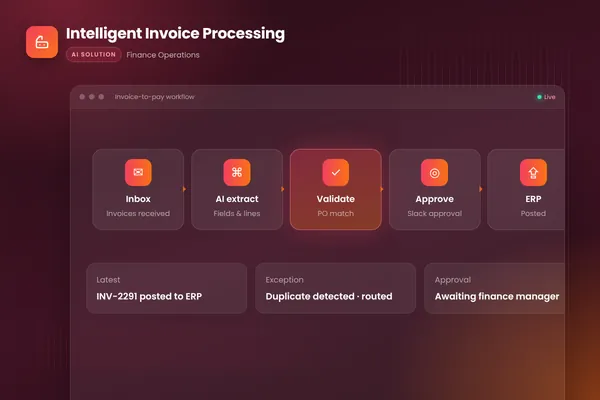
BufferSol delivery data: a working agent on your real data inside 30 days, and Done For You automations live in 3 to 6 weeks. Success is measured on your baseline: scaled error against naive by horizon, bias, on-time delivery of the weekly view and analyst hours saved. A pilot is not a full rollout. It shows what a rollout needs. See our intelligent invoice processing case study for the pattern on finance data.
Is this right for you?
Check these signs. Three or more means a pilot is worth scoping.
- Your 13-week forecast is built by hand and takes more than a day each week.
- Customers pay late in patterns you can describe but the forecast ignores.
- You cannot say how accurate last quarter's forecast was, or whether it leaned high or low.
- A vendor has quoted you an accuracy gain and you cannot test it.
- Surprises such as a late payer or a missed commitment reach you from the bank, not the forecast.
The matching ready-made automation is Financial Reporting and Cash Forecasting, a Done For You build for finance teams that want a rolling forecast from live ledger data in 3 to 6 weeks. For the receivables side, see Collections and Accounts Receivable, and browse the Done For You catalogue. Related: AP automation, AI workflow automation examples and AI automation agency guide.
Is there anything we did not re-check?
Yes. Facts we did not re-check: facts checked November 2026 against the pages named in this post. We did not open the J.P. Morgan research behind Xero's "up to 50%" figure, and we did not read the Citizens Bank page (access error) or the MDPI paper (403). The three figures on DataRobot's page have no source in the page text, so we did not use them as facts. We read the Emerald study through its abstract page, not the full paper. The eight-week scoring example and the weekly cost estimate are BufferSol illustrations with invented numbers. Vendor pages change, so re-check before you buy.
If you want a cash forecast you can score, we recommend asking BufferSol for a scoped estimate of a 30-day pilot now, so your 2027 treasury plan rests on a baseline-tested forecast built on your own data.
Frequently asked questions
Can AI improve cash flow forecasting?
Yes, in narrow ways, and only when tested. AI cash flow forecasting models predict when each customer will actually pay, refresh daily and make variance analysis cheap. They do not see commitments no system has recorded, and they are only as good as the data. Measure any model against a naive forecast on your own history before believing a vendor's improvement figure.
How accurate is AI cash flow forecasting?
No source we opened gives a measured accuracy by horizon. Xero repeats a J.P. Morgan figure of up to 50 percent lower error, which we could not trace, and a 2024 conference paper reports LSTM error of 4.2 percent against ARIMA at 5.5 percent on one unpublished dataset. Treat both as claims to test. Report accuracy for next week, next month and next quarter separately.
What is the best way to measure cash flow forecast accuracy?
Use mean absolute error in currency, a weighted absolute percentage error across the period, bias and a scaled error against a naive forecast, reported by horizon. Avoid plain percentage error on net cash. Hyndman's textbook warns that percentage errors are undefined at zero and extreme near zero, and weekly net cash often sits near zero.
Which cash flows should AI forecast and which should rules handle?
Rules or a calendar should handle contractual flows such as payroll, debt service, tax and scheduled transfers. TechnoLynx calls these deterministic. AI earns its place on the uncertain remainder, mainly customer payment timing and variable spend. A hybrid keeps the known items exact and spends model effort where uncertainty actually lives.
How much history does an AI cash forecast need?
Rework suggests at least two years of bank transaction history so seasonality can be seen, with daily or weekly granularity. We found no source that proves a minimum for every business. Hyndman's textbook says the test set should ideally be at least as long as your longest forecast horizon, so plan history for both fitting and testing.
How do I test a vendor's AI cash forecast claim?
Give the vendor your history up to a cut-off date and ask for forecasts at each horizon for the weeks after it, without showing them the actuals. Score the result against a naive forecast and against your current spreadsheet using the same metric. Repeat at several cut-off dates. Rework warns a model always looks better on the history it was fitted to.
What can AI not do in cash flow forecasting?
It cannot see an event that is not in the data. Xero says that if something has not happened before in your data, the AI will not see it coming. Planned acquisitions, disputes and funding rounds need a person to enter them as overrides. It also does not decide what to do about a shortfall, which Aleph's page says plainly.
How long does it take to pilot AI cash flow forecasting?
A first working version on your own ledger and bank data is a matter of weeks, not months, if the data is reachable. BufferSol's pilot puts a working agent on your real data inside 30 days: a prototype in about two weeks, then a live pilot on a first slice, with a person approving any override.
Sources
- Harnessing AI and Machine Learning for Improved Cash Flow Forecasting, CEUR Workshop Proceedings (DoSIER 2024)
- The applicability of machine learning algorithms in accounts receivables management, Journal of Applied Accounting Research (Emerald), via EconPapers
- How to turn AI cash flow forecasting into capital advantage, U.S. Bank
- Using AI to Forecast Cash Flow: What UK Business Owners Should Know, Xero
- AI cash flow forecasting: what it changes and what it misses, Phacet Labs
- AI cash flow forecasting tools: what they actually automate (2026), Aleph
- AI Cash Flow Forecasting: How It Works for Finance Teams, TechnoLynx
- AI Cash Flow Forecasting: Methods, Data and Accuracy, Rework
- Forecasting: Principles and Practice, chapter 5: The forecaster's toolbox, Rob J Hyndman and George Athanasopoulos (OTexts)
- Another look at measures of forecast accuracy, Rob J Hyndman and Anne B Koehler
- TimeSeriesSplit (time series cross-validator), scikit-learn
- Forecasting methods in automated machine learning, Microsoft Learn
- AFP Survey: AI Priorities Rise Across Treasury Teams While AI-Related Challenges Grow, Association for Financial Professionals
- 2026 AFP Treasury Benchmarking Survey Report: People and Policies, Association for Financial Professionals
- Building the Cash Muscle: How Private Equity Is Elevating the 13-Week Forecast, Association for Financial Professionals
- How AI Is Transforming Cash Flow Forecasting: A Guide for Business Owners, HubSpot
- AI Cash Flow Forecasting: How It Works and Best Practices, Tipalti
- Improving Cash Flow with AI-Driven Financial Forecasting, DataRobot
Cite this article
BufferSol Editorial Team (2026). Can AI Improve Cash Flow Forecasting? 7 Ways It Works in 2027, and Where It Doesn't. BufferSol Technologies. https://buffersoltech.com/blog/ai-cash-flow-forecasting-2027
BufferSol Editorial Team
AI & software engineering team
Senior engineers, AI specialists and product leads at BufferSol Technologies who design, build and run AI agents, autonomous workflows and custom software for companies in the US, UK and Europe.
Reviewed by Sufyan K., Senior Writer, BufferSol Technologies.