Key takeaways
- There are five routes, not two: a seat-based sales suite, an autonomous AI SDR subscription, a data-and-workflow stack, a hybrid and a full custom build.
- Every cost and timeline figure we found comes from a company that sells one side. AiSDR puts a build at $180K-$580K+ in year 1; DevCommX says $150,000-$300,000; Knowlee says EUR 600K-950K. We show each with its author.
- 11x's pricing page lists its Growth plan at $36,000 per year, billed annually, for up to 5 users and 2,000 new prospects a month, as of November 2026. A third-party roundup lists a different figure, so check live.
- Both routes owe the same sending rules: Google's bulk-sender rules start above 5,000 messages a day to Gmail, and Yahoo asks for SPF, DKIM and DMARC. Buying does not remove the duty; it moves who runs it.
- In BufferSol's three-year estimate from sourced ranges, buying costs $90,000-$450,000 and building $270,000-$480,000, so the ranges overlap and fit, control and risk decide.
Build vs buy AI sales platform in 2027 comes down to five routes, not two. Buy a seat-based sales suite, rent an autonomous AI SDR, assemble a data-and-workflow stack, run a hybrid, or build your own. Every price and timeline we found comes from a company selling one side, and the ranges overlap, so fit, control and sending risk matter more than the sticker.
This post compares the routes with facts read in November 2026, shows the numbers side by side, and ends with a 30-day pilot you can run before committing. For the wider picture see our AI sales platform guide and our guide to AI SDRs.
What does build vs buy mean for an AI sales platform?
An AI sales platform is software where AI agents research accounts, write outreach, handle replies and book meetings, with people approving the sensitive steps. Buying means paying a vendor for that software as a service. Building means your team, or a partner such as BufferSol, writes and runs the agent on your own accounts. The choice is really about who owns the data, the sending reputation and the maintenance.
AgentMail (November 13, 2026) draws the line this way: "Buy when your sales motion looks like most B2B outbound: a list of accounts, a sequence, a meeting." It adds "Build when the agent needs data only you have, like product usage, signup events or account state." AgentMail sells email infrastructure for builders, so treat that as one seller's view. Anthropic's agent guide gives neutral advice for the build side: "we recommend finding the simplest solution possible, and only increasing complexity when needed."
| Buy | Build | |
|---|---|---|
| Who writes the agent | The vendor | Your team or a partner |
| Who holds the sending reputation | Shared with the vendor's infrastructure | You, on your own domains |
| Where your data sits | In the vendor's product | In your own systems |
| What changes with a new model | The vendor ships it | You test and migrate it |
| What you pay per month | A subscription or usage fee | Engineering time plus usage |
Source: BufferSol view, built from the vendor pages cited in this post
BufferSol Technologies · buffersoltech.com
1. Is a seat-based sales suite enough: Outreach or Salesloft?
A seat-based suite is the cheapest way to add AI to reps who already sell, and the weakest at running outbound alone. You pay per user, the AI features draw on a credit pool, and a rep still owns each conversation. It suits teams whose reps do the selling and want help with research and drafts, not an agent that works unattended.
Outreach's pricing page calls it "the AI Agent Platform for Revenue teams" and shows four Amplify plans by AI credits: Essentials with 10,000, Core with 25,000, Plus with 50,000 and Pro with 100,000. It states "Per user pricing. No platform fees. Support included." Each plan says "Request pricing", so no dollar figure is public. As of November 2026, the page names agents such as research, personalization and meeting prep, and does not describe an AI SDR.
Salesloft's pricing page lists "AI Agents" described as "Automate work and take action across the revenue lifecycle." As read in November 2026, that page shows no plan names or prices either. Neither vendor gives a price we can compare, so the cost column for this route stays blank until a quote arrives.
Choose it if your reps are hired, productive and short of prep time, and you want the AI inside one workspace. Skip it if you want meetings booked with no rep in the loop, or you need data from your own product. Our AI SDR guide and sales automation versus AI sales agent post draw the line between assisted and autonomous work.
2. Should you rent an autonomous AI SDR: 11x, AiSDR or Artisan?
Rent one when your motion is standard outbound and you want meetings without staffing a stack. These tools run the whole sequence: find leads, write and send messages, handle replies and book meetings. The trade-off is that your sending reputation, data and workflow live inside the vendor's design.
11x's pricing page states "Starting at $36,000 / yr" for Growth, "Billed annually", with "Up to 5 End Users" and "2,000 New Prospects per Month". Its Pro plan allows up to 10 end users and 5,000 new prospects a month, and Enterprise allows 10,000+ prospects a month. Pro and Enterprise pricing is "custom". The same page says every plan bundles "contact data, email deliverability, warmup, inbox rotation, meeting scheduling, CRM sync, and onboarding" and that you "only need to bring your own CRM license." Another source disagrees: AgentMail lists the same plan at "$3,750 per month billed annually", which is $45,000 a year. We use the 11x page, as of November 2026, and tell you to confirm it before signing.
AiSDR's own comparison page puts buying at "Annual Total $11K–$36K/yr", covering the platform subscription, infrastructure, deliverability management, data enrichment and support. That is a vendor claim about its own product. A Nitrobots article, written by another vendor, puts it plainly: "Buying gets you live in weeks; building is a multi-quarter commitment before you make a single call."
Artisan describes Ava as an "AI BDR" that books meetings. Its pricing page showed no figures when we read it, so we give no Artisan price. Do not use a price from a search snippet; ask for a written quote.
Choose it if you want pipeline this quarter and your motion looks like most B2B outbound. Skip it if your security review blocks outside vendors, or the agent must read data a vendor cannot reach. Our best AI SDR tools post compares these products feature by feature.
3. Can a data-and-workflow stack such as Clay do the job?
Yes, for teams with a RevOps person who enjoys wiring tools together. You buy data, enrichment and an AI research step from one vendor, add a sender and a CRM, and build the rules yourself. It costs less than an autonomous SDR and asks more of your team.
Clay's pricing page shows a Free plan with 500 actions a month, Launch at "$167/mo" with 15,000 actions, and Growth at "$446/mo" with 40,000 actions, with Enterprise "Custom". It says "Actions measure platform usage", that its data credits start at $0.05 each, and that its AI agent is called Claygent. The page contradicts itself: its plan descriptions say Launch "starting at $185/mo" and Growth "starting at $495/mo". We quote the cards and flag the difference, so read the live page.
Acquaint Softtech, a development firm, estimates a stack of Clay plus a sender plus a CRM at "~$300 to $1,500 per month plus sending". Treat that as one seller's estimate. AY Automate says entry plans for individual tools "can start in the low hundreds of dollars per month".
Choose it if you have someone to own the workflow and want control over the data steps. Skip it if no one will maintain it; a stack that nobody owns breaks quietly. Our AI lead generation post, CRM data automation post and CRM hygiene automation cover the data side.
4. Does a hybrid build, buying the sending layer, make sense?
For teams that need their own logic but not their own plumbing, yes. A hybrid buys the commodity parts, such as sending infrastructure and contact data, and builds the agent that uses your own data to decide who to contact and what to say. It is the route sellers mention least, and it is often the one a mid-sized team ends up choosing.
Knowlee is the only source we found that prices it: "two engineers for 2-3 months", which it puts at "€30-60K", with a year-1 total of "€80-180K" and a timeline of "6-12 weeks". Knowlee sells its own agent platform, so these are its estimates in euros. AgentMail shows the pattern in its own example: you build the logic and buy the email layer.
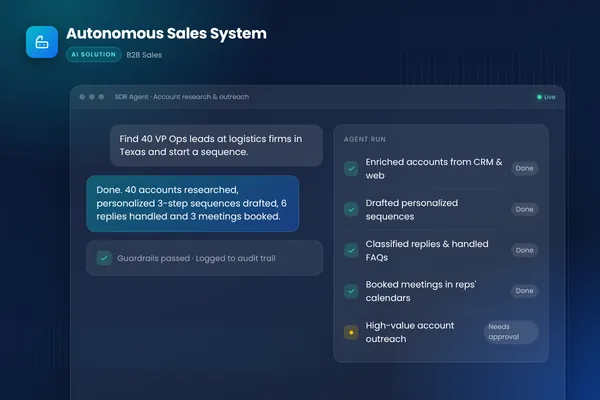
BufferSol builds this route. In our autonomous sales system, a research agent, a writing agent and an inbox agent run on the client's own CRM, with approval queues for high-value accounts. Our AI agents service covers the build, our meeting prep and follow-up automation is a ready-made add-on, and our AI meeting booking agent post shows the booking step.
Choose it if your data is the advantage and sending is not. Skip it if you have no one to review the agent's work each week.
5. When does a full custom build pay off?
When the platform is itself your product, when no vendor can pass your security review, or when your volume makes a per-seat or per-prospect fee larger than a build. Otherwise sellers on both sides agree it costs more and takes longer than it first looks.
AiSDR lists its own cases for building: you want to build and sell an AI SDR, you can dedicate 2-3 AI/ML engineers full-time for at least 6 months, your security review blocks any vendor from processing prospect data, you have ruled out the major platforms, and you can fund $180K-$360K a year of maintenance. It then concludes: "If any of these apply, build it. If not, AiSDR is the faster path to pipeline." That is a vendor telling you when not to buy from it, which is useful, and also self-interested.
DevCommX, an agency that sells development, gives "$150,000 – $300,000 (2–3 engineers for 6 months)" for a year-1 build and "0.5 engineer / year" for maintenance, with break-even in "Year 2–3 (if executed well at scale)". Nitrobots adds that "the build often costs far more than it first appears."
Choose it if you hit two or more of AiSDR's cases above. Skip it if you are building to save money in year one; no source we read shows that it does. Our how-long-to-build post explains why build timelines stretch.
Where do the published cost figures disagree?
Everywhere, and the direction follows the seller. A tool vendor shows a high build cost, a development agency shows a mid-range one, and an agent-platform vendor shows the highest. We show each figure with its author, so you can see the incentive.
| Source | Sells | Year-1 build | Buy per year | Build time | Buy time |
|---|---|---|---|---|---|
| AiSDR | An AI SDR tool | $180K-$580K+ | $11K-$36K | About 6 months | Live in under 2 hours (its claim) |
| DevCommX | Development services | $150,000-$300,000 | $30,000-$150,000, mid-market | 3 to 9 months | 1 to 4 weeks |
| Knowlee | An agent platform | EUR 600K-950K | EUR 40-120K, mid-market | 12-18 months | 4-8 weeks |
| Acquaint Softtech | Development services | No total given | $24k-$60k autonomous | Not stated | Not stated |
| 11x | An AI SDR | Not covered | From $36,000 | Not covered | Onboarding included |
Knowlee gives "three mid-senior engineers for 12-18 months" at about EUR 120-180K each a year, which is why its build total is the highest. DevCommX assumes two or three engineers for about six months. The difference is team size and how much governance is counted, not a fact about AI. As of November 2026, no neutral analyst source on this exact question was found.
Source: Figures as published by each author in 2026; every author sells one side. See the sources in this post.
BufferSol Technologies · buffersoltech.com
What does every route owe Gmail, Yahoo and the law?
The same floor, whether you buy or build. A tool can run the plumbing, but your domain, your list and your unsubscribe handling remain your responsibility. This is the cost most build-vs-buy pages leave out, and it applies to every one of the five routes.
Google's sender rules say "Starting February 1, 2024, email senders who send more than 5,000 messages per day to Gmail accounts must meet the requirements in this section." They require SPF and DKIM, a DMARC policy that "can be set to none", and one-click unsubscribe for marketing messages. They also say to keep spam rates in Postmaster Tools below 0.30%, with a stricter recommendation of 0.10%. Yahoo's page asks bulk senders for SPF and DKIM, a DMARC policy of at least "p=none", a list-unsubscribe header, honoring unsubscribes "within 2 days", and a spam rate below 0.3%. Yahoo's page states no volume threshold.
US law adds the opt-out clock. 15 U.S.C. 7704, the CAN-SPAM Act's provisions, sets 10 business days to honor an opt-out and requires a "valid physical postal address" in commercial email. For recipients in the EU, GDPR Article 6 lists six lawful bases, including consent and legitimate interests, which applies "except where such interests are overridden by the interests or fundamental rights and freedoms of the data subject". That text comes from an unofficial mirror, and we did not open EUR-Lex, so treat it as a pointer. None of this is legal advice.
| Duty | Source | Who runs it if you buy | Who runs it if you build |
|---|---|---|---|
| SPF, DKIM and DMARC | Google, Yahoo | Vendor, on its domains or yours (ask) | You |
| One-click unsubscribe | Google, Yahoo | Vendor, but the list is yours | You |
| Opt-out within 10 business days | 15 U.S.C. 7704 | You are the sender in law; confirm the process | You |
| Lawful basis in the EU | GDPR Article 6 | You, as controller | You |
11x bundles "email deliverability, warmup, inbox rotation" into every plan, and AiSDR lists "Deliverability management" as included. Those are the vendors' statements, and neither page says who answers if a domain is blacklisted. Ask in writing, and see our AI vendor security questionnaire post and data processing agreement post.
How do you compare three-year cost with your own numbers?
Add the year-1 cost, the running cost for years 2 and 3, and the people you must keep. Here is a worked example, labelled as a BufferSol estimate, using only the sourced ranges above. Replace each input with yours.
- Buy, low and high. DevCommX gives $30,000-$150,000 a year at mid-market. Three years is $90,000 to $450,000. 11x's Growth plan at $36,000 a year is $108,000 over three years if the price stays flat; its page says renewal increases are capped but gives no cap.
- Build, low and high. DevCommX gives $150,000-$300,000 in year 1. For maintenance, DevCommX says "~0.5 engineer / year", and AiSDR prices one maintenance engineer at $120K-$180K a year, so half is $60,000-$90,000. Two more years is $120,000 to $180,000. Three years is $270,000 to $480,000.
- What it shows. The two ranges overlap between $270,000 and $450,000, so a team at the expensive end of buying can spend the same as a team at the cheap end of building. This is BufferSol estimate arithmetic on sellers' figures, not a benchmark, and it leaves out usage fees, data and domains on the build side.
Your own inputs matter more than ours. Count the loaded cost of the engineer or partner you would use, the number of prospects a month you really send, the sending domains you need and the meetings you expect. Our AI SDR guide and how-long-to-set-up post show how those inputs move.
How long does each route take to first meeting?
Buying is faster by every source, and the sources disagree on how much. All of these timelines are sellers' claims.
| Route | Timeline | Source |
|---|---|---|
| Buy, vendor claim | Live and sending in under 2 hours | AiSDR |
| Buy, agency estimate | One to four weeks | DevCommX |
| Buy, agent vendor | 4-8 weeks for configuration and first campaign | Knowlee |
| Buy, agency (marketing) | Days, managed and pre-built | NomadX |
| Hybrid | 6-12 weeks | Knowlee |
| Build | About 6 months | AiSDR |
| Build | Three to nine months | DevCommX |
| Build | 12-18 months with governance | Knowlee |
| BufferSol | A working agent on your real data inside 30 days; Done For You live in 3 to 6 weeks | BufferSol delivery data |
Two details change the picture. AiSDR says a self-built system needs "Mailbox warmup. 4-6 weeks of reputation building", and claims its own tool goes live "with no 4-6 week warmup". Acquaint Softtech and AY Automate both say a bought tool can start within days, while "a custom build typically takes weeks" in AY Automate's wording, which sells agency work. The spread is wide because "live" means different things: connected, sending, or booking meetings. See our speed-to-lead automation post and the proposal and quote automation for the step after the meeting.
What does a custom agent do step by step?
It does the same job as a bought tool, through your own systems, with your own approval rules. Here is the flow BufferSol built in the autonomous sales system, described from our project record.
- Research. A research agent builds a brief on each account from public sources and the CRM: company signals, role, recent news and likely priorities.
- Draft. A writing agent drafts a multi-step sequence in the company's voice, tailored to the persona and trigger.
- Approve. High-value accounts wait in an approval queue. Every send runs through guardrails and rate limits.
- Send and watch. The system sends within limits and logs every touch back to the CRM automatically.
- Handle replies. An inbox agent classifies replies, answers common questions and proposes meeting times; warm leads go to a rep.
- Book and log. Qualified meetings are booked into the rep's calendar, and the CRM stage updates without manual entry.
The stack in that project was Claude and OpenAI models, LangGraph, Python, PostgreSQL, and the HubSpot and Gmail APIs. The point for build vs buy is step 3: approval rules and data access are yours to set, which is the main thing a bought tool cannot offer. Our human-in-the-loop agents post shows how to design the approval step, and our AI agent architecture post covers the parts.
- 011. ResearchBrief on each account from public sources and your CRM.
- 022. DraftMulti-step sequence in your voice, tailored to the persona.
- 033. ApproveHigh-value accounts wait for a person. Rate limits apply.
- 044. Send and logMessages go out within limits; every touch is logged to the CRM.
- 055. Handle repliesReplies classified, FAQs answered, warm leads handed to a rep.
- 066. BookQualified meetings land in the rep's calendar.
Source: BufferSol autonomous sales system (portfolio project record)
BufferSol Technologies · buffersoltech.com
What does a custom agent not do?
It does not remove the sending floor, it does not arrive faster than a subscription, and it does not run without an owner. A custom agent still needs authenticated domains, an unsubscribe process and a person who reviews exceptions each week. Anthropic warns to start simple, and BufferSol agrees: begin with one narrow job, not a full platform.
It also carries a maintenance duty. AiSDR's page lists "LLM deprecations" as a 2-4 week migration each time and "Spam filter changes" that can drop deliverability, and while that is a vendor arguing its case, the maintenance list is real work for any builder. Plan for it. Our AI SDR guide and AI sales platform guide list the weekly checks, and our AI agent evaluation post shows the test set that catches regressions.
Which route fits which team?
Match the route to the constraint that decides it. This table is BufferSol view, built from the sources above.
| Your situation | Likely route | Why |
|---|---|---|
| Reps are productive and short of prep time | 1. Seat-based suite | Outreach and Salesloft add AI to existing seats |
| Standard B2B outbound, no engineers | 2. Autonomous AI SDR | 11x bundles data, deliverability and onboarding |
| A RevOps owner and appetite to tinker | 3. Data-and-workflow stack | Clay prices by actions and credits |
| Your own data is the advantage | 4. Hybrid | Knowlee prices it at 6-12 weeks |
| Security blocks vendors, or you sell the platform | 5. Full custom build | AiSDR lists these as cases to build |
If two rows fit, start with the cheaper route and a narrow job, and move up only when the data shows the limit. A pilot on one segment tells you more than any comparison page. Our AI outbound calls post and TCPA post cover the phone channel if you add it, and our AI voice agents service builds it.
What changes in 2027 for AI sales platforms?
Three dated facts and one view. Every forward claim here is labelled.
- Pricing is moving to usage. As of November 2026, Outreach sells AI credits per plan, Clay meters "actions" and data credits, and 11x caps new prospects a month. Plan a 2027 budget around volume, not seats.
- Contracts lock in. 11x's page says "Annual is the default" and that multi-year commitments "lock your current rate for the full term". Negotiate an exit before you sign a multi-year term.
- Sender rules stay in force. The Google and Yahoo pages describe requirements already in place. Neither page, as read in November 2026, announces a change for 2027.
- BufferSol view: the gap between buying and building is narrowing for narrow jobs, because a custom agent on your own data can be a pilot, not a project. Expect more teams to run a hybrid in 2027 than the two-option framing suggests. No analyst source we opened forecasts this.
Who owns the sending domains and data in each route?
In a build you own both. In a purchase the contract decides, so read it. 11x's page says it bundles "email deliverability, warmup, inbox rotation" and that "multi-year commitments lock your current rate for the full term", but it does not say what happens to your domains or data at exit. AiSDR says it offers "GDPR-compliant regional processing, SSO, audit logs", which is a vendor statement about its own product.
Ask who registers the domains, who holds the mailboxes and what you can export when you leave. Our AI vendor security questionnaire post, data processing agreement post and AI agents service show what to ask and what a build keeps in your hands.
Can you run a pilot instead of choosing now?
Yes, and it is the cheapest way to settle the question. A pilot on one segment shows reply rates, deliverability and review effort on your own accounts, which no comparison page can. Nitrobots says buying gets you live in weeks, so a bought tool can serve as the benchmark while a custom agent runs on the same segment.
Run both on equal slices for a month if budget allows, and compare meetings per hundred prospects, review time and sending health. AgentMail and Knowlee both describe hybrid paths that fit this approach. Our how-long-to-set-up an AI sales platform post and AI SDR guide show the first month in detail.
What do the vendor pages not show?
Prices, results and responsibility. Of the pages we read, Outreach, Salesloft and Artisan show no dollar figures. Clay's page contradicts itself between its cards and its FAQ. None of the pages shows independent results, and every comparison article we found was written by a company that sells one side. Sendro's article labels both its case studies "Illustrative example", so we used none of their results.
We also found no public figure for how often an outbound domain gets blocked under either route. AiSDR claims "$50K–$200K per burnt domain", which is its own estimate, so we do not repeat it as a fact. Treat results claims as vendor claims, and ask for references you can call.
Which questions should you ask every vendor in writing?
Ask these before you sign, and keep the answers.
- Who owns our sending domains and mailboxes if we leave? Check against Google's rules on authentication.
- What happens to our data and the replies when the contract ends?
- How are unsubscribes handled, and how fast? Yahoo says within 2 days; US law sets 10 business days.
- What does a renewal cost? 11x says increases are capped; ask for the cap in the contract.
- What is counted as a prospect, an action or a credit? Compare with Clay's definition of an action.
- Which lawful basis do you assume for EU contacts? See GDPR Article 6.
- Who approves a message before it sends, and can we require approval for named accounts?
- What is the exit route? Ask for an export of leads, sequences and logs. See AgentMail's note on building around your own data.
What does a 30-day pilot deliver for a sales platform?
In 30 days you get a working AI sales agent on your own accounts, with your team approving what matters, which tells you whether to buy, build or run a hybrid. The plan:
- You bring: read access to your CRM, a target segment of a few hundred accounts, your current sequences and reply rates as the baseline, a sending domain with SPF, DKIM and DMARC in place, and one rep who reviews drafts.
- We build, in about two weeks: a prototype that researches accounts, drafts outreach and classifies replies on your real data, scored on cases you choose.
- We launch, in the final stretch: a live pilot on one segment with approvals on high-value accounts, send limits, CRM logging and a report against your baseline.
Success is measured on your own numbers: reply rate, meetings booked, share of drafts approved without edits and hours of rep time saved. A pilot is not a full rollout; it shows what a rollout would need. If your job matches a catalogue item, Done For You is shorter: BufferSol builds and runs it, live in 3 to 6 weeks, with pricing quoted after a short call. See our AI SDR outbound automation, our speed-to-lead automation and the Done For You catalogue. The B2B SaaS page shows the type of business this fits.
Is this right for you?
Check how many describe your team:
- You can name the segment you would test first and the CRM it lives in.
- Your reps or a RevOps owner can review drafts weekly.
- You have, or can set up, authenticated sending domains.
- A tool has not yet fit, or your security review slows vendors down.
- You want evidence on your own accounts before committing to a contract or a build.
If few apply, start with the cheapest route that fits and a narrow segment. Our AI lead qualification post, AI appointment setter post and AI sales outreach personalization post show smaller first steps, and our AI for sales prospecting post covers the research step. For build costs and scoping, see how an AI automation agency prices work and what an agency does, and our autonomous workflows service for adjacent automations.
Facts checked November 2026 on AiSDR, DevCommX, Knowlee, 11x, Clay, Outreach, Salesloft, Google, Yahoo, 15 U.S.C. 7704, AgentMail, Nitrobots, NomadX, Acquaint Softtech, AY Automate and Anthropic. Facts we did not re-check: HubSpot Sales Hub and Apollo prices (their pages did not load usable text), the FTC CAN-SPAM guide (blocked, so the statute text was used), the official EUR-Lex text of GDPR (not opened), Artisan's price (not published on the page we read) and every BufferSol timeline (our own delivery data).
If a custom or hybrid sales agent is on your shortlist, ask BufferSol for a scoped estimate and a 30-day pilot plan for one segment now, so the 2027 budget covers it and the pilot can start in Q1 2027.
Frequently asked questions
Should we build or buy an AI sales platform?
Buy when your motion is standard outbound: a list of accounts, a sequence and a meeting. Build, or hybrid, when the agent needs data only you hold, must act inside your own systems, or your security review blocks outside vendors. AgentMail makes the same split. BufferSol recommends testing one narrow job with a 30-day pilot before committing to either route.
How much does a custom AI SDR cost compared with buying one?
Published figures differ by author. DevCommX gives $150,000-$300,000 for a year-1 build and $30,000-$150,000 a year to buy at mid-market. AiSDR, which sells a tool, says a build costs $180K-$580K+ in year 1. Knowlee gives EUR 600K-950K. Each source sells one side, so run your own numbers with the three-year worked example in this post.
How long does an off-the-shelf AI SDR take to go live compared with a build?
Sources give different ranges, and each is a seller's claim. DevCommX says one to four weeks to buy and three to nine months to build. Knowlee says 4-8 weeks to buy and 12-18 months to build. AiSDR says about 6 months to build. BufferSol's own figure is a working agent on your real data inside 30 days, and Done For You automations live in 3 to 6 weeks.
Does buying an AI SDR tool remove our email compliance duties?
No. Google says senders above 5,000 messages a day to Gmail must meet its bulk-sender rules, including SPF, DKIM and DMARC. Your sending domain, your list and your unsubscribe handling stay your responsibility, and CAN-SPAM requires honoring opt-outs within 10 business days. A vendor can run the plumbing, but ask for the written split of duties. This is not legal advice.
What is a hybrid AI sales platform?
A hybrid buys the commodity layer, such as sending infrastructure or contact data, and builds the part that is specific to you, such as the research and qualification logic that reads your own data. Knowlee prices a hybrid with a custom agent at EUR 80-180K in year 1 and 6 to 12 weeks. That is a vendor estimate, so confirm it against a scoped quote.
Sources
- Build vs buy an AI SDR, AiSDR
- AI SDR: Buy vs Build Decision Framework (2026), DevCommX
- Build vs Buy AI SDR 2026: Six Dimensions, Honest Tradeoffs, One Decision Framework, Knowlee
- Alice pricing, 11x
- Clay pricing, Clay
- Outreach pricing, Outreach
- Salesloft pricing, Salesloft
- Email sender guidelines, Google Workspace Admin Help
- Sender best practices, Yahoo Sender Hub
- 15 U.S. Code 7704 - Other provisions relating to commercial electronic mail, Cornell Law School Legal Information Institute
- Art. 6 GDPR - Lawfulness of processing, gdpr-info.eu (unofficial text of Regulation (EU) 2016/679)
- Best AI sales agents 2026, AgentMail
- Build vs buy AI SDR, Nitrobots
- Build vs Buy AI SDR 2026, NomadX
- How to build an AI SDR sales automation platform, Acquaint Softtech
- Building effective agents, Anthropic
Cite this article
BufferSol Editorial Team (2026). Build vs Buy AI Sales Platform: Top 5 Routes to Compare for 2027. BufferSol Technologies. https://buffersoltech.com/blog/build-vs-buy-ai-sales-platform-2027
BufferSol Editorial Team
AI & software engineering team
Senior engineers, AI specialists and product leads at BufferSol Technologies who design, build and run AI agents, autonomous workflows and custom software for companies in the US, UK and Europe.
Reviewed by Sufyan K., Senior Writer, BufferSol Technologies.