Key takeaways
- Instantly says an AI BDR implementation takes 5 to 8 weeks when done correctly; Oliv AI says a CRM-layer rollout takes about a month, with most of it in parallel. Both are vendor statements.
- Setup is several clocks, not one: admin access, CRM data, sender authentication, domain warm-up and validation.
- Google requires SPF, DKIM and DMARC from senders of more than 5,000 messages a day to Gmail accounts and says to keep spam rates in Postmaster Tools below 0.30%.
- Instantly says new sending domains need a minimum of four to six weeks of warmup; Google and Yahoo do not state a warm-up period.
- A pilot on a small slice can start inside 30 days, but full scale is a later decision made on validated numbers.
How long does it take to set up an AI sales platform? Vendors give three answers: 5 to 8 weeks for an AI BDR (Instantly), about a month for a rollout on top of your CRM (Oliv AI), and a 30/60/90-day phased rollout (Apollo). For 2027, this post turns them into a five-week plan with the clocks laid out, based on pages read in November 2026.
An AI sales platform is software that researches prospects, writes and sends outreach, handles replies and books meetings, with people approving the risky steps. For the full picture, read our AI sales platform guide. For tools, see best AI SDR tools.
How long does an AI sales platform setup take in total?
There is no single number, because each source times a different layer. The honest answer is a range of about one to eight weeks, depending on whether you send cold email from a new domain. Every figure below is stated by a vendor or platform, and none comes with customer-measured results.
| Source | Timeline it states | What it covers | Type |
|---|---|---|---|
| Instantly, AI BDR guide | 5 to 8 weeks | Domain purchase to validated performance | Vendor |
| Instantly, warmup guide | Four stages, the last one after day 30 | Sender warm-up only | Vendor |
| Oliv AI, rollout guide | About a month, mostly in parallel | CRM layer, admin access to day-30 review | Vendor |
| Apollo, setup guide | Phased 30/60/90 days | Foundation, then orchestration | Vendor |
| Salesforce, readiness guide | 15 to 60 minutes | Data Cloud and Einstein provisioning only | Vendor help |
The Salesforce guide is for service agents, not sales rollouts, and its 15 to 60 minutes covers provisioning only. Treat it as a floor for one task, not a rollout time. In our view (BufferSol view), plan on five weeks for a first live pilot and treat the rest as a gradual ramp.
- 01Week 1Get admin access, connect the CRM, set up DNS records
- 02Weeks 2 and 3Warm up the sending domain while you prepare data and sequences
- 03Week 4Train the team and set the approval rules
- 04Week 5Validate performance on a small slice before scaling
BufferSol Technologies · buffersoltech.com
The 5-week plan to set up an AI sales platform in 2027
Each step below is a decision with a test. The plan follows the week order Instantly describes: "Week 1 covers DNS setup, weeks 2 to 3 build sender reputation, week 4 trains your team, and week 5 validates performance." We add the admin and data work that run in parallel. Vendor facts are as of November 2026.
1. Who gives you admin access, and when?
Book the people who hold your admin rights in week one. Oliv AI's guide says to "Book the admins you need in week one, so no connection waits on a calendar invite," and "Connect the CRM first." It adds that "Most teams are connected within a week."
Apollo's foundation phase includes "setting user permissions." No page we read puts a number on admin lead time, so ask your own admins how long a new connection takes. If a security review is required, start it now. Our AI vendor security questionnaire post covers what to expect. Do this first if your CRM or email admin is a part-time role.
2. Is your CRM data ready for an agent?
Clean the fields the agent reads before it reads them. Apollo's foundation phase covers the data model, deduplication and integration health over days 1 to 30, but gives no duration for cleaning CRM records, and neither does any other page in our set. This is the phase no vendor times.
Start with three checks: duplicate accounts, missing owner fields and stale contacts. An agent that writes to a messy CRM makes the mess faster. Our post on AI lead qualification shows which fields the agent needs. Do this in parallel with the domain work in week one.
3. Is your sending domain authenticated?
Set up SPF, DKIM and DMARC before a single message goes out. Google's sender guidelines say "email senders who send more than 5,000 messages per day to Gmail accounts must meet the requirements in this section," and "We require that you set up these email authentication methods for your domain" (SPF, DKIM and DMARC). Google also says to "Keep spam rates reported in Postmaster Tools below 0.30%" and that marketing messages "must support one-click unsubscribe."
Yahoo's Sender Hub says "Implement both SPF & DKIM," "Publish a valid DMARC policy with at least p=none - DMARC must pass," and "Keep your spam rate below 0.3%." Neither page says a low-volume pilot is exempt, and the 5,000 threshold is Google's definition of a bulk sender, so check your own volume. This is not legal advice, and the pages carry no dates. Do this in week one because the warm-up cannot start before it.
4. How long does email domain warmup take?
Plan four to six weeks for a new domain, based on a vendor source. Instantly says "New sending domains need a minimum of four to six weeks of warmup." Its warmup guide says the process "unfolds in four stages: building initial trust (~ days 1-7), scaling volume safely (~ days 8-21)," with sending volume at "5-10 emails per day" at first and rising "from 10-20 daily emails up to 40-60 by day 21."
The page says "The final week brings you to 60-100 emails per day" and gives no end date for the last stage. Google and Yahoo state no warm-up period, so this timeline is Instantly's view, not a rule. If you send from an existing domain with a good record, ask your vendor what applies. A pilot of 50 prospects a day does not need full volume. Our post on how long it takes to build an AI agent covers the build side, and our AI lead generation software post compares the sending tools. Choose a new domain if you want to protect your main domain's reputation.
5. How do you validate before you scale?
Validate on a small slice and set the stop rules in advance. Instantly says week 5 "validates performance," and Apollo says "SDRs need sequences, messaging templates, and AI-assisted research running within the first 30 days to see value." Apollo also claims teams "reach their first active workflow in days, not weeks" (a vendor marketing claim, not a measured result).
Check four things in the slice, starting with the Google spam-rate limit: spam complaints against the 0.30% limit, bounce rate, replies that needed a person, and opt-outs. The FTC's CAN-SPAM guide says "You must honor a recipient's opt-out request within 10 business days" and "The law makes no exception for business-to-business email." Test that the agent honors an opt-out in a test run. UK and EU rules differ and are not covered here. Our TCPA post covers the calling rules, and our post on AI sales outreach personalization covers the message itself. Scale only if the slice passes all four checks.
Source: Instantly (Jul 2026), Google email sender guidelines, read November 2026
BufferSol Technologies · buffersoltech.com
Which timeline claims can you trust, and which are marketing?
Trust the rules and test the rest. Google's and Yahoo's pages are rule statements from the platforms that decide whether your mail arrives, so the SPF, DKIM, DMARC and spam-rate points are the firmest facts in this post. The week counts are different: they come from vendors who sell the tool, and the pages do not say how many customers they describe.
Two details show why. The Instantly guide (published 15 July 2026) says an implementation "takes 5 to 8 weeks when done correctly," which makes the figure conditional on doing it right. Oliv AI (updated 3 November 2026) says most of its month "runs in parallel," so a longer calendar does not mean more work. And the Apollo page (14 April 2026) gives phases but no single total. When you compare vendors, ask each one for the median setup time of its last ten customers, in writing, and what counted as "live".
What does a delay cost you?
A delay costs you the learning, not just the calendar. Each week without a live pilot is a week without reply data, and reply data is what tells you whether the offer and the list work. This is BufferSol view, and we have no sourced figure for the cost of a late start.
To see it for yourself, count the meetings your pilot is meant to book each week and multiply by the weeks of delay (BufferSol estimate, using your own numbers). Compare that with the cost of any shortcut. The shortcut with the clearest rule against it is skipping authentication: Google says "We require that you set up these email authentication methods for your domain." Start the slow clocks first, and do the fast work while they run.
What does the week-by-week checklist look like?
Use these verb-first steps to run the pilot. They are a BufferSol plan built from the sources above, not a vendor standard:
- Book the CRM and email admins (week 1).
- Connect the CRM first, then the inbox, then calendar and Slack (week 1).
- Publish SPF, DKIM and DMARC records for the sending domain (week 1).
- Start warm-up on the new domain (weeks 1 to 3, continuing into the pilot).
- Clean duplicates and owner fields in the CRM (weeks 1 to 2).
- Write two sequences and the approval rules for replies (weeks 2 to 3).
- Train the reps on the review queue (week 4).
- Launch to one segment and review the four checks weekly (week 5).
What changes in 2027 for AI sales setup?
No source we opened forecasts setup times for 2027, so everything here is BufferSol view, written as reasoning, not fact.
We expect CRM connection to keep getting faster, because vendors already describe it in days or a week. We expect sender rules to stay the slow part, because reputation builds over weeks, not clicks. And we expect buyers to ask for the pilot first and the contract second, since a month of real data answers more than a demo. Plan a Q1 2027 pilot, and keep the budget decision until the validation numbers are in.
What does an AI sales platform not do on day one?
It does not fix a weak offer, a poor list or a broken CRM. It can send a wrong message, write to the wrong contact or miss an opt-out if the rules are not set. Require a person to approve new sequences, review a sample of sent messages each week and keep a log of every send.
Vendor figures need the same care. The Instantly 5 to 8 weeks, the Oliv month and the Apollo days-not-weeks line are claims from vendor pages. Our human-in-the-loop post explains where to place approvals, and sales automation versus an AI sales agent covers what the agent adds.
When should you build your own AI sales agent?
Build when your CRM, your offer and your approval rules are your own, or when per-seat fees grow with the team. Buy when a packaged platform already fits your CRM. A build needs design, testing and upkeep that a packaged product handles for you.
Build when:
- Your CRM is custom. The agent works inside your objects and fields.
- Your approvals are specific. The agent applies your rules and names the approver.
- Your pipeline is mixed. The agent covers email, calls and meetings with one log.
- Seats are growing. You pay model and hosting costs, not a fee per user.
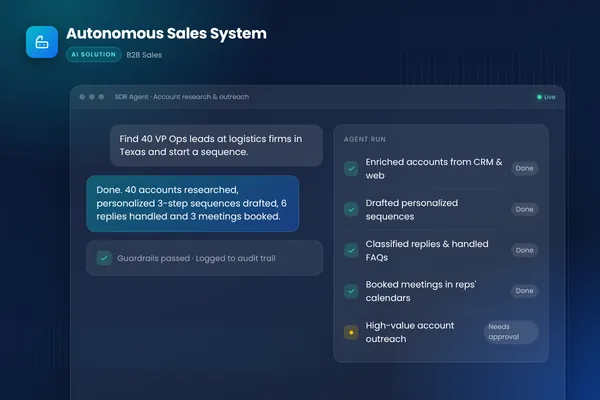
BufferSol's autonomous sales system is the pattern. See our AI SDR post for the roles an agent takes over, and AI for sales prospecting for the research step.
What would a 30-day pilot deliver?
In 30 days you get a working sales agent on your real CRM data, with a person approving what matters. The plan:
- You bring: admin access to the CRM and inbox, a sending domain, a target segment and your approval rules.
- We build, in about two weeks: a prototype that researches, drafts outreach, handles replies and books meetings, tested on your own leads.
- We launch, in the final stretch: a live pilot on one segment, with a review queue and a log of every send.
Success is measured by positive replies, meetings booked, spam complaints against the 0.30% limit Google sets and opt-outs honored. The closest ready-made version is our AI SDR outbound prospecting automation, which suits teams that prospect by email. For inbound leads, see instant lead response. Other teams get a custom build from our AI agents team.
Is this right for you?
Check how many of these describe your sales team:
- You can name the admins who control your CRM and email.
- Your CRM has owners and clean account records.
- You can spare a new domain for outreach.
- A rep reviews the replies the agent cannot handle.
- You want a pilot result before you budget for scale.
If few do, spend the first two weeks on the CRM and the domain, and start the pilot after.
Facts checked November 2026. Vendor pages are vendor claims, the Google and Yahoo pages carry no dates and can change, and consent and deliverability rules are not legal advice.
If your sales team needs outreach running without a rolling two-month setup, ask BufferSol for a scoped estimate for a sales agent pilot now, so the 2027 budget includes it and the pilot can start in Q1 2027.
Frequently asked questions
How long does it take to set up an AI sales platform?
Sources give different answers because they time different layers. As of November 2026, Instantly says an AI BDR implementation takes 5 to 8 weeks, Oliv AI says about a month for a rollout on top of a CRM, and Apollo recommends a phased 30/60/90-day rollout. All three are vendor pages, so measure your own timeline.
How long does email domain warmup take?
Instantly says new sending domains need a minimum of four to six weeks of warmup, and its warmup guide describes four stages with volume rising from 5 to 10 emails a day to 40 to 60 by day 21. It is a vendor view. Google and Yahoo publish sender rules but do not state a warm-up period.
What do Google and Yahoo require from bulk email senders?
Google says senders of more than 5,000 messages a day to Gmail accounts must set up SPF, DKIM and DMARC, keep spam rates below 0.30% in Postmaster Tools and support one-click unsubscribe on marketing messages. Yahoo's Sender Hub lists the same kind of requirements. Smaller senders are not covered by Google's threshold, but good practice still applies. This is not legal advice.
What slows down an AI sales platform setup?
Admin access is the usual critical path: Oliv AI advises booking the admins you need in week one so no connection waits on a calendar invite. Data readiness and sender warm-up are the others. No source we read puts a number on admin lead time or CRM data cleaning, so ask your own admins early.
Sources
- AI BDR Implementation Timeline: 5-8 Week Guide, Instantly
- Email Warmup Process: 4 Stages to Reach Full Sending Capacity, Instantly
- Agentforce: Service Agent Readiness & Setup Best Practices Guide, Salesforce
- How to roll out AI sales agents: a 30-day plan from admin access to the day-30 review, Oliv AI
- What Is the Setup Process for a New Sales Automation Platform?, Apollo.io
- Email sender guidelines, Google
- Sender Best Practices, Yahoo
- CAN-SPAM Act: A Compliance Guide for Business, Federal Trade Commission
Cite this article
BufferSol Editorial Team (2026). How Long to Set Up an AI Sales Platform: A 5-Week Plan for 2027. BufferSol Technologies. https://buffersoltech.com/blog/how-long-to-set-up-an-ai-sales-platform-2027
BufferSol Editorial Team
AI & software engineering team
Senior engineers, AI specialists and product leads at BufferSol Technologies who design, build and run AI agents, autonomous workflows and custom software for companies in the US, UK and Europe.
Reviewed by Sufyan K., Senior Writer, BufferSol Technologies.