Key takeaways
- Sales automation software runs predefined rules; an AI sales agent decides its own next step toward a goal. Anthropic (19 December 2024) draws the same line between workflows and agents.
- Apollo (31 March 2026) puts it as: 'automation removes manual steps. Agents replace manual thinking.'
- Agent pages describe a range of autonomy: Outreach says its agents 'can autonomously execute the work', while Salesforce says agents 'act within defined limits and hand off complex matters to human staff'.
- Test any 'agent' claim by sending replies the vendor did not script and reading what the tool decided and why.
- Pilot both on the same leads for 30 days before you commit a 2027 budget.
Sales automation software is a system that runs steps you define in advance, such as sending the next email in a sequence. An AI sales agent is given a goal and decides its own next step, such as researching an account, drafting a message and handling the reply. For 2027 budgets, the useful question is which of your sales steps are rules and which need judgment. We checked vendor pages in November 2026.
For the wider picture, read our AI sales platform guide. If you are shopping for tools, our post on the best AI SDR tools compares vendors.
1. Rules versus goals
The core difference is who decides the next step. According to Anthropic's "Building effective agents" (19 December 2024), "workflows are systems where LLMs and tools are orchestrated through predefined code paths," while "agents, on the other hand, are systems where LLMs dynamically direct their own processes and tool usage."
Apollo's article (31 March 2026) applies it to sales: "Sales automation is rule-based: if a prospect opens an email, enroll them in step 2." Its agents are "goal-based." Apollo adds: "A helpful way to think about it: automation removes manual steps. Agents replace manual thinking." HubSpot shows the middle ground, with "automated multi-channel outreach that adapts based on prospect engagement." Choose automation when you can write the rule. Choose an agent when the right step depends on context you cannot write down.
2. Who researches and writes the message
Automation fills a template; an agent builds the message. Apollo says agents, "given a target account, research the buyer, draft a personalized message." 11x says its agents "find the right accounts, research them like a rep would, and craft messages worthy of a response, across channels." Artisan says its agent "locates prospects and fills in their company details without manual research."
Outreach says its Revenue Agents take over "sequencing," so reps can spend their time on customer conversations. Test it by giving each tool the same ten accounts and comparing the first messages with what your best rep would write. Our post on AI sales outreach personalization shows what good looks like.
3. What happens when a reply arrives
Replies are where the two part ways. A sequence stops, tags or hands the reply to a person. Artisan says its agent "writes tailored messages, sends them, and handles the replies that come back," and then "books meetings." 11x says voice and chat agents "contact, qualify and book meetings like your best rep, 24/7, across multiple languages."
Salesforce says its sales development agent works around the clock, "autonomously answering product questions, handling objections, and booking meetings for sales reps." Send each tool three replies it was not scripted for: a "not now, try in March", a pricing question and a referral to a colleague. Read what it decided and the reason it logged.
4. How much it does without a person
Agent pages describe a range of autonomy, so ask what the human does. Outreach says its AI Agents "can autonomously execute the work." Salesforce's Agentforce page calls agents "autonomous, proactive applications designed to execute specialized tasks," and also says "the agents act within defined limits and hand off complex matters to human staff."
Neither page gives you a way to check the claim in a trial, so write your own rule: which messages need review, which leads are off limits, and when the agent hands off. Our guide to human-in-the-loop AI agents explains how to design it.
- 011. SendGive the tool three replies it was not scripted for.
- 022. WatchSee whether it chooses the next step or follows a fixed path.
- 033. ReadCheck the reason it logged for each decision.
- 044. LimitSet a rule it must not break and see whether it holds.
- 055. Hand offConfirm a person gets the case with full context.
Source: BufferSol process
BufferSol Technologies · buffersoltech.com
5. What data it needs
Both tools run on your CRM, and an agent also reads context. HubSpot's Sales Hub page says "sales automation and workflows automate repetitive tasks," and that its AI "analyzes conversation transcripts, emails, and deal history to suggest CRM updates." It also lists a Breeze Prospecting Agent (Beta), an AI agent that "learns from your best reps over time."
An agent is only as good as what it can read: deal history, transcripts and a clean CRM. If your data is thin or duplicated, fix that first. Our post on AI lead generation software covers data sources.
6. Predictability and who owns the risk
Rules are predictable; agents are flexible. According to Anthropic, "workflows offer predictability and consistency for well-defined tasks," while "agents are the better option when flexibility and model-driven decision-making are needed at scale."
BufferSol view: that trade-off decides who owns a mistake. A rules error is a bug in a sequence you can read. An agent error is a decision you need a log to explain, so the log and the limits matter more than the label. Outbound email and calls also fall under consent and marketing rules in your market. This is not legal advice; see our post on TCPA and AI calls for the US call rules.
What changes in 2027 for sales automation buyers?
No analyst forecast loaded for this post, so every forward claim is BufferSol view.
We expect vendors to keep relabelling sequence tools as agents, so the word will tell you little. Outreach already calls itself "the complete agentic AI platform purpose-built for revenue." A search result mentioned an analyst warning about "agent washing", but we could not open that page, so we do not rely on it. Check the claim yourself with the five-step test above, and put any budget for an agent behind a pilot in Q1 2027.
How do sales automation software and an AI sales agent compare?
| Question | Sales automation software | AI sales agent |
|---|---|---|
| Who decides the next step | Your rule | The agent, within limits |
| Message | Template with merge fields | Researched and drafted per account |
| Replies | Stops or hands to a person | Reads and decides the next action |
| Best for | Well-defined, repeatable steps | Judgment at volume |
| Main risk | Rules go stale | Decisions you must be able to explain |
Outreach says automated next steps can be triggered by signals, which "turns insight directly into action." Vendor pages did not state what either option costs, what data it needs or how long setup takes, so ask for those in writing. HubSpot's page showed prices that carried no date, so we do not quote them.
Which questions should you put to every vendor in writing?
Send the same list to each vendor and compare the answers, not the demos.
- What does the tool decide on its own? Ask for a list of decisions it makes without a person and the limits on each.
- How do I review messages? Ask whether you can approve the first batch and then sample, and where that setting lives.
- What does it log? Ask for one lead's full history, with the reason behind each step.
- What data does it read and write? Ask which CRM fields it changes and whether every change can be reversed.
- How are consent and opt-outs handled? Ask how a "stop" reply is detected and applied across channels.
- What does the quote include? Ask for seats, usage, setup and renewal terms in one annual figure.
Keep the answers beside your test results. The vendor that answers precisely is usually the one that will support you after you sign.
What does an AI sales agent not do?
An agent does not fix a weak offer, a poor lead list or a messy CRM. It does not remove the need for consent rules, and it should not talk to a high-value account without a person watching. Vendor pages are mostly undated marketing, we found no independent benchmark of meetings booked, and "autonomous" is the vendors' own word. Treat each claim as a question for the trial.
When does a custom AI sales agent beat sales automation software?
Choose automation software when your process is a clear set of rules and your current tools already run it. Choose a custom agent when the work needs judgment on your own data and you want the limits, logs and prompts in your environment, with no per-seat fees.
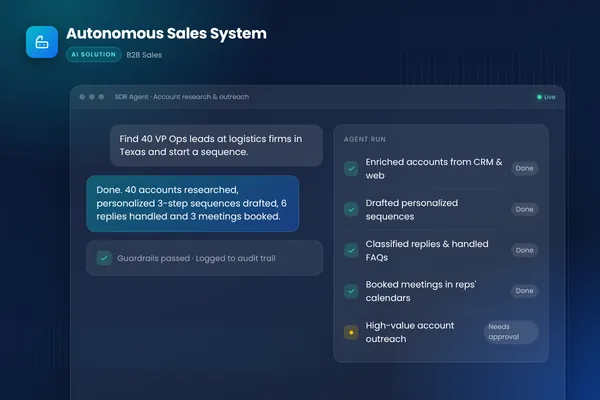
BufferSol's autonomous sales system shows the pattern: an agent researches leads, drafts outreach, handles replies and books meetings, with people approving where it matters. Our AI agents team builds it around your CRM. Our post on the AI SDR explains the role in more detail.
| Sales automation software | AI sales agent | |
|---|---|---|
| Choose it when | You can write the rule | The next step depends on context |
| You must watch | Stale rules and broken sequences | Decisions, limits and logs |
| First step | List which steps are rules | A 30-day pilot on the same leads |
BufferSol Technologies · buffersoltech.com
What would a 30-day pilot deliver?
A pilot is a working agent on your real leads inside 30 days.
- Week 1: you provide CRM access, a lead list, your offer and tone, your do-not-contact rules and who approves messages.
- Weeks 2 and 3: a prototype researches accounts, drafts messages and handles replies on a test slice, with a person approving each one.
- Week 4: a live pilot on a first slice of leads, running beside your existing sequences so you can compare.
Success is measured by meetings booked, replies handled correctly, leads wrongly contacted and hours your team saves. The ready-made version is our AI SDR outbound automation, built for sales teams that research and write every message by hand.
Is this right for you?
A pilot fits if most of these are true:
- Your sequences work but replies still wait for a person.
- Your reps spend hours researching accounts.
- Your CRM holds usable deal history.
- A named person can approve messages and set limits.
- You can compare results against your current sequences.
If none applies, tidy your sequences and CRM first. Our post on AI lead generation software is a good next step.
Facts checked November 2026. Most vendor pages carry no date, so re-check each one before you sign.
If your reps are researching and replying by hand, ask BufferSol for a scoped estimate for an AI sales agent, so the 2027 budget includes it and the pilot can start in Q1 2027.
Frequently asked questions
What is the difference between sales automation software and an AI sales agent?
Sales automation software runs rules you set, such as enrolling a prospect in step 2 when they open an email. An AI sales agent is given a goal and decides its own steps: researching the buyer, drafting a message and handling replies. Apollo's article puts it as automation removing manual steps while agents replace manual thinking.
Do I need an AI sales agent if I already have sales automation?
Not necessarily. Sales automation software handles well-defined, repeatable steps predictably, which is what Anthropic's guidance says workflows offer. An AI sales agent earns its place when the work needs judgment at volume, such as reading replies and choosing the next action. Start by listing which steps in your process are rules and which need a decision.
Can an AI sales agent send messages without human review?
Vendor pages differ. Artisan says its agent Ava writes tailored messages, sends them and handles the replies, while Salesforce says its agents act within defined limits and hand off complex matters to staff. Decide your own review rule: many teams review the first batch and sample the rest. Outbound consent rules apply to both tools and this is not legal advice.
How should I pilot sales automation software against an AI sales agent?
Run both on the same list of leads for 30 days with the same goal, such as booked meetings. Keep a human reviewing messages in week one, then sample. Compare meetings booked, replies handled correctly, leads wrongly contacted and hours spent by your team. A custom AI sales agent from BufferSol follows this plan on your CRM data.
Sources
- Building effective agents, Anthropic
- What's the Difference Between Sales Automation and Sales AI Agents?, Apollo.io
- Sales Software | HubSpot, HubSpot
- Agentforce: The AI Agent Platform | Salesforce, Salesforce
- What is Outreach? | Agentic AI Revenue Platform, Outreach
- Artisan: Hire Ava, the autonomous AI BDR, Artisan
- 11x: AI Agents for Outbound, Inbound & Expansion, 11x
Cite this article
BufferSol Editorial Team (2026). 6 Ways Sales Automation Software Differs From an AI Sales Agent, and Which Your Team Needs in 2027. BufferSol Technologies. https://buffersoltech.com/blog/sales-automation-vs-ai-sales-agent-2027
BufferSol Editorial Team
AI & software engineering team
Senior engineers, AI specialists and product leads at BufferSol Technologies who design, build and run AI agents, autonomous workflows and custom software for companies in the US, UK and Europe.
Reviewed by Sufyan K., Senior Writer, BufferSol Technologies.