Key takeaways
- Real personalization is a specific, sourced reason to contact this person now, tied to a problem they likely care about. A first name and company name are not personalization.
- Build every message from a research brief, so each hook can be checked by a rep.
- Keep a claims register: the agent may only state results, customers and features that are approved.
- Personalization helps engagement, but deliverability still depends on authentication, volume, complaints and easy unsubscribes.
- Review drafts with reps first, measure replies by segment, and raise volume only when quality holds.
AI sales outreach personalization works when each message gives the reader a specific, sourced reason it was written to them now, connects that reason to a problem they likely care about, and asks for a small next step. A first name and a company name dropped into a template is not personalization, and readers can tell. The AI's job is to research, draft from that research, and stay inside rules about what it may claim; deliverability still depends on how you send.
This post covers what real personalization looks like, how to build messages from a research brief, how to stop the AI from making claims it should not, and how to scale without hurting your sending reputation. For the full outbound system, see our AI sales platform guide.
Token personalization vs real personalization
| Token personalization | Real personalization |
|---|---|
| "Hi Sam, I see you work at Acme" | "Acme opened a second warehouse in Leeds last month" |
| Compliments on the company's website | A specific trigger with a source a rep can check |
| The same pitch to every role | The problem this role is most likely to own |
| A long product description | One relevant outcome, stated carefully |
| "Do you have 30 minutes?" | A small, specific next step |
The difference is research. A message can only be specific if someone, or something, found a fact worth mentioning.
Build every message from a brief
In the autonomous sales system we built, the work is split: a research agent writes a brief per prospect (company signals, role, recent news, likely priorities), and a separate writing agent drafts sequences in the company's voice from that brief. Keeping them apart means each brief can be checked on its own, and the writer only uses what the brief contains.
A simple structure for each first message, built from the brief:
- 011. The reasonOne sourced fact from the brief that makes this message timely.
- 022. The connectionWhy that fact likely matters to this person's role.
- 033. The relevanceOne approved, specific way you help with that problem.
- 044. The askA small next step, such as a short call or a useful resource.
Source: BufferSol recommended practice for writing agents
BufferSol Technologies · buffersoltech.com
Keep it short. Each part is a sentence or two. If the brief has no good reason to write, the right answer is to skip that contact for now, not to invent one.
An illustrative example
Here is how the four parts fit together for an invented prospect: an operations director at a distribution company whose brief notes a new warehouse opening, sourced to the company's own news page.
"Hi Priya, I saw on your news page that the Leeds warehouse opened in October. A second site usually means two sets of supplier invoices and receipts to match. We build AI workflows that read supplier invoices and match them to purchase orders and goods receipts before they reach an approver. Would a 15-minute call next week be useful to see if that fits your setup?"
Every sentence maps to the brief or the claims register: the fact has a source, the connection is a reasonable inference stated as one, and the capability is described the way an approved claim describes it. Nothing is promised about savings or speed that has not been approved.
Follow-ups that add something
Most sequences include follow-ups, and that is where AI outreach often becomes repetitive. A useful follow-up adds something new: a second relevant fact from the brief, a short resource that helps with the problem, or a different angle for a different likely priority. "Just bumping this to the top of your inbox" adds nothing and invites a complaint.
Give the writing agent a plan for the sequence: what each step adds, how many steps there are, and when it stops. Stop the sequence as soon as the person replies, opts out or becomes an opportunity in the CRM. Spacing matters too: leave enough days between steps that each message has a chance to be read, and never send the next step to someone who has already answered.
A claims register keeps the agent honest
Writing agents will happily claim results, name customers or promise features if nothing stops them. Keep a claims register: a short, approved list of what the agent may say about outcomes, customers, integrations and pricing, with the wording for each. Instruct the agent to say nothing outside it, and check every draft against it before sending.
This is the same idea as giving an agent clear instructions and limits. Anthropic's Building effective agents recommends investing in clear tool documentation and instructions, and OpenAI's practical guide to building agents recommends guardrails that check outputs before they reach the outside world. A claims check on every draft is one of those guardrails.
Variety without spam signals
Personalization changes the opening of each message, but filters judge the sender as well as the words. Google's email sender guidelines ask all senders to authenticate with SPF or DKIM and to keep reported spam rates in Postmaster Tools below 0.3%, recommending staying below 0.1%. Bulk senders face stricter requirements, including DMARC and one-click unsubscribe for marketing messages.
Practical rules for AI-written outreach:
- Vary content because the facts vary, not by spinning synonyms. Each message should differ because its reason to write differs.
- Keep formatting plain. Short text, few links, no heavy images.
- Ramp volume slowly on new mailboxes and cap sends per mailbox per day.
- Make opting out easy and honor it at once. The FTC's CAN-SPAM guide requires a clear opt-out and accurate headers for commercial email, with no exception for business-to-business messages.
- Pause automatically if complaints or bounces rise.
Review before you scale
Start with reps reviewing every draft for one segment they know well. Their edits teach the writing agent your voice, and they catch weak reasons and stretched claims. Look for patterns: if reps keep deleting the same kind of opening, change the instruction rather than fixing each draft.
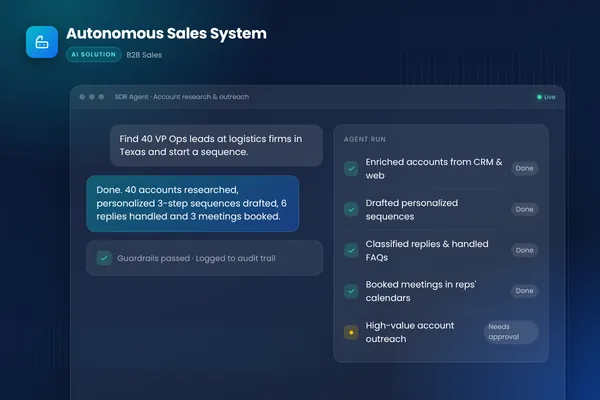
Once edits are rare, move lower-value accounts to a weekly sample and keep high-value accounts on full review. Our autonomous sales system requires human approval for high-value accounts before anything is sent, alongside rate limits on every send.
What to measure
Track reply rate and positive reply rate by segment and by type of reason used, the share of drafts reps send unedited, unsupported claims caught by the check, unsubscribe and complaint rates, and meetings booked. Compare reasons: if "new location" hooks earn replies and "recent funding" hooks do not, adjust the brief template.
Common mistakes
- Personalizing the greeting, not the reason. The first line should earn the second.
- Over-long research paragraphs. One sourced fact beats five.
- Unsupported claims. Anything not in the claims register comes out.
- Scaling before quality is proven. Volume multiplies whatever is wrong with the drafts.
- Ignoring replies that say "not now". Log the timing and follow up when it was suggested.
Getting started
Pick one segment, write the brief template and the claims register with your best reps, and collect five emails they consider excellent. At BufferSol, you get working research and writing agents on your real accounts in under 30 days, with full rollout typically in 4 to 8 weeks. Our AI agents team builds the agents, and our autonomous workflows team connects them to your CRM and inboxes. For what happens after the first email, see our post on what an AI SDR does day to day.
Frequently asked questions
What is AI sales outreach personalization?
It is using AI to tailor sales emails or messages to each recipient: referencing something specific and relevant about their company or role, connecting it to a problem they are likely to have, and proposing a sensible next step. Good systems base each message on a sourced research brief and limit what the AI may claim.
Does AI personalization stop emails going to spam?
Not on its own. Spam filtering depends heavily on sender reputation: authentication, sending volume, complaint rates and unsubscribe handling. Google's sender guidelines ask all senders to keep reported spam rates below 0.3%. Relevant, well-targeted messages help keep complaints low, but they cannot fix an unauthenticated domain or a sudden spike in volume.
How do you stop an AI from making things up in sales emails?
Give it a research brief with sources and a claims register listing what it may say about your results, customers and product. Tell it to leave out anything not in either. Have reps review drafts at first, and check every draft for unsupported claims before it is sent.
Sources
- Email sender guidelines, Google Workspace Admin Help
- CAN-SPAM Act: A Compliance Guide for Business, Federal Trade Commission
- Building effective agents, Anthropic
- A practical guide to building agents, OpenAI
Cite this article
BufferSol Editorial Team (2026). AI Sales Outreach Personalization: Emails That Get Read, Not Flagged as Spam. BufferSol Technologies. https://buffersoltech.com/blog/ai-sales-outreach-personalization
BufferSol Editorial Team
AI & software engineering team
Senior engineers, AI specialists and product leads at BufferSol Technologies who design, build and run AI agents, autonomous workflows and custom software for companies in the US, UK and Europe.
Reviewed by Sufyan K., Senior Writer, BufferSol Technologies.