Key takeaways
- An account brief is a one-page summary of a target company and contact: what changed, who matters, likely priorities and one reason to reach out, with a source on every line.
- Agents are fast at gathering and summarizing public signals. Reps stay in charge of judgment: which accounts matter and which hooks are worth using.
- Rank sources in tiers. Company-owned pages and filings come first, news second, and anything unverifiable is left out.
- Brief accuracy is checkable: every fact needs a link, a date and a rule for what happens when sources disagree or are missing.
- Research on named people is personal data. In the UK and EU, that can trigger notice duties within one month, or at the first message.
AI for sales prospecting means an agent does the research that comes before outreach: it reads public sources about a target company, pulls out timely signals, and writes a short account brief that a rep can check in two minutes. It works when every line of the brief has a source and a date. It fails when the agent is allowed to guess. The result is a better decision about who to contact and why, not an automatic send.
This post shows how that brief is built, what goes in it, how to rank sources, how to check accuracy, and what the data rules require. For the whole outbound system, see our AI sales platform guide.
Why research is the first thing to automate
Research is slow, repetitive and easy to skip, which is why so much outreach ends up generic. Salesforce's State of Sales survey of 7,775 sales professionals (fieldwork in August and September 2022) found reps spend just 28% of their week selling, with the rest going to tasks such as deal management and data entry. The survey does not measure research time alone, so we will not claim a number for it. The point is simpler: any hour not spent on the work that needs a human is worth reclaiming.
Research suits an agent because the steps are well defined: look in known places, read, extract, summarize. Anthropic's guide to building effective agents describes this kind of task split into independent subtasks run in parallel, and advises finding "the simplest solution possible" before adding autonomy. A research brief is a good first job: a bad one costs a rep a minute, not a customer.
What goes in an account brief?
Keep it to one page. If a rep cannot scan it before a call, it is a report, not a brief.
| Section | What it contains | Required source |
|---|---|---|
| Company snapshot | What they sell, size band, locations, customers they name publicly | Company website, filings |
| What changed | New location, product, hire, funding, leadership change, regulation | News item or company page with date |
| Who matters | Role of the contact, likely owner of the problem, others involved | Company team page, public profile |
| Likely priorities | Two or three problems this role probably owns, labelled as inference | Reasoned from the facts above |
| Reason to reach out | One timely, sourced hook | Linked fact from "What changed" |
| Do not mention | Sensitive or unverified items to leave out | Agent's own flags |
| Gaps | What the agent looked for and did not find | None |
The "gaps" row matters most for trust. A brief that says "no recent news found" is more useful than one that fills the space.
The research workflow, step by step
- 011. Start from a target accountThe agent receives an account from your approved list, with the ideal customer profile and any CRM history.
- 022. Gather from ranked sourcesIt reads the company's own pages first, then dated news, and records each URL and date.
- 033. Extract signalsIt pulls out what changed, who owns the problem and any conflicts with CRM data.
- 044. Write the briefIt fills the template, labels inferences, and writes 'not found' for gaps.
- 055. Check and scoreA second pass confirms each line has a source, then scores fit against your criteria.
- 066. Hand to a repA rep approves, edits or skips the account. Only approved briefs reach the writing step.
Source: BufferSol recommended practice for research agents
BufferSol Technologies · buffersoltech.com
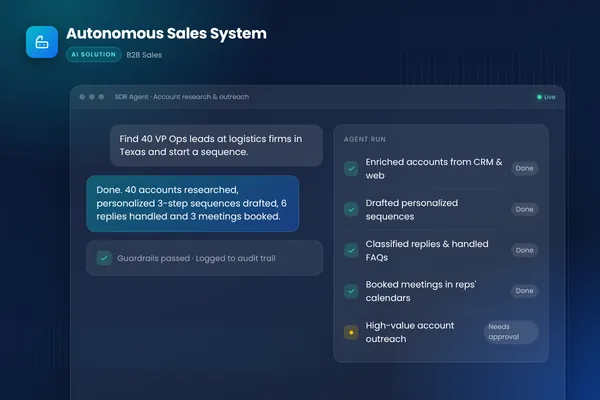
In the autonomous sales system we built, a research agent enriches each account from public sources and the CRM, builds the brief, and passes it to a separate writing agent. Keeping those two jobs apart means each brief can be inspected on its own, and the writer can only use facts that made it into the brief. High-value accounts require human approval before anything is sent.
Rank your sources in tiers
Not all web pages are equally trustworthy, and an agent will treat them equally unless you tell it not to. A simple three-tier ranking works:
- Tier 1, company-owned and official. The company's website, press page, careers page, public filings and registers. Use freely, with the date.
- Tier 2, dated third-party reporting. Trade press and news from named outlets. Use when the item is dated and links to a page the agent actually read.
- Tier 3, unverifiable. Anonymous posts, scraped aggregator data with no source, and anything the agent cannot open. Leave it out.
When tiers disagree, prefer the higher tier and note the conflict. When the CRM disagrees with the web, flag it for a rep rather than overwriting either.
Also set clear limits on where the agent may look. Respect each site's terms and robots rules, and skip anything behind a login. A rule written down once is cheaper than a complaint later.
A two-minute accuracy check
A rep reviewing a brief should be able to answer these questions quickly:
- Does every line have a link and a date?
- Do the three most important links open and say what the brief claims?
- Is the contact still in that role, according to a tier 1 source?
- Is the "reason to reach out" a fact, not an inference dressed as one?
- Are inferences labelled as inferences?
- Is anything sensitive, such as health, family or finances of a named person, included? If so, remove it.
Run the same checks on a weekly random sample once reps trust the system. Track the share of briefs with at least one wrong fact, the share reps skip as irrelevant, and the share of approved briefs that lead to a reply. If wrong facts appear, change the source rules, not just the one brief.
Personalization hooks that come from a brief
The brief exists to give outreach a real reason to write. Good hooks are specific, recent and checkable: a new office, a product launch, a hiring pattern that suggests a project, a regulation that affects their sector. Weak hooks are compliments and generic "I saw your website" lines.
Use the "likely priorities" section to connect the hook to a problem, and let the rep decide whether the angle fits. If you want to see how a brief becomes a message, read our post on AI sales outreach personalization. For what happens after the first message, see what an AI SDR does day to day.
Data rules for researching named people
Researching a company is straightforward. Researching a named person is processing personal data, even when every source is public. In the UK and EU that brings obligations. Under Article 14 of the GDPR, when you obtain personal data from somewhere other than the person, you generally need to provide information such as who you are, the purposes and legal basis, the source of the data and the person's rights. It must be given within a reasonable period and at most one month, or at the latest when you first communicate with them. There are exemptions, for example where the person already has the information.
Practical consequences for a prospecting agent:
- Keep personal data in briefs to what the outreach needs, mainly role and business context.
- Record the source of each item about a person, so you can state it.
- Put the required information in your first message or a linked privacy notice.
- Honor objections and deletion requests at once, and keep a suppression list.
- Keep data inside systems your contracts cover, and check where your AI provider processes it.
Rules differ by country and by who you are contacting, so get advice from your own counsel. This is not legal advice.
Where research agents go wrong
- Stale facts. A "new" product from two years ago is not a hook. Require dates and set a freshness window.
- Confusing similar companies. Same name, different firm. Require a match on domain or registration details before accepting a source.
- Inference stated as fact. "They are struggling with X" is not something a web page told you.
- Too much detail. Five facts dilute the one that matters. Cap the brief length.
- No feedback loop. If reps never mark why they skipped a brief, the system cannot improve.
What a 30-day pilot delivers
At BufferSol, the pilot starts with one segment and a list of accounts your reps already know well. Within about two weeks we aim to have a working research agent producing briefs on your real accounts, with your template and source rules. The remaining weeks are a live pilot on a first slice of the work: reps review every brief, we measure accuracy and usefulness, and tune the rules from their edits. Full rollout and wider coverage come after, once quality holds. Our AI agents team builds the agents, and our autonomous workflows team connects them to your CRM.
If you would rather not build and run it yourself, our done-for-you AI SDR outbound automation covers research, writing and meeting booking on your own tools.
Getting started
Pick one segment and 50 accounts your best rep knows well. Write the brief template and source tiers together, run the agent on those accounts, and have the rep mark every line right or wrong. That sample will tell you more about readiness than any demo.
Frequently asked questions
What is AI for sales prospecting?
It is using AI agents to do the research that comes before outreach: finding target accounts, reading public sources, spotting timely signals and writing a short brief per account. A rep then uses the brief to decide whether and how to reach out. The agent speeds up gathering and summarizing; people keep decisions about targeting and messaging.
How long does AI account research take?
An agent can usually assemble a brief from public sources in minutes rather than the hours a rep might spend, depending on how many sources it reads and how much checking you require. The time you save is real, but a brief that skips verification is not worth having, so build the checks in before chasing speed.
Is it legal to research prospects with AI?
Researching companies is generally low risk. Researching named individuals is processing of personal data, so UK GDPR and EU GDPR apply: you need a lawful basis and, under Article 14, usually must tell people where their data came from, at the latest in your first message. Check with your own counsel; this is not legal advice.
How do you stop an AI from making up facts in a brief?
Require a source URL and date for every line, reject any line without one, and have the agent write 'not found' instead of guessing. Then spot-check a sample each week. Keeping research and writing as separate steps also helps, because the writer can only use facts that survived the brief.
Sources
Cite this article
BufferSol Editorial Team (2026). AI for Sales Prospecting: How an Agent Builds a Sourced Account Brief in Minutes. BufferSol Technologies. https://buffersoltech.com/blog/ai-for-sales-prospecting
BufferSol Editorial Team
AI & software engineering team
Senior engineers, AI specialists and product leads at BufferSol Technologies who design, build and run AI agents, autonomous workflows and custom software for companies in the US, UK and Europe.
Reviewed by Sufyan K., Senior Writer, BufferSol Technologies.