Key takeaways
- AI lead generation uses agents to spot buying signals, build target lists, enrich records, score fit and timing, and route qualified leads to reps or outreach.
- Keep fit and timing as separate scores: fit says whether an account could buy, timing says whether now is a good moment.
- Every fact an agent adds to a lead should carry its source, and unknowns should stay unknown rather than be guessed.
- Data rules come first: lawful basis for personal data in the UK and EU, CAN-SPAM for US email, and the terms of every platform you take data from.
- Reps should see why each lead was scored the way it was, and their feedback should change the scoring.
AI lead generation uses AI agents to find and qualify potential customers. An agent watches for signals that an account may need what you sell, builds a list that matches your ideal customer profile, enriches each record from approved sources and your CRM, scores it for fit and timing, and routes the best leads to a rep or to outreach. Reps get fewer, better leads, each with a short explanation of why it is worth their time.
This post covers the five steps of AI lead generation, the checks each step needs, how to design scoring that reps trust, and the data rules to follow. It focuses on the work before the first email. For outreach, replies, deliverability and booking, see our AI sales platform guide.
The five steps of AI lead generation
- 011. SignalsWatch approved sources for events that suggest a need: hiring, funding, expansion, new tools, inbound visits.
- 022. List buildingFind accounts and roles that match the ideal customer profile; apply exclusions first.
- 033. EnrichmentAdd firmographics, roles and context from approved sources and the CRM, with a source for every fact.
- 044. ScoringScore fit and timing separately, with the reasons written out.
- 055. RoutingSend top leads to reps or outreach, park the rest for later, log everything in the CRM.
Source: BufferSol autonomous sales system
BufferSol Technologies · buffersoltech.com
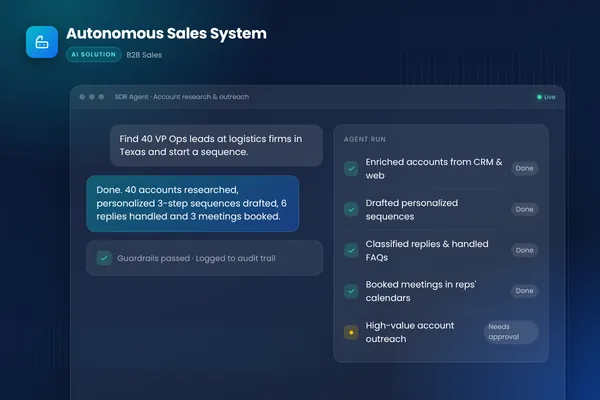
In the autonomous sales system we built for a B2B sales team, a research agent does much of this work: it enriches each account from public sources and the CRM and builds a brief covering company signals, the contact's role, recent news and likely priorities. Before that system, reps spent most of the week on manual prospecting, building lists and researching accounts, and had little time left for conversations.
1. Signals
A signal is an event that makes an account more likely to need you now. Which signals matter depends on what you sell: a company hiring for a role your product supports, opening a new office, announcing funding, adopting a tool you integrate with, or visiting your pricing page. Write the list with your best reps, and for each signal note why it matters and how long it stays relevant. A funding announcement from last week is a reason to call; one from two years ago is not.
2. List building
The agent turns your ideal customer profile into a list: industries, size bands, regions and the roles you sell to. Exclusions come first and are enforced in code: current customers, open opportunities owned by a rep, competitors, people who have opted out and any markets you do not serve. Doing this before research saves money and prevents the most embarrassing mistakes.
3. Enrichment
Enrichment adds the facts a rep or a writing agent needs: what the company does, its size band, the contact's role and team, recent news and the signal that triggered the lead. Two rules keep it trustworthy. Every fact carries a source link, so a rep can check it in seconds. And the agent writes "unknown" instead of guessing; a confident wrong fact in a first email does more damage than a gap.
4. Scoring
Scoring decides who gets a rep's time. The design matters enough to have its own section below.
5. Routing
Top leads go to the right rep, by territory or account owner, or into an outreach sequence. Leads that fit but are not ready are parked with a reminder date. Everything is logged in the CRM, so nobody researches the same account twice and leadership can see what the agent produced.
Scoring that reps trust
The most common failure in lead scoring is a single number nobody can explain. Reps ignore it, and the work upstream is wasted. A better design keeps two scores and shows its reasons.
| Score | What it answers | Typical inputs |
|---|---|---|
| Fit | Could this account buy from us at all? | Industry, size band, region, tech stack, the roles present |
| Timing | Is now a good moment to reach out? | Recent signals and how fresh they are, inbound activity, past conversations |
An account with strong fit and strong timing goes to a rep today. Strong fit and weak timing is parked and watched. Weak fit is dropped, however strong the timing looks. Keeping the two apart stops a noisy signal, such as a viral press release, from pushing a poor-fit account to the top.
Show the reasons in plain words next to each score: "Fit: mid-size logistics firm in the UK, uses the ERP we integrate with. Timing: hiring two AP clerks this month." Reps can check those reasons in a glance, and when they disagree, their feedback should change the rules. Review a sample of scored leads with reps every week during the first month.
Plain rules handle most of fit. The agent adds value where judgment is needed: reading a job post, a press release or a company page and deciding whether it really signals a need for your offer. OpenAI's practical guide to building agents points to exactly this kind of task, decisions that need nuanced judgment or unstructured data, as where agents beat rule-based systems.
Data rules come first
Lead generation handles personal data about real people, and the rules apply whether a person or an agent collects it. Check each market with legal counsel; this is a starting checklist, not legal advice.
UK and EU personal data. Names, work emails and job titles of people at companies are personal data. Many B2B teams rely on legitimate interests. The ICO's guidance on when you can rely on legitimate interests says you must do a three-part test: identify the purpose and why it is a legitimate interest, show the processing is necessary, and balance your interests against those of the person. It also notes that electronic marketing which needs consent under PECR cannot rely on legitimate interests. Keep research proportionate and record your assessment.
US email. The FTC's CAN-SPAM compliance guide makes no exception for business-to-business email: accurate headers, honest subject lines, a postal address and a working opt-out are required.
Platform terms. Where data comes from matters as much as what it is. LinkedIn's user agreement prohibits using software, scripts or robots to scrape or copy the service, including profiles. Use data providers and APIs that license the data for your use, and keep a record of where each field came from.
Opt-outs and retention. When someone objects or opts out, suppress them everywhere, including in future list builds. Delete research on leads you are not pursuing after a set period.
Where people stay in control
Lead generation is lower risk than sending email, because nothing reaches a prospect until outreach starts. People still need a few control points:
- Sales leadership owns the ideal customer profile, the signal list and the exclusions.
- Reps review scored leads during the pilot and give weekly feedback.
- Any change to scoring rules is tested on past leads before it goes live.
- High-value accounts go to a named rep, not straight into automated outreach.
For more on placing these checkpoints, see human-in-the-loop AI agents.
How to measure it
Track what happens to the leads, not just how many there are: share of routed leads reps accept, meetings booked and held from agent-sourced leads, time reps spend on research before and after, CRM completeness for new accounts, and opt-out and complaint rates once outreach starts. Compare against a segment worked the old way during the pilot.
Getting started
Write down your ideal customer profile, ten signals your best reps act on and your exclusion rules, then pick one segment. An agent can research and score that segment on real accounts within the first two weeks, with reps reviewing every lead. Our AI agents team builds the research and scoring agents, and our autonomous workflows team connects them to your CRM and data sources.
Frequently asked questions
What is AI lead generation?
AI lead generation is the use of AI agents to find and qualify potential customers. Agents watch for buying signals, build lists that match your ideal customer profile, enrich each record with facts from approved sources and the CRM, score each account for fit and timing, and route the best leads to reps or to outreach, with every step logged.
Is it legal to use AI to collect B2B leads?
It can be, if the data and its use follow the rules. In the UK and EU, contact details of individuals at companies are personal data, so you need a lawful basis such as legitimate interests, which the ICO says requires a three-part test. US commercial email follows CAN-SPAM. Platform terms also apply: LinkedIn's user agreement prohibits scraping. Get legal advice for your markets.
How is AI lead scoring different from traditional lead scoring?
Traditional scoring adds points for fixed attributes and actions, such as company size or a page visit. An AI agent can also read unstructured information, such as a job post, a press release or a reply, and explain why it matters for your offer. The best designs keep the scoring rules visible and let reps correct them.
Sources
- When can we rely on legitimate interests?, Information Commissioner's Office
- CAN-SPAM Act: A Compliance Guide for Business, Federal Trade Commission
- User Agreement, LinkedIn
- A practical guide to building agents, OpenAI
Cite this article
BufferSol Editorial Team (2026). AI Lead Generation: How AI Agents Find and Qualify B2B Leads. BufferSol Technologies. https://buffersoltech.com/blog/ai-lead-generation
BufferSol Editorial Team
AI & software engineering team
Senior engineers, AI specialists and product leads at BufferSol Technologies who design, build and run AI agents, autonomous workflows and custom software for companies in the US, UK and Europe.
Reviewed by Sufyan K., Senior Writer, BufferSol Technologies.