Key takeaways
- Speed to lead is the time between a person asking for contact and a reply; an agent can catch the form, call or message, qualify, book and route within a minute, but vendors' 'under a minute' claims are untested.
- The most quoted statistic is misread: Megabite says the 2007 Lead Response Management study measured the odds of making contact (100 times at 5 minutes versus 30) and 'did not measure close rates at all'.
- The Harvard Business Review page we opened says 'most companies are not responding nearly fast enough' and shows no response-time figures; the 42-hour and 37% numbers appear only on secondary pages.
- The FCC's February 2024 ruling confirms that the TCPA's restrictions on 'artificial or prerecorded voice' encompass current AI technologies that generate human voices, and 47 CFR 64.1200 requires prior express written consent for many marketing calls.
- Nothing we opened describes where a person approves an AI first contact, so the safe design is BufferSol view: people approve the script, consent wording and routing rules, and the agent follows them.
Speed to lead is the time between a prospect asking to hear from you and your first real reply. An AI agent can catch the form, call or message, ask your qualifying questions, book a meeting and route the lead, all inside a minute. This 2027 guide gives seven use cases, plus the consent rules, using sources read in November 2026.
For the wider picture, read our AI sales platform guide. For the qualification step, see our AI lead qualification post.
What does the research on lead response time actually say?
It says less than most posts claim. The Harvard Business Review page, The Short Life of Online Sales Leads (March 2011), says "Our research shows that most companies are not responding nearly fast enough." The page text we opened shows no response-time figures, so we do not attribute any number to it.
The widely repeated numbers sit on secondary pages. Nurture247 (April 2026), a sales-AI vendor, says "In a Harvard Business Review audit of 2,241 U.S. companies, the average first response to a web lead took 42 hours" and "23% of companies never responded at all." Megabite (August 2026), another vendor blog, reports the same audit as 37% responding within an hour and 42 hours as the average among companies that replied within 30 days. We cannot confirm either from HBR itself, so read them as secondary readings.
The older study is a different thing. Megabite says it "examined three years of data covering six companies, more than 15,000 web-generated leads and over 100,000 call attempts", found a "100× drop in the odds of making contact, calling at 30 minutes rather than 5" and a "21× drop in the odds of qualifying the lead across the same interval", and "did not measure close rates at all." The table sets the claims against what the pages support.
| Common claim | What the opened pages say | Verdict |
|---|---|---|
| "5-minute reply makes you 100 times more likely to convert" | Megabite: the study measured contact odds, not close rates | Misreading |
| "Average first response is 42 hours" | Nurture247 and Megabite report it; the HBR page we opened shows no figure | Secondary only |
| "23% of companies never replied" | Nurture247 and Megabite report it | Secondary only |
| "Odds of contact fall sharply after 5 minutes" | Megabite: 100 times at 30 minutes versus 5 | Supported as contact odds |
Source: Megabite, 'Lead response time: what the research actually says', August 2026. A vendor's reading of the study; we did not open the original paper.
BufferSol Technologies · buffersoltech.com
The honest takeaway: faster contact helps you reach and qualify leads, and no opened page proves it raises close rates. Our how long to set up an AI sales platform post uses the same standard of proof.
How does a speed-to-lead agent work from form to meeting?
It follows five steps: capture, qualify, book, route and sync. Harmony.ai says "We listen to your form endpoint, CRM webhook, or lead-source feed and dial out within seconds of submission", runs "your qualifying questions, disclosures, and rebuttals - same script, every call, 24/7", books warm leads onto a rep's calendar, and syncs the "Transcript, recording, disposition, and next action" to the CRM.
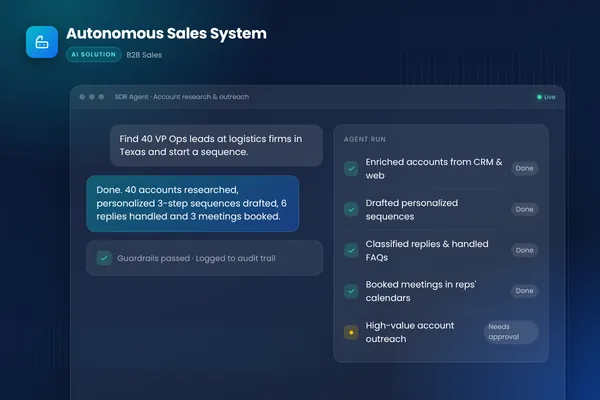
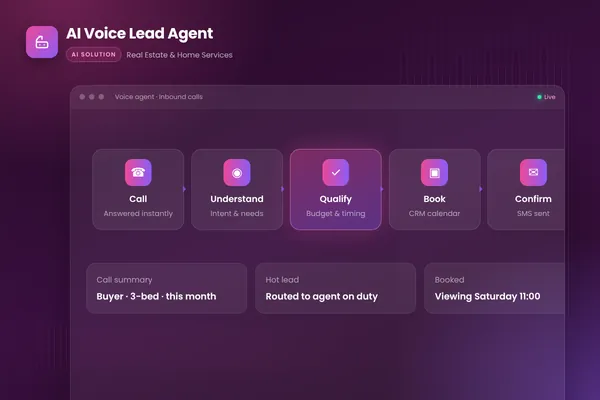
That page is product marketing, so its speed claims are the vendor's own. Harmony.ai also says it uses its own model "with a sub-200ms median response", which we could not test. BufferSol built a similar capture-qualify-book flow in its autonomous sales system case study and a voice version in its AI voice lead agent case study.
- 011 CaptureListen to the form, CRM webhook or lead feed
- 022 First touchCall, text or email within seconds, with the right disclosures
- 033 QualifyAsk your questions in your script
- 044 Book or routeBook a calendar slot or hand a hot lead to a live rep
- 055 SyncWrite transcript, outcome and next action to the CRM
BufferSol Technologies · buffersoltech.com
The seven use cases below are the parts you can build one at a time. Each one says what it does, what the opened sources show, and when to choose it.
1. Can a form submission trigger a call within seconds?
Yes, technically, and it is the core of speed to lead. A webhook from the form starts the first touch. Harmony.ai says it dials "within seconds of submission", and Twilio (October 2026) shows how a developer wires a voice agent to a phone number: "Under Voice Configuration, set "A call comes in" to Webhook".
The Twilio tutorial is mainly about inbound calls, and it has a section on placing outbound calls through voiceChannel.initiateOutboundConversation. It does not show a form-to-call flow end to end, so that build is yours to design. Calling a form lead raises the consent question covered in use case 6. Choose it if your leads expect a call and you can show consent on the form. Skip it if your form has no calling consent. Our AI outbound calls post covers the voice side.
2. Should the first touch be a text or email instead of a call?
Often, yes, because the rules and the buyer's habits differ by channel. For email, the FTC's CAN-SPAM guide (August 2023, edited January 2024) says "Your message must include a clear and conspicuous explanation of how the recipient can opt out of getting marketing email from you in the future." It also says "You must honor a recipient's opt-out request within 10 business days."
The same FTC page says "The law makes no exception for business-to-business email", so a B2B lead does not escape the rule. It sets a penalty of "up to $53,088" per violating email. CAN-SPAM covers email; calls and texts fall under different rules, covered below. Choose it if the lead gave an email and not a phone number. Skip it if the message would be unsolicited marketing. Our AI email automation post and AI sales outreach personalization post show how to keep each message specific.
3. Can the agent qualify the lead in your own words?
It can, if you write the script. Harmony.ai says its agent "Runs your qualifying questions, disclosures, and rebuttals - same script, every call, 24/7." The value of a script is that every lead hears the same questions, so the answers are comparable in the CRM.
The research tells you what qualification buys you. Megabite reports a "21× drop in the odds of qualifying the lead" when the call came at 30 minutes instead of 5, as part of the older study, and Nurture247 repeats the contact-odds finding. Both are vendor readings. Keep the question list short (three to five), as BufferSol view, and have a person approve it. Choose it if reps waste time on poor-fit leads. Skip it if every lead is already pre-qualified. See our AI lead generation software post and AI sales prospecting post.
4. Can the agent book the right rep's calendar?
Yes, and routing by owner is the part teams often skip. Calendly says Routing "allows you to qualify, route, and schedule meetings instantly from your website" and can "Automatically route based on real-time Salesforce or HubSpot ownership". The plan limits matter: "Calendly Routing is available on Teams and Enterprise plans" and "Only Enterprise customers have access to the Salesforce lookup."
That page is dated March 2023, so check current plan rules before you buy. It also says nothing about AI. Choose it if each lead already has an owner in the CRM. Skip it if your team shares leads and nobody owns one. Our AI meeting booking agent post covers calendar rules in depth, and our AI appointment setter post covers the booking conversation.
5. Should the lead rotate between reps?
When no owner exists, rotation spreads the work. HubSpot (page updated October 2026) says "A Sales Hub Professional or Enterprise subscription is required to assign and rotate leads or deals using workflows", and defines round robin as "assign records in a rotating, sequential order." The page labels lead and deal assignment "(BETA)".
Two details are easy to miss. For leads, "you'll need to turn off the Sync lead owner with contact or company owner setting." And when owners are added or removed after the workflow is on, "The assignment counts for that action will reset and the random assignments will start again." We did not open Salesforce's equivalent, so we say nothing about it. Choose it if you run HubSpot Sales Hub Professional or higher and need fair rotation. Skip it if territory or account rules decide ownership. Our CRM data automation post covers the owner field.
6. What do you need before an AI agent calls or texts a lead?
You need documented consent, and you need to know which rule applies. Paragraph (a)(2) of 47 CFR 64.1200 covers any telephone call that "includes or introduces an advertisement or constitutes telemarketing, using an automatic telephone dialing system or an artificial or prerecorded voice" to the listed kinds of numbers, "other than a call made with the prior express written consent of the called party".
The FCC's declaratory ruling, FCC 24-17 (adopted February 2, 2024), says "we confirm that the TCPA's restrictions on the use of "artificial or prerecorded voice" encompass current AI technologies that generate human voices." Revocation is covered too: requests to revoke consent "made in any reasonable manner" must be honored "within a reasonable time not to exceed ten business days from receipt of such request" under the same rule. Plura, an AI voice vendor, adds "Consent remains valid until the consumer revokes it by any reasonable means", as a secondary reading.
What we could not verify: whether a web-form submission counts as consent for a call or text. Plura does not say, and Harmony.ai says "your counsel confirms the rules for your use case". This is not legal advice. Write the consent wording on the form, store it with the lead, and ask counsel before you launch. Our TCPA and AI calls post goes deeper, and our AI voice agents guide covers the channel.
| Channel | Rule we opened | What it asks of you |
|---|---|---|
| Call with artificial or AI voice | 47 CFR 64.1200, FCC 24-17 | Prior express written consent for marketing calls to listed numbers |
| Revoking consent | 47 CFR 64.1200 | Honor within a reasonable time, up to ten business days |
| Marketing email | FTC CAN-SPAM guide | Opt-out explanation; honor within 10 business days |
| Form as consent | Not verified in any opened page | Ask counsel |
7. Can the record sync, and can a person take over a hot lead?
Both, and the hand-off is where deals are won or lost. Harmony.ai says "Hot leads warm-transfer live to an available rep" and that "Transcript, recording, disposition, and next action sync to Salesforce, HubSpot, or whatever you run." A rep who gets the transcript does not re-ask the questions.
The record should also hold the consent trail: the form wording, the timestamp, the channel and any opt-out. Our CRM data automation post shows which fields an agent should and should not write, and our workflow exception handling post shows how a failed hand-off gets an owner. Choose it if reps lose context when a lead is passed on. Skip it if one person already handles each lead end to end.
How much of a minute does each step use?
A budget makes "under a minute" testable. As a BufferSol estimate, with assumed times and not measurements, a sixty-second design might spend about 3 seconds on webhook delivery and lead lookup, 10 on enrichment, 10 on consent and rule checks, 15 to place or send the first touch, and the rest as headroom. Change the numbers to match your stack, then measure.
| Step | BufferSol estimate (assumed) | What to log |
|---|---|---|
| Webhook and lookup | 3 seconds | Submission and receipt timestamps |
| Enrichment | 10 seconds | Fields added, source |
| Consent and rule check | 10 seconds | Consent text, DNC result, hours check |
| First touch | 15 seconds | Channel, send or dial time |
| Headroom | 22 seconds | Retries, queue delay |
Harmony.ai says it dials "in under a minute", which is a vendor claim with no test on the page. The first number to know is your current median response time, so measure that first. Our AI agent evaluation post shows how to set up a test.
Where does a person approve an AI first contact?
No opened page describes an approval step for AI first contact, consent capture or outbound text. The nearest is Harmony.ai's hand-off, "Hot leads warm-transfer live to an available rep", which is routing, not approval. So this is BufferSol view, not a sourced fact.
We would put people at five points: approving the script and disclosures, approving the consent wording on the form, setting routing and rotation rules, reviewing a sample of transcripts each week, and taking every hot lead live. The agent does not write free-form first messages; it fills approved templates. Our human-in-the-loop AI agents post explains why a named owner matters, and our AI agent architecture post shows where the gates sit.
Which questions should you ask a speed-to-lead vendor in writing?
Ask these before you sign and keep the answers:
- How do you measure "under a minute": from submission to dial, to answer or to first word?
- Where does consent come from, and do you store the wording and timestamp per lead?
- How is a revocation handled, and how fast does it reach every channel?
- Which CRMs do you write to, and which fields?
- What happens when the rep is unavailable for a warm transfer?
- Can we edit the script and disclosures ourselves?
- Can we export every call, text and decision for audit? Our AI vendor security questionnaire and data processing agreement post cover data handling.
What does a speed-to-lead agent not do?
It does not make a poor offer good, fix a form that collects bad data, or decide whether a lead may be contacted. It cannot confirm consent that was never collected. It can be fast and wrong, such as calling a number in the wrong time zone or texting a person who opted out yesterday.
The research limits the claim too. Megabite says the older study "did not measure close rates at all", so speed alone is a contact and qualification lever, not a proven close-rate lever. Calendly and HubSpot show that routing depends on plan and setup. Plan for a person to own the script, the rules and the weekly review.
What do the sources not show about speed to lead?
They show vendor claims and one secondary-source reading of old research. Of the pages we opened, only the FTC, the Cornell LII copy of 47 CFR 64.1200, the FCC ruling and HBR are not selling a product, and HBR shows no figures.
Harmony.ai, Plura, Nurture247 and Megabite all sell sales or voice products. No page we opened gives a tested time to first touch, a failure rate or a build cost for a custom agent. The original 2007 study and the HBR figures were not available to us in primary form. Our best AI SDR tools post and sales automation versus AI sales agent post apply the same caution to tool claims.
What changes in 2027 for speed to lead?
No source we opened forecasts speed to lead in 2027, so this section is BufferSol view, written as reasoning.
We expect consent to become the first design question, because the FCC's 2024 ruling already treats AI voices as artificial voices. We expect buyers to demand a measured time to first touch, since the vendor claims are untested. And we expect more teams to separate speed from fit: Megabite's reading is that faster contact raises contact and qualification odds, not proven closes. Plan the 2027 budget around a pilot on one lead source.
When should you build your own speed-to-lead agent?
Build when your lead sources, rules and CRM do not fit a packaged tool. Stay with a packaged tool such as Harmony.ai or your CRM's own workflows when one source and one rep team are enough.
No source we opened covers custom builds, so this is BufferSol view:
- You have several lead sources with different consent wording.
- You need your own routing rules beyond one owner field or simple rotation.
- You need approvals in your tools, with named approvers.
- You need your own audit log of consent, timestamps and decisions.
BufferSol's AI agents service and AI voice agents service build these. See also how long it takes to build an AI agent and our AI SDR post.
What would a 30-day pilot deliver?
In 30 days you get a working speed-to-lead agent on your real leads, with a person on every hot hand-off. The plan:
- You bring: read access to your CRM and form feed, the consent wording on your forms, your qualifying questions, your routing rules and a named approver.
- We build, in about two weeks: a prototype that catches each submission, checks consent, sends an approved first touch, asks your questions, books or routes, and writes the record back, tested on past leads.
- We launch, in the final stretch: a live pilot on one lead source, with a log of every timestamp, consent check and decision, and a weekly transcript review.
Success is measured by median time to first touch, share of leads contacted, qualified leads booked, hand-off quality and opt-outs honored. The closest ready-made version is our instant lead response and qualification automation, built for sales teams. See also the Done For You catalogue, AI SDR automation and CRM hygiene automation.
Is this right for you?
Check how many describe your team:
- You cannot say your median time to first reply.
- Leads arrive from forms, calls and chat, and some wait overnight.
- You can show consent on every form.
- Each lead has an owner or a clear rotation.
- A rep can take a hot lead live during working hours.
If few apply, fix the form, consent and ownership first, then pilot.
Facts checked November 2026 on the HBR, FTC, Cornell LII, FCC, Plura, Nurture247, Megabite, Harmony.ai, Calendly, Twilio and HubSpot pages; vendor pages are marketing and this is not legal advice. Facts we did not re-check: the 42-hour, 37% and 23% HBR-study figures (the HBR page we opened does not show them, so they are cited only to the secondary pages that report them), the original 2007 Lead Response Management paper, Salesforce lead assignment, and any speed or accuracy claim that is not a vendor's own.
If slow replies are costing you leads, ask BufferSol for a scoped estimate for a speed-to-lead agent on your lead sources now, so the 2027 budget includes it and the pilot can start in Q1 2027.
Frequently asked questions
What is speed to lead?
Speed to lead is how quickly a business responds after a prospect asks to be contacted, usually by form, call or chat. Megabite says the best-known research, a 2007 study with InsideSales.com, measured the odds of reaching a lead, not closing one. Automation shortens the first touch, but a person still owns the relationship.
Does responding in five minutes make a lead 100 times more likely to buy?
No. Megabite says the study found a 100 times drop in the odds of making contact when calling at 30 minutes instead of 5, and that it 'did not measure close rates at all'. The claim of '100 times more likely to convert' is a common misreading. Nurture247 repeats the contact-odds wording.
Can an AI voice agent call a web lead without consent?
Treat it as no, until counsel says otherwise. The FCC's 2024 declaratory ruling confirms the TCPA's 'artificial or prerecorded voice' restrictions encompass current AI technologies that generate human voices, and 47 CFR 64.1200 requires prior express written consent for many telemarketing calls to wireless numbers. This is not legal advice.
Do email rules apply to B2B leads?
Yes. The FTC's CAN-SPAM guide says 'The law makes no exception for business-to-business email.' It also says a message must explain how to opt out and that you must honor an opt-out request within 10 business days. Penalties run up to $53,088 per violating email on the page we read.
How fast can an AI agent respond to a lead?
Vendors say seconds. Harmony.ai says it 'dials in under a minute' and calls every lead 'the second it lands', but gives no independent test. Treat this as a claim and measure it yourself: log the timestamp of each submission and each first touch, then check the median and the slowest tenth.
Sources
- The Short Life of Online Sales Leads, Harvard Business Review
- CAN-SPAM Act: A Compliance Guide for Business, Federal Trade Commission
- 47 CFR 64.1200 - Delivery restrictions, Legal Information Institute, Cornell Law School
- Implications of Artificial Intelligence Technologies on Protecting Consumers from Unwanted Robocalls and Robotexts (FCC 24-17), Federal Communications Commission
- TCPA Compliance Guide: 2026 Rules, Consent, and AI Voice, Plura
- Speed to Lead: What the Evidence Actually Says, Nurture247
- Lead response time: what the research actually says, Megabite
- Speed-to-Lead AI for Inbound Leads, Harmony.ai
- Calendly Routing: Turn high-value leads into qualified meetings instantly, Calendly
- How to Build a Voice AI Agent with OpenAI's GPT-Live, Twilio Agent Connect, and TypeScript, Twilio
- Assign and rotate record owners using workflows, HubSpot
Cite this article
BufferSol Editorial Team (2026). Speed to Lead Automation: 7 Use Cases Worth Building in 2027. BufferSol Technologies. https://buffersoltech.com/blog/speed-to-lead-automation-2027
BufferSol Editorial Team
AI & software engineering team
Senior engineers, AI specialists and product leads at BufferSol Technologies who design, build and run AI agents, autonomous workflows and custom software for companies in the US, UK and Europe.
Reviewed by Sufyan K., Senior Writer, BufferSol Technologies.