Key takeaways
- A launch in 30 days means a working agent on one call type, tested in text, then voice, then the phone, and live on a small slice of real calls by day 22. It does not mean every call type on every line. Retell's own 30-day guide uses the same four weeks, each with a done-when test.
- Pick the first traffic share from numbers, not habit. Vendor plans quote 10%, or 20 to 30%, without a method. BufferSol's rule is to keep the slice big enough to review about 60 calls and small enough that a total failure costs less than a loss cap you set in week 1.
- Zero failures in a small sample proves little. By the statistical rule of three (BufferSol view), 47 clean calls only bound the true failure rate near 6%, and about 150 clean calls are needed to claim under 2%. Step the share up only after each step has enough calls.
- Check the rules for your direction of calls. The FCC's February 2024 ruling covers calls you initiate with AI voices, the EU AI Act's Article 50 asks that people be told they are dealing with an AI, and the ICO's live-marketing-calls page is under review. An inbound-only pilot is simpler, and this is not legal advice.
- Plan for the miss. If the pilot fails its scorecard, hold the share, fix on a draft version, retest, and after two fix cycles narrow the call type. A rollback must be one move, not a meeting.
- A 30-day BufferSol pilot delivers a working agent on your real calls: a prototype in about two weeks, then a live slice with warm transfer, daily review and a signed scorecard.
AI voice agent implementation in 2027 is a four-week job when it is scoped to one call type: choose and measure it, build and connect it, test it in text, voice and on a phone line, then put a small slice of real calls through it with a one-move rollback. This plan gives each week a goal, an owner, a human approval and a done-when test, plus the traffic rule and failure path that vendor plans skip.
It sits inside our AI voice agents guide. For the underlying build, see how to build an AI receptionist and AI call center agents.
What is AI voice agent implementation, in plain words?
It is the work between "the demo sounded good" and "real callers use it every day." A voice agent is software that holds a phone conversation, uses a language model to decide what to do, and acts in your systems through tools. Implementation covers the call type, the scripts, the connections, the tests, the traffic and the people who own it. BufferSol's AI voice agents service is built around the same steps.
The gap is real. The platforms say a first agent takes minutes: Vapi says it takes "under 5 minutes" and Retell says 15 minutes to build, test and call one. Retell's own buyer guide puts it differently: "A demo runs the happy path. A POC shows whether the agent holds up on the rules that make your calls hard." This post is about the second half.
How were the facts checked, and what is left out?
We opened the platform, regulator and vendor pages named below in November 2026 and compared each quotation with the live page text. Platform documentation is the evidence for how its own product behaves. Competitor guides are used only for what they say they cover. Pages that returned 403 or 404 were not used, and we did not try to get around any block.
Not covered: legal advice, US state call-recording laws (we opened no statute), outbound calling rules beyond a short pointer, and prices beyond the few numbers a vendor page states. Vendor facts are dated November 2026. The last section lists what we could not re-check. Treat every limit and price as a thing to confirm before you sign.
What do the top 30-day plans cover, and what do they leave out?
They share one shape: scope, design, test, soft launch. We read the vendor guides that rank for the keyword and the platform docs behind them.
| Topic | Covered by | Left out |
|---|---|---|
| Four phases in 30 days | Kea AI, Retell | Evidence behind the day counts |
| One call type first | Retell, Aloware | How to rank call types |
| Traffic share on day one | Aloware (10%), Kea AI (20 to 30%), Enterprise DNA (three options) | How to choose the share |
| Testing before live | Retell, Vapi docs | How many runs prove anything |
| A review cadence | Enterprise DNA (weekly), Retell (daily) | What to do when the review is bad |
| Rules for the calls | Not found | Regulator pages for recording and AI disclosure |
| A 2027 view | Not found | What changes next year |
This plan fills the right-hand column. Where we reason beyond the sources we say BufferSol view.
What does the 30-day plan look like at a glance?
Four weeks, each with one goal and one gate. The gate is a test that must pass before the next week starts, which echoes Retell's rule: "Don't start the next week until the current one is done."
| Week | Days | Goal | Human approves | Done when |
|---|---|---|---|---|
| 1 | 1 to 7 | Scope one call type and set the scorecard | Business owner signs scope | One-page scope and scorecard signed |
| 2 | 8 to 14 | Build and connect the agent | Operations lead approves wording | Main path works end to end on a draft |
| 3 | 15 to 21 | Test in text, voice and on a phone line | Compliance and team lead sign off | Suite passes at the bar and transfers work |
| 4 | 22 to 30 | Soft launch on a slice, review daily | Owner approves each step up | A full week of live slice is scored |
- 01Week 1: ScopeOne call type, a baseline from real recordings, a signed scorecard.
- 02Week 2: BuildA draft agent connected to one system, with a human fallback.
- 03Week 3: TestText, then voice, then a real phone line, with staff as callers.
- 04Week 4: Soft launchA small slice of live calls, daily review, one-move rollback.
- 05Day 31 on: Step upRaise the share one step at a time, scored each week.
BufferSol Technologies · buffersoltech.com
What happens on each of the 30 days?
A day-by-day table, so nobody asks "what are we doing this week?" It is ours, built from the shapes in the vendor guides, and the Basis column names the page behind each step. Days are working targets, and the weekly gates decide when you move on.
| Days | Task | Owner | Basis | Read in our library |
|---|---|---|---|---|
| 1 to 2 | Pull a week of recordings and phone reports | Operations lead | Retell: real recordings, not the assumed script | AI receptionist guide |
| 3 | Rank call types and choose one | Business owner | Enterprise DNA: three tiers of call type | AI readiness assessment |
| 4 to 5 | Baseline numbers and the loss cap | Finance and operations | Aloware: compare against a human baseline | ROI calculator |
| 6 to 7 | Sign scope, scorecard and fallback | Business owner | Retell: both sides sign first | Human in the loop |
| 8 to 9 | Draft agent, opening line, tool list | Builder | Retell: start from a template | AI agent architecture |
| 10 to 11 | Connect the one system, mock the writes | Systems owner | ElevenLabs: tool mocking | CRM integration |
| 12 to 14 | Handoff rules, main path end to end | Operations lead | Vapi: transfer modes | Exception handling |
| 15 to 17 | Text suite, repeat runs | QA reviewer | Retell: simulation cases | AI agent evaluation |
| 18 to 19 | Voice and phone tests, transfers | Telephony owner | Vapi: controlled test calls | AI call center agents |
| 20 to 21 | Staff rehearsal, rules note, rollback drill | Compliance lead | EU Article 50 | Data processing agreements |
| 21 | Capacity, fallback number, alerts on | Telephony owner | Retell: concurrency and fallback | Vendor security questionnaire |
| 22 | The slice goes live | Telephony owner | Retell: a small share of real traffic | AI voice agents guide |
| 23 to 28 | Daily review, fixes on a draft | Reviewer and builder | Retell: review calls every day | Workflow automation guide |
| 29 | Score the week on the signed scorecard | Business owner | Retell: the scorecard | AI lead qualification |
| 30 | Decide: expand, hold or rescope; write the report | Business owner | Retell: three outcomes | AI appointment setter |
Who needs to be in the room, and who approves what?
Five roles, one owner per row. Retell's guide warns that "Shared rows are where rollouts stall.", and BufferSol's delivery experience agrees: a plan with no named approver stalls in week 3. The table is ours, and it assumes a team of about ten to fifty people.
| Role | Owns | Approves | Week it matters most |
|---|---|---|---|
| Business owner | The call type and the scorecard | Scope, launch, each step up | 1 and 4 |
| Operations or contact-centre lead | The human fallback and the staffing | Agent wording, handoff rules | 2 |
| Systems owner (CRM or calendar admin) | The one system the agent writes to | Tool permissions | 2 |
| Telephony owner | Numbers, forwarding, routing | Slice routing | 3 and 4 |
| Compliance or privacy lead | Disclosure, recording, retention | The rules table in week 3 | 3 |
If one person holds three roles, write down which hat they wear for each decision. Our human-in-the-loop guide covers where approvals belong in an agent, and the AI readiness assessment helps you find the owners first.
What changes in 2027 for voice agent launches?
Three things, and only the first is dated. BufferSol view for the rest, written as reasoning and not as forecast.
First, disclosure. Cooley's note, published 3 August 2026, says "Providers must disclose that users are engaging with AI, unless this is already obvious", and names voice assistants and AI agents among the systems in scope under the EU AI Act. So a launch plan for 2027 treats the opening line as a designed part of the call.
Second, models change under you. The ElevenLabs quickstart page carries a banner announcing removal dates in 2027 for named older models, so a version you test in December may not exist in March. BufferSol view: put a re-test into the calendar each quarter, and keep prompts on a versioned draft. Third, UK guidance is moving: the ICO's live-calls page says it "is under review" after the Data (Use and Access) Act came into law on 19 June 2025. Re-read the regulator's pages before each step up.
1. Week 1 (days 1 to 7): which call type do you scope, and what do you measure first?
Pick one call type with steady volume and an outcome you can check in a system of record, then measure it before you build anything. Retell's guide puts it as "Pick one call type with steady volume and an outcome you can check in a system of record: an appointment booked, a lead routed, a ticket created." Our reading of that: if a machine cannot mark the call true or false afterwards, it is not a first call type.
The week ends with a one-page scope signed by the business owner and a scorecard signed by both sides. Everything below is the work that gets you to those two pages.
How do you choose the first call type?
Score each candidate on four things and take the best total. BufferSol view: volume, simplicity, checkability and downside.
| Candidate call type | Volume | Simple to script | Checkable outcome | Downside if wrong | Good first pick? |
|---|---|---|---|---|---|
| New appointment request | High | Yes | Booking in calendar | Lost booking | Yes |
| Business hours and location | High | Yes | Answer given | Low | Yes, but low value |
| After-hours message and callback | Medium | Yes | Ticket created | Low | Yes, lowest risk |
| Order or job status | Medium | Needs a lookup | Status read from system | Medium | Second pick |
| Billing dispute | Low | No | Hard to mark | High | No |
| Complaint or cancellation | Low | No | Hard to mark | High | No |
Our AI receptionist guide breaks front-desk work into call types, and the AI appointment setter post covers the booking path. For a trade, a missed-call and booking flow is the usual start: see Missed-call capture and job booking.
Why is after-hours often the safest first call type?
Because the alternative is voicemail, so the downside is small. Enterprise DNA's guide offers a time-based option: "Route calls to voice AI during after-hours only. This captures calls that would have gone to voicemail anyway, so the risk is low and the value is immediate." Retell's guide also calls after-hours coverage "a strong first job".
The trade-off is learning speed. After-hours volume is often a fraction of the day's, so a slice takes longer to fill. Weigh that against the loss cap in week 4. Our receptionist guide lists what goes wrong when the first job is too wide.
How do you measure the baseline before you build?
Pull a week of real recordings or logs for the chosen call type and record six numbers. Without them no result in week 4 means anything. Retell's guide tells you to pull "real recordings or transcripts of that call type, not the script your team thinks callers follow", and we agree.
| Baseline number | How to get it | Why it matters |
|---|---|---|
| Calls per week of this type | Phone system report | Sets the slice size |
| Share answered live | Phone system report | Shows the missed-call gap |
| Average handle time | Phone system report | Cost per call comparison |
| Outcome rate (booked, resolved) | CRM or ticket system | The number the agent must match |
| Average value of one outcome | Finance | Sets the loss cap |
| Top five reasons callers ask | Listen to 30 recordings | Scripts and test cases |
If you cannot get a number, write "unknown" and plan to measure it in the pilot. The AI receptionist cost calculator uses the same inputs, and the AI agent ROI calculator turns them into a payback view.
What goes on the one-page scope?
Five answers, the same five a good project brief needs. Retell's scope list asks for the one call type in scope, what is out of scope, a success metric a machine can mark, the one system of record, and where calls go when the agent cannot help. We add two lines.
- Call type in, call types out. Name the exclusions: billing disputes, complaints, emergencies.
- Success metric. For example: "booking created in the calendar, confirmed by SMS." Machine-markable.
- System of record. One system only in the first release.
- Fallback. Who answers when the agent hands off, and in which hours.
- Approvers. Who signs the wording and who signs launch.
- Loss cap (BufferSol addition). The most the business will risk in a week of live slice, in money.
- Rollback owner (BufferSol addition). The one person allowed to move traffic back.
Keep it to one page. A scope that needs a second page is two projects.
What should the success scorecard say before the first test call?
It should say what passes, what fails and what happens next, agreed before anyone has seen a result. Retell's guide says "Both sides sign the criteria before the first test call," because criteria written later drift toward what the agent happened to do. Its example scorecard has nine rows with five gates, a maximum of 18, and 16 as a sensible default bar.
BufferSol view: copy that structure, but write your own rows from your scope. The table below is the shape we use. Gates must pass whatever the total.
| Row | Type | Passes when | Adapted from |
|---|---|---|---|
| Success metric holds daily | Gate | At or above the signed threshold, spot-checked against the system of record | |
| No critical errors | Gate | No invented facts, no skipped disclosure in the reviewed sample | |
| Change loop works | Gate | Your team fixed a failed call on a draft, tested and published it without a vendor ticket | |
| Compliance on file | Gate | Disclosure, recording and retention sign-offs are written down | |
| Handoffs land | Scored | Transfers reach the right queue on a real line, in and out of hours | |
| Regression suite holds | Scored | Pass rate held across the last two changes | |
| Alerts reach a person | Scored | Each alert has an owner who acts | |
| Capacity and cost | Scored | Peak hour fits the concurrency limit; cost per resolved call within budget |
What do you need from telephony in week 1?
Three decisions, made early because number changes take days. Decide which number the agent answers, how calls reach it, and what happens when it cannot take a call.
- Which number. A new number for the pilot is the cleanest. Vapi's quickstart warns "It can take a few minutes for the number to become active", and says free Vapi numbers only take inbound calls.
- How calls arrive. Forwarding from your current line, a SIP trunk, or a routing rule in your phone system. Your telephony owner decides.
- What happens at capacity. Retell's docs say pay-as-you-go workspaces start with 20 concurrent calls, and a call that finds no free slot after about 40 seconds goes to a fallback number if one is set, otherwise it ends. Set a fallback number now.
Our voice agents guide covers the audio side of the line, and the call center post helps if an existing menu will sit in front of the agent.
Why four weeks and not six?
Because 30 days forces a narrow scope, and a narrow scope is what makes a first launch safe. BufferSol's own process, set out on the AI voice agents service page, is a prototype in about two weeks and a pilot on part of your traffic within 30 days, with "full rollout across call types, with every integration" typically taking 4 to 8 weeks.
Retell's guide uses the same four-week frame, and Kea AI's plan uses four weeks too, so the shape is common. Our build-time guide explains why the clock depends more on the number of call types and integrations than on the model.
What should you tell your staff before launch?
Tell them what changes for their calls, in plain words, one week before the slice goes live. The people who answer the fallback line will see the agent's mistakes first, and they decide whether the pilot feels safe.
- What the agent will and will not handle. Show the scope page.
- What a handoff looks like. Show the summary a person receives.
- How to flag a bad call. One button, one channel, no forms.
- What happens to their work. Say it directly; a pilot that scares the team gets quiet sabotage.
Our AI automation agency guide and what an agency does describe how a build partner shares this work with your team.
Which of our pages help with each part of week 1?
Use the table to pick the right page for the job at hand. Every row is a page we publish, so you can read in the order you plan.
| Week 1 job | Page |
|---|---|
| Rank call types for a front desk | AI receptionist guide |
| Plan booking calls | AI appointment setter |
| Qualify callers | AI lead qualification |
| Find owners and gaps | AI readiness assessment |
| Estimate the value | AI agent ROI calculator |
| Estimate running cost | AI receptionist cost calculator |
| See a finished build | AI voice lead agent case study |
How do you finish week 1, and how do you know it is done?
By checking five items. The gate is binary, and the week is not done until all five are ticked.
- The scope page is signed by the business owner.
- The scorecard is signed by both sides, with the pass bar written as a number.
- The baseline numbers are in a sheet, with "unknown" marked where they are.
- The fallback number and its hours are confirmed by the person who will answer it.
- The loss cap and the rollback owner are named.
If you cannot tick all five by day 7, the honest options are to narrow the call type or to move the launch date. Do not carry an unsigned scorecard into week 2.
2. Week 2 (days 8 to 14): how do you build the agent and connect it to one system?
Build on a draft version, connect only the system named in the scope, and keep the human fallback live from the first test. This is the prototype stage. BufferSol's own process in the voice agents service is a working agent on a test number in about two weeks, with test calls scored for accuracy and tone, which matches this week.
Retell's guide gives the platform half: "In Retell, a new version starts as a draft you can edit and test, and publishing makes it read-only so you always have a fixed configuration to return to." Whatever platform you use, ask for the same two things: an editable draft and a frozen published version.
What does the agent do on one call, step by step?
It runs a fixed workflow, with a person as the exit at every step. This is the agentic part: the agent does the work through tools, and a person owns the decisions that matter. The steps are ours, and they fit most front-desk call types.
| Step | What the agent does | Tool it uses | Where a person is involved |
|---|---|---|---|
| 1. Answer | Greets, says it is an AI assistant | Voice platform | Opening line approved by operations |
| 2. Identify | Asks the reason for the call, matches the number to a contact | CRM lookup (read only) | None |
| 3. Qualify | Asks the two or three questions the call type needs | Script in the prompt | Questions approved by owner |
| 4. Check | Reads availability or status | Calendar or system read | None |
| 5. Act | Books, creates a ticket or takes a message | Calendar or ticket write | Writes limited to the scope; changes to money or stage need a person |
| 6. Confirm | Reads the result back and sends an SMS or email | Messaging tool | Template approved by owner |
| 7. Hand off | Transfers with a summary, or promises a callback | Transfer tool | Fallback team answers |
| 8. Record | Writes call record, outcome and next step | CRM write after the call | Daily sample review |
- 01Answer and discloseThe agent says it is an AI assistant.
- 02Identify and qualifyReason for the call, caller match, two or three questions.
- 03Check and actReads availability, then books or logs once.
- 04ConfirmReads the result back; sends a message.
- 05Hand off or finishWarm transfer with a summary, or a promised callback.
- 06RecordOutcome and next step written to the system.
BufferSol Technologies · buffersoltech.com
Our AI agent architecture guide shows where the tool layer sits, and the workflow automation guide covers the steps around it.
Which tools does the agent get, and which start read-only?
Give it the smallest set that completes the call type, and keep writes narrow. BufferSol view: reads first, writes that create things next, writes that change things only with a person.
| Tool | Access in the pilot | Why |
|---|---|---|
| Contact lookup | Read | Low risk, speeds the greeting |
| Calendar availability | Read | Needed to offer slots |
| Calendar booking | Create only | Reversible; no edits or cancels |
| Ticket or note | Create only | Leaves a record for people |
| Deal stage, owner, amount | None | A person changes these |
| Refund, credit, discount | None | Out of scope for week 4 |
| Transfer to a person | Yes | The safe exit |
| SMS confirmation | Yes, templates only | No free-form text |
Retell's guide gives the matching test rule: "Mock anything that writes to a live system." An unmocked custom function calls its real endpoint during a test, so a test can create a real booking.
What can go wrong with a connection in the first two weeks?
Three things, and each has a plain defence. Slow endpoints leave the caller in silence, duplicate calls create two bookings, and time zones shift a slot by hours. Our CRM integration guide gives numbers for each. The short version:
- Slow endpoint. Set a tool timeout of a few seconds and give the prompt a fallback line (BufferSol view).
- Repeat calls. Make every create safe to repeat, so a retry cannot book twice.
- Time zones. Store and speak the business time zone, and name it when offering a slot.
None of this needs custom code on day 8. It needs an owner who has read the system's API notes by day 10.
How should the agent open the call and say it is an AI?
With one plain sentence, in the first seconds, then the question. BufferSol view, and a design choice, not a quote from any law: "Hi, this is the assistant for Riverside Dental. I'm an AI, and I can book you in or take a message. How can I help?"
Why this wording: it names the business, discloses the AI, states two things the agent can do, and asks one question. The legal side is in the week 3 rules table. Article 50 of the EU AI Act asks that people "are informed that they are interacting with an AI system" unless that is obvious, "at the latest at the time of the first interaction or exposure". Putting the line first meets that in spirit even where no law applies.
How do you write the handoff and escalation rules?
As a short list the agent can follow, with a trigger, a destination and a line to say. Callers should not repeat themselves after a transfer. Vapi's call-forwarding docs list the modes: blind transfer is the default, and warm modes can speak a message or a generated summary to the destination before connecting the caller, with some modes limited to Twilio.
| Trigger | Action | What the caller hears |
|---|---|---|
| Caller asks for a person | Transfer in hours; callback task out of hours | "I'll connect you now." |
| Emergency words (named in scope) | Transfer, no questions | "I'm connecting you straight away." |
| Two failed attempts to understand | Transfer with summary | "Let me bring in a colleague." |
| Out-of-scope call type | Take a message | "I'll pass this to the team today." |
| Caller upset (flagged by the prompt) | Transfer with summary | "I'm sorry about this; connecting you." |
| Tool failure | Take details, create task | "I can't see the calendar. A person will call you back." |
Retell's docs add a testing trap: "Transfer Call works on phone calls only, not web calls." So web-call tests cannot prove transfers. Our human-in-the-loop guide gives an eleven-field handoff packet if you want a fuller summary.
What settings matter for voice, model and speed?
The voice and model trade quality against delay. ElevenLabs' quickstart says "Using higher quality voices, models, and LLMs may increase response time," and advises balancing quality and latency for the expected use case. For a booking call, speed and clarity beat a rich voice.
BufferSol view: pick one voice that is clear on a phone line, pick the fastest model that passes your tests, and keep the prompt short. Measure the delay on the phone, not in the browser. Our voice agents guide covers the audio chain.
How do you set up the success metric inside the platform?
As a field filled after every call, so week 4 charts it without manual work. Retell's guide says its post-call extraction "runs after each call ends and includes a built-in call_successful field plus custom fields you define", and suggests a field such as "appointment_booked".
Do the same on any platform: define the machine-markable outcome from your scope as a boolean, name it plainly and check it against the system of record on a sample. A metric that only the vendor can compute is a risk for the change-loop gate.
What should the agent do when it cannot hear or understand the caller?
Ask once more in a different way, then offer a person or a callback. Never loop. BufferSol view: two attempts, then the handoff rule fires, which matches the "two failed attempts" row in the handoff table above.
A voice platform will hear some callers badly: a bad line, a strong accent, a noisy room. Add a test case for each in week 3, using the simulation features for the decision and a real phone call for the audio. Our multilingual support post is the place to start if your callers speak more than one language, and AI customer service covers the wider support picture.
Should the pilot record calls?
Only if you have decided why, for how long and who may listen. A recording helps the daily review, and it creates a consent and retention duty. Twilio's docs say "If you choose to record voice or video calls, you need to comply with certain laws and regulations, including those regarding obtaining consent to record".
The alternative is to keep transcripts and summaries without audio, which several platforms support. BufferSol view: pick one, write the retention period in the compliance note, and tell callers in the opening. The data processing agreement guide lists what to ask a vendor about stored calls.
How do you know week 2 is done?
When the main path works end to end on a draft and the owners have seen it. The gate has five checks.
- A test caller can complete the call type from greeting to confirmation on a test number.
- The agent says it is an AI in its first line.
- The one connected system receives a correct record, and a repeated tool call creates nothing twice.
- A handoff reaches the fallback person with a summary.
- The outcome field fills after every test call.
If three of five pass, that is a hold, not a pass. Use the extra days; the launch date is the thing that moves.
3. Week 3 (days 15 to 21): how do you test the agent before real callers hear it?
In three layers, cheapest first: text, then voice, then a real phone line. Retell's guide says it in one line: "Test in text first, then voice, then the phone." Vapi's testing docs agree: "Chat Simulations run faster and cost less than voice Simulations."
The week ends with a suite that passes at the bar you signed, a rehearsal by your own staff and transfers proven on a real line.
Why test in three layers and not just by talking to it?
Each layer catches a different failure. Text tests check decisions and tool use. Voice tests check hearing, pace and interruptions. Phone tests check numbers, carriers and transfers. Vapi's docs say it plainly: "Place controlled test calls when you need to verify phone-number routing, carrier behavior, voicemail, or other telephony setup."
| Layer | What it checks | Cost | Catches | Basis |
|---|---|---|---|---|
| Text simulation | Decisions, tool calls, refusals | Lowest | Wrong answers, wrong tool, missing step | Retell simulation |
| Voice or web call | Hearing, pace, interruptions | Medium | Misheard names, talking over the caller | Vapi voice simulations |
| Real phone call | Routing, transfer, carrier audio, voicemail | Highest | Broken forwarding, failed transfers | Retell transfer docs |
| Staff rehearsal | Hard callers on real-shaped records | People time | What your calls are really like | Retell guide |
How do you build the test suite?
From the real recordings you pulled in week 1, one case per call pattern. Retell's simulation docs describe a case as a persona prompt for the simulated caller, success criteria, preset variables and function mocks, and say "Each is graded on its own, and the run passes only if every criterion passes."
Start with about 25 cases in five buckets. BufferSol view, and the numbers are ours.
| Bucket | Cases | Example |
|---|---|---|
| Happy path | 5 | Books the first slot offered |
| Variants | 8 | Caller changes the day twice; gives a date, not a time |
| Hard callers | 6 | Interrupts, mumbles, speaks fast, asks off-topic things |
| Out of scope | 3 | Asks about a refund; asks for a named person |
| Failures | 3 | Calendar down; transfer line busy; caller hangs up mid-booking |
Add every failed real call as a new case afterwards. Vapi's docs say the same: "When you find a real failure, add it to your test set so the same issue gets caught next time."
How many times should each test run?
More than once, because the same test can pass or fail on different runs. ElevenLabs' testing docs say it exactly: "A single pass shows the agent can succeed; probabilistic testing shows how often it will by running the same test multiple times and reporting a pass rate." Their dashboard shows green at 100% passed, amber at 80% or more and red below 80%, with failures grouped by reason.
BufferSol view: run critical cases five times in text and the most important three or four again in voice. Require every critical case to pass every run before launch. For the others, a bar you sign in week 1 applies. Vapi's docs agree that "one pass does not prove consistent behavior."
What does testing cost?
Real money, at production rates, so plan it. Retell's testing pricing page says there is "no separate test tier and no free testing sandbox", puts voice tests at roughly $0.07 to $0.31 per minute depending on the model and voice, phone tests at about $0.015 per minute extra for a Retell number, and text tests at roughly $0.001 to $0.05 per message.
A worked example, with invented inputs and all of it a BufferSol estimate: 25 cases, 5 runs each in text, at 12 messages a case and $0.02 per message, costs 25 × 5 × 12 × 0.02 = $30. Ten voice runs of 4 minutes at $0.15 a minute cost 10 × 4 × 0.15 = $6, and ten phone runs add 10 × 4 × 0.015 = $0.60 of telephony. Total about $36.60 (BufferSol estimate).
The point is the ratio: text is cheap, voice is not, so do most checking in text. The cost calculator covers running costs, which this sum does not.
Which edge cases should your own staff try?
The ones that trip up new hires. Retell's guide advises that your own staff "play your hardest callers, on records shaped like your real ones." Ask the people who take these calls today to call in as five kinds of caller.
| Caller | What they do | What should happen |
|---|---|---|
| The rusher | Gives details before being asked | Agent keeps what was said, skips the question |
| The changer | Changes the booking mid-call | Agent confirms the final choice once |
| The wanderer | Asks about something out of scope | Agent declines and returns to the task or hands off |
| The silent one | Says nothing, or coughs | Agent re-prompts once, then offers a callback |
| The doubter | Asks "Am I talking to a person?" | Agent says it is an AI and offers a human |
Our agent evaluation guide covers scoring, and exception handling shows how to treat what falls outside the script.
How do you test transfers and the phone line itself?
On a real line, in and out of hours, with someone answering at the other end. Web calls cannot prove it: Retell says transfers need a phone call. Test five things with real calls.
- A transfer in hours reaches the right person within the ring time you set.
- An out-of-hours transfer becomes a callback task, not a dead line.
- The summary reaches the person before or as the call connects, where your platform supports it.
- Forwarding from your main number lands on the agent's number.
- A call placed while the concurrency limit is full reaches the fallback number, per Retell's queue behavior.
Keep a log: date, tester, line, result. It goes in the compliance file.
Which rules apply to calls handled by a voice agent?
It depends on the direction of the call and where the caller is. This week, the compliance lead reads the pages below and signs a short note. This is not legal advice, and we opened only the pages named.
| Question | What we read | What it says | What it means for an inbound pilot |
|---|---|---|---|
| Do US consent rules cover AI voices? | FCC ruling FCC 24-17 (adopted 2 Feb 2024) | Calls made with AI technologies that generate human voices fall under the TCPA and "require the prior express consent of the called party to initiate such calls" absent an emergency purpose or exemption | Covers calls you initiate. A pilot that only answers inbound calls is not initiating them. For outbound see our TCPA guide |
| Must callers be told it is an AI? (EU) | AI Act Article 50, Cooley's note | Informed that they are interacting with an AI system, at first interaction, unless obvious | Say it in the first line |
| UK marketing calls | ICO live marketing calls guidance | Covers live marketing calls under PECR; page says it is under review | Not a guide to inbound answering. We found no AI-specific wording on it |
| UK data use | ICO right to be informed | Privacy information must be given at the time you collect personal data | Give a short notice about recording and data use |
| AI and data protection | ICO AI guidance page | Lists a risk toolkit and advice on explaining AI-assisted decisions | Use it for the privacy review |
| Call recording | Twilio recording docs | If you record, you must comply with consent laws, such as California's Invasion of Privacy Act | Decide whether you record at all |
For the US we did not open a state recording statute, so the post makes no claim about two-party consent. Name a person to check your states.
Do callers have to be told that a call is recorded or handled by AI?
Plan on yes for both, and write the line before you decide where the law requires it. Our reading of the sources: the EU text asks for AI disclosure at first interaction, the ICO says privacy information must be given when you collect personal data, and Twilio warns that recording brings consent laws, naming California's as one. These are three different duties.
BufferSol view: one short opening line covers the AI notice, and a second sentence covers recording and data use where you record: "This call may be recorded to help us improve the service." Have counsel approve both. Do not copy a vendor blog's claim about a specific number of seconds; the pack for this post searched for an Ofcom source on that and found none, so we make no such claim.
What about card numbers and other sensitive details?
Keep them off the agent in the pilot. Twilio's docs say "Call recordings aren't Payment Card Industry (PCI) compliant by default", with a PCI mode to enable in its console for a payment workflow. BufferSol view: take payment by a secure link or a person, not by speaking digits to an agent in a first release.
The same goes for health or identity details. If your call type needs them, add them in a later step with a privacy review, as the data processing agreement guide and the vendor security questionnaire describe.
How do you know week 3 is done?
When all four checks pass, and the compliance note is signed.
- The text suite passes at the signed bar, with every critical case passing every run.
- The important cases pass in voice, with a pass rate above your bar.
- Staff rehearsal found no critical failure, or every failure has become a test case that now passes.
- Transfers work on a real line in and out of hours, and the fallback number answers.
If the suite passes but staff found a critical failure, week 3 is not done. Fix, retest, and move the soft launch back. The day count is a target, and the scorecard decides.
4. Week 4 (days 22 to 30): how do you soft launch on real calls without risking the business?
Send a small slice of one call type to the agent, review it every day, and keep a rollback that takes one move. Retell's guide words it this way: "Send a small share of real traffic to the agent, watch it daily, and keep a one-move rollback ready." The share, the review and the rollback are the three things to design here.
Do not put every call through the agent by day 23. Kea AI's plan lists "Route 100% of calls through the AI system" for days 22 to 23, while Enterprise DNA says "Do not route 100% of your calls to voice AI on day one." BufferSol view: one call type, one slice, and no full migration inside the first 30 days.
What share of calls should the agent take first?
The smaller of two limits: the share that fills a review sample, and the share a total failure could afford. Vendor plans fix a number instead. Aloware says "Route 10% of live calls to the agent", Kea AI says 20 to 30%, and Enterprise DNA lists a time-based, a type-based and a volume-based option. None says how to pick. Here is a rule, with an invented example.
- Sample floor. You want about 60 calls reviewed in the first week, roughly twelve a working day for a person to listen to.
- Loss cap. The business owner names the most it will risk in a week, in money, if every call in the slice went wrong.
- Value per call. Outcome rate × value of one outcome, from the baseline.
- Slice ceiling. Loss cap ÷ value per call.
- Choose. If the floor is below the ceiling, take a slice between them. If it is above, change the slice type before you raise the cap.
What does the share rule give on a worked example?
An invented business with 400 calls a week of the chosen type. All inputs are BufferSol estimate figures, and the arithmetic was checked by script.
| Input or step | Value | How |
|---|---|---|
| Calls a week of this type | 400 | Baseline |
| Outcome rate (booking) | 35% | Baseline |
| Value of one booking | $120 | Finance |
| Value per call | $42 | 0.35 × $120 |
| Value in a total loss, all 400 calls | $16,800 | 400 × $42 |
| Loss cap set by the owner | $2,000 a week | Owner's choice |
| Slice ceiling | 47 calls (about 12% of calls) | $2,000 ÷ $42 |
| Sample floor | 60 calls | Review plan |
The floor (60) is above the ceiling (47), so the two limits clash. Do not raise the cap to fit. In this example BufferSol would run a 10% slice, which is 40 calls a week and $1,680 at risk, for two weeks to reach 80 calls, or add after-hours calls to the slice, where the agent replaces voicemail and the downside is smaller (BufferSol view). Both numbers above are a BufferSol estimate with invented inputs, to show the method.
Why does a clean small sample prove so little?
Because zero failures in n calls only caps the true failure rate at roughly 3 divided by n, a common rule of thumb known as the rule of three. We did not source it in this post, so treat it as BufferSol view and do the arithmetic on your own counts. It assumes calls are independent and that the n calls were actually reviewed.
| Clean reviewed calls | Failure rate could still be as high as (BufferSol estimate) |
|---|---|
| 20 | 15% |
| 47 | 6.4% |
| 60 | 5% |
| 100 | 3% |
| 150 | 2% |
| 300 | 1% |
| Item | Value |
|---|---|
| 20 calls | 15% |
| 47 calls | 6.4% |
| 100 calls | 3% |
| 150 calls | 2% |
| 300 calls | 1% |
Source: BufferSol estimate (rule of three: about 3 divided by n), not a sourced study
BufferSol Technologies · buffersoltech.com
This is why Retell's guide says to "score again at every step up in traffic, because a share that worked at a small slice can break at a larger one." A slice of 47 clean calls is a good start, and it is not a proof.
How do you step up from the first slice to full traffic?
One step at a time, each after a scored week and a clean count. The table continues the worked example: 400 calls a week, $42 value per call, all figures BufferSol estimate with invented inputs, checked by script.
| Step | Share | Calls a week | Clean reviewed calls so far (if all pass) | Failure rate still possible (3 ÷ n) | Value exposed a week | Who approves |
|---|---|---|---|---|---|---|
| 1 | 10% for 2 weeks | 40 | 80 | 3.8% | $1,680 | Owner |
| 2 | 25% for 1 week | 100 | 180 | 1.7% | $4,200 | Owner re-signs cap |
| 3 | 50% for 1 week | 200 | 380 | 0.8% | $8,400 | Owner re-signs cap |
| 4 | 100% of this call type | 400 | 780 | 0.4% | $16,800 | Owner and compliance |
The cap applies to the first slice. At each later step the owner re-signs a higher cap, because the evidence has grown, and a step only happens if the scorecard says expand. Note that these steps run past day 30. Our build-time guide and receptionist guide explain why the first 30 days end at a live slice and not a full rollout.
How do you route the slice of live calls?
By one of three methods, chosen by your telephony owner. Retell's guide says "your telephony owner routes a portion of calls to the agent's number from your existing IVR or queue." Enterprise DNA names the same three choices as time, type or volume.
| Method | How it works | Good when | Watch out for |
|---|---|---|---|
| Time-based | After-hours or a quiet window goes to the agent | You want the lowest downside | Slow sample |
| Type-based | One call type goes to the agent | The IVR already separates reasons | Callers who pick the wrong option |
| Volume-based | A percentage of calls, chosen at random | You want a fair comparison with humans | Needs routing support |
| Overflow | Calls that would queue go to the agent | Peaks are your pain | Mixed call types |
For a comparison group, keep the rest of the same call type on people and compare outcomes over the same days. Aloware's guide makes the same point: compare "the KPIs" of the two groups.
What do you review every day in the first week?
A fixed list, by a named person, in the same twenty minutes. Retell's guide says it in three words: "Review calls every day." Their tools include call history filtered by outcome and disconnection reason, live monitoring that lets "a supervisor follow a live transcript, listen in silently or take over a call", and sampled quality scoring.
| Daily check | Look at | Action if bad | Platform tool |
|---|---|---|---|
| Outcome rate | The success field against the system of record | Hold the share | |
| Five calls listened to end to end | Tone, pace, any wrong fact | Add a test case | |
| Every transfer | Did it land, did the person have the summary | Fix handoff rule | |
| Every hang-up in the first 20 seconds | Opening line | Reword opener | |
| Every tool error | Calendar, CRM, SMS | Fix connection, check for duplicates | |
| Alerts fired | Who saw it, what they did | Reassign owner |
Write findings in one shared note, so the change loop gate in the scorecard has evidence.
Who listens to the daily sample, and for how long?
One named reviewer, for about twenty minutes a day in the first week, then less. Rotate if you can, because fresh ears hear different things. The reviewer is not the builder: a builder hears what they meant, and a team lead hears what a caller heard.
If you need scoring at volume, Retell's guide describes sampled AI quality scoring against criteria you define, with a sampling percentage you can set to 100%. BufferSol view: use machine scoring to choose which calls a person listens to, never to replace the listening. The agent evaluation guide explains why.
Which alerts should you switch on?
Five, each with a named person who acts on it. Retell's guide says its alert rules "send an email or webhook when call success rate, call volume, concurrency used, negative sentiment or cost crosses a threshold you set." Thresholds are yours, and BufferSol view is to start tight and loosen them with evidence.
| Alert | Start with | Who acts | Metric named by |
|---|---|---|---|
| Success rate drops | Below the scorecard threshold for a day | Operations lead | Retell alert rules |
| Call volume spike | Over twice the usual hour | Telephony owner | Retell alert rules |
| Concurrency used | Over 80% of the limit | Telephony owner | Retell concurrency docs |
| Negative sentiment | Any day above the baseline | Team lead | Retell alert rules |
| Cost | Over the daily budget | Business owner | Retell alert rules |
An alert nobody owns is noise, and the scorecard row "alerts reach a person who acts" fails on it.
What happens when too many callers ring at once?
The platform queues, then diverts or drops, so set the limit and the fallback first. Retell's concurrency docs say a pay-as-you-go workspace has 20 concurrent calls by default, that new inbound calls briefly wait for a slot, and that after about 40 seconds the call goes to the fallback number if one is set. Without one, or if the transfer fails, the call ends.
Work out your peak: calls per hour × average minutes ÷ 60. For example, 30 calls in the busiest hour at 4 minutes each is 30 × 4 ÷ 60 = 2 concurrent calls on average (BufferSol estimate), with bursts higher. A slice of 10% needs far less than the default 20, so the limit matters at full traffic, and the scorecard checks "capacity and cost" at each step.
How do you roll back in one move?
By pointing live calls at the last good version with one action, and rehearsing it before launch. Retell's guide describes tags: "Moving the prod tag to a new version switches live calls to it; moving it back rolls back." It also describes A/B testing, which "splits a phone number's traffic between agents by percentage, so a fix can take a small share while the rest stays on the agent you trust."
Retell's A/B docs give an example split of 80% to one agent and 20% to another. Whatever platform you use, write the rollback as a one-line instruction, name the one person allowed to run it, and run it once in week 3 so nobody learns it during an incident. The scorecard's change-loop gate expects a deliberate rollback to have been done.
What if the pilot misses the scorecard?
Do not widen the share. Move to a fix cycle, and write down in advance what each kind of miss means. Retell's scorecard has three outcomes: expand, hold and fix, or rescope, and suggests rescoping when the outcome or no-critical-errors rows still score 0 after two fix cycles. We add the actions below, which are BufferSol view.
| What went wrong | Decision | Action in the next week | Stop rule |
|---|---|---|---|
| Success rate under the bar, no critical errors | Hold and fix | Fix top two causes on a draft, rerun the suite, keep the share | Two cycles with no gain: rescope |
| One critical error (invented fact, skipped disclosure) | Roll back, then fix | Move live tag back, add test case, retest 5 times | A second critical error: pause the slice |
| Transfers fail | Hold | Fix routing on a real line, retest | Cannot fix in a week: take a message, no live transfer |
| Calls are fine, volume is too low to judge | Extend | Add after-hours or a second week | After three weeks: widen the slice type |
| Callers hang up in the opening | Hold | Reword opener, test two versions | A/B split shows no gain: rescope |
| Cost per resolved call over budget | Hold | Cheaper model or shorter prompt, retest | Still over: reconsider the call type |
A failure is information. The call type that fails is often the wrong first job, and a narrower one is the cheapest fix.
What can a 30-day pilot not prove?
Five things, and it should say so in the report. BufferSol view, and consistent with the rule-of-three table above.
- Rare events. A 40-call week cannot show a failure that happens once in a thousand calls.
- Seasonal peaks. One month cannot show the holiday rush or the Monday after a storm.
- Every call type. One call type tells you nothing about the others.
- Long-run cost. Model prices and versions change, as the 2027 section notes.
- Customer opinion. Hang-up and repeat-call rates are signals, and a survey is a different job.
Say these in the week 4 report, so the next budget is set on what was learned.
How do you score week 4 and decide what is next?
On the scorecard you signed in week 1, after one full week of live traffic, with the owner in the room. The result is one of three decisions, and the arithmetic is simple: gates must pass, and the total must clear the bar.
| Decision | When | Next step |
|---|---|---|
| Expand | Every gate passes and the total clears the bar | Next step in the ladder, scored again after a full week |
| Hold and fix | Any gate scores partly, or the total is below the bar | Same share, fix on a draft, rerun the suite |
| Rescope | Outcome or no-critical-errors still fails after two fix cycles | Roll back, narrow the call type, then try again |
If the decision is expand, put the date of the next scored week in the calendar before you leave the meeting.
What does a 30-day BufferSol pilot deliver?
A working agent on your real calls, not a slide deck. This section is the offer, in the terms of the plan above. BufferSol's AI voice agents service page describes the same process: call mapping, a prototype in about two weeks, and a pilot on real calls within 30 days.
| Stage | What you get | What we need from you |
|---|---|---|
| Week 1 | Scope, baseline sheet, scorecard draft | Recordings, access to phone and CRM reports, an owner |
| Week 2 | A prototype on a test number, connected to your calendar or CRM | One system admin for a few hours |
| Week 3 | A tested agent, test suite, handoff rules, a rules note | Staff time for rehearsal; compliance review |
| Week 4 | A live slice with warm transfer, daily review notes, a scored report | A telephony owner; a named fallback team |
Success is measured against the scorecard: the outcome rate against the baseline, critical errors, handoff quality and cost per resolved call. Pricing is quoted after a short call. The result is a pilot on one call type, with a plan for what comes next. It is not a promise that every edge case is handled in 30 days.
What would BufferSol build for this?
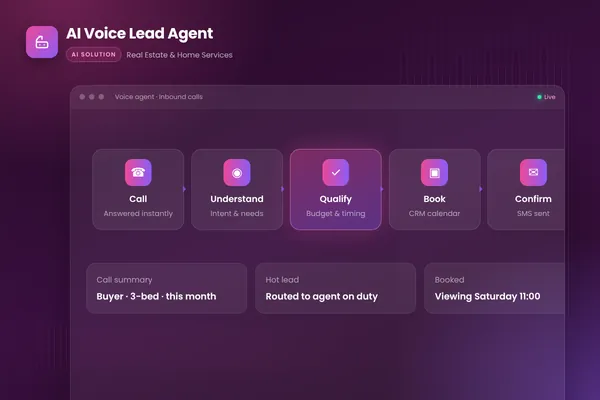
A voice agent on your own phone line, calendar and CRM, with the guardrails in this plan built in. In our AI voice lead qualification agent case study, the agent answers inbound calls, asks qualification questions, books into the CRM calendar, sends an SMS confirmation and routes hot leads to a person at once. The stack on our service page includes OpenAI Realtime, Twilio, LiveKit, Deepgram, ElevenLabs and the HubSpot API.
For this plan, we add the pieces that make a launch safe: the scorecard, the test suite, the handoff packet, the rollback and the daily review sheet. Our AI agents service covers agents that act beyond calls, and the AI automation agency guide explains how to judge a build partner.
Which Done For You automation matches this plan?
For most local-service businesses, Missed-call capture and job booking: an agent that answers calls you miss, qualifies them and books the job, live in 3 to 6 weeks. It suits trades and service teams that lose work to voicemail. For clinics, see Patient intake and scheduling, and for property teams Property lead response. Pricing is quoted after a short call.
The industry pages carry the same logic: HVAC, plumbing and electrical, medical practices and law firms.
How does this plan differ from the vendor 30-day guides?
In five places, each tied to a page we read. The vendor guides are fair starting points. They differ from this plan where a choice needs evidence.
| Point | Vendor plans | This plan |
|---|---|---|
| Day 22 to 30 | Kea AI: full migration on days 22 to 23 | A live slice of one call type, stepped up after a scored week |
| First share | Aloware: 10%; Kea AI: 20 to 30% | The smaller of a sample floor and a loss ceiling |
| Proof | A fixed share and a review | A clean-call count per step (BufferSol view) |
| Rules for calls | Not found | A rules table from the FCC, ICO and EU texts |
| Failure | Enterprise DNA: a weekly review | A decision table with stop rules |
The platform guide closest to ours is Retell's, and we credit its four-week shape, its scorecard and its tag and alert tools. What we add is the share rule, the clean-call table, the rules table and the failure path.
Is this plan right for you?
If you can tick three or more of these, a 30-day pilot on one call type fits.
- You miss or lose calls that a person could answer by following a script.
- One call type makes up a large share of volume and ends in an outcome you can check.
- You can name one system the agent should write to, and one person who can approve changes.
- You have a team that can take a transfer within hours you can state.
- You are planning next year's budget and want a measured start in Q1 2027.
If you tick none, start with the AI readiness assessment before a pilot.
What do three platforms' own docs say about each week's job?
Each platform documents the same jobs a little differently, and the differences affect which one you pick. We read the three quickstarts and the testing, transfer and capacity pages that exist for each. "Not found" means we did not find a page for it, not that the product lacks it.
| Job | Retell | Vapi | ElevenLabs |
|---|---|---|---|
| First agent | 15-minute quickstart | Under-5-minute quickstart | Quickstart |
| Test in text | Simulation testing | Chat simulations | Agent testing |
| Mock live tools | Function mocks | Not found on the page we read | Tool mocking |
| Repeat runs | Batches with a pass rate | Multiple iterations | Pass rate across runs |
| Transfer to a person | Transfer call tool | Call forwarding modes | Not found on the page we read |
| Capacity and fallback | Concurrency and fallback number | Not found on the page we read | Not found on the page we read |
| Traffic split | A/B testing | Not found on the page we read | Not found on the page we read |
| Test cost | Testing pricing | Not found on the page we read | Not found on the page we read |
BufferSol view: pick on the rows that matter to your call type, and ask each vendor in writing for the cells we could not find. BufferSol builds on several of these platforms, and our software comparison covers the buyer side.
Which of our pages cover the later weeks?
The same map as week 1, for weeks 2 to 4. Read in the order you plan to work.
| Job | Page |
|---|---|
| Tool permissions and agent design | AI agent architecture |
| Where people approve | Human in the loop |
| Handling what falls outside the script | Workflow exception handling |
| Scoring an agent | AI agent evaluation |
| Outbound consent rules | TCPA and AI calls |
| Outbound calling at scale | AI outbound calls |
| Vendor data terms | Data processing agreements |
| Vendor security review | AI vendor security questionnaire |
| Follow-up after the call | AI SDR |
| Support-style calls | AI customer support agent guide |
Which quotations does this plan rely on, and where are they?
A ledger of the main quotes, so you can check each against its page. Quotes are copied from the live page text we read in November 2026.
| Quote | Page | Used in |
|---|---|---|
| "Test in text first, then voice, then the phone." | Retell guide | Week 3 |
| "Review calls every day." | Retell guide | Week 4 |
| "Do not route 100% of your calls to voice AI on day one." | Enterprise DNA | Week 4 |
| "Route 10% of live calls to the agent" | Aloware | Week 4 |
| "Route 100% of calls through the AI system" | Kea AI | Week 4 |
| "Transfer Call works on phone calls only, not web calls." | Retell transfer docs | Weeks 2 and 3 |
| "one pass does not prove consistent behavior" | Vapi voice testing | Week 3 |
| "informed that they are interacting with an AI system" | Article 50 | Weeks 2 and 3 |
| "require the prior express consent of the called party to initiate such calls" | FCC 24-17 | Week 3 |
| "Call recordings aren't Payment Card Industry (PCI) compliant by default" | Twilio recording docs | Week 3 |
Where should you read next?
Match the next question to a post. This table is a map, and every row links to a page we publish.
| If your next question is | Read |
|---|---|
| What is the full picture of voice agents? | AI voice agents guide |
| How do I build the receptionist itself? | AI receptionist guide |
| How do inbound call centre agents work? | AI call center agents |
| How do outbound AI calls work? | AI outbound calls |
| What are the US consent rules for outbound? | TCPA and AI calls |
| How do I connect calls to my CRM? | CRM integration |
| How do I keep the delay low? | Voice AI latency |
| How do I keep a human in the loop? | Human in the loop |
| How do I judge an agent? | AI agent evaluation |
| Is a chatbot enough? | AI agent vs chatbot |
Which sources did each part of this plan rely on?
Each row names the page we read and what we used it for. Dates are what the page showed in November 2026, and "Not shown" means the page showed none.
| Source | Type | Date shown | Used for |
|---|---|---|---|
| Retell: demo to production | Platform blog | 16 Oct 2026 | Four weeks, scorecard, tags, alerts |
| Retell quickstart | Platform docs | Not shown | First agent in 15 minutes |
| Vapi quickstart | Platform docs | Not shown | Under 5 minutes; number activation |
| ElevenLabs quickstart | Platform docs | Not shown | Latency trade-off |
| Kea AI guide | Vendor guide | 15 Jun 2026 | Four-week shape, 20 to 30% share |
| Enterprise DNA guide | Vendor guide | Not shown | Time, type and volume slices |
| Aloware guide | Vendor guide | Not shown | 10% beta slice |
| Retell concurrency | Platform docs | Not shown | Limit, queue, fallback |
| Retell transfer call | Platform docs | Not shown | Phone-only transfers |
| Vapi call forwarding | Platform docs | Not shown | Transfer modes |
| Retell A/B testing | Platform docs | Not shown | Traffic split |
| Retell testing pricing | Platform docs | Not shown | Test costs |
| Retell simulation | Platform docs | Not shown | Test case anatomy |
| Vapi voice testing | Platform docs | Not shown | Three-layer testing |
| ElevenLabs agent testing | Platform docs | Not shown | Repeated runs, pass rates |
| FCC 24-17 | Regulator ruling | 2 Feb 2024 | TCPA and AI voices |
| AI Act Article 50 | Law text | In force | AI disclosure |
| Cooley note | Law firm note | 3 Aug 2026 | Date and scope |
| ICO live calls | Regulator guidance | Under review | UK marketing calls |
| ICO right to be informed | Regulator guidance | Under review | Privacy information |
| ICO AI page | Regulator guidance | Not shown | AI risk toolkit |
| Twilio recording | Telephony docs | Not shown | Recording consent, PCI |
Facts checked November 2026. We opened the pages above and compared each quotation with the live page text. Re-check limits, prices and legal rules before you build or launch.
Facts we did not re-check: the Ofcom data-protection page (403) and a Twilio recording-compliance page (404) were not readable and are not used; Kea AI's other claims and a SimbaVoice plan (404); the claim in a vendor blog that UK rules require AI disclosure "within the first 5 seconds" (no regulator source found, so not used); the exact models named in the ElevenLabs banner on removal dates (the banner text was only partly readable); the rule of three, which is stated as BufferSol view and not sourced here; and US state call-recording laws (no statute opened). We did not try to get around any block.
If one call type on your phones should end in a booking or a resolved request, ask BufferSol for a scoped estimate of a 30-day voice agent pilot on your own line and systems, so the budget and a Q1 2027 start are settled before your next planning round.
Frequently asked questions
How long does it take to launch an AI voice agent?
A first working agent on a test number can take minutes on a platform quickstart, since Vapi says under five minutes and Retell says 15. A launch on real calls takes longer. BufferSol's plan reaches a live slice of one call type inside 30 days, with a prototype in about two weeks. Every call type on every line usually takes longer.
What should the first week of an AI voice agent project cover?
Week 1 picks one call type, pulls real recordings, measures today's baseline, names the one system the agent writes to, sets the human fallback, and gets a one-page scope and scorecard signed. Retell's guide says both sides should sign the success criteria before the first test call, because criteria written afterwards drift toward what the agent happened to do.
What share of calls should go to the voice agent first?
Vendor guides quote 10% (Aloware) or 20 to 30% (Kea AI), with no method. BufferSol's rule is to size the slice so it yields about 60 reviewable calls and so a total failure costs less than a loss cap set in week 1. If those two limits clash, change the slice type, for example after-hours calls, rather than raising the cap.
Do I have to tell callers they are speaking to an AI?
In the EU, Article 50 of the AI Act says AI systems meant to interact with people must inform them, at the latest at first interaction, unless that is obvious to a reasonably well-informed person. BufferSol recommends a plain opening line everywhere. Rules differ by country and call type, so check with counsel. This is not legal advice.
How many test calls are enough before going live?
There is no single number. Vapi says one pass does not prove consistent behavior, and ElevenLabs reports a pass rate across repeated runs (green at 100%, amber at 80% or more). BufferSol's plan runs each critical scenario several times in text, repeats the important ones in voice, and ends with staff calling in on a real phone line.
What should I do if the pilot does not hit its targets?
Do not widen the share. Keep it where it is, fix the failed calls on a draft version, turn each failure into a test case, run the suite again and score the next week. Retell's scorecard suggests rescoping after two fix cycles still fail the outcome rows. Move the live tag back to the last good version while you work.
What does BufferSol deliver in a 30-day voice agent pilot?
A working voice agent on your real calls: a prototype on a test number in about two weeks, connected to your calendar and CRM, then a live pilot on a first slice of traffic with warm transfer to your team, monitoring and daily tuning. It is a pilot on one call type, not a full rollout of every edge case. Pricing is quoted after a short call.
Sources
- From Voice AI Demo to Production: What Buyers Need in the First 30 Days, Retell AI
- Build your first phone agent in 15 minutes, Retell AI docs
- Phone calls (quickstart), Vapi docs
- Quickstart (ElevenLabs Agents Platform), ElevenLabs docs
- AI Phone System Implementation: 30-Day Setup Guide, Kea AI
- Voice AI Implementation Playbook, Enterprise DNA
- The Ultimate Guide to AI Voice Agent Implementation, Aloware
- Guidance on direct marketing using live calls, Information Commissioner's Office (UK)
- Artificial intelligence (UK GDPR guidance and resources), Information Commissioner's Office (UK)
- The right to be informed, Information Commissioner's Office (UK)
- Declaratory Ruling FCC 24-17: Implications of Artificial Intelligence Technologies on Protecting Consumers from Unwanted Robocalls and Robotexts, Federal Communications Commission
- Article 50: Transparency obligations for providers and deployers of certain AI systems, EU Artificial Intelligence Act (text)
- EU AI Act: Transparency Obligations Take Effect 2 August 2026, Cooley LLP
- A/B testing, Retell AI docs
- Understand concurrency and limits, Retell AI docs
- Transfer call, Retell AI docs
- Testing pricing, Retell AI docs
- LLM simulation testing, Retell AI docs
- Call forwarding, Vapi docs
- Voice testing, Vapi docs
- Agent testing, ElevenLabs docs
- Recording (Twilio Voice API), Twilio docs
Cite this article
BufferSol Editorial Team (2026). AI Voice Agent Implementation in 2027: A 4-Week Plan to Launch in 30 Days. BufferSol Technologies. https://buffersoltech.com/blog/ai-voice-agent-implementation-2027
BufferSol Editorial Team
AI & software engineering team
Senior engineers, AI specialists and product leads at BufferSol Technologies who design, build and run AI agents, autonomous workflows and custom software for companies in the US, UK and Europe.
Reviewed by Sufyan K., Senior Writer, BufferSol Technologies.