Key takeaways
- AI account-based selling means agents do the repetitive work (choose accounts, research them, watch signals, draft outreach, update the CRM) and people approve what is sent. It is the account-focused version of the AI SDR, not a replacement for the rep.
- Most published numbers are vendor-reported or relayed. G2's 2026 report says active use of AI prospecting spans 25% to 75% of customers depending on the platform, and Attention's buying-committee figures come second-hand, so test any figure on your own accounts.
- Intent is a core input but rarely the deciding factor on its own, according to G2's survey of nine platforms. Our worked score combines fit, decaying signals and reach, so a perfect-fit account with a stale signal waits.
- No source gives a verified response window after a signal. The signal clock in this guide is BufferSol view, and a four-week holdout test tells you whether acting faster actually raises reply rates for your accounts.
- Signal-based outreach still needs a lawful basis and an opt-out. The ICO says UK GDPR applies to direct marketing even in a business context, and GDPR Article 21 gives people the right to object at any time.
- A 30-day pilot can put a working account agent on your real accounts: a prototype in about two weeks, then a live pilot on a first slice with every send approved by a person.
AI account-based selling uses software agents to pick target accounts, research them, watch buying signals and prepare each outreach, while people approve what gets sent. In 2027 the teams that win will act on fresh signals within days, not weeks. This guide gives 7 use cases, a worked scoring sheet, a signal clock and a 30-day pilot, with every source checked in November 2026.
It sits inside our AI sales platform guide. For the volume version of the same agent, see what an AI SDR does and how to prospect with AI.
What is AI account-based selling, and how does it differ from account-based marketing?
It is account-based selling with agents doing the repetitive work. Copy.ai frames the method as a sales strategy built around a small set of top prospects, and says a GTM AI platform can take over the repetitive parts. Our reading: the target list is short and named, and each account gets its own plan.
Account-based marketing (ABM) is the marketing half of the same idea: ads, content and events aimed at the same accounts. Demandbase writes from the marketing side, and its use-case table says AI "monitors intent data in real time and finds accounts showing active research behavior." Selling adds the part marketing cannot do: a named rep decides who to call, when and what to say. Our AI lead qualification guide covers the inbound side, and AI lead generation covers the top of the funnel.
Who is this guide for, and how were the facts checked?
It is for a sales leader, founder or revenue-operations lead at a B2B company with a defined list of accounts worth winning, from about 20 to a few hundred. We opened every source named below in November 2026 and re-read each quotation against the live page. Pages that blocked us are listed in the last section, not guessed at.
Almost every figure in this field is vendor-reported. We say so each time, and where a number is relayed from another publisher we name both. Anything marked BufferSol view is reasoning, not data. If you only want the first move, read our AI sales platform guide for the wider picture, then jump to what a 30-day pilot delivers.
Why do account-based sellers need AI now?
Because buyers do most of their research before a rep is involved. HG Insights says buyers "conduct independent research, compare solutions quietly, and only engage when they are confident about their needs." Highspot makes the same point in its 2026 guide: buyers are more independent than ever and often spend a lot of time researching before speaking with reps.
That shifts the rep's job from finding accounts to noticing the right moment. Noticing is cheap for a machine and slow for a person with 80 accounts. G2's 2026 report puts it this way: AI "concentrates value where human capacity is most constrained, deciding where to focus limited outreach time." That is the whole case for the agent, and it is a prioritisation case, not a writing case.
How big is the buying committee, and why does that change the job?
Large enough that one contact is never the account. Attention says the average B2B purchase involves 13 internal stakeholders and 9 external participants, and attributes the figure to Forrester's State of Business Buying 2026. We could not open the Forrester report (the press page returned "page not found"), so treat the number as relayed, not confirmed.
The direction is easy to accept even without the figure. Highspot says large deals "almost never run from first meeting to signature in a tidy line." If several people shape a deal, an agent that only scores companies misses most of the work. Use case 5 below covers how a small team maps the committee.
What do the top guides agree on, and what do they leave out?
They agree on the basics and skip the operating detail. We read the current top results for "ai account based selling" and the vendor guides that sit beside them. The table shows where the pages stop.
| Topic | Covered by the top pages | Left out |
|---|---|---|
| Definition and benefits | Copy.ai, Salesforce, Highspot | Nothing; this is the common ground |
| Intent data as a signal | Demandbase, HG Insights, Cognism | How to weight it against fit |
| Buying committees | Attention, Apollo | A method that needs no conversation-intelligence tool |
| Timing | Demandbase, G2 say timing adjusts "dynamically" | A window, a first channel, a stop rule |
| Metrics | DestinationCRM relays Gartner's three | A test that separates the agent's effect from luck |
| Consent and opt-out | Apollo lists guardrails | Legal basis, objection handling, call-list screening |
This guide fills the right-hand column with working examples. Every number we invent is labelled, and every number we borrow is attributed.
Which claims about AI and account-based selling can you trust?
Read the evidence type before the number. The table sorts what the main pages actually claim.
| Claim | Said by | Evidence type | How to use it |
|---|---|---|---|
| 60% of B2B software teams use AI across sales processes | G2 | G2's own data | Context for adoption, not for results |
| Active use of AI prospecting spans 25% to 75% of customers | G2 | Reported by nine platforms | Shows adoption varies with data maturity |
| Over 50% less research and qualification time | G2 | Platform-reported | A hypothesis to measure on your own accounts |
| 4x faster sales velocity, $17M new pipeline at ScienceLogic | G2 | A 6sense case study | One customer story, not a benchmark |
| 13 internal stakeholders and 9 external participants | Attention | Relayed from Forrester | Direction only; the report was not opened |
| 81% of top-performing account-based organisations trust their ICP | DestinationCRM | Gartner, July 2021 article | Old; shows ICP quality matters |
| 60% of go-to-market leaders cite consistent performance as a top challenge | Highspot | Highspot's own 2025 report | Context for why teams look at AI |
Nothing in the table is an independent test of an agent's effect on revenue. That is why this guide ends with a holdout test you can run yourself.
Where does each source come from, and when was it checked?
Twenty pages, each opened in November 2026, with the publisher type and the date the page itself shows. A vendor page is evidence of what the vendor claims, not of what is true everywhere.
| Source | Publisher type | Page date | Used for |
|---|---|---|---|
| G2 2026 report | Review marketplace | 18 Feb 2026 | Adoption, intent as one input, failure causes |
| Demandbase | ABM vendor | 23 Apr 2026 | Use-case table for signals and timing |
| Apollo | Sales data vendor | 1 Jun 2026 | Scoring, guardrails, content signals |
| HG Insights | Data vendor | 3 Mar 2026 | Quiet buyer research, intent data |
| Highspot, target accounts | Enablement vendor | Updated 7 Oct 2026 | Research and "why now" |
| Highspot, ABS in 2026 | Enablement vendor | Updated 2026 | Independent buyers |
| Attention | Conversation-intelligence vendor | 30 Apr 2026 | Buying committees, single-threading |
| Copy.ai | GTM AI vendor | Apr and Nov 2026 | Definition |
| Salesforce, ABS | CRM vendor | Not shown | ICP and Gartner relay |
| Salesforce, AI sales agent | CRM vendor | Not shown | Suggestive and autonomous modes |
| DestinationCRM | Trade press | 28 Jul 2021 | Gartner's three metrics |
| Cognism | Data vendor | Not shown | First- and third-party intent |
| ICO, B2B marketing | UK regulator | Under review | UK GDPR and PECR in B2B |
| ICO, email marketing | UK regulator | Not shown | Companies and objection lists |
| ICO, telephone marketing | UK regulator | Not shown | TPS and CTPS screening |
| GDPR Article 21 | EU regulation, unofficial copy | In force | Right to object |
| GDPR Recital 47 | EU regulation, unofficial copy | In force | Legitimate interest |
| LinkedIn Help | Platform rules | Not shown | Automation limits |
| Companies House API | UK registry | Not shown | Rate limit for registry reads |
| RFC 9309 | IETF standard | 2022 | Robots rules |
- 011. Account listScore fit and keep the list fresh.
- 022. Account briefA short, sourced brief before a rep opens the account.
- 033. Signal watchlistA few signals, weighted, with decay.
- 044. Timing rulesA signal clock tested against a holdout.
- 055. Committee mapRoles, names and gaps, built from your own records.
- 066. DraftsAccount-specific messages a person approves.
- 077. CRM upkeepNotes, tasks and stalled-deal alerts written back.
BufferSol Technologies · buffersoltech.com
Which source covers each use case best?
Use this to read further. Each row names the page that says the most about that use case; none of them gives the working method, which is what the sections below add.
| Use case | Best page to read | A second view |
|---|---|---|
| 1. Account list | HG Insights | DestinationCRM |
| 2. Account brief | Highspot | G2 |
| 3. Signals | Cognism | Demandbase |
| 4. Timing | Demandbase | G2 |
| 5. Committee | Attention | Apollo |
| 6. Drafts | Apollo | Salesforce |
| 7. CRM upkeep | Copy.ai | Salesforce |
1. Can AI build and refresh your target account list?
Yes, if you give it a written ideal customer profile (ICP) and your closed-won history. The agent scores every candidate company on fit and keeps the list current as companies grow, shrink or change tools. HG Insights says predictive account insights "allow your team to shift from manual or static prioritization to a dynamic model."
The step people skip is writing the profile down. DestinationCRM relays Gartner's view that building an effective ICP gives you the highest-priority accounts, and says 81% of top-performing account-based organisations are confident their ICP matches the attributes of ideal accounts (a July 2021 article; old, but it is the only Gartner-sourced line in the top results). The agent needs the same clarity. A five-line ICP beats a model trained on a messy CRM.
What inputs does the account-list agent need?
Four things, all of which you probably have. Keep the list of inputs short so the first version ships in days.
| Input | Where it lives | Why the agent needs it |
|---|---|---|
| Closed-won accounts, last 24 months | CRM | To learn what a good fit looks like |
| Closed-lost with a reason | CRM | To learn which look-alikes do not buy |
| Written ICP in five lines | Sales leader | To set hard filters (size, region, tools) |
| Do-not-contact list | CRM or finance | To suppress customers, churned and objectors |
Apollo adds a useful guard: its guide lists suppression lists as one of four guardrails, excluding accounts in active deals, recent churns or flagged as not ready (Apollo). Put the suppression list in the first build, not the third.
How many accounts should the list hold?
Fewer than you think. A list an agent can brief and a rep can actually work is the right size, and for a team of two to four sellers that is usually 30 to 100 named accounts in the first quarter. That number is BufferSol view, based on how many briefs a rep can read in a week, not a measured benchmark.
Split the list in two. Tier 1 accounts get a person-written first touch with an agent-made brief. Tier 2 accounts get agent drafts that a rep approves in bulk. Apollo's guardrails make the same cut: for Tier 1, "require rep approval before AI-drafted messages send" (Apollo). Our AI outreach personalisation guide shows the draft side.
2. Can AI research an account before a rep opens it?
Yes, and this is the use case with the clearest payoff. The agent reads a fixed set of sources, then writes a one-page brief with a link behind every claim. Highspot says "Deep research changes the tone before a meeting even happens", and G2 reports that platforms describe "over 50% reductions in research and qualification time" (platform-reported, so test it).
Keep the brief short enough that a rep reads it. A brief nobody opens is the same as no research. The next sections set out what goes in it and which sources the agent may read.
What should an account brief contain?
Seven fields, each with a source link, and nothing the agent cannot point to. The format below is what we would build first; the field list is BufferSol view.
| Field | Example (invented account) | Source rule |
|---|---|---|
| What they do and size | "Regional freight broker, about 120 staff" | Company site or register |
| Why now | "Posted for an AP clerk on 12 Nov" | Dated job post or news link |
| Likely pain in our terms | "Manual invoice keying" | Marked as inference |
| Who we know there | Two CRM contacts, last touch dates | CRM only |
| Roles missing | "No finance lead named" | Gap flag, not a guess at a name |
| Last interaction | "Pricing page, 5 days ago" | Own analytics |
| Do-not-say list | "Do not mention their layoffs" | Rep-written |
Apollo's explainable-scoring idea fits here: a rep should see "the why behind each account's rank", for example that an account "spiked on [topic] content, added two new sales ops headcount, and matches three of your top five closed-won attributes" (Apollo). A brief with its reasons attached is also easier to approve.
Which sources may a research agent read?
Open, public and permitted ones, plus your own data. The rule of thumb is simple: if a person could not read it without logging in, break a rule or ignore a robots file, the agent should not read it either.
- Your own systems: CRM, email threads, website analytics, support tickets.
- Company pages: the account's own site, press page and job board.
- Public registers: for UK companies, the Companies House API allows up to 600 requests in a five-minute window per application and returns a 429 error once you pass it, so the agent needs a pause rule.
- Robots rules: RFC 9309 says crawlers are requested to honour robots.txt rules, and notes that the rules "are not a form of access authorization", so a robots file is a courtesy signal, not a permission slip.
- LinkedIn: LinkedIn's help page says it does not permit third-party software, including "crawlers", bots, browser plug-ins or extensions, that scrape or automate activity on its website. Do not point an agent at it.
If an agent needs data from a site that bans automated access, buy it from a licensed provider or leave it out.
What does the research agent do when a source is thin?
It says so. An agent that fills gaps with plausible text is worse than a blank field. The rule we build in: every sentence in a brief carries a link or the label "inference", and any field with no source reads "not found". A rep can work with "not found". A rep who finds one made-up detail in a brief stops trusting the rest, and the programme dies from that one error.
Two checks keep this honest. First, a nightly sample of five briefs is checked by a person against the links. Second, the agent never writes a contact's personal details (family, home address, personal social posts) into a brief, whatever it finds. Our AI agent evaluation guide covers how to score this kind of check.
3. Which buying signals should AI watch, and which should it ignore?
Watch a handful, weight them, and ignore the rest. G2's survey found that across responses from ZoomInfo, Cognism, Apollo.io, 6sense, Firmable and Dealfront, "intent emerged as a core input, but rarely as the deciding factor on its own." Platforms weigh intent alongside fit, technology, hiring velocity, engagement history and CRM interactions.
So the watchlist is a short list of signals with a point value each, and fit still decides whether the account is on the list at all. The next sections show the kinds of intent data, then a worked score.
What kinds of intent data exist?
Two, plus public events. Cognism says "There are two main categories of intent data: first-party intent data collected from your own channels and third-party intent data collected from external sites or providers." First-party intent is data from your own site, forms, emails and customer interactions. Third-party intent comes from outside sources and providers.
Add a third group that is cheap and often better for a small team: public events such as a job post, a leadership change or a funding announcement. HG Insights says buyer intent data "gives your team visibility into accounts that are actively researching their product category", and Demandbase lists the same idea in its table: detect when a target account starts researching relevant topics and alert reps. For a small team, first-party signals are the best place to start because you already own the data and the lawful basis is simpler.
Does the type of content an account reads change its score?
Yes, according to Apollo: "An account that downloads a playbook should score differently than one that reads a blog post." Apollo's own table gives a high purchase window of 12 months for a playbook download, 3 to 6 months for an on-demand webinar, immediate follow-up for an interactive demo, a low-to-medium research-phase reading for an eBook and a low awareness-stage reading for a blog post.
Those windows are Apollo's claims and the page gives no data behind them, so treat them as a starting order rather than a rule. They also show a gap: they describe how far off a purchase might be, not how fast a rep should respond. The signal clock in use case 4 deals with response speed, and the worked score below uses points per signal type so you can change the order after your own test.
How do you score an account? A worked example with invented accounts
Add three parts: fit, signals that fade, and reach. The weights below are BufferSol view, and the accounts are invented for the example. Score = fit (0 to 40) + signal points (0 to 40, after fading) + reach (0 to 20, for named, verified contacts in the buying group).
Signal points start from a base value and shrink with age. A signal under four days old counts in full; 4 to 7 days old counts at 0.8 of its value; 8 to 14 days at 0.5; 15 to 30 days at 0.25; older than 30 days at zero. A hard floor sits on top: fit below 25 means no outreach, however loud the signal.
| Signal (base points) | Age | Multiplier | Counted |
|---|---|---|---|
| Pricing page visit by a known account (20) | 5 days | 0.8 | 16 |
| Job post for the role we serve (15) | 10 days | 0.5 | 7.5 |
| Case-study page visit (12) | 3 days | 1.0 | 12 |
| Leadership change in the buyer role (15) | 3 days | 1.0 | 15 |
| Playbook download (8) | 20 days | 0.25 | 2 |
| Blog read (3) | 2 days | 1.0 | 3 |
Now five invented accounts, scored with the table above.
| Account (invented) | Fit | Signals counted | Reach | Total | Action |
|---|---|---|---|---|---|
| E: 250-person logistics firm | 36 | 40 (pricing 20 + job post 15 + case study 12 = 47, capped) | 18 | 94 | Rep call task the same day |
| A: 120-person freight broker | 34 | 23.5 (pricing 16 + job post 7.5) | 12 | 69.5 | Researched email within 2 working days |
| B: 400-person manufacturer | 38 | 3 (blog read) | 4 | 45 | Watch weekly, no outreach |
| D: 900-person distributor | 40 | 2 (old download) | 0 | 42 | Watch weekly, find a contact |
| C: 60-person software firm | 22 | 27 (new VP, case study) | 16 | 65 | Parked: fit below the 25 floor |
| Item | Value |
|---|---|
| E | 94points |
| A | 69.5points |
| C (parked) | 65points |
| B | 45points |
| D | 42points |
Source: BufferSol estimate: invented accounts and weights, to show the method
BufferSol Technologies · buffersoltech.com
Two lessons sit in the table. Account D has the best fit on the list and still waits, which matches G2's finding that intent is rarely the deciding factor alone, in reverse: fit alone is not either. Account C looks hot and is parked, because a loud signal from the wrong company wastes a rep's week.
How do you keep a score explainable?
Store the parts, not just the total. Every score row keeps fit, each signal with its date and multiplier, and reach, so a rep can read "why this account, why now" in one glance. Apollo calls this explainable AI scoring and says it gives reps "the why behind each account's rank, making prioritization actionable instead of opaque."
It also protects you. When a score looks wrong, you can see whether the fit rule, a stale signal or a missing contact caused it, and fix one number instead of arguing with a black box. Our human-in-the-loop guide covers how to review an agent's reasoning without reading every line.
Is a revenue-weighted score better than a fit score?
It can be, once you have enough closed deals to trust it. Apollo says "Revenue-weighted AI prioritization ranks accounts by predicted incremental revenue impact, not just fit score." That needs a history of won deal values, and a team with a few dozen closed deals has too little data for a model to learn from.
For a small team the practical version is simpler: multiply the final score by an expected deal size band (small, medium, large) that a sales leader sets by hand. It is crude and it is visible. When you have a year of clean closed-won data, let the agent propose weights and keep a person in charge of approving them.
4. How soon after a signal should you act?
No source we opened gives a verified answer. Demandbase says AI "adjusts timing, channels, and content dynamically based on how accounts are responding", and G2 says relevance "is no longer decided once, it's recalculated continuously." Neither gives a number of hours or days.
So the clock below is BufferSol view. It is a starting hypothesis built from how fast signals fade (the multipliers above) and how many touches a small team can make without nagging. The next section gives the clock, and the one after shows how to test it on your own accounts.
What does the signal clock look like?
One row per signal, with a first-action deadline, a first channel and a stop rule. Every value is BufferSol view and meant to be changed after your test.
| Signal | First action by | First channel | Stop rule |
|---|---|---|---|
| Demo or contact request | Same working day, by a person | Reply to the form channel | Hand to the rep; the agent stops |
| Pricing page visit, known account | 1 working day | Person-written email or call task | 3 touches in 14 days with no reply |
| Case-study visit | 2 working days | Email with a relevant story | 2 touches in 14 days |
| Job post for the role we serve | 3 working days | Email naming the need, not the post | 2 touches in 21 days |
| Leadership change in the buyer role | 5 working days | Short intro email | 2 touches in 30 days |
| Funding announcement | 7 working days | Light email, no pitch | 2 touches in 30 days |
| Playbook download | 2 working days | Value-led follow-up | 2 touches in 21 days |
| Blog read | None | Add to weekly watch | Re-score weekly |
The agent's job is to put each due action in the rep's queue with the brief attached. It does not send first touches to Tier 1 accounts on its own, which matches Apollo's guardrail of rep approval before AI-drafted messages send.
Which channel should go first?
Email for most signals, a call task for the strongest ones, and never an automated call to a company you have not screened. HG Insights says to "time outreach using buyer intent signals", but its page does not rank channels either. Our view is that the strongest first-party signals deserve a human voice and the weaker public signals earn a short email.
The call route carries rules. The UK ICO says that "in general, you must not make marketing calls to any number listed on the Telephone Preference Service (TPS) or Corporate TPS (CTPS)" without consent (ICO), so screen call lists before a task is created. For voice automation in the US and UK, read our TCPA guide for AI calls.
When should the agent stop chasing an account?
On a written rule, never on a feeling. The stop rules in the clock cap touches per signal. Add a global rule: no account gets more than one new touch in any seven-day window, whatever its signals say, and any reply, objection or "not now" suppresses the account until a person releases it.
The stop rule is also where Apollo's suppression-list guardrail earns its place: accounts in active deals, recent churns or flagged as not ready never enter the queue. The agent checks the suppression list before it drafts, not after.
How do you run a four-week holdout test on timing?
Split the signalled accounts at random into two groups and delay one. For four weeks, every account with a qualifying signal gets a random draw. Half follow the clock. The other half wait seven extra days before the first touch. Everything else is identical.
At the end, compare reply rate and meetings booked per group. With fewer than about 30 accounts in each group, treat the result as a hint, not proof; that threshold is BufferSol view. If fast action does not beat the delay, relax the clock and save your reps' time. If it does, you now have the first evidence for your own accounts, which no top result offers. Our AI agent evaluation guide covers how to keep such a test honest.
5. Can AI map the buying committee without a conversation-intelligence tool?
Partly, and you can start with a spreadsheet. Apollo says "Buying-group mapping is now more important than individual lead scoring for enterprise deals." Attention argues that "Most ABS tools map the buying committee from outside the company" and that "Every stakeholder on a buying committee leaves a trail in the calls."
Highspot's buying-group guide, published 29 April 2026, starts from the same place: winning a complex buying group "starts with mapping who influences the purchase, who signs off, what each person cares about", and it advises asking who manages final sign-off and who can change scope or budget. Attention sells conversation intelligence, so the argument suits its product, but the limit is real: an agent that has not heard the call does not know what the CFO said. What it can do is build the outside map and flag the holes, then ask a person to fill them after each real meeting.
What does the outside map contain?
Five role types, and for each one a name or a gap. The roles are generic, so adapt them to your market.
| Role | What the agent looks for | Where it looks | If missing |
|---|---|---|---|
| Economic buyer | The person who signs | CRM, company site | Flag "no budget owner named" |
| Champion | The contact who replies | Email threads | Flag "single-threaded" |
| Day-to-day user | Team lead of the affected team | CRM, site team page | Ask the champion for an intro |
| Finance or procurement | Who approves spend | CRM, past deals | Flag early, not at quote stage |
| Blocker or risk owner | IT, security, legal | Past deals with similar firms | Add a checklist task |
Use only data you may hold: your own CRM and email, and the company's public pages. Do not scrape personal profiles, and keep personal data to business facts (name, role, business email). The next section covers the single-thread alert that matters most.
How do you catch a single-threaded deal early?
With a plain rule on the pipeline. Attention's page gives an example prompt for an agent: "Flag any deal where the only contact hasn't replied in 14 days." The page adds that "Forrester's data is unambiguous: single-threaded deals stall", a claim we could not confirm because the Forrester source did not open.
You do not need a platform to apply the rule. A scheduled job can count the contacts linked to each open opportunity, check the date of the last reply from each, and put a task on the owner's list when only one person is involved or the only reply is more than 14 days old. The 14-day threshold is Attention's example, so tune it to your sales cycle.
6. Can AI draft account-specific outreach that a person approves?
Yes, with limits on what it may say. The agent writes from the brief, so a message mentions only facts that have a source link. Highspot says sellers who win know "every person enters with their own agenda and version of 'Why now.'" A good draft addresses one person's version of why now, not the company's.
The approval step is the control, not a formality. Salesforce's AI sales agent page describes the same split in its own product: you can "automatically update opportunities in autonomous mode or review, edit, and approve updates in suggestive mode", as of November 2026. We recommend suggestive mode for every first touch.
What should the draft never do?
Six things, written as hard rules so the agent can be tested against them.
- Never state a fact that is not in the brief with a link.
- Never mention personal details (family, home, private social posts).
- Never imply a relationship that does not exist ("as we discussed").
- Never claim a result or customer name BufferSol cannot back.
- Never send to a contact on the suppression or objection list.
- Never send without the opt-out line your regional rules need.
Apollo cites Gartner's 2025 data as finding that 73% of B2B buyers actively avoid suppliers that send irrelevant outreach. We have not opened Gartner's research, so the figure is relayed, but it explains why the relevance threshold matters: do not auto-send on weak signals. Our personalisation guide covers the writing side, and the AI SDR outbound automation is the built-and-run version.
How does a rep approve a draft in under a minute?
By seeing the reason, the draft and the evidence on one screen. The approval card shows the account score with its parts, the signal and its date, the draft, and the three source links behind any fact. The rep presses approve, edits or rejects with a one-line reason.
Rejection reasons are the gold. Log them as a short code ("wrong person", "stale signal", "tone", "fact wrong") and review the counts weekly. A rising "fact wrong" count means the research step needs fixing before anyone widens the pilot. HG Insights frames the aim as shifting "from manual or static prioritization to a dynamic model"; the reject log is how the model learns what your team will not send.
7. Can AI keep the account plan and CRM current?
Yes, and for most teams this is where the hours go back. The agent writes a note after every logged touch, creates a task when a signal is due, moves nothing without a rule, and refreshes the account plan from the week's changes. Copy.ai lists the same chores, saying account-based selling takes "Researching accounts, crafting personalized messaging, coordinating across teams, and tracking engagement across channels."
Be strict about what it may write. A CRM full of agent opinions is worse than a stale one. Our CRM data automation guide lists the mistakes to avoid, and the CRM hygiene automation page shows the ready-made version. The service behind both is AI agent development.
What may the agent write to the CRM, and what may it not?
Write notes, tasks and signal logs freely. Ask a person before it changes anything that others report on.
| Action | Allowed without approval | Needs a person |
|---|---|---|
| Add a note with source links | Yes | No |
| Create a follow-up task | Yes | No |
| Log the signal and score parts | Yes | No |
| Change opportunity stage | No | Yes |
| Change deal amount or close date | No | Yes |
| Merge or delete a contact | No | Yes |
| Send an email or sequence step | No (Tier 1) | Yes; Tier 2 in bulk |
Every write carries the run ID so that a bad batch can be found and undone. Our workflow exception handling guide shows how to build the undo path.
Do consent rules allow signal-based outreach?
Often yes in B2B, but not automatically, and the rules differ by place. This section is not legal advice; ask counsel before you launch. In the UK, the ICO's B2B guidance says "If you are processing personal data for direct marketing purposes, even in a business context, the UK GDPR applies." It also says the rule on marketing by electronic mail "doesn't apply to corporate subscribers", while sole traders and some partnerships count as individual subscribers. The ICO notes the page is under review because of the Data (Use and Access) Act, so re-check it before you build.
For email, the ICO's email page says you can send marketing emails or texts to companies, but "it is good practice to keep a 'do not email or text' list of any companies that object." The agent should check that list first.
What about GDPR and the right to object?
Direct marketing can rest on legitimate interest, but people can object. Recital 47 says "The processing of personal data for direct marketing purposes may be regarded as carried out for a legitimate interest." Article 21 then gives the right to object: "Where personal data are processed for direct marketing purposes, the data subject shall have the right to object at any time", and after an objection the data "shall no longer be processed for such purposes."
Build that into the agent as a suppression write that takes effect at once, across every tool. The text above is the unofficial gdpr-info.eu copy of the regulation, which is how we read it; for formal use, check the Official Journal. For the lawful-basis detail, the ICO's legitimate interests guidance lists a three-part test (what counts as a legitimate interest, whether the use is necessary, and a balancing test) and has sections on direct marketing and on business-to-business contacts; only its headings loaded for us, so we do not quote it. Our cold-email compliance guide and DPA checklist cover the vendor side.
What about US rules?
We did not re-check them. The FTC's CAN-SPAM compliance guide returned a "request resembles an abusive automated request" page when we opened it, so we do not quote it, and we did not try to get around the block. Read the guide directly, and take advice on state laws and on any call or text automation. Our TCPA guide for AI calls covers the calling side from primary sources.
Can a small team run this without an account-based selling platform?
Yes, in a spreadsheet and one weekly ritual, which is how we would start. Most top results assume you already own a platform. You may not need one yet.
Build one sheet with a row per account and columns for tier, fit points, signal log, signal dates, reach, score and next action. Use a formula for the fading multiplier from the table above. Then run a 45-minute weekly review: sort by score, read the top five briefs, approve the drafts, update the log. An agent can fill the sheet and write the briefs; the spreadsheet keeps everything visible while you learn what matters.
| Step | Who | Time per week |
|---|---|---|
| Refresh signals and scores | Agent | Runs overnight |
| Read the top five briefs | Rep | 15 minutes |
| Approve or edit drafts | Rep | 15 minutes |
| Log rejections and fix rules | Sales lead | 15 minutes |
The times are BufferSol estimates for a list of 30 to 100 accounts. Move to a platform or a custom agent when the sheet slows you down, not before.
When does a platform win, and when does a custom agent?
Buy a platform when you want broad third-party data and standard workflows across many sellers. Demandbase, Apollo, HG Insights and G2's surveyed vendors sell exactly that. Build a custom agent when your best signals live in your own systems, when you need approvals and writes shaped to your CRM, or when per-seat fees outgrow the value.
| Platform | Custom agent | |
|---|---|---|
| Signal data | Broad third-party feeds | Your own systems plus chosen public sources |
| Workflow | Vendor's standard flow | Shaped to your CRM and approval rules |
| Cost model | Seats or usage, per vendor | One build plus run cost (see pricing table) |
| Speed to start | Fast if your data fits | About 30 days to a working pilot |
| Control | Within the vendor's settings | Full, with audit logs |
BufferSol Technologies · buffersoltech.com
Our best AI SDR tools and build vs buy guides give the buyer's comparison, and the AI agent pricing table lists vendor prices as each vendor states them.
Why does AI account-based selling fail, and how do you spot it early?
For structural reasons rather than missing features. G2 says failures "are no longer driven by missing features. Instead, they emerge from structural friction, poor inputs, fragmented execution, and unclear accountability between humans and machines." It also says data readiness "remains the single biggest constraint."
| Failure | Early sign | Fix |
|---|---|---|
| Stale CRM data | Scores that rank churned accounts high | Clean and sync before scoring (Apollo lists stale CRM data first) |
| Tech silos | Signals in one tool, tasks in another | One queue the rep reads |
| No feedback loop | Rejection reasons are not logged | Reason codes and a weekly review |
| Unclear owner | Nobody approves drafts in time | Name an owner per tier |
| Weak signal auto-sent | Replies that say "why me?" | A relevance threshold (Apollo) |
Apollo quotes Gartner as warning that by 2028 AI agents will outnumber sellers by 10x while fewer than 40% of sellers will say agents improved productivity. We did not open Gartner's release, so we relay it as a caution, not a fact.
How does account-based selling connect to inbound lead handling?
Through the same agent skills and the same CRM. An account agent watches named accounts; an inbound agent answers whoever arrives. When a named account fills a form, the inbound path should hand it to the account owner at once, with the brief attached. Our AI lead qualification guide covers the inbound scoring, and AI lead generation covers the wider funnel.
Booking is the other shared step: an account agent that finds the right moment should not then make the contact wait for a slot. See our AI appointment setter guide and the meeting prep and follow-up automation. The service behind all of it is AI agent development, and the prospecting basics are in AI for sales prospecting.
Which numbers show it works?
Gartner's three, plus three of ours. DestinationCRM relays Gartner's Craig Rosenberg recommending that sales leaders track "opportunity rate, target account pipeline, and account win rate." Those are the outcomes. Our leading measures tell you sooner whether the agent is helping.
| Measure | Type | How to read it |
|---|---|---|
| Opportunity rate on worked accounts | Outcome (Gartner via DestinationCRM) | Share of worked accounts that open a deal |
| Target-account pipeline | Outcome | Value created from the list |
| Account win rate | Outcome | Wins per worked account |
| Median hours from signal to first touch | Leading (BufferSol view) | Is the clock being followed? |
| Reply rate on signalled vs unsignalled accounts | Leading (BufferSol view) | Do signals beat cold? |
| Share of drafts approved unedited | Leading (BufferSol view) | Is the agent's quality improving? |
Set a baseline for four weeks before the agent runs, then compare. Without a baseline you will credit the agent for a good quarter.
Does an account-based agent replace SDRs?
No, and we would not pitch it that way. Highspot says "Deep research changes the tone before a meeting even happens", which is a rep's advantage. The agent removes list-building and note-taking so the same person has more time for conversations. Our AI SDR guide, AI lead generation guide, AI appointment setter guide and meeting prep automation cover how roles split. BufferSol view: for a list of about 50 accounts, one seller with an agent can keep up with signals that a team would miss.
What does the agent look like end to end?
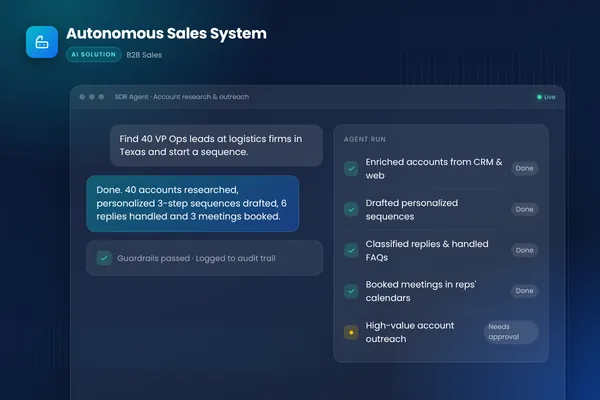
Eight steps with a person at two of them. The sequence is the one BufferSol builds in its Autonomous Sales System: a research agent enriches each account from public sources and the CRM, a writing agent drafts in the company's voice, and an inbox agent classifies replies. High-value accounts require human approval and every action is logged back to the CRM.
- 01LoadPull the account list, ICP and suppression list.
- 02ScoreFit, fading signals and reach, stored as parts.
- 03ResearchA sourced brief; gaps marked as not found.
- 04QueueDue actions land in the rep's list with the brief.
- 05ApproveA person approves, edits or rejects with a reason code.
- 06SendApproved messages leave from the rep's own inbox.
- 07LogNotes, tasks and signals written to the CRM with a run ID.
- 08LearnWeekly review of rejections and holdout results.
BufferSol Technologies · buffersoltech.com
The matching systems are the ones in our AI agents service, described in our agent architecture guide: CRM, inbox, calendar and the signal sources you choose. The ready-made starting point is the AI SDR outbound automation, built for teams that want it run for them.
What changes in 2027 for account-based selling?
Three things, each labelled by how sure we are. First, buyers keep researching alone: HG Insights says "B2B sales cycles continue to grow longer and more complex", which raises the value of noticing signals early. Second, platforms keep moving from alerts to action. G2 says the next phase of prospecting "is continuous and semi-autonomous, where AI systems dynamically re-rank opportunities in real time."
Third, BufferSol view: buyers of agents will ask for proof from their own accounts, so holdout tests and reason-coded rejection logs will matter more than vendor case studies. Salesforce already offers suggestive and autonomous modes in one product, which suggests approval settings will become a normal buying question. Re-check any vendor claim before you sign, because every page we read is dated 2026.
What does an AI account-based selling stack cost?
It depends on seats, data feeds and build scope, and most vendors do not publish enough to compare. We do not quote prices here. Use the AI agent ROI calculator with your own numbers and the AI agent pricing table, which shows prices only where the vendor's own page states them, with the date checked.
For a custom build, BufferSol quotes after a short call on your accounts and systems. Our guide to how long an agent takes to build and the AI sales platform timeline set the time expectations.
What should you do in the first week, before any build?
Four things, none of which needs a vendor. First, write the ICP in five lines and the suppression list, using the profile questions in our AI lead qualification guide. Second, pull your last 24 months of closed deals and list the signals that preceded the wins, as the AI SDR guide suggests for outbound.
Third, build the spreadsheet from the small-team section for 30 accounts and score them by hand once. Fourth, size the prize with the AI agent ROI calculator and compare tool prices in the AI agent pricing table. If the hand score changes who you call first, the agent is worth building; our AI sales platform guide and agent development service are the next stop, and the Autonomous Sales System case study shows the build.
What a 30-day pilot delivers for account-based selling
A working agent on your real accounts inside 30 days, in two stages, delivered as part of our AI agent development service and modelled on the Autonomous Sales System. This matches the delivery model on our AI agents service page: prototype in about two weeks, then a live pilot on a first slice.
| Week | Deliverable |
|---|---|
| 1 | ICP and suppression list agreed; account list scored; brief template signed off |
| 2 | Prototype: briefs for 20 to 50 accounts, signal watchlist, approval card |
| 3 | Live pilot on a first slice; every send approved by a person; reject codes logged |
| 4 | Review: baseline versus pilot, holdout result, what to widen or stop |
What you provide: read access to the CRM and email metadata, a written ICP, a suppression list, a named approver per tier and 30 minutes a week. How success is measured: time from signal to first touch, draft approval rate, reply rate on signalled accounts and the four-week holdout result. A pilot cannot prove revenue impact; a sales cycle is longer than 30 days.
Is this right for you?
Check the signs. If most apply, a scoped estimate is worth your time.
- You have a named list of 20 to a few hundred accounts worth winning.
- Your reps spend hours a week on research and CRM notes.
- Signals exist in your own tools (website visits, replies, product use) that nobody checks daily.
- You can name who approves outreach and who owns the suppression list.
- Your CRM is clean enough to trust, or you will fix it in week one.
If you want it built and run for you, the AI SDR outbound automation and meeting prep and follow-up automation are the ready-made versions, for sales teams that would rather not run it themselves.
How does this connect to the rest of BufferSol's sales work?
Through one agent platform, one case study and a few ready-made automations. Pick the row that matches where you are.
| Where you are | Start here |
|---|---|
| Want the service overview | AI agent development |
| Want to see a built system | Autonomous Sales System case study |
| Want it built and run for you | AI SDR outbound automation |
| Want clean CRM data first | CRM hygiene automation |
| Want meeting prep and notes | Meeting prep and follow-up automation |
| Want to size the return | AI agent ROI calculator |
| Want vendor prices as stated | AI agent pricing 2027 table |
| Want the architecture | AI agent architecture |
| Want a readiness check | AI readiness assessment |
| Want the build guide | AI agent development guide |
| Want to check exceptions | Workflow exception handling |
| Want the pillar overview | AI sales platform guide |
What should you read next?
| If you want to | Read |
|---|---|
| See the volume version of this agent | AI SDR |
| Qualify inbound leads fast | AI lead qualification |
| Write better first touches | AI sales outreach personalisation |
| Prospect with AI | AI for sales prospecting |
| Check what a vendor does with your data | DPA checklist for AI vendors |
| Understand lead generation | AI lead generation |
| Book meetings automatically | AI appointment setter |
| Review agent safety | Human-in-the-loop AI agents |
| See the whole pillar | AI sales platform guide |
Updating this list is part of every new sales post, so the account-based guide does not sit alone.
Facts checked November 2026. We opened and re-read: G2, Demandbase, Apollo, HG Insights, Highspot (two guides and the buying-group article), Attention, Copy.ai, Salesforce, DestinationCRM, Cognism, the ICO's B2B page, email page and telephone page, GDPR Article 21 and Recital 47 (unofficial text), LinkedIn's help page, the Companies House API guide and RFC 9309. Re-check pricing, features and legal rules before you buy or launch.
Facts we did not re-check: Forrester's State of Business Buying 2026 and McKinsey figures (relayed by Attention; the Forrester page did not open); Gartner figures relayed by Apollo, Salesforce and DestinationCRM (the Gartner site blocked automated access); the FTC's CAN-SPAM guide (blocked); the body of the ICO's legitimate interests page (only its headings loaded). We did not try to get around any block.
If account-based selling is on your 2027 plan, ask BufferSol for a scoped estimate of a 30-day account-agent pilot on your own accounts, so the budget and the Q1 2027 start date are set before your next planning cycle.
Frequently asked questions
What is AI account-based selling?
AI account-based selling is a focused B2B sales method where software agents choose a short list of high-value accounts, research each one, watch buying signals and prepare account-specific outreach, while sales reps approve and send. Copy.ai frames the method as a sales strategy built around a small set of top prospects; the AI takes over the research, scoring and tracking around that focus.
How is AI account-based selling different from an AI SDR?
An AI SDR works a high volume of leads through outreach sequences. AI account-based selling works a short list of named accounts, so each account gets its own research brief, a buying-committee map and a timing rule. The same agent skills apply, but the target list is smaller, the message is more specific and a person approves more of the sends.
Which buying signals should a small team act on first?
Start with signals from your own channels: a pricing or case-study page visit by a known account, a reply, or a demo request. Cognism calls these first-party intent data. Add a small number of public signals, such as a job post for the role your product serves or a leadership change. Treat blog reads and single downloads as weak.
How soon should you contact an account after a buying signal?
No source we found gives a verified window. BufferSol view: contact first-party high-intent signals within one working day, hiring or leadership signals within three working days, and drop a signal after 30 days. Because nobody has proven these numbers, run a four-week test where half of the signalled accounts get a delayed touch and compare replies.
Can AI map a buying committee without a conversation-intelligence tool?
Partly. An agent can list likely roles from your CRM contacts, your own email threads and the company's public team page, then flag missing roles. It cannot know what a CFO said on a call you did not record. Attention argues that second map can only be built from conversations, so a person still adds names after each real meeting.
Is signal-based B2B outreach legal?
It depends on the country, the channel and whether the contact is an individual or a corporate subscriber. The ICO says UK GDPR applies to direct marketing to individuals even in a business context, and PECR rules differ for email and calls. GDPR Article 21 gives the right to object to direct marketing at any time. This is not legal advice; check with counsel.
How long does it take to build an AI account-based selling agent?
A working agent on your real accounts takes about 30 days with BufferSol: a prototype in about two weeks covering list scoring, account briefs and signal alerts, then a live pilot on a first slice of 20 to 50 accounts. Platform-level features such as intent data feeds and full CRM automation can take longer and depend on your data.
Sources
- G2's 2026 Report: The State of AI Sales Intelligence in Prospecting, G2
- How to Leverage to AI in Account-Based Marketing, Demandbase
- How to Use AI to Improve Targeting of High-Value Accounts in 2026, Apollo.io
- How to Use AI-Driven Account Intelligence and Buyer Intent to Shorten Your Sales Cycle, HG Insights
- Target account selling: How to close high-value deals, Highspot
- Account-based selling in 2026: Everything to know, Highspot
- Account-Based Selling with AI Agents: Why Conversation Intelligence Belongs in Your ABS Stack, Attention
- Account-Based Selling: The Complete Guide, Copy.ai
- What Is Account-Based Selling?, Salesforce
- AI, ABM Strategies Aren't Just for Marketing, DestinationCRM
- Intent Data: What It Is, How It's Collected, and 7 Ways to Use It, Cognism
- Best AI Sales Agent | Sales Cloud, Salesforce
- Business-to-business marketing, ICO
- Electronic mail marketing, ICO
- Telephone marketing, ICO
- Art. 21 GDPR: Right to object, gdpr-info.eu (unofficial text of Regulation (EU) 2016/679)
- Recital 47: Overriding legitimate interests, gdpr-info.eu (unofficial text of Regulation (EU) 2016/679)
- Prohibited software and extensions, LinkedIn Help
- How sellers can navigate complex B2B buying groups, Highspot
- Legitimate interests, ICO
- Rate limiting (Companies House API), Companies House
- RFC 9309: Robots Exclusion Protocol, IETF
Cite this article
BufferSol Editorial Team (2026). AI Account-Based Selling in 2027: 7 Use Cases for Research, Signals and Timing. BufferSol Technologies. https://buffersoltech.com/blog/ai-account-based-selling-2027
BufferSol Editorial Team
AI & software engineering team
Senior engineers, AI specialists and product leads at BufferSol Technologies who design, build and run AI agents, autonomous workflows and custom software for companies in the US, UK and Europe.
Reviewed by Sufyan K., Senior Writer, BufferSol Technologies.