Key takeaways
- Intercompany reconciliation is two jobs in order: getting two entities' records to agree, then eliminating the agreed balances. Kognitos says the harder half is the cleanup before elimination, and the IFRS 10 text requires intragroup balances to be eliminated in full.
- The first mistake is buying a matcher before you understand why balances break. Kognitos warns that automation on misaligned account structures and entity mappings generates false exceptions at scale.
- An AI agent should detect, match, draft and route. A person should approve postings, write-offs and policy. BDO says the more automation is involved, the more important it is that human review is real and well understood.
- Every quantified result we found is a vendor's own, such as Trintech's 90 percent of records reconciled automatically and a Siemens drop from over 15,000 manual line items to under 200. Measure your own baseline instead: breaks per entity pair, days to clear and touches per break.
- Start with one entity pair for 30 days: one match rule, one tolerance, one named owner for each side of the exception queue. This is BufferSol's plan, not a sourced benchmark.
Intercompany reconciliation automation means an AI agent matches what two related entities each recorded, explains the breaks and drafts the fix, while a person approves every posting. In 2027 the common failure is not the matching, it is skipping the groundwork and the approvals. This guide names 5 mistakes, gives a worked break sheet and a 30-day plan for one entity pair.
For the wider finance picture, read our finance IT solutions guide. For the neighbouring close tasks, see our financial close automation guide and the AI accounting software guide.
What is intercompany reconciliation, and why does it hold up the close?
It is the work of matching the intercompany balances that two related legal entities recorded and getting them to agree before consolidation. BlackLine defines it along those lines and says "Unreconciled intercompany differences are one of the most common causes of delayed or inaccurate consolidated financial statements." insightsoftware calls the reconciliation "a prerequisite for producing accurate consolidated financial statements and for completing intercompany eliminations during the financial close."
It holds up the close because the two sides are recorded separately. Kognitos says the two sides "are recorded by two different entities, often in different systems, different currencies, and different charts of accounts", so the records frequently do not match. Our financial close automation guide shows where intercompany sits in the whole close, and our financial close automation guide compares the tool types.
What does the IFRS 10 text actually require for eliminations?
It requires intragroup balances and transactions to be eliminated in full. The version of IFRS 10 endorsed for use in the EU in Commission Regulation (EU) No 1254/2012 says in paragraph B86(c) that consolidated financial statements "eliminate in full intragroup assets and liabilities, equity, income, expenses and cash flows relating to transactions between entities of the group", and adds that "Intragroup losses may indicate an impairment that requires recognition in the consolidated financial statements."
Two more paragraphs matter for automation. B87 says that if a group member uses accounting policies other than those of the consolidated statements, "appropriate adjustments are made" to conform them. B92 says the statements of the parent and its subsidiaries used in consolidation "shall have the same reporting date", with additional information prepared where the dates differ unless impracticable. We read that endorsed text, not the standard on the IFRS Foundation site, and we did not retrieve US GAAP's ASC 810. This is not accounting advice. See our human-in-the-loop post for the review side.
What causes intercompany balances not to match?
Four causes recur: timing, foreign exchange, account mapping and judgment. Kognitos lists "inconsistent charts of accounts across entities, timing differences (one entity books in January, the counterparty in February), FX and currency differences, and the sheer volume of transactions across many entity pairs." insightsoftware lists timing differences, currency conversion variances and data entry errors as root causes.
Numeric advises categorising discrepancies by type: timing, amount and classification. The table below is BufferSol's worked version: one invented illustration per cause, with the fix and who owns it. The amounts are illustrations, not data from any company.
| Cause | Worked break (invented) | Fix | Owner |
|---|---|---|---|
| Timing | Entity A books a $10,000 service charge on 31 January, Entity B books the payable on 2 February | Agree a cut-off calendar and an accrual on B | Both controllers |
| Foreign exchange | A books a receivable of €9,000 at one rate, B books the payable at another, leaving a small gap | Fix which rate source and date apply to both sides | Group treasury |
| Account mapping | A books to "Intercompany receivable - B", B books to a general payables account | Map B's account to the intercompany account and block free posting | Group controller |
| Judgment | A treats a charge as a loan, B treats it as a fee | Written policy per transaction type, a person decides exceptions | Group controller |
Why does the number of entity pairs matter?
Because the work is one problem per pair, and the number of pairs grows fast. Kognitos says the reconciliation is not one big matching problem but many, one per entity pair, each with its own breaks. BufferSol calculation: with n entities there can be n times (n minus 1) divided by 2 pairs, so 5 entities can have 10 pairs and 10 entities can have 45.
Microsoft's Dynamics 365 setup page adds a practical wrinkle: you create pairs of legal entities with an originating and a destination company, and if either can originate a transaction you set up a reciprocal pair. In that system 10 entities could need up to 90 directed pairs. Most groups use a few busy pairs and many quiet ones, so start with the busiest. Our financial close automation guide shows the same match-then-review pattern against an external statement.
Source: BufferSol calculation: n times (n minus 1) divided by 2; directed pairs are n times (n minus 1), per the originating and destination setup on Microsoft Learn
BufferSol Technologies · buffersoltech.com
What does an AI agent do in intercompany reconciliation, step by step?
It pulls the data, normalises it, matches it, explains the breaks, drafts the fix and routes it. HighRadius says "AI agents scan ledgers, invoices, and supporting documents across entities to identify matching transactions", that they "initiate intercompany dialogue to resolve mismatches", and that they monitor "continuously, not just at period-end." Kognitos adds normalising inconsistent account structures and reasoning about why breaks occur.
The table is BufferSol's version for an agent built on your systems, with a human gate in every row that touches the ledger. Our AI agent architecture post explains the loop and our human-in-the-loop post explains where the gates go.
| Step | What the agent does | Where a person acts |
|---|---|---|
| Collect | Reads each entity's intercompany accounts from the ERP | Confirms the entity list and accounts |
| Normalise | Maps accounts and currencies to a common view | Approves the mapping table |
| Match | Pairs lines by reference, amount and date | Sets the rules and tolerance |
| Explain | Labels each break: timing, FX, mapping, judgment | Reviews labels in the first weeks |
| Draft | Proposes an accrual, an FX true-up or a mapping fix | Approves every posting |
| Route | Sends the break to the owner of each side | Resolves and records the decision |
| Eliminate | Prepares elimination entries from agreed balances | Approves, with impairment review on losses |
What should an agent be allowed to post, and what must a person approve?
Let the agent detect, match, draft and route, and let a person approve what changes the ledger. BDO describes three scenarios for a journal entry: a preparer drafts and a reviewer posts; AI drafts, the preparer reviews and submits, and a reviewer posts; and AI generates and submits the entry before a reviewer posts. It says "The more automation is involved, the more important it is that human review is real and well understood."
OpenAI's agent guide says high-risk actions, "sensitive, irreversible, or have high stakes", should trigger human oversight until confidence grows, and names making payments as an example. The table is BufferSol's recommended split. Our AI agent evaluation post shows how to score the agent before you widen its permissions.
| Action | Agent alone | Needs a person |
|---|---|---|
| Match two lines by reference and amount | Yes | No |
| Label a break as timing, FX or mapping | Yes, with a log | Review early on |
| Draft an accrual or FX true-up | Draft only | Approve before posting |
| Post a journal entry | No | Yes |
| Write off a small difference | No | Yes, within a policy limit |
| Change an account mapping | No | Yes |
| Change an FX rate policy | No | Yes, by group treasury |
| Approve eliminations | No | Yes |
1. Are you automating matching before you fix the reasons balances break?
This is the first mistake, and the cost is false exceptions at scale. Kognitos says "Automation helps substantially, but the harder half is the reconciliation cleanup before elimination, not the elimination entries", and warns that automation on top of misaligned account structures and entity mappings "generates false exceptions at scale", so the data foundation and mapping come first. BlackLine says "At its core, intercompany is a data problem."
The fix is a short groundwork step. Standardise how intercompany entries are identified: BlackLine's glossary says every journal entry that touches an intercompany transaction needs one standard way of being identified and entered. Microsoft's setup guidance advises unique main accounts per company for Due to and Due from, "to simplify the reconciliation and elimination". Choose this fix first if your breaks are mostly mapping and coding. Skip it if one entity pair uses the same ERP and accounts. See our AI accounting software guide.
2. Are you letting the agent post or approve without a person?
This is the second mistake, and it turns an assistant into part of the control. BDO says the question is "whether the tool is assisting the preparer or functioning as part of the control itself", and that when an organisation relies on a tool for a complete and accurate result without a first layer of review, the tool may become part of the key control environment, needing more attention to access, change control and governance.
The IFRS 10 text points at a judgment an agent should not make alone: intragroup losses may indicate an impairment requiring recognition in the consolidated statements. Keep the agent to drafting and a person on approval, as in the table above. The PCAOB's 2024 spotlight reports preparers using generative AI to assist with reconciliations and to identify reconciling items, with human supervision emphasised. Our human-in-the-loop post and AI agent evaluation post cover review quality.
3. Are you judging success by a vendor headline instead of your own baseline?
This is the third mistake, and every figure we found is a vendor's own. Trintech shows "90%+ of intercompany records automatically reconciled" and a Siemens case study of line items needing manual analysis falling "from over 15,000 to less than 200 – a reduction of 99%". Those are vendor-published claims about specific customers and tell you nothing about your data.
Take your own baseline instead. For each entity pair, record breaks opened, days to clear, touches per break, the share cleared by rule and the number unresolved at close. Numeric advises documenting root causes of recurring discrepancies, which is the same data. BufferSol estimate, with assumptions shown: 200 breaks a month across three pairs, 20 minutes of staff time per break and a loaded $40 an hour is about 67 hours and $2,700 a month. Replace each input with yours. Our AI agent ROI calculator helps with the arithmetic.
- 01Count breaksBreaks opened per entity pair per close.
- 02Time themDays from open to cleared, by cause.
- 03Count touchesPeople and emails per break.
- 04Share by ruleBreaks cleared by a match rule with no touch.
- 05Unresolved at closeBreaks still open when consolidation starts.
BufferSol Technologies · buffersoltech.com
4. Are you starting with every entity pair at once?
This is the fourth mistake, and it buries the signal in noise. Deloitte describes separately managed processes where a team buys an intercompany solution while the treasury team starts its own automation, and both overlap. A big-bang rollout multiplies that: many pairs, many owners and no way to tell which rule caused which exception.
Pick one pair, ideally the busiest, and write down one match rule, one tolerance and one named owner for each side of the exception queue. Deloitte advises "clear ownership with defined roles and responsibilities" to reduce manual errors and improve the handling of out-of-balance items, and a central repository for intercompany transactions. Widen to the next pair only when the first pair's exceptions fall. Our financial close automation guide and workflow exception handling post cover the queue design.
5. Are you leaving cut-off, FX and policy differences until the close?
This is the fifth mistake, and the close is the worst time to find it. insightsoftware gives an example where one subsidiary booked a local-currency payable and its counterpart booked the matching receivable at a different rate, and notes that some organisations perform currency-adjusted reconciliations before consolidation. The IFRS 10 paragraphs on uniform policies and a common reporting date make cut-off and policy a consolidation requirement, not a preference.
Settle three things before automating: a cut-off calendar every entity follows, one source and time for exchange rates, and a written policy per transaction type. Then the agent labels timing, FX and policy breaks and drafts the standard fix. Deloitte also advises settlement criteria like timing, terms, owners and limits, so settlement is a separate step after reconciliation. See our AI bookkeeping post for how settled positions feed the forecast.
How do you set a matching tolerance for intercompany balances?
Start exact, then add one tolerance at a time, by currency and amount, with a person approving the first month. Deloitte advises driving automation through predefined matching rules built on consistencies between source systems. Trintech says "Rule-based controls enforce pricing, timing, and approval standards while still allowing flexibility for local requirements."
BufferSol view: use a first rule on a shared reference plus an exact amount in one currency. Add a second rule with a small tolerance for rounding in converted amounts. Add a third for timing, matching across the cut-off by reference within a stated number of days. Log which rule matched each line so a reviewer can see why. We found no source that publishes a recommended tolerance, so treat any figure as yours to set. Our AP automation guide shows the same layered-rule approach.
Do you need one chart of accounts across all entities?
No, but you need a maintained map. Kognitos names inconsistent charts of accounts as a breakpoint and says the data foundation and mapping have to be right first. Microsoft advises that if you use a trading partner or counterpart dimension to identify the intercompany party, you define it as a fixed dimension on the main account.
A usable map has one row per entity and account: the entity's account, the group account it maps to, the trading partner and the owner who approves changes. Keep it in version control and require a person to approve any change. The agent reads the map and refuses to match lines whose accounts are not in it. Our AI accounting software guide and AI for accounting firms post cover mapping in smaller groups.
What does the agent need from each entity?
Five data sets: the intercompany accounts, the transactions with a reference, the exchange rates used, the account map and the approval list. Deloitte notes that many source systems feed the process, each with formats of its own, including homegrown systems and data from commercial websites and customer platforms. The table is a checklist for week one.
| Item | Why it matters | Owner |
|---|---|---|
| Intercompany account balances for the pair | The starting point for a match | Entity controllers |
| Transaction lines with reference and date | Needed for line-level matching | Entity accountants |
| Rate source and date used on each side | Explains FX breaks | Group treasury |
| Account map between entities | Prevents false exceptions | Group controller |
| Approval list with limits | Defines who signs what | CFO office |
| Read access to each ledger | Lets the agent collect | IT |
How do you tell the agent to talk to the other entity's team?
By routing a structured request with the break, the evidence and the proposed fix, and recording the answer. HighRadius says agents "initiate intercompany dialogue to resolve mismatches, routing clarification requests to the right teams" and track communications and decisions for transparency. That is the opposite of an email chain between two controllers at month end.
BufferSol rule: a request names the pair, the lines, the suspected cause, the proposed entry and a due date, and the reply is stored against the break. The agent never asks a counterparty to change a posted entry without the owner's approval. Trintech describes dispute management in the same area. Our workflow exception handling post shows the queue layout.
What about netting and settlement after reconciliation?
Treat it as the next step, not part of matching. Deloitte advises separating settlement transactions after reconciliation with clear criteria and determining netting requirements to group transactions and reduce unnecessary excess settlements, which may optimise cash flow and cut fees. Trintech's page lists a "Net and settle transactions" section too.
BufferSol view: leave netting out of the first 30 days. Reconciliation has to be trustworthy before you net positions, and netting brings treasury, tax and payment approvals that a pilot should not carry. Plan it as phase two, using the same ownership table. See our accounts receivable automation guide for how settlement matching works on the receivables side.
What changes in 2027 for intercompany reconciliation automation?
The vendor message shifts from matching to agents and continuous close, and the audit message shifts to review quality. BlackLine says its intercompany product relies on AI agents to compare balances between entities as they change, and HighRadius says its agents monitor continuously, not just at period end. Both are vendor statements.
On the control side, BDO published its controller guidance in August 2026, and COSO lists "Achieving Effective Internal Control Over Generative AI (2026)" among its internal control documents; we saw the title, not the paper. BufferSol view: in 2027 buyers will ask not only how many breaks an agent clears but how a reviewer can see what it did. Re-check any vendor claim here before you buy. See our finance IT solutions guide for the reporting side.
What do the top-ranking guides cover, and what is missing?
They cover the definition, the causes and the case for automation. They skip a worked example, an approval split and a baseline method. We read BlackLine, Deloitte, Trintech, insightsoftware and the Kognitos guide in November 2026, and two other vendor pages for the agent claims. Every one is vendor or consultancy content.
| Topic | BlackLine | Deloitte | Trintech | insightsoftware | Kognitos |
|---|---|---|---|---|---|
| Definition | Yes | Not found | Not found | Yes | Yes |
| Causes of breaks | Not found | Not found | Not found | Timing, FX, data entry | Four causes |
| Matching rules | Not found | Yes | Rule-based controls | Not found | Not found |
| Worked break per cause | Not found | Not found | Not found | One FX example | Not found |
| Approval split | Not found | Not found | Approval standards | Not found | Not found |
| Baseline method | Not found | Not found | Vendor figures only | Not found | Not found |
"Not found" means we did not find it on the page we opened. That gap is what the break sheet, approval table and baseline here fill.
Which intercompany claims are vendor-measured?
Almost all of the numbers. The table grades the ones we used.
| Claim | Who | How strong |
|---|---|---|
| 90 percent of records reconciled automatically | Trintech | Vendor headline |
| Siemens: over 15,000 to under 200 line items | Trintech | Vendor-published case study |
| Delays the close by weeks | Intuit | Vendor statement, no method |
| Eliminate in full, B86(c) | EUR-Lex | Standard text as endorsed in the EU |
| Harder half is the cleanup | Kognitos | Vendor opinion |
| Review quality decides control risk | BDO | Audit firm guidance |
Only the IFRS text is a standard. Everything else is a company's view of its own market, so build the decision on your own baseline.
How does elimination automation relate to matching?
They are two jobs, and the second depends on the first. Solver describes consolidation software that matches intercompany transactions, applies elimination rules set up in advance and posts offsetting entries at the consolidation layer. Trintech's guide says eliminations are entries made during consolidation to remove the effects of transactions between related entities.
insightsoftware adds unrealised profit on asset transfers to the list of what elimination adjusts for, and the IFRS 10 text says profits or losses recognised in assets such as inventory and fixed assets are eliminated in full. That is judgment-heavy, so keep a person on approval. BufferSol view: automate matching first, drafting of simple eliminations second and anything involving unrealised profit last. See our financial close automation guide.
What should the audit trail record?
Each match, each label, each draft, each approval and who made it. The PCAOB's spotlight says preparers emphasised human supervision and review of generative AI output. COSO frames internal control as helping improve confidence in information. For a custom agent, BufferSol records eight fields per break: pair, lines, rule that matched, label, drafted entry, approver, posting reference and time.
Keep logs for as long as your retention policy requires; we did not open a retention rule. Make the log readable by a reviewer without the agent's help. BDO asks what the AI is doing, what the reviewer can see, whether data can be changed and whether the review is substantive. Our human-in-the-loop post goes into evidence in more depth.
When does a custom agent beat a platform?
A custom agent wins when your ERP mix, mappings or approvals do not fit a package, or when you want to own the workflow. A platform wins when your process is standard and you want a vendor to carry the roadmap. BufferSol view: if all entities share one ERP and chart of accounts, price a platform first. If you run several systems with local variations, price a custom agent.
Anthropic's engineering team says the most successful agent builds it has seen used simple, composable patterns rather than complex frameworks, which is how we keep a pilot small. Our financial close automation guide sets out the trade-off, and the AI agent pricing table lists vendor prices as checked on their pages.
How does BufferSol build this for you?
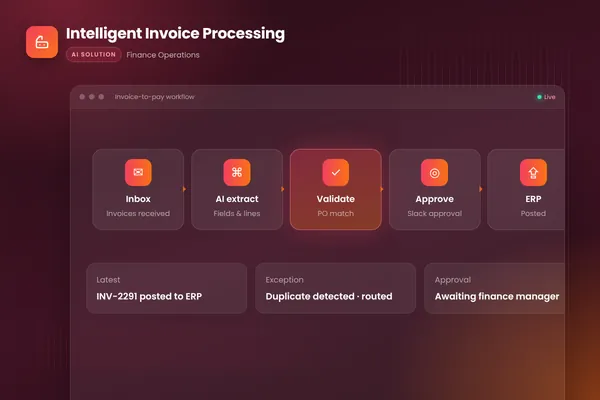
We build the agent on your ledgers, mapping and approval list, and run the 30 days in the plan below. The intelligent invoice processing case study is our closest published build: an agent that extracts, matches, flags mismatches and routes approvals, with exceptions in a review queue showing the reason. Intercompany applies the same pattern to two ledgers instead of an invoice and a purchase order.
The autonomous workflows service page lists our process and stack. For a ready-made version, see the Done For You month-end reconciliation automation, live in 3 to 6 weeks. Prices are quoted after a short call. Our AI automation agency guide explains what to ask any delivery partner.
Why do finance teams call intercompany a data problem?
Because most breaks come from records that were never aligned, not from arithmetic. BlackLine says "At its core, intercompany is a data problem, one that manual effort won't solve", and describes four stages: recording transactions, reconciling balances, eliminating and reporting. Kognitos says the two sides can both be right by their own books and still disagree.
Deloitte offers the structural answer: a central repository for all intercompany transactions that acts as a single source of truth. An AI agent works best on top of that repository, because it reads one shape of data instead of seven. Our finance IT solutions guide and AI accounting software guide cover the data layer.
What does a worked intercompany break sheet look like?
It shows both sides of each break, the cause, what the agent does and what a person does. This is a BufferSol illustration with invented amounts and entities, built from the four causes the sources list. Use it as a template for your own first sheet.
| Ref | Entity A books | Entity B books | Gap | Cause | Agent does | Person does |
|---|---|---|---|---|---|---|
| 1 | $10,000 service charge, 31 Jan | Payable, 2 Feb | $10,000 in Jan | Timing | Labels timing, drafts an accrual on B | Approves the accrual |
| 2 | $4,800 management fee | $4,800 expense | None | None | Matches by reference | None |
| 3 | €9,000 receivable | $9,640 payable at a different rate | Small | FX | Labels FX, shows both rates | Treasury confirms the rate source |
| 4 | Receivable to B | Booked to general payables | Full line | Mapping | Cannot match, flags the account | Controller fixes the map |
| 5 | $25,000 loan | $25,000 loan, interest missing | Interest | Judgment | Flags missing interest | Controller decides treatment |
| 6 | $7,200 royalty | $7,150 expense | $50 | Amount | Labels as a small difference | Approves a write-off or asks A |
| 7 | Two invoices of $3,000 | One payment of $6,000 | None | One-to-many | Matches one to many by reference | Spot-checks the grouping |
| 8 | Fixed asset transfer | Not booked | Full line | Missing entry | Flags and drafts B's entry | Approves, checks unrealised profit |
The sheet is deliberately short. In a real close you will have hundreds of lines, and the point is that each has one label and one owner. Numeric advises categorising discrepancies by type, which is what the cause column does. Our financial close automation guide shows how tools handle one-to-many matches.
How should the agent label and explain a break?
With one label from a short list, a confidence level and the evidence on screen. Kognitos says the most important capability is reasoning about why breaks occur (timing, FX, coding, judgment) and resolving them. insightsoftware says discrepancies are flagged, investigated for root causes and resolved through journal entries or allocations.
BufferSol's label set has seven values: timing, FX, mapping, amount, missing entry, duplicate and judgment. The agent shows the two lines, the rule that did or did not match them and why it chose the label. For judgment it never proposes an entry, it only routes. Hypatos and HighRadius both describe agents that identify, validate and match; the labelling step is what makes the output reviewable. See our AI agent evaluation post.
What does a good intercompany exception queue look like?
One queue, one owner per side, a reason code and a due date on every item. Deloitte advises clear ownership with defined roles and responsibilities to reduce manual errors and improve handling of out-of-balance items. Numeric lists clear communication channels between entity accounting teams among its key actions.
| Field | Why it matters |
|---|---|
| Entity pair and lines | Everyone sees the same evidence |
| Label and confidence | Shows what the agent thinks and how sure it is |
| Owner on each side | Nobody waits for the other to act |
| Proposed entry | Turns discussion into a decision |
| Due date | Breaks cleared before consolidation, not after |
| Decision and approver | Becomes the audit trail |
Our workflow exception handling post and human-in-the-loop post cover queue design.
How do loans, fees and asset transfers differ from sales?
Each type has its own accounting treatment, so the agent should handle them with separate rules. Trintech's guide lists common eliminated types: intercompany sales of goods, shared service charges, management fees and corporate cost allocations, loans and related interest, royalties and licensing fees, fixed asset transfers and dividends, and says each has unique accounting considerations. Solver adds unrealised profit still sitting in inventory at period end.
| Type | Agent suitability (BufferSol view) | Why |
|---|---|---|
| Sales and purchases of services | High | Reference and amount usually match |
| Management fees and allocations | High | Recurring, predictable amounts |
| Loans and interest | Medium | Interest and rate changes cause breaks |
| Royalties | Medium | Rate and period rules vary |
| Fixed asset transfers | Low | Unrealised profit needs judgment |
| Dividends and equity | Low | Policy-heavy, person-led |
Start with the high rows and add the others as the first pair stabilises. See our financial close automation guide.
What is a safe autonomy ladder for an intercompany agent?
Move up one rung at a time, and only when the log supports it. OpenAI's guide says human intervention is "especially important early in deployment, helping identify failures, uncover edge cases, and establish a robust evaluation cycle." Anthropic says the most successful implementations it saw used simple, composable patterns.
| Rung | What the agent does | Move up when |
|---|---|---|
| 1 | Reads and reports breaks only | Labels match your own for two closes |
| 2 | Matches by rule and labels | Reviewers rarely change a label |
| 3 | Drafts entries for approval | Approvers rarely edit a draft |
| 4 | Posts small, rule-bound items with a limit | Never without a written policy and approver |
This ladder is BufferSol view. Rung 4 is optional, and many teams stop at rung 3. BDO says the risk increases when AI affects financial reporting with limited human oversight. Our AI agent development guide covers permissions.
How do preventative controls reduce breaks before month end?
By checking entries when they are posted, not when they are reconciled. Trintech describes "preventative & detective controls" and rule-based controls that enforce pricing, timing and approval standards. HighRadius says agents monitor continuously, not just at period end, so problems show up while the entity can still fix them.
A simple preventative set: require a trading partner and a reference on every intercompany line, block posting to an unmapped account, show the agreed rate on the entry and flag a cut-off breach on the last day. Each rule removes a whole class of breaks. Microsoft's setup page shows one way a system holds the originating and destination setup in a shared table. See our AI accounting software guide.
How do you test the agent before it touches live balances?
Replay two past closes and compare its labels with what your team found. Take last month's and the month before's intercompany lines for the pilot pair, run the agent read-only, and score three things: did it match what your team matched, did it label each break the way your team did and did it invent a break that was not real. OpenAI stresses a robust evaluation cycle.
Kognitos warns that false exceptions at scale are harder to resolve than the manual process, so count false exceptions explicitly. BufferSol pass marks for rung 2, set as view and tuned to you: label agreement on most breaks, no unexplained false exceptions and every unmatched line explained. Our AI agent evaluation post and AI readiness assessment help set them.
Which questions should you ask an intercompany vendor in writing?
Ask for the data they need, the labels they produce, the approvals they enforce, the evidence they keep, the exit and the baseline they will help you take. Each question comes from a gap above.
- What data do you need from each ledger, and read-only or write? Microsoft shows how originating and destination setups differ.
- How do you map accounts across entities? Kognitos says mapping comes first.
- Which actions need a person? BDO says review must be real.
- What evidence does the log keep? COSO frames control around confidence in information.
- What did your headline result measure? Trintech's figures are vendor-published.
- How do we leave, and what do we keep? Ask for the map, rules and log in a usable format.
Compare answers side by side. Our AI vendor security questionnaire post shows how.
Is a spreadsheet enough for a small group?
For two or three entities with few transactions, often yes. Intuit says that reviewing spreadsheets, reconciling mismatched data and manually identifying unrealised profits "can delay your close by weeks", a vendor statement with no method behind it. Solver says the gap between "must be eliminated" and "how to eliminate it" is where most of the manual close work lives.
BufferSol view: automate when you can name the pain in numbers, such as breaks per close and days to clear, and when entity pairs or ledgers are multiplying. Below that, tighten the spreadsheet with a standard reference, a map and a cut-off calendar first. Those same steps make later automation easier. Our AI for accounting firms post and AI for accounting firms post cover lighter setups.
What happens after day 30?
You widen pair by pair and move up the autonomy ladder only on evidence. Month two adds the next busiest pair and a second tolerance. Month three adds loans and fees to the rule set. After the first full close on the pilot pair, review the baseline: breaks per close, days to clear and touches per break against where you started.
Keep three rules through all of it: nothing posts without an approver, every mapping change has an owner and every rule has a reason in the log. Treat netting and settlement as a separate phase. Deloitte separates settlement criteria and netting from reconciliation for the same reason. See our how long to build an AI agent post.
What does a failed intercompany pilot look like?
A failed pilot shows false exceptions rising, labels that reviewers keep changing, or entries posted without approval. None ends the project. Each points to a fix: a mapping error, a missing rule or a scope that was too wide. Decide with the baseline numbers you took in week one, using widen, hold or stop.
If you stop, keep the account map, the rules, the break sheet and the exception log, since all are reusable. Kognitos says the mapping has to be right first, and a pilot that fixes the map is still a gain. Our workflow exception handling post and AI automation agency guide cover restarting with a narrower scope.
How should a controller read the agent's weekly report?
Look at five numbers and one list, in the same order every week. The numbers are the baseline measures: breaks opened, days to clear, touches per break, share cleared by rule and unresolved items. The list is every entry the agent drafted and a person changed, with the reason. BDO asks what the AI is doing, what the reviewer can see, whether data can be changed and whether the review is substantive, and the weekly report is where a controller checks those answers.
Kognitos warns about false exceptions at scale, so add one more number: breaks the agent raised that turned out not to be real. Trintech and HighRadius both describe real-time or continuous flagging, which makes a weekly rhythm easy to keep. Our AI agent evaluation post and financial close automation guide show how to track the trend over several closes.
| The AI agent | A person | |
|---|---|---|
| Collect and normalise | Reads both ledgers and the account map | Owns the map and approves changes |
| Match | Applies the rules and tolerance | Sets the rules and reviews the first weeks |
| Explain | Labels each break and shows evidence | Resolves judgment cases |
| Draft | Prepares accruals, true-ups and eliminations | Approves every posting |
| Report | Sends the weekly numbers and the changed-draft list | Decides widen, hold or stop |
BufferSol Technologies · buffersoltech.com
What role does treasury play in an intercompany pilot?
Treasury owns the exchange rate source and the settlement step, so involve it in week one. insightsoftware notes that some organisations perform currency-adjusted reconciliations to account for rate movements before consolidation, which only works if both sides use the same rate source and date. Deloitte describes treasury teams running their own netting and settlement initiatives, and warns that unshared scope wastes effort.
Ask treasury for three things: the rate source and cut-off time, the settlement calendar and the netting rules if any. Write them into the pilot plan, and keep netting out of the first 30 days. Our accounts receivable automation guide and AI bookkeeping post cover neighbouring settlement and ledger work.
Which controls does an auditor expect around an AI-drafted intercompany entry?
We found no rule that says auditors expect a specific control, so base the design on guidance that exists. BDO says that if AI suggests coding or prepares support for a journal entry, someone with the appropriate knowledge should review the output before it is finalised. The PCAOB spotlight records preparers emphasising human supervision of generative AI output in financial reporting.
COSO publishes the Internal Control - Integrated Framework and lists newer documents on generative AI and robotic process automation. Practical design: named approver, a log that shows draft and final entry side by side, access limited to the agent's service account, and a change record for every rule and mapping. Our auditors and AI-prepared reconciliations post covers what auditors ask to see, and the AI agent evaluation post covers testing.
Which source backs which mistake?
Each mistake rests on named pages. A row with one vendor source is one vendor's view.
| Mistake | Main sources | What they support |
|---|---|---|
| 1. Matching before fixing causes | Kognitos, BlackLine, Microsoft | Cleanup first; data problem; unique accounts |
| 2. No person on approval | BDO, OpenAI, EUR-Lex | Assist versus control; high-risk actions; impairment judgment |
| 3. Vendor headline as proof | Trintech, Numeric | Vendor figures; root-cause records |
| 4. Every pair at once | Deloitte, Kognitos | Overlapping owners; one problem per pair |
| 5. Cut-off, FX, policy late | insightsoftware, EUR-Lex | FX example; uniform policies and reporting date |
| Agent behaviour | HighRadius, Hypatos, Solver | Matching, dialogue, elimination rules |
Hypatos says agent-based solutions can automate much of the data identification, extraction, validation and matching between related payable and receivable transactions in affiliated entities; we use that page only for that sentence.
Where should you read next?
These BufferSol guides go deeper on one part each and can be read in any order.
| If your gap is | Read | What it covers |
|---|---|---|
| The whole finance programme | Finance IT solutions guide | Close, AR, reconciliation and reporting |
| The close | Financial close automation | Tasks, owners and timing |
| Tool choice | Reconciliation software vs AI agents | When each wins |
| Review and audit | Auditors and AI-prepared reconciliations | What reviewers need to see |
| Bank side | Bank reconciliation automation | Match-then-review on a bank feed |
| Approvals | Human-in-the-loop AI agents | Where people approve |
| Scoring | AI agent evaluation | Test sets and pass marks |
| Timeline | How long to build an AI agent | What fits in 30 days |
| Value | AI agent ROI calculator | Your own volume and cost |
What are the limits of this guide?
It is a planning guide, not accounting or tax advice. We tested no vendor product and found no source that verifies a 30-day automation of intercompany reconciliation, so the plan is labelled BufferSol's own. The IFRS 10 text we cite is the version endorsed in an EU regulation of 2012, and we did not retrieve ASC 810. Transfer pricing and tax treatment are outside this guide.
NetSuite's article and Nanonets' page returned an access error or a missing page, and the Oracle documentation page returned only navigation text, so none is used. The Hypatos page was only partly readable, so one sentence is all we take from it. Read our financial close automation guide for the surrounding process.
What does a 30-day pilot deliver for intercompany reconciliation?
It delivers a working agent on your real balances for one entity pair and a decision you can defend. BufferSol's 30-day pilot follows the shape of our other autonomous workflow builds: a prototype in about two weeks, then a live pilot on one pair with a person approving every posting.
| Days | Deliverable | Output you keep |
|---|---|---|
| 1 to 5 | Pair chosen, baseline taken, account map drafted | Baseline of breaks, days to clear and touches |
| 6 to 14 | Agent reads both ledgers, match rule and tolerance written | Breaks labelled by cause on last month's data |
| 15 to 22 | Live on the pair, drafts only, person approves everything | Exception log with owners and reasons |
| 23 to 30 | Measure and decide | A widen, hold or stop memo beside the baseline |
What we need from you: read access to both ledgers, last two months of intercompany lines, the account map owners and the approval list. Success is judged on your baseline, not a vendor headline. Our how long to build an AI agent post gives the wider timeline.
Is this right for you?
It is if you recognise most of these signs:
- Intercompany balances are still agreed over email in the last days of the close.
- Two entities book the same transaction in different months or at different rates.
- You cannot say how many breaks a typical close opens or how long each takes to clear.
- You run more than one ERP or chart of accounts across the group.
- A vendor promised a headline automation rate and you have no baseline to test it.
If three or more apply, the Done For You month-end reconciliation automation is the matching automation: it is for finance teams that close the books each month and want an agent that matches, explains and routes the differences, live in 3 to 6 weeks. Prices are quoted after a short call, never on the page. Our AI agent ROI calculator gives a first view of the value.
Updated November 2026: all vendor statements checked on the dates in the text. Facts checked November 2026. Facts we did not re-check: US GAAP ASC 810 (not retrieved), the full text of IFRS 10 on the IFRS Foundation site (we read the EU-endorsed text), the content of COSO's 2026 generative AI paper (title only), and any vendor result figure beyond the page that states it.
A scoped estimate for your intercompany reconciliation is the sensible next step: plan the 2027 budget around one entity pair and a real baseline, and start the 30-day pilot in Q1 2027 so the first full close on that pair is measured before you widen.
Frequently asked questions
What is intercompany reconciliation automation?
Intercompany reconciliation automation is software, and increasingly AI agents, that matches the balances two related legal entities record against each other, flags the differences and routes them for resolution before consolidation. BlackLine defines the process as matching and agreeing intercompany balances before consolidation. An AI agent adds reasoning about why a break happened and drafts the fix for a person to approve.
Can AI agents automate intercompany eliminations?
An agent can draft elimination entries from agreed balances, and a person should approve them. IFRS 10, as endorsed in the EU, requires intragroup assets, liabilities, income, expenses and cash flows to be eliminated in full, and notes that intragroup losses may indicate an impairment. That second point is a judgment, so keep a person on the approval step.
What causes intercompany balances not to match?
Four causes recur in the sources: timing differences, such as one entity booking in January and the counterparty in February; foreign exchange differences, such as different rates on each side; inconsistent charts of accounts between entities; and judgment about how to record the same transaction. Kognitos and insightsoftware both list these, and each needs a different fix.
Do you need one chart of accounts to automate intercompany reconciliation?
No, but you need a clear mapping. Kognitos lists inconsistent charts of accounts as a breakpoint and warns that automation on misaligned mappings creates false exceptions at scale. Microsoft's Dynamics 365 setup guidance advises unique Due to and Due from main accounts per company to simplify reconciliation and elimination. A maintained map between entities is enough to start.
What should an AI agent be allowed to post in intercompany accounting?
Start with nothing that moves money or changes the ledger without approval. Let the agent detect, match, draft journals and route exceptions, and let a named person approve postings, write-offs and foreign exchange policy. OpenAI's agent guide says sensitive, irreversible or high-stakes actions should trigger human oversight until confidence in the agent grows.
How do you measure whether intercompany automation works?
Take a baseline before you start and track the same numbers after: breaks opened per entity pair, days to clear each break, touches per break, the share cleared by rule and the number unresolved at close. Vendor figures such as Trintech's 90 percent are their own claims. Your own baseline is the only comparison that tells you whether your close improved.
How long does it take to automate intercompany reconciliation?
A working pilot on one entity pair fits in about 30 days. BufferSol's plan puts a working agent on your real balances in about two weeks, then a live pilot with a person approving every posting. Stabilising rules across every entity pair takes longer, and no source we opened publishes a verified timeline, so treat 30 days as a pilot.
Sources
- What is Intercompany Reconciliation? (F&A Glossary), BlackLine
- Redefining Intercompany for the Next Era of Finance, BlackLine
- Intercompany Accounting, Deloitte US
- Intercompany Reconciliation, insightsoftware
- Intercompany Eliminations, insightsoftware
- Optimize Intercompany Accounting, Trintech
- What Are Intercompany Eliminations?, Trintech
- Intercompany Reconciliation: Automating the Hardest Close Step (2026), Kognitos
- A Guide to Automating Intercompany Accounting with Agentic AI, HighRadius
- How to use agentic AI to automate your intercompany reconciliation, Hypatos
- Commission Regulation (EU) No 1254/2012 (IFRS 10 as endorsed), EUR-Lex
- Intercompany accounting setup, Microsoft Learn
- Internal Control - Integrated Framework, COSO
- Reviewing AI in Finance Processes: Practical Audit Considerations for Controllers, BDO
- A practical guide to building agents, OpenAI
- Spotlight: Staff Update on Outreach Activities Related to the Integration of Generative AI in Audits and Financial Reporting, PCAOB
- Building effective agents, Anthropic
- Intercompany Reconciliation: A Guide to Eliminating Multi-Entity Transactions, Numeric
- How does consolidation software automate intercompany elimination entries?, Solver
- Intercompany eliminations: A guide for multi-entity businesses, Intuit
Cite this article
BufferSol Editorial Team (2026). Intercompany Reconciliation Automation With AI Agents in 2027: 5 Mistakes to Avoid. BufferSol Technologies. https://buffersoltech.com/blog/intercompany-reconciliation-automation-2027
BufferSol Editorial Team
AI & software engineering team
Senior engineers, AI specialists and product leads at BufferSol Technologies who design, build and run AI agents, autonomous workflows and custom software for companies in the US, UK and Europe.
Reviewed by Sufyan K., Senior Writer, BufferSol Technologies.