Key takeaways
- The gap between reconciliation software and an AI agent is narrowing: Trintech, BlackLine and HighRadius now describe agents, and every page we opened keeps a human on approvals.
- Ask who approves an adjustment and where it is logged, not whether the tool is called an agent.
- Solvexia's blog (20 August 2026) says reconciliation tools 'do not replace accounting judgment on exceptions'.
- No vendor page we opened showed a price, so ask for a written quote on your account and transaction volume.
- No independent accuracy benchmark was found; match rates on vendor pages are self-reported and untested.
Account reconciliation software matches two sets of records and flags the differences, while an AI reconciliation agent also works the differences: it investigates, proposes an adjustment and drafts the entry for a person to approve. In 2027 the more useful question is who approves the adjustment and where it is logged. We checked six vendors' own pages in November 2026.
For the wider picture, see our finance IT solutions guide. If you are also looking at close, our post on financial close automation covers the month-end side.
1. What exactly gets matched, and how much is left over?
Ask what the tool matches on its own and what it leaves in a queue. HighRadius's product page says the tool will "auto-match transactions using AI to minimize manual exceptions" and "detect missing entries, duplicates, timing gaps, or unmatched transactions instantly." Numeric says "reconcile the balance sheet automatically" and "increase match rate each month with suggestions from AI agents."
According to Solvexia's blog (20 August 2026), "reconciliation software automates the predictable and flags the unpredictable." Choose rules-based software when most of your volume is predictable, such as bank lines with clean references. Choose an agent when the leftover pile is large and each item needs research.
The pages do not separate bank matching, intercompany matching and balance-sheet substantiation, so name your scope in writing before a demo.
2. Who works the exceptions?
Find out whether the tool queues exceptions or investigates them. Trintech's home page says "Trintech's AI agents take on the reconciliations, matching, and journal entries that slow your financial close." FloQast says "Reconciliations matched. Exceptions flagged. Journal entries drafted — continuously, not just at month-end."
According to HighRadius's blog (last updated 2 April 2026), "agentic AI introduces autonomous exception handling that clears the queue in real-time." That is the vendor's own claim, and "autonomous" is its word. Test it by sending ten awkward items, such as a timing gap, a duplicate and a split payment, and read what the tool did with each.
Choose software if your team can clear exceptions in a day. Choose an agent if exceptions pile up and the same research repeats. Our post on workflow exception handling shows what a good exception record holds.
- 011. PickChoose ten open items from last month, including the hard ones.
- 022. RunLoad the same ten items into each tool.
- 033. ReadCheck what each tool proposed and the reason it gave.
- 044. CompareMark where the proposal matches what your team did.
- 055. TraceAsk for the log of one item from open to posted.
Source: BufferSol process
BufferSol Technologies · buffersoltech.com
3. Who approves the adjustment?
Every page we opened keeps a person on the sign-off, so ask who that person is. HighRadius's product page says "review exceptions with human-in-loop approvals and documented audit trails." Trintech says "your team keeps full oversight, and every action stays explainable and audit-ready" and describes "AI predicting, coordinating, and executing the work while keeping a human in the loop." FloQast says "every output is explainable, every decision is logged, and the sign-off always stays with you."
According to Solvexia's blog, "financial reconciliation tools do not replace accounting judgment on exceptions." BufferSol view: the person who approves an adjustment should not be the person who prepared the reconciliation, and the tool should enforce that. Our guide to human-in-the-loop AI agents explains approval design.
4. What does the log hold?
Ask for one adjustment's full history, because the log is what an auditor reads. HighRadius says the tool will "capture every match, exception, approval, and adjustment with timestamps" and "maintain traceability from exception → resolution → journal posting." Solvexia says "every match, exception, and resolution is logged with full context." FloQast says "every decision is traceable and exportable, ISO 42001 certified, and SOC 2 Type II compliant."
On controls, COSO says "effective internal controls are good for business" and "internal controls have value beyond compliance and external financial reporting." That is general framing, not a rule for reconciliations. We tried to open the PCAOB auditing standard and it did not load, so check your auditor's requirements directly.
5. What will it cost, and who says so?
Expect to ask, because no price was visible. HighRadius, FloQast, Trintech, Numeric and BlackLine showed no pricing on the pages we opened. BlackLine's headline calls it "The Agentic Financial Operations Platform", and the page text we retrieved stopped there, so we make no other claim about it.
Ask each vendor for a written annual quote that states:
- number of accounts and reconciliations per month
- transaction volume and data sources
- users and approvers
- implementation, training and connector fees
- what changes at renewal
A custom agent has a different shape: a one-off build plus run costs, with no per-seat fees, which we cover under the pilot below.
What changes in 2027 for reconciliation teams?
No analyst forecast or regulator timeline loaded for this post, so every forward claim is BufferSol view.
We expect the labels to blur: Trintech and BlackLine already call themselves agentic platforms and FloQast describes AI that drafts entries, so "agent" will say less than the log and the approval step do. We expect auditors to ask more about AI-prepared entries, but we found no source, so ask your own auditor. Plan a test in Q1 2027 on one account group before you commit a budget line.
How do the options compare side by side?
| Question | Reconciliation software | AI reconciliation agent |
|---|---|---|
| Matching | Rules and AI suggestions | Same, plus research on gaps |
| Exceptions | Queued for your team | Investigated, with a proposed fix |
| Approval | A person signs off | A person signs off, with the draft attached |
| Log | Match, exception, approval | Same, plus the reasoning |
| Price | Not public in our check | A scoped build quote |
Which questions should you put to every vendor in writing?
Send the same list to each vendor and compare the written answers, not the demos.
- Which reconciliation types are covered? Ask separately about bank matching, intercompany matching and balance-sheet substantiation, because the pages blur them.
- What does the agent do with an item it cannot match? Ask for a worked example with the reason, the proposed fix and the owner.
- Who can approve, and can the preparer approve their own work? Ask whether the tool enforces separation of duties and logs each step.
- What is in the log? Ask for one adjustment's history in an export your auditor can open.
- How is the match rate measured? Ask for the sample, the period and the account types behind any figure you are shown.
- What does the quote include? Ask for accounts, volume, users, implementation and renewal terms in one annual figure.
Keep the answers in one sheet next to your results from the ten-item test. A vendor that answers precisely in writing is usually easier to work with after you sign.
What does an AI reconciliation agent not do?
An agent does not own the control. It does not replace the accountant who signs off, it cannot fix source data that is wrong and the "autonomous" wording is the vendors' own. No independent accuracy benchmark was found, and match rates quoted in search results did not appear on pages we opened, so we do not quote them. Reconciliations also depend on clean feeds from your bank and ERP.
When does a custom agent beat reconciliation software?
A custom agent wins when your reconciliations follow your own rules: unusual account structures, several ledgers, or adjustments that need your policy. Choose packaged software when its standard workflow fits and your auditor already knows it. Choose a custom agent when you want the logic, prompts and logs in your own environment.
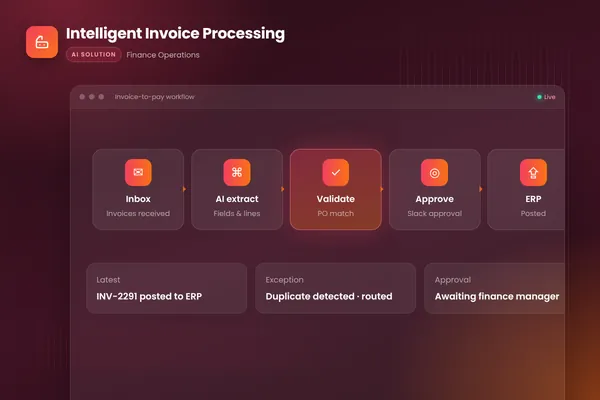
BufferSol's intelligent invoice processing project shows the pattern in AP: read, match, flag, route for approval and log. The same design suits reconciliation, and our autonomous workflows team builds it around your ledger and bank feeds. For related tools, see our best accounting automation software post and AI accounting software guide.
| Reconciliation software | Custom AI agent | |
|---|---|---|
| Best when | Standard flow fits and volume is predictable | Exceptions repeat and rules are your own |
| Approval | Built into the tool | Designed around your sign-off chain |
| First step | Test ten hard items | A 30-day pilot on one account group |
BufferSol Technologies · buffersoltech.com
What would a 30-day pilot deliver?
A pilot is a working agent on your real accounts inside 30 days.
- Week 1: you provide a month of bank and ledger exports for one account group, your matching rules and your approval chain.
- Weeks 2 and 3: a prototype matches items, investigates gaps and drafts adjustments, scored against what your team did.
- Week 4: a live pilot on that group, with every adjustment approved by a named person and logged.
Success is measured by the share of items matched without a person, exceptions explained with a reason, time to close that account group and adjustments reversed after approval. The ready-made version is our month-end reconciliation automation, built for finance teams that close the books by hand.
Is this right for you?
A pilot fits if most of these are true:
- Your team spends days each month matching and chasing gaps.
- Exceptions repeat and follow your own rules.
- You can export bank and ledger data.
- A named person can approve adjustments.
- Your auditor wants a log of each decision.
If none applies, test packaged software on ten hard items first. Our post on accounts receivable software questions covers the collections side.
Facts checked November 2026. Most vendor pages carry no dates and no prices, so re-check each one before you sign.
If reconciliations are taking your team days each month, ask BufferSol for a scoped estimate for a reconciliation agent, so the 2027 budget includes it and the pilot can start in Q1 2027.
Frequently asked questions
What is account reconciliation software?
Account reconciliation software compares two sets of records, such as a bank statement and a ledger, matches what agrees and flags what does not. Solvexia's blog says it 'automates the predictable and flags the unpredictable.' Modern tools add AI matching and exception workflows, and they keep a log of each match, exception and approval for the auditor.
How is an AI reconciliation agent different from reconciliation software?
Software matches by rules and queues what it cannot match. An AI reconciliation agent also works the exceptions: it investigates a gap, proposes an adjustment and drafts the journal entry for a person to approve. Vendor pages such as Trintech's describe agents doing this with a human in the loop, so the difference is how much of the exception work the tool does.
Can an AI agent post reconciliation adjustments without approval?
It can be built that way, but the vendor pages we opened do not do it. FloQast says 'the sign-off always stays with you', and HighRadius describes human-in-loop approvals. A safer design lets an agent draft the adjustment and a different person approve it, with both steps logged, which also keeps segregation of duties intact.
How much does account reconciliation software cost?
No vendor we checked in November 2026 showed a price on its pages: HighRadius, BlackLine, FloQast, Trintech and Numeric all left pricing out. Ask each vendor for a written annual quote that states your number of accounts, transaction volume, users and implementation fees, so quotes can be compared on the same basis.
Sources
- AI-Powered Account Reconciliation Software for Faster Financial Close | HighRadius, HighRadius
- FloQast | Accounting Workflow Automation, FloQast
- Trintech | Financial Close and Account Reconciliation Software, Trintech
- Numeric | The Data Platform for Finance, Numeric
- AI reconciliation software: what it actually does vs the hype?, Solvexia
- 7 Ways Agentic AI Enhances Accounts Reconciliation Speed and Accuracy, HighRadius
- Internal Control | COSO, COSO
- BlackLine: The Agentic Financial Operations Platform, BlackLine
Cite this article
BufferSol Editorial Team (2026). Account Reconciliation Software vs AI Reconciliation Agents: 5 Questions to Settle Before 2027. BufferSol Technologies. https://buffersoltech.com/blog/account-reconciliation-software-vs-ai-agents-2027
BufferSol Editorial Team
AI & software engineering team
Senior engineers, AI specialists and product leads at BufferSol Technologies who design, build and run AI agents, autonomous workflows and custom software for companies in the US, UK and Europe.
Reviewed by Sufyan K., Senior Writer, BufferSol Technologies.