Key takeaways
- A realistic first live slice is about six weeks for one helpdesk and one language, per eesel's week-by-week plan: 2 weeks is the floor and 8 weeks a normal ceiling. These are vendor planning ranges, not independent measurements.
- Published figures vary because vendors count different things as live: Intercom's Fin enterprise page says most deployments launch within 20 days, Salesforce says 6-12 weeks for complex enterprise deployments, and Macha says about a quarter for multi-brand, multi-language teams.
- Connecting a helpdesk takes an afternoon on eesel's account; the time goes into knowledge, a drafts-only phase and approvals. Intercom requires at least 10 public Help Center articles before Fin can go live.
- Since 2 August 2026, the European Commission says Article 50 of the AI Act applies, so people must be told they are talking to an AI from the start of the first interaction unless it is obvious.
- BufferSol's own figures: a working support agent on your real tickets inside 30 days (a prototype in about two weeks, then a live pilot on a first slice), and Done For You automations live in 3 to 6 weeks.
How long to deploy an AI support agent in 2027? A live slice on one helpdesk and one language takes about six weeks on eesel's week-by-week plan, with 2 weeks as the floor and 8 as a normal ceiling. "Live" means the agent answers real customers without a person reading each reply first. Vendors who say "under an hour" mean connected, not live. BufferSol's pilot puts a working agent on your tickets inside 30 days.
This post lays out the six weeks, shows what each source says for each step, and explains what slows teams down. For the wider picture see our AI customer support agent guide and our AI customer service post and AI customer service software post cover tools and prices.
What does "live" mean when a vendor says an AI support agent is live?
It means one of five things, and the headline numbers depend on which one is counted. Connected means the agent can read your helpdesk. Drafting means it writes replies that a person sends. Assisted means it answers a small audience. Autonomous means it answers the easy topics alone. Full coverage means every topic, channel and language.
Macha says published timelines run from "less than an hour" to connect to 30 to 90 days, and that "the spread comes from what each vendor counts as done." The table below sorts the definitions. It is BufferSol's own framing, built from the sources linked in each row.
| Stage | What the agent does | Typical sourced timing |
|---|---|---|
| 1. Connected | Reads the helpdesk and help center | An afternoon, per eesel; under an hour with pre-built integrations, per Fin |
| 2. Drafting | Writes replies a person approves | Week one, "often in the first week" |
| 3. Assisted | Answers a small test or internal audience | Intercom's steps before any wider audience |
| 4. Autonomous on easy topics | Answers the easiest topics alone | Week 6 in eesel's plan |
| 5. Full coverage | Many categories, actions, brands and languages | 6 to 8 weeks with actions; about a quarter multi-brand |
Source: Figures as published by Fin, eesel, Salesforce and Macha in 2026; each is a vendor or vendor-adjacent claim, not an independent measurement.
BufferSol Technologies · buffersoltech.com
1. Week 1: how do you connect the helpdesk and pick five topics?
Connect the helpdesk on day one, then pick five routine, high-volume topics and name one owner. Day one is easy by design. The harder part is choosing a narrow slice, because every source we read ties speed to starting small. This is the step that decides whether the plan takes two weeks or eight.
eesel says "Connecting the helpdesk takes an afternoon; the rest goes into knowledge, a drafts-only phase and approvals." Twig lists "Willingness to start with a focused scope (e.g., one product line or one ticket category)" among what speeds a rollout, and "Requirement to handle 100% of ticket types from day one" among what slows it. Pick topics such as order status, returns, shipping and password resets; our order-status automation and refunds and returns automation are narrow starts.
Do this week: connect read access, export 200 to 300 recent tickets, choose the five topics, and name the person who can say what the right answer is within a day. Start the security and data processing review now; Macha says that review "is the slowdown that most often runs longest" and adds 10 to 30 days in its estimate unless it starts on day one. Our AI vendor security questionnaire post and DPA post list what to ask.
2. Week 2: why fix the knowledge before the AI?
Because the agent can only be as good as the answers it reads. Most delays hide here. Fix the answers for your five topics, remove contradictions and add the missing ones. A thin help center is the main reason plans stretch from six weeks to eight or longer.
Two sources put numbers on it. eesel says "Teams that need to build their knowledge base first usually take six to eight weeks." Intercom's setup guide says "To set Fin live, you must have at least 10 public articles live in your Help Center." That is a product floor, not a measure of quality. Twig lists "Sparse or outdated documentation" as the first slowdown.
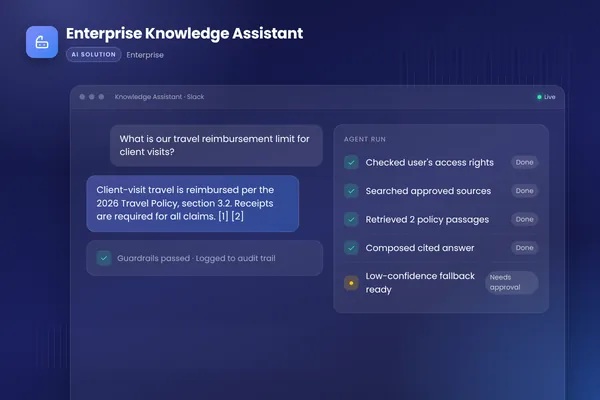
Do this week: for each of the five topics, write the answer a good agent would give, link the policy it comes from, and mark who approves changes. Our enterprise knowledge assistant shows how a grounded answer layer works, and our AI readiness assessment checks the data side.
3. Week 3: how do you test on tickets you already solved?
Run the agent on past tickets where you know the right answer, and score it. A test on solved tickets costs nothing in customer trust and tells you where the knowledge is still wrong. Write the cases before you tune anything.
eesel puts it in week 3: "test on tickets you've already solved." Anthropic's evals guide says "20-50 simple tasks drawn from real failures is a great start" and that regression evals "should have a nearly 100% pass rate" to protect "against backsliding". It also names three kinds of grader: "code-based, model-based, and human." Use all three: rules for policy, a model for tone and a person for the hard calls.
Do this week: build a set of 20 to 50 past tickets across the five topics, including ones that should escalate. Score right answer, right tone and right escalation, and write down the failures. Our AI agent evaluation post shows how to score the set, and our workflow exception handling post shows what a clean handover looks like.
4. Week 4: what changes when drafts go out on live tickets?
The agent writes a reply on every real ticket in the five topics and a person reads it before it sends. Drafting is the safest way to meet real customers because a person reads every reply. It gives you real edits to learn from, which is why most plans spend two weeks here.
eesel says drafts on live tickets "can start much sooner, often in the first week, because drafting carries no risk: a person reads every reply before it goes out." The OpenAI Agents SDK documents the same idea in code: "pause agent execution until a person approves or rejects sensitive tool calls." Twig puts setup and testing in weeks 1-2 and the soft launch in weeks 3-4.
Do this week: turn on drafts for the five topics, have agents accept, edit or reject each one, and track the edit rate. Our human-in-the-loop AI agents post and AI ticket routing post show approve-first designs.
5. Week 5: how do you turn every edit into a rule?
Read each edit a person made and decide whether it is a missing fact, a wrong rule or a tone note. Then change the knowledge or the instructions once, so the same edit never has to be made twice. This is where quality climbs, and it is the least visible work in the plan.
eesel calls week 5 "drafts, and turn every edit into a rule." Twig says "Month 2 is about scaling coverage and addressing the gaps discovered during soft launch." Twig, a vendor, also says teams "typically see 20-40% ticket deflection by day 30 and 40-60% by day 90", which is a vendor claim we do not rely on; measure your own baseline.
Do this week: group the edits by cause, fix the top three causes, and rerun the 20 to 50 test cases so nothing regresses. Set the rule for when a draft may send without a person, such as a topic whose edit rate stays low. Our Zendesk AI agent mistakes post and Freshdesk AI agent post show the usual traps.
6. Week 6: when can the agent answer the easy topics alone?
When the edit rate on a topic is low and the test cases pass, switch that topic to autonomous replies for a small audience, then widen it. Do not switch all five at once. Widen by audience first, then topic, and keep the escalation path open.
Intercom's guide says to "Expand the audience Fin is replying to, so that Fin is replying to some real customer conversations," then "Review the results from Fin AI Agent > Analyze then expand Fin to handle more of your volume or topics." It also warns that "Fin will immediately begin handling conversations for the audience you've configured." eesel puts "let it answer the easiest topics on its own" in week 6.
Do this week: switch on the lowest-risk topic for a small audience, with a visible handover to a person and a daily review for the first week. Our ticket triage and resolution automation is the ready-made version, and our support inbox automation covers email.
What does the six-week plan look like at a glance?
Here it is as a table, with a source for every row and BufferSol's own mapping in the last column. The sources are vendor plans, so read the weeks as planning ranges.
| Week | Step | Source for the step | BufferSol pilot mapping |
|---|---|---|---|
| 1 | Connect, pick five topics | eesel, Twig | Discovery and access |
| 2 | Fix the knowledge | Intercom, eesel | Prototype starts on your real data |
| 3 | Test on solved tickets | Anthropic, eesel | Prototype scored on your cases |
| 4 | Drafts on live tickets | OpenAI Agents SDK, Twig | Live pilot on a first slice, with approvals |
| 5 | Turn edits into rules | eesel | Pilot tuning and report |
| 6 | Easy topics alone | Intercom | Next slice, agreed from pilot results |
- 01Week 1Connect the helpdesk, pick five topics, name an owner, start security review.
- 02Week 2Fix the knowledge for those topics.
- 03Week 3Test on 20 to 50 solved tickets.
- 04Week 4Drafts on live tickets, a person approves each one.
- 05Week 5Turn every edit into a rule and rerun the tests.
- 06Week 6Easy topics answered alone, for a small audience first.
Source: Steps from eesel's week-by-week plan, mapped by BufferSol
BufferSol Technologies · buffersoltech.com
How long do larger or more complex deployments take?
Longer, and the sources agree on the direction. Salesforce says typical enterprise timelines are 6-12 weeks, Macha says about a quarter for multi-brand, multi-language teams, and Twig says ranges run to 90 days. The drivers are scope, actions and approvals, not the model.
Salesforce's Agentforce page says "For more complex enterprise deployments involving multiple agents, integrations, and change management, a typical timeline is 6–12 weeks from kickoff to production," and gives "Engine deployed their customer-facing AI agent in just 12 days, while Safari365 went live in six weeks." Those are Salesforce's chosen examples. Fin's enterprise page says "Most enterprise deployments launch within 20 days" with its Deployment Services team and "Setup takes under an hour for platforms with pre-built integrations." That is a vendor claim tied to a paid service.
Twig says implementation "ranges from 30 minutes to 90 days," and "A vendor that implemented in 30 minutes for a 10-person team may take 6 weeks for a 200-person team." Its table lists Decagon at about six weeks, Sierra at weeks to months and Forethought at 30 to 90 days. Macha adds a scale marker: Leafworks reports bringing one client's 3 business units, 11 support addresses and 4 languages into a single Zendesk setup in 5 weeks. Macha notes that was the help desk consolidation, and the AI work sits on top of a setup like that.
Why does launching all categories at once cost about five weeks?
Because each category adds its own knowledge, tests and approvals. Macha says "a team that launches all three together goes live in week 7 or 8 instead of week 2 or 3." That is a gap of 5 weeks either way: 7 minus 2 is 5, and 8 minus 3 is 5. This arithmetic is a BufferSol estimate from Macha's own numbers.
The order matters more than the speed. Launch the first category, learn from real edits, then add the next one, and you reach real customers sooner and make fewer repeated mistakes. Our Shopify customer support AI post and WISMO automation post show a narrow first category, and our returns automation post shows a second one that takes actions.
Why do actions take longer than answers?
Because an action changes a system and has to be safe to repeat. A read-only answer can be wrong without harm; a refund cannot. Twig says "A full API integration with custom workflows takes weeks." Macha budgets 6 to 8 weeks for several categories with actions, against 1 to 2 weeks for one ticket category on one help desk.
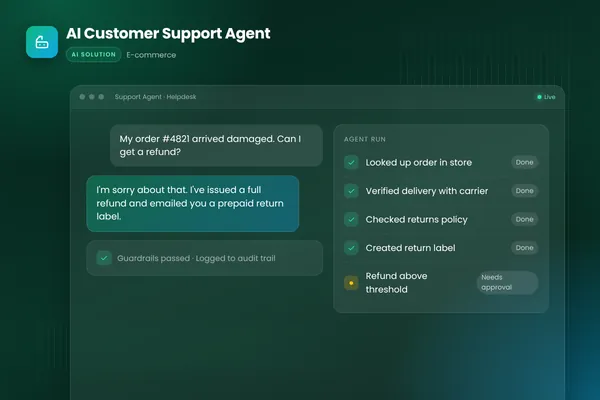
The OpenAI Agents SDK warns that approval "permits a tool call to execute; it does not guarantee exactly-once execution." So an action needs an approval path, a safe repeat and a log. In BufferSol's AI customer support agent, the agent looks up orders and creates return labels itself, while refunds above a threshold go to a person with a summary. Our AI agents service builds these connections.
What does the EU AI Act change for a support agent in 2027?
It adds a disclosure step that is already in force. The European Commission says Article 50 applies from 2 August 2026, and that people must be told they are interacting with an AI unless it is obvious. A support agent that talks to EU customers needs a clear first-message notice, and the wording is part of the plan.
The Commission's FAQ says "Providers of AI systems that directly interact with people must design and develop those systems in such a way that the individuals concerned are informed that they are interacting with an AI system, unless this is obvious," and "People must be notified when they are interacting with an AI system from the start of the first interaction in a clear and distinguishable manner." The FAQ was last updated on 24 July 2026. A practical guide from a third-party site says the same and that "These obligations apply from 2 August 2026." We did not check US or UK rules, and this is not legal advice.
What changes in 2027 for AI support agent timelines?
Three dated facts and one view. Every forward claim here is labelled.
- Disclosure is now part of go-live. The Commission says Article 50 applies from 2 August 2026, so a 2027 launch plan includes the notice from day one.
- The risk framework is being revised. NIST's page says "The AI RMF 1.0 is being revised as part of the White House AI Action Plan," so check it again before a 2027 review. It is "intended for voluntary use."
- Evals are a named step. Anthropic tells teams to start early, which is why week 3 above is a test on solved tickets.
- BufferSol view: "live in minutes" claims will keep falling, and buyers will ask what the vendor counts as live. Expect 2027 plans to be judged on how soon the first topic answers alone with a low edit rate, not on connection time. No analyst source we opened forecasts this.
What does each source count, side by side?
Each counts a different finish line, which is why the numbers cannot be compared directly. This table lists every timeline we opened, who published it, what they sell and what the figure covers.
| Source | Sells | Figure | What it covers |
|---|---|---|---|
| Fin enterprise page | An AI agent | 20 days, most enterprise deployments | With its Deployment Services team |
| Fin enterprise page | An AI agent | Under an hour | Platforms with pre-built integrations |
| Salesforce | An AI agent platform | 6-12 weeks | Complex enterprise deployments |
| Twig | An AI support tool | 30 minutes to 90 days | Depends on architecture, training and integrations |
| Twig, 90-day plan | An AI support tool | Weeks 1-2 setup, weeks 3-4 soft launch | A phased plan to month 3 |
| Macha | AI agent services | 1-2 weeks, 6-8 weeks, about a quarter | One category, several with actions, multi-brand |
| eesel | An AI support tool | 2 to 8 weeks | Kickoff to answering customers alone |
| BufferSol | Custom agents and Done For You | 30 days to a working pilot; 3 to 6 weeks live | BufferSol delivery data |
Read the middle of the table as the planning range: about two to eight weeks for a first live slice, and six to twelve for something broader. The edges are the cases that count connection, or that include a paid deployment team.
How do you decide a topic is ready to answer alone?
Set the rule before week 4, in numbers, so nobody argues about it in week 6. Here is a worked example, labelled as a BufferSol estimate with assumed numbers, not results. Say the agent drafts 200 replies on one topic across weeks 4 and 5, and reviewers edit 20 of them. That is a 10% edit rate (20 divided by 200). A rule such as "switch the topic to autonomous when the edit rate stays under 10% for two weeks and all 20 to 50 test cases pass" is then testable.
The numbers are yours to choose; the habit is the point. Anthropic's evals guide describes regression evals that "should have a nearly 100% pass rate", and Intercom tells teams to "Review the results from Fin AI Agent > Analyze" before widening. Write the threshold, the audience size and the person who decides into one page, and keep it with the ticket triage and resolution automation scope. Our human-in-the-loop AI agents post shows how to design the review step.
How does a platform rollout differ from a custom agent build?
A platform is faster to start and a custom agent fits your systems better. A platform such as Fin or Agentforce brings the agent and the connections to its own helpdesk. A custom agent is built around your tools, your approval rules and your data, and so it needs more discovery before the first test.
| Platform inside one helpdesk | Custom agent built by BufferSol | |
|---|---|---|
| Connection | Pre-built integration to its own helpdesk | Built around your tools and APIs |
| Where the time goes | Knowledge, drafts, approvals | The same, plus integrations and permissions |
| Actions in your systems | Limited to what the platform offers | Designed per action, with approvals |
| Who owns the rules | The vendor's settings | You, in your own repository |
| First working version | Days to weeks, per vendors | A working agent inside 30 days, BufferSol delivery data |
Source: BufferSol view, built from the vendor pages cited in this post
BufferSol Technologies · buffersoltech.com
Choose a platform if one helpdesk holds the work and its limits suit you. Choose a custom agent if the agent must act across several of your tools, follow your approval rules and report in your terms. Twig says "A full API integration with custom workflows takes weeks", which is the cost of that fit. Our AI agents service, AI customer support agent project and Done For You catalogue show both routes.
What should you measure in the first 30 days after launch?
Four things: edit rate on drafts, share of tickets finished without a person, escalations that went to the right person, and customer complaints about the agent. Track them daily for the first two weeks, as Twig says: "Expect to spend the first 2-4 weeks monitoring closely".
Compare each to your own baseline from before launch, not to a vendor figure. Twig offers 20-40% deflection by day 30 as its own expectation, and we treat it as a vendor claim. Intercom names "resolution rate, CSAT" as example success metrics. Pick yours in week 1, so the pilot report in week 4 has a before and after. Our customer feedback insights automation turns complaints into a theme list, and our AI ticket routing post shows what to log.
Who does what in each week?
Four roles carry the plan, and the calendar slips when one of them is missing. The table is BufferSol view, with the source for each duty linked, and it assumes a team with one helpdesk and no unusual review.
| Role | Weeks 1-2 | Weeks 3-4 | Weeks 5-6 |
|---|---|---|---|
| Support lead | Picks five topics and the success metrics, per Twig | Reviews edit rate, per eesel | Decides the first autonomous topic, per Intercom |
| Knowledge owner | Fixes answers for the five topics; Intercom needs 10 public articles | Turns edits into articles | Updates articles as policy changes |
| Reviewers | Write 20 to 50 test cases, per Anthropic | Accept, edit or reject drafts, per the OpenAI Agents SDK | Spot-check autonomous replies |
| IT and security | Review data flows, which Macha says runs longest | Grant scoped access | Approve widening, with the Article 50 notice live |
If a role is vacant, name a stand-in before week 1; the delays Twig lists, and the speed factors it names, such as an "Executive sponsor who can make decisions quickly", are mostly about people, not software. Our support inbox automation and AI help desk post show how small teams share these roles.
What puts a deployment near two weeks, near eight, or beyond?
Scope, knowledge, approvals and reviews. This table is BufferSol view, built from the sources above and our projects, not a public benchmark.
| Factor | Toward 2 weeks | Toward 8 weeks or more |
|---|---|---|
| Scope | One category, one helpdesk, one language | Several categories, brands or languages (Macha) |
| Knowledge | Clear, current articles | Sparse or outdated (Twig) |
| Actions | Read-only answers | Refunds, cancellations, record changes |
| Approvals | A named owner who decides in a day | Long approval chains for customer-facing changes |
| Reviews | Security and legal started in week 1 | Started after the build |
| Helpdesk | A common helpdesk with pre-built integrations | Custom or legacy system |
What do the sources not tell you about deploying an AI support agent?
No independent study with a measured production timeline turned up. Every duration here comes from a vendor or a consultancy selling something. Twig, Macha and eesel all sell AI support products or services, and Fin and Salesforce sell their own agents. We could not open Zendesk's AI agents page, which returned an error, so no Zendesk timeline is given.
eesel says its numbers "are planning ranges from rollouts I've watched, not a vendor promise." Treat all of them that way. Intercom's setup guide gives a process and no duration, and we found no Intercom page with an official rollout time apart from Fin's enterprise claim.
What does it not cover: the agent's limits
An AI support agent does not remove the need for people. It cannot judge an unusual refund, it will not know a policy that has not been written down, and it can be wrong with confidence. A plan that ends at launch has no one watching quality. Twig says "Expect to spend the first 2-4 weeks monitoring closely" after go-live.
That tail is real work: read samples daily, review escalations, update the knowledge when policies change and rerun the test cases after every change. Anthropic calls regression evals the guard against backsliding. Our AI agent versus chatbot post and AI customer service agent post explain where the line falls.
Which questions should you ask a vendor about their timeline in writing?
Ask these before you sign, and keep the answers.
- What counts as live in your quote: connected, drafting, assisted or autonomous? See Macha's point on what each vendor counts as done.
- How many help center articles must exist before launch? Intercom says at least 10 for Fin.
- How is the first audience limited, and how do we widen it?
- How are actions approved and made safe to repeat, as the OpenAI Agents SDK warns?
- Who runs the security and data processing review, and when does it start? Macha says it often runs longest.
- What is the AI disclosure text, and where does it appear, given Article 50?
- Who watches quality for the first 2-4 weeks, as Twig advises?
What does a 30-day pilot deliver for a support agent?
In 30 days you get a working AI support agent on your real tickets, with your team approving what matters. The plan, which matches weeks 1 to 4 above:
- You bring: read access to your helpdesk and help center, 200 to 300 recent tickets, five topics to start with, a named owner and one reviewer who can decide within a day.
- We build, in about two weeks: a prototype on your real tickets, scored on 20 to 50 cases you choose for accuracy, tone and escalation.
- We launch, in the final stretch: a live pilot on a first slice, with a person approving replies, logging, an edit-rate report and a plan for the next topic.
BufferSol delivery data: a working agent on your real tickets inside 30 days, with Done For You automations live in 3 to 6 weeks. These are our commitments, not an industry benchmark. Success is measured on your own baseline: accuracy on the case set, edit rate on drafts, share of tickets resolved without a person and time saved. A pilot is not the full rollout; it shows what a full rollout needs. Done For You is the shorter route when a catalogue item fits: BufferSol builds and runs it, with pricing quoted after a short call. Start with the ticket triage and resolution automation, the order status automation or the Done For You catalogue. The online stores page shows the type of business it fits. Our customer feedback insights automation is a useful add-on.
Is this right for you?
Check how many describe your team:
- You can name five routine topics that make up a big share of tickets.
- Your help center, or a set of macros, already holds the answers.
- One person can decide what the right answer is within a day.
- You can tell which actions a person must approve.
- You want to see the agent on your own tickets before you widen it.
If few apply, start with a week on knowledge and one topic. Our AI help desk post, AI customer service software post and AI customer service agent post show smaller first steps, and our how-long-to-build post covers custom builds.
Facts checked November 2026 on Intercom's setup guide, Fin's enterprise page, Salesforce, Twig, Macha, eesel, the European Commission FAQ, NIST, Anthropic and the OpenAI Agents SDK. Facts we did not re-check: Zendesk's page (it returned an error), the NIST AI 100-1 PDF, any US or UK disclosure rule, and every BufferSol timeline (our own delivery data).
If one ticket category is costing your team the most time, ask BufferSol for a scoped estimate and a 30-day pilot plan for it now, so the 2027 budget covers it and the pilot can start in Q1 2027.
Frequently asked questions
How long does it take to deploy an AI customer support agent?
For one helpdesk and one language, eesel says 2 weeks is the floor and 8 weeks a normal ceiling before the agent answers customers on its own, and its sample plan takes six weeks. Macha says 6 to 8 weeks for several categories with actions. These are vendor ranges. BufferSol's pilot puts a working agent on your real tickets inside 30 days.
Can an AI support agent go live in one day?
It can be connected in a day, and on eesel's account connecting the helpdesk takes an afternoon. Going live in a way you can trust takes longer, because the knowledge has to be right, the agent has to be tested on past tickets and people have to approve replies first. Intercom, for example, requires at least 10 public Help Center articles before Fin can go live.
What slows down an AI support agent deployment?
Twig lists sparse or outdated documentation, a custom or legacy helpdesk, complex approval chains for customer-facing changes and a demand to handle every ticket type from day one. Macha adds that a security and data processing review is the slowdown that most often runs longest. Starting those reviews in week one, and launching one ticket category first, shortens the plan.
How many help center articles does an AI support agent need?
It depends on the platform. Intercom states that to set Fin live you must have at least 10 public articles live in your Help Center. That is a floor for the product, not a quality bar. eesel says teams that must build their knowledge base first usually take six to eight weeks, so audit the articles for your top five topics before you start.
Do we have to tell customers they are talking to an AI?
In the EU, the European Commission says Article 50(1) of the AI Act requires providers of systems that interact directly with people to design them so people are informed they are interacting with an AI, unless this is obvious, and that Article 50 applies from 2 August 2026. Check US and UK rules separately. This is not legal advice.
Sources
- Set up and go live with Fin, Intercom
- Fin for Enterprise, Fin (Intercom)
- Agentforce metrics, Salesforce
- How long does AI support implementation actually take?, Twig
- What Does the First 90 Days of AI Customer Support Implementation Look Like?, Twig
- AI customer support implementation timeline, Macha
- AI support implementation timeline: a week-by-week plan from real rollouts, eesel
- Transparency obligations under Article 50 AI Act (FAQ), European Commission
- The EU AI Act's Transparency Rules: A Practical Guide to Article 50, artificialintelligenceact.eu
- AI Risk Management Framework, NIST
- Demystifying evals for AI agents, Anthropic
- Human-in-the-loop, OpenAI Agents SDK
Cite this article
BufferSol Editorial Team (2026). How Long to Deploy an AI Support Agent in 2027: A 6-Week Plan. BufferSol Technologies. https://buffersoltech.com/blog/how-long-to-deploy-an-ai-support-agent-2027
BufferSol Editorial Team
AI & software engineering team
Senior engineers, AI specialists and product leads at BufferSol Technologies who design, build and run AI agents, autonomous workflows and custom software for companies in the US, UK and Europe.
Reviewed by Sufyan K., Senior Writer, BufferSol Technologies.