Key takeaways
- Vendors quote 5 minutes (NextPhone), under an hour (365Agents), 1 to 3 days for a production setup (365Agents) and 1 to 2 weeks (Ainora). Each counts a different finish line, and every figure is a vendor claim.
- Hands-on time is small: NextPhone says about 4 hours over 3 days and Ainora says 3 to 5 hours in total. The calendar time is longer because of knowledge gathering, testing and a supervised launch.
- Keeping your number is two different jobs: forwarding calls, or porting it. 47 CFR 52.35 sets one business day for a simple port and four business days for a non-simple one, unless a longer period is requested.
- If the receptionist also sends texts, Twilio says campaign reviews take up to 5 business days for standard use cases, and manual brand reviews take seven business days or more.
- Recording and AI disclosure are setup steps: Twilio's page says recording means complying with consent laws, and the European Commission says Article 50 of the AI Act applies from 2 August 2026.
How long to set up an AI receptionist in 2027? A basic one that answers and takes messages can be running in under an hour, per 365Agents, and a fully configured one typically takes 1-3 days of elapsed time. An AI receptionist is a voice agent that answers your business line, handles questions, books appointments and transfers to a person. Ainora says 1-2 weeks including a supervised launch.
This post separates the claims by what each one measures, then walks through the six decisions that set your clock. For the wider picture see our AI receptionist guide and our AI voice agents guide.
What does "set up" mean when a vendor quotes minutes?
It means one of three things: the line answers, the agent knows your business, or real callers are served well. Vendors quote the first, buyers care about the third, and the gap between them is the real setup time. Each figure below is a vendor claim, and each page measures something different.
| Source | Figure | What it measures |
|---|---|---|
| NextPhone | "goes live in 5 minutes" | Answering calls; the page separates this from about 4 hours of hands-on tuning over 3 days |
| Retell AI | "15 minutes" | A first test agent and a purchased number, in its quick start |
| 365Agents | Under an hour | A basic receptionist that answers, takes messages and sends them to you |
| 365Agents | 1-3 days of elapsed time | Production setup with live calendar booking, knowledge base, CRM and brand voice |
| Ainora | 1-2 weeks | First conversation to live operation, with a supervised launch |
| Smith.ai | No time stated | Its own getting-started page gives none |
Retell's quick start lists three actions: click "Buy New Number", "Assign your agent to the number in the configuration settings", and dial the number. Its next steps point to customizing prompts, voice and knowledge, and to adding functions that integrate APIs, so those come after the 15 minutes. NextPhone says "goes live in 5 minutes" and, on the same page, "about 4 hours of hands-on time over 3 days." The Smith.ai getting-started page states no setup time; the only time-related text we found was a 30-day money-back guarantee.
Source: Figures as published by 365Agents, NextPhone and Ainora in 2026, and BufferSol delivery data; none is an independent measurement.
BufferSol Technologies · buffersoltech.com
1. Do you forward your number or port it?
Forward it to start, and port it later if you want to leave your carrier. Forwarding sends calls from your existing number to the receptionist and needs no transfer. Porting moves the number itself, which is a regulated process with its own clock. Choose forwarding for a pilot; choose porting when the platform is staying.
The federal rule is current and short. 47 CFR 52.35(a) says carriers "must complete a simple wireline-to-wireline or simple intermodal port request within one business day unless a longer period is requested by the new provider or by the customer." Paragraph (d) gives "four business days" for a non-simple port. FCC 09-41, the 2009 order behind the rule, defines a simple port by four conditions, including that it "involve an account only for a single line" and "do not include a reseller." It also notes "The wireless industry established a voluntary standard of two and one-half hours for wireless-to-wireless ports."
Three details change the clock. The rule binds carriers, so your platform's own promise matters more than the regulation. A business with several lines is not a single-line port. And a port can be paused when the customer or new provider asks for more time. The 365Agents help center lists forwarding, porting and text-message compliance as separate articles from its setup-time answer, which fits that split. Our AI call center post covers number routing for larger teams.
Do this week: decide forward or port, find who holds the number today, and ask your platform for its port timeline in writing.
2. Does it only answer calls, or text and call out too?
Answering inbound calls is the quickest scope. Texting adds a registration wait, and calling out adds consent rules. Each one adds days or weeks, so decide before week one. A receptionist that only answers can be live in days; one that also texts or dials out has a longer path.
For texts, Twilio says "US regulations require A2P 10DLC registation to send text messages from a US 10DLC number to US recipients through an application." It adds that the Campaign Registry "typically approves brands within a few minutes of submission", that "Campaign reviews take up to 5 business days for standard use cases", and "If your campaign is still in progress after 10 days, reach out to Support." Its standard registration guide says "Manual reviews take seven business days or more." So a texting receptionist has a calendar item that no prototype can speed up.
For outbound calls, FCC 24-17 says AI-generated voices are "artificial" voice messages "because a person is not speaking them", and that callers "must obtain prior express consent from the called party before making a call". The ruling is about calls a business initiates. We did not find a page that settles how it applies to a receptionist that only answers inbound calls, so that question is listed as not checked. Our AI outbound calls post and TCPA post cover the outbound side, and this is not legal advice.
Do this week: if you want texts, start the registration now; it runs while you build.
3. Which call types and call flows does it handle?
Start with the three or four call types that fill your day: questions, messages, bookings and transfers. Write each flow on one page: what the caller says, what the agent asks, which system it checks and when it hands off. Gathering that information, not the technology, is where most setup time goes.
365Agents says production setup "typically takes 1–3 days of elapsed time, most of it gathering the information the AI needs rather than technical work." Ainora's process starts with a discovery session that "typically takes 1-2 hours", then a configuration phase it calls "the most intensive phase" that "happens almost entirely without your involvement." Its table gives Days 2-6 for configuration. NextPhone's Day 1 is "Core Setup (75 minutes hands-on)", covering account creation, phone configuration, a greeting script and basic routing.
Our AI receptionist guide breaks the job into five call types, and our AI voice agents guide lists what goes wrong when flows are vague. For a trade, see the home services post and the HVAC, plumbing and electrical page; for a clinic, the medical practices page; for a firm, the law firms page.
Do this week: list your call types by volume, write the answer for your ten most common questions, and note the exact words that should trigger a handoff.
4. How do you connect the calendar, the CRM and the handoff?
Connect read access to the calendar first, then booking, then the CRM, and test each with real calls. This is where a voice agent stops being a demo. It reads availability, books into your calendar, writes a call summary to your CRM and transfers to a person when it should.
NextPhone's Day 2 is "Intelligence and Testing (2.5 hours hands-on)": calendar integration, CRM connections, knowledge base upload and test scenarios. Ainora lists "Integration access setup" at 15-30 minutes on Day 7 and "Test call feedback" at 30-60 minutes on Days 8-9. Retell's quick start notes in its test panel that call transfer is not supported in its web call test, which is a reminder to test the handoff on a real number.
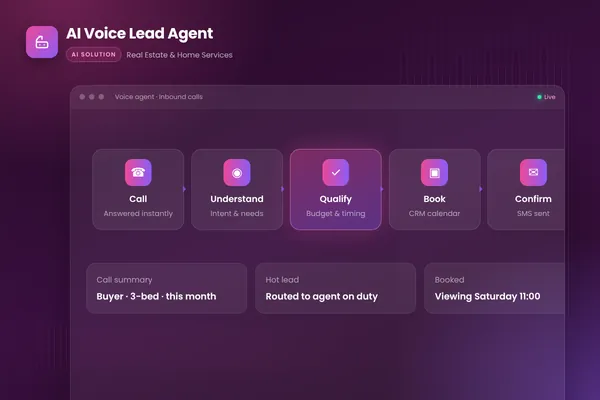
In BufferSol's AI voice lead agent, the agent answers, asks qualification questions, books into the CRM calendar, sends an SMS confirmation and routes hot leads to a person at once. Our AI voice agents service builds this, and the missed-call capture and job booking automation and patient intake and scheduling automation are ready-made versions.
Do this week: grant calendar access, book five test appointments, and make a test transfer to the person who will take real ones.
5. What do you say and record on every call?
Decide the opening line and the recording rule before the first real call. The agent should say it is an AI, and if you record, it should say so and get consent where the law needs it. This is not a technical delay; it is a decision that someone has to own, and most setup guides skip it.
Twilio's Record page says "If you choose to record voice or video calls, you need to comply with certain laws and regulations, including those regarding obtaining consent to record (such as California's Invasion of Privacy Act and similar laws in other jurisdictions)." A law-firm alert from July 2024 says "The following states require the consent of all parties involved in a communication for it to be legally recorded" and lists 13 states: California, Connecticut, Delaware, Florida, Illinois, Maryland, Massachusetts, Montana, Nevada, New Hampshire, Oregon, Pennsylvania and Washington. That list is one firm's 2024 summary, so check the statutes for your states.
For the EU, the Commission's FAQ says "Providers of AI systems that directly interact with people must design and develop those systems in such a way that the individuals concerned are informed that they are interacting with an AI system, unless this is obvious." It adds that "Article 50 of the AI Act applies as from 2 August 2026." The setup guides we read from NextPhone and Ainora do not mention recording consent or an AI notice. Not legal advice.
Do this week: write the greeting with the AI notice, decide whether you record, and have someone check the rule for the states and countries your callers are in.
6. When does the receptionist count as live?
When real callers are served well with a person watching, not when the line first answers. Treat go-live as a staged event: first overflow or after-hours calls, then the main line. Define in advance who watches, for how long, and what would make you switch it off.
NextPhone calls Day 3 a "Soft Launch (monitoring, minimal hands-on)". Ainora puts a supervised launch of 2-3 days on Days 10-12, with 30 minutes a day of monitoring review, then 30 minutes a month. BufferSol's pilot is the same idea over a longer window: a live pilot on part of your traffic, with a warm transfer to your team and daily tuning, within 30 days. Our how-long-to-build an AI agent post explains why a staged launch matters.
Do this week: pick the first slice, such as after-hours calls, name the reviewer, and write the off-switch rule.
What does the setup look like week by week?
Here it is as a table. The sources are vendor guides and public rules, and the last column is BufferSol delivery data, so read the weeks as a plan, not a promise.
| Week | What happens | Source for the step | BufferSol pilot mapping |
|---|---|---|---|
| 1 | Choose forward or port; start texting registration; list call types; gather knowledge | 47 CFR 52.35, Twilio, 365Agents | Discovery and access |
| 2 | Build flows and knowledge; connect calendar and CRM; test calls | NextPhone, Ainora | Prototype on a test number, scored on test calls |
| 3 | Soft launch on a slice with a warm transfer; daily review | Ainora, NextPhone | Live pilot on part of your traffic |
| 4 | Tune the flows; report against your baseline; plan the next slice | Ainora | Pilot report inside 30 days |
| Monthly | A short review of calls and changes | Ainora | Done For You run and review |
- 01Week 1: decideForward or port, texts or not, call types, knowledge, AI notice and recording rule.
- 02Week 2: buildFlows, calendar and CRM connected, test calls scored.
- 03Week 3: soft launchA slice of real calls, warm transfer, daily review.
- 04Week 4: tune and reportFix the misses, compare with your baseline, plan the next slice.
Source: Steps drawn from NextPhone and Ainora, mapped by BufferSol
BufferSol Technologies · buffersoltech.com
How much of the calendar is your own time?
Very little, and the sources agree on that. NextPhone says about 4 hours of hands-on time over 3 days. Ainora says "Your time investment is approximately 3-5 hours total across the process." The rest of the calendar is waiting: for knowledge to be gathered, for the build, for test calls and for the supervised launch.
Here is the arithmetic, labelled as a BufferSol estimate. Ainora's own table lists a 1-2 hour discovery session, 30-60 minutes of configuration review, 15-30 minutes of integration access, 30-60 minutes of test call feedback and 30 minutes a day of launch monitoring on Days 10-12. Adding the rows gives 3.75 hours at the low end (1 + 0.5 + 0.25 + 0.5 + 1.5) and 6 hours at the high end (2 + 1 + 0.5 + 1 + 1.5), a little above Ainora's own 3-5 hours. Spread over 10 to 12 days, that is under a tenth of a working day each day. The point is that your effort is small, but only if you answer within a day.
How long does a basic answering line take compared with a full receptionist?
A basic line is an hour or less; a full receptionist is days to weeks. 365Agents draws the line at features: a basic receptionist "answers calls, takes messages, and sends them to you", while the production setup adds "live calendar booking, custom knowledge base, CRM integration, and brand voice". Pick a basic line if you only need to stop missed calls. Pick the full setup if calls should become bookings.
| Scope | Elapsed time | Source | Fits when |
|---|---|---|---|
| Answers, takes messages | Under an hour | 365Agents | You only need to stop missed calls |
| Plus calendar, knowledge, CRM, brand voice | 1-3 days | 365Agents | Calls should turn into bookings |
| With discovery, tuning and supervised launch | 1-2 weeks | Ainora | A team reviews the first calls |
| Plus texts or outbound | Add the registration wait | Twilio | You follow up by SMS |
| Custom agent on your own systems | Inside 30 days to a pilot | BufferSol delivery data | Calls must act inside your tools |
What is the difference between forwarding and porting a number?
Forwarding sends calls from your existing number to the receptionist; porting moves the number itself to a new provider. Forwarding is reversible in minutes and has no regulatory clock, so it suits a pilot. Porting follows the carrier rule in 47 CFR 52.35 and suits a receptionist you plan to keep.
| Forward calls | Port the number | |
|---|---|---|
| What moves | Only the calls | The number itself, to a new provider |
| Rule that sets the clock | None specific; your carrier's forwarding settings | One business day simple, four business days non-simple (47 CFR 52.35) |
| Easy to switch off | Yes, change the forwarding setting | No, the number now sits with the new provider |
| Best for | A 30-day pilot or overflow calls | A receptionist you plan to keep |
Source: 47 CFR 52.35 via Cornell LII; forwarding row is BufferSol view
BufferSol Technologies · buffersoltech.com
If you port, check the four conditions that FCC 09-41 uses to define a simple port, including a single-line account and no reseller. If your number runs through a reseller or a multi-line system, expect the non-simple path. Twilio is a common platform for these numbers, and the same carrier checks apply there.
How do you test an AI receptionist before real callers hear it?
Make about 20 scripted calls that cover every flow, and score each one. Anthropic's evals guide says "20-50 simple tasks drawn from real failures is a great start", and the same idea fits a phone agent. NextPhone includes "testing scenarios" in Day 2, and Retell offers a web call test that does not support transfer, so run the transfer on a real number.
| Test calls | How many | What to check |
|---|---|---|
| Common questions | 6 | Right answer from your approved content; no invented prices |
| Bookings and changes | 6 | Right slot, right calendar, a confirmation sent |
| Messages | 3 | Name, number and reason captured and delivered |
| Transfers and emergencies | 3 | Warm transfer reaches the right person; urgent words trigger it |
| Off-topic or upset callers | 2 | Polite exit or handoff, no argument |
This plan is BufferSol view, and the counts are a starting point. Add a failed real call to the set every time one appears, so regression checks protect what already works. Our AI agent evaluation post shows how to score the set.
What do setup guides leave out?
Number porting, text registration and recording consent. Of the guides we opened, NextPhone's says "Getting live takes about 5 minutes" and "Plan for 30-60 minutes to work through every step", and neither it nor its setup-time page mentions consent. Ainora's page does not mention recording or consent. The only primary sources in this post are the FCC, the CFR and Twilio's docs, and the porting order is from 2009.
| Topic | NextPhone | Ainora | Retell quick start | Smith.ai |
|---|---|---|---|---|
| Setup time stated | Yes | Yes | 15 minutes in the title | No |
| Recording consent mentioned | Not found | Not found | Not found | Not found |
| Supervised or soft launch | Day 3 | Days 10-12 | Not covered | Not covered |
Read "Not found" as "we searched the page text for the word and did not find it" in November 2026, not as proof the vendor does nothing.
That matters because the fast figures come from the companies selling the product. Treat "5 minutes" as the time to hear a greeting, and plan the rest. Our AI call center post and AI call center agent post show how vendors present similar claims.
Can a small business set up an AI receptionist without technical staff?
For a basic line, yes. NextPhone says "You don't need IT staff, developers, or technical expertise", and 365Agents says a basic receptionist can be set up in under an hour. Both are vendor claims about their own self-serve products. A receptionist that books into your own systems, follows your rules and hands off to your staff needs more design, which is where a build partner helps. Retell's quick start is aimed at people who will configure prompts and functions themselves.
Choose self-serve if your needs are standard and someone on your team enjoys configuring tools. Choose a build or Done For You if calls must act inside your own systems. Our AI voice agents service and Done For You catalogue cover both ends.
Why does the first week decide the last one?
Because gathering your own information is the longest step, and only you can do it. 365Agents says production setup is "most of it gathering the information the AI needs rather than technical work." Ainora says its discovery session "typically takes 1-2 hours" and is "faster" when you have a website, brochures or FAQ pages, because the team pre-populates the knowledge base first. NextPhone puts knowledge base upload in Day 2.
So the cheapest way to shorten setup is to write down hours, prices, services, policies, and the words that should trigger a transfer before you start. Our AI receptionist guide has a setup worksheet, and our AI readiness assessment checks the data side. If your answers live in one person's head, name that person in week 1.
How does setup differ by type of business?
The steps are the same; the rules and systems differ. This table is BufferSol view, built from our projects and linked pages, and shows where each type of business tends to spend extra time.
| Business | Where the extra time goes | Closest ready-made version |
|---|---|---|
| Home services | Emergency rules, dispatch, quotes | Missed-call capture and job booking |
| Medical practice | Patient identity, scheduling rules, privacy review | Patient intake and scheduling |
| Law firm | Conflict checks, what the agent must not say | Client intake and engagement |
| Real estate | Lead routing and viewing slots | Property lead response |
| Hotel or restaurant | Bookings, hours, menus | Hospitality automations |
Our home services post, HVAC, plumbing and electrical page and medical practices page go deeper. Medical and legal setups add a review step, so plan for the longer end of any range, and see the law firms page and the brokerages page for the same pattern.
How many real calls should you review before widening?
Review a set number, not a feeling. Here is a worked example, labelled as a BufferSol estimate with assumed numbers, not results. Say the pilot slice is after-hours calls and you get 40 a week. After three weeks that is 120 real calls (40 times 3). A rule such as "widen to the main line when 50 consecutive calls need no correction and every test call still passes" is then testable, and you can see on the calendar when you will reach it.
The thresholds are yours to set. What matters is that someone writes them down in week 1, so the decision is not made by whoever heard the last bad call. Ainora allows a supervised launch of 2-3 days and then 30 minutes a month of review; for a business with fewer calls, a longer slice is the better choice. Our AI voice agents service runs the review as part of a pilot, and our AI voice lead agent shows what a call record looks like.
What should the first monthly report show?
Five numbers against your own baseline: calls answered, bookings made, messages that needed no follow-up, transfers that went to the right person and corrections your reviewer made. Pull the baseline from your phone system before launch, not from a vendor figure. Our AI call center post lists the metrics larger teams track, and our AI outbound calls post covers the extra consent log an outbound program needs.
What changes in 2027 for AI receptionist setup?
Three dated facts and one view. Every forward claim here is labelled.
- The AI notice is in force in the EU. The Commission's FAQ, last updated 24 July 2026, says Article 50 applies from 2 August 2026, so a 2027 setup includes the notice from the first call.
- AI voices are artificial under the TCPA. FCC 24-17 was adopted in 2024, so any outbound plan in 2027 starts with consent.
- The porting rule has not moved. 47 CFR 52.35, as read in November 2026, still gives one business day for a simple port.
- BufferSol view: minutes-to-live claims will keep shrinking, and the work that decides quality, the knowledge and the handoff, will not. Expect buyers in 2027 to ask what is counted as live. No analyst source we opened forecasts this.
What does an AI receptionist not do?
It does not replace judgment, and it does not know what you have not told it. It will not decide an unusual complaint, give legal or medical advice, or handle a call it was not set up for. A setup that ends at go-live has no one reviewing the calls. Ainora allows 30 minutes a month for ongoing review, which is the minimum, not a target.
Plan for a review each week at first: listen to a sample, read the summaries, check every transfer and update the knowledge when prices or hours change. Our human-in-the-loop AI agents post and workflow exception handling post show how to design the handover.
What is the setup checklist, step by step?
Do these in order. Each step is a verb and a result.
- Decide forward or port, and ask for the port timeline in writing, per 47 CFR 52.35.
- Choose inbound only, or inbound plus texts, and start the registration with Twilio's quickstart if you text.
- List your call types by volume, as Ainora's discovery session does.
- Write the answer to your ten most common questions, which 365Agents says is most of the elapsed time.
- Set the handoff: who takes a transfer, when, and what the agent says first.
- Connect the calendar and CRM, and book five test appointments, as in NextPhone's Day 2.
- Write the AI notice and the recording rule, using Twilio's guidance and the Article 50 FAQ.
- Test with 20 real-sounding calls, including a transfer on a real number.
- Launch on a slice, such as after-hours calls, with a named reviewer.
- Review daily at first and monthly after, and rerun your test calls after every change.
Which questions should you ask a vendor about setup time in writing?
Ask these before you sign and keep the answers.
- What does your setup time count: answering, a configured agent, or supervised calls? See the table at the top and NextPhone's split.
- How long does a port take, and who requests it? 47 CFR 52.35 sets the carrier rule.
- Do we need A2P registration, and who files it? Twilio says up to 5 business days for standard campaigns.
- How do you tell callers it is an AI, given Article 50?
- How do you handle recording consent by state, per Twilio?
- How is a transfer tested before launch?
- Who reviews calls in the first two weeks, and how often afterwards, as Ainora describes?
What does a 30-day pilot deliver for an AI receptionist?
In 30 days you get a working AI receptionist on your real calls, with your team taking the transfers. The plan:
- You bring: your business hours, services and prices, answers to your top questions, calendar access, the numbers calls should transfer to, and one reviewer who can decide within a day.
- We build, in about two weeks: a prototype on a test number, connected to your calendar and CRM, with test calls scored for accuracy and tone.
- We launch, in the final stretch: a live pilot on part of your traffic, such as after-hours calls, with a warm transfer, call summaries and a report against your baseline.
BufferSol delivery data: a working voice agent on your real calls inside 30 days, with Done For You automations live in 3 to 6 weeks. These are our commitments, not an industry benchmark. Success is measured on your own baseline: calls answered, bookings made, messages that needed no follow-up and transfers that went to the right person. A pilot is not the full rollout. For a ready-made version, see the missed-call capture and job booking automation, the property lead response automation or the Done For You catalogue, with pricing quoted after a short call. The HVAC, plumbing and electrical page and medical practices page show the type of business each fits. Our client intake automation fits law firms.
Is this right for you?
Check how many describe your business:
- Calls go unanswered after hours or at busy times, and you can estimate how many.
- You can write down your hours, services, prices and ten most common questions.
- Someone can take a transferred call, and you can name who.
- You use a calendar or CRM the agent should write to.
- You want to hear it on your own calls before you widen it.
If few apply, start with a basic answering line and one call type. Our AI appointment setter post, AI lead qualification post, speed-to-lead automation post and support agent deployment post show smaller first steps and the same staged approach for chat.
Facts checked November 2026 on 365Agents, NextPhone, Retell, Ainora, Smith.ai, Twilio, FCC 24-17, FCC 09-41, 47 CFR 52.35, Kilpatrick Townsend and the European Commission FAQ. Facts we did not re-check: the FCC consumer pages (blocked), how the TCPA applies to inbound answering, state recording statutes (only a law-firm summary was read), UK and other non-US rules, and every BufferSol timeline (our own delivery data).
If missed calls are costing you work, ask BufferSol for a scoped estimate and a 30-day pilot plan for an AI receptionist now, so the 2027 budget covers it and the pilot can start in Q1 2027.
Frequently asked questions
How long does it take to set up an AI receptionist?
It depends on what you count. 365Agents says a basic receptionist can be set up in under an hour and a fully configured one typically takes 1-3 days of elapsed time. Ainora says 1-2 weeks from first conversation to live operation, including a supervised launch. BufferSol puts a working receptionist on your real calls inside 30 days, then widens it.
Can I keep my existing business phone number?
Yes, in two ways. You can forward calls from your number to the receptionist, which needs no transfer, or you can port the number to the platform. Under 47 CFR 52.35, a simple wireline or intermodal port must be completed within one business day, and a non-simple port within four, unless a longer period is requested. Ask your platform for its own quote in writing.
How much of my own time does setting up an AI receptionist take?
Little. NextPhone says about 4 hours of hands-on time over 3 days, and Ainora says approximately 3-5 hours total across its process, much of it a discovery session of 1-2 hours. Gathering your pricing, hours, FAQs and handoff rules before you start is the part that most often adds time. BufferSol asks for one owner and one reviewer.
Do I need to register to send text messages from an AI receptionist?
If it texts customers from a US 10DLC number, yes. Twilio says US regulations require A2P 10DLC registration, that the Campaign Registry typically approves brands within a few minutes, and that campaign reviews take up to 5 business days for standard use cases. Inbound voice calls do not need this registration. Start it in week one.
Do I have to tell callers they are talking to an AI?
In the EU, the European Commission says Article 50(1) of the AI Act requires systems that interact directly with people to be designed so people are informed they are interacting with an AI, unless this is obvious, and that it applies from 2 August 2026. Recording consent is a separate duty that varies by US state. Check your own rules. This is not legal advice.
Sources
- How long does it take to set up an AI receptionist?, 365Agents
- AI Receptionist Setup Time: Complete Timeline Guide (Sign-Up to First Call), NextPhone
- How to Set Up AI Receptionist: Complete Configuration Guide, NextPhone
- Build your first phone agent in 15 minutes, Retell AI
- AI Receptionist Implementation: What to Expect, Ainora
- How to Get Started with Smith.ai, Smith.ai
- A2P 10DLC registration application quickstart, Twilio
- Direct Standard and Low-Volume Standard Registration Guide, Twilio
- TwiML Voice: Record, Twilio
- FCC 24-17 Declaratory Ruling (CG Docket No. 23-362), Federal Communications Commission
- FCC 09-41 Local Number Portability Porting Interval and Validation Requirements, Federal Communications Commission
- 47 CFR 52.35 - Porting Intervals, Cornell Law School Legal Information Institute
- Wiretap Laws in the United States, Kilpatrick Townsend & Stockton LLP
- Demystifying evals for AI agents, Anthropic
- Transparency obligations under Article 50 AI Act (FAQ), European Commission
Cite this article
BufferSol Editorial Team (2026). How Long to Set Up an AI Receptionist in 2027: 6 Decisions That Set the Clock. BufferSol Technologies. https://buffersoltech.com/blog/how-long-to-set-up-an-ai-receptionist-2027
BufferSol Editorial Team
AI & software engineering team
Senior engineers, AI specialists and product leads at BufferSol Technologies who design, build and run AI agents, autonomous workflows and custom software for companies in the US, UK and Europe.
Reviewed by Sufyan K., Senior Writer, BufferSol Technologies.