Key takeaways
- An AI receptionist for a law firm answers intake calls, asks practice-area questions, captures conflict-check details, books a consultation and hands anything that needs a lawyer to a lawyer.
- LOW/CODE says its preliminary conflict checks do 'not replace attorney judgment', and RapidDev says to 'route every captured conflict-check record to a human for the actual clearance'.
- Open says 'The AI never gives legal advice'; Open, AI Front Desk and LOW/CODE did not mention recording consent; only RapidDev's sample prompt does.
- Prices differ by model: AI Front Desk lists $99 a month with 200 minutes, JustCall says 'starts at $99/month', and Smith.ai's own page showed human-first plans from $300 a month.
- Prospective-client rules vary by state: DC's Rule 1.18 says a person who 'discusses' a possible engagement is covered, New Hampshire says one who 'provides information'.
An AI receptionist for law firms is a voice agent that answers intake calls, asks the questions your practice areas need, captures the details a conflict check starts with, books a consultation and passes anything that needs a lawyer to a lawyer. For 2027, the question is how much of intake to hand over and where a person must stay. This post gives the top five jobs, with vendor claims read in November 2026.
For the wider picture, read our AI voice agents guide. For the mistakes buyers make, see 5 AI receptionist mistakes. This is not legal advice.
What is an AI receptionist for a law firm?
It is a voice agent connected to your phone line and your case or CRM system, built for the first conversation with a prospective client. Open says "Law firms lose more revenue at the intake stage than at any other point in the matter lifecycle", and AI Front Desk says "Intake is the most expensive part of running a law firm, and the easiest to lose." Both are vendor opinions, not studies.
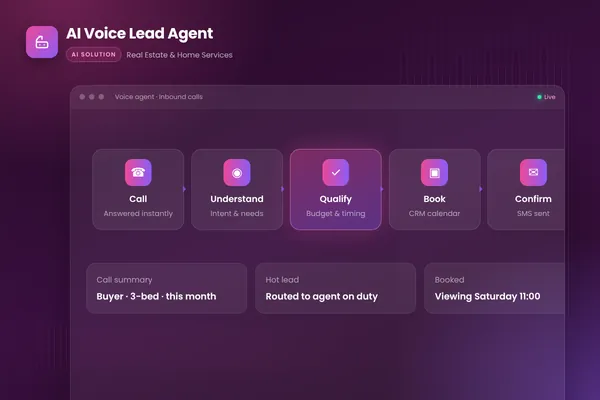
The agentic version does work through your systems and leaves a trace. BufferSol built a similar pattern in its AI voice lead agent, and our AI receptionist explainer covers the basics. The same idea, for a different regulated field, is in our medical practice receptionist post.
- 011 AnswerPick up and collect the facts by practice area
- 022 CaptureRecord conflict-check details for staff to clear
- 033 BookFill a consultation slot in the right calendar
- 044 Hand offPass lawyer-only questions and emergencies to a person
- 055 ProtectHandle consent, recording and confidentiality
BufferSol Technologies · buffersoltech.com
How much does an AI receptionist for a law firm cost?
It depends on whether the plan is AI-first or answered by people, and pages mix the two. As of November 2026, AI Front Desk says "Plans that answer phone calls start at $99 per month, or $79 per month billed annually, with 200 voice minutes included." JustCall says its law-firm service "starts at $99/month" and its calculator lists the AI voice add-on "As low as $0.15/min, first 100 minutes free". That page does not say whether the $99 plan includes the add-on.
| Option | Price shown | What to know |
|---|---|---|
| AI Front Desk | From $99 a month, 200 voice minutes | Page does not mention Clio, recording or consent |
| JustCall | "starts at $99/month" | Unclear if the AI voice add-on is included |
| Smith.ai | Starter $300 a month for 30 calls, Basic $810 for 90, Pro $2,100 for 300 | Page did not say which tab; AI-first plans not shown |
| Open | No prices on the page | Links to a pricing page |
| LOW/CODE estimate for a custom build | "$50,000-$120,000 to build and $2,000-$5,000 per month" | Unsourced vendor estimate, from a firm that sells builds |
We left out the AI-first Smith.ai plans quoted by third-party pages. Smith.ai's own page showed none of them, so we could not confirm them. Our AI call center software post shows how per-minute plans add up. Open and Clio show no prices on the pages we read.
1. Can it answer every call and collect the intake facts?
Yes, and that is the job most firms start with. JustCall says its agent "Asks case-specific questions for each practice area", listing topics such as "Accident date, medical treatment, insurance coverage" for personal injury and "Arrest date, bond status, court date" for criminal defense. The page does not give the exact wording of the questions.
LOW/CODE puts the value this way: "An AI receptionist for law firms closes that gap by handling intake around the clock." That is a marketing line from LOW/CODE, a firm that builds these systems, so test it on your own calls. Our conversational IVR post shows how a caller speaking in plain sentences changes the menu tree.
Choose an AI-first intake agent if after-hours and overflow calls go to voicemail. Stay with a human answering service if most of your callers are in crisis and you want a person to answer first. Our AI lead qualification post covers the question design.
2. Can it capture conflict-check details without clearing the conflict?
It can capture the details, and a person should clear them. JustCall says its agent "collects conflict check information, such as opposing party names, prior attorneys" and "Captures opposing party details to avoid violations." AI Front Desk says it "runs conflict-check questions, captures matter type and jurisdiction".
Open goes further, saying "Conflict checks happen on the call" and that its agent queries your case system by party name and matter type. LOW/CODE says its agent "runs preliminary checks against the firm's conflict database before the consultation, not after", then adds "This does not replace attorney judgment on conflicts." RapidDev says "Route every captured conflict-check record to a human for the actual clearance before the firm engages a new client."
The safe rule is simple, and it is BufferSol view: the agent collects and flags, a person clears. Lawmatics describes the same split in its own software: it "automatically scans your database for potential conflicts, flagging any matches". Flagging is not clearing. No vendor page we opened says what a firm must do before an AI's check counts as enough, so write that rule yourself.
| What the page says | What a person still does | |
|---|---|---|
| JustCall | Collects opposing party names and prior attorneys | Clears the conflict |
| Open | Conflict checks on the call, queried by party name | Staff review anything flagged |
| LOW/CODE | Preliminary checks before the consultation | Attorney judgment on conflicts |
| RapidDev | Captured records routed to a human | Actual clearance before engagement |
Source: Vendor pages as read in November 2026. Vendor claims; the staff column follows what LOW/CODE and RapidDev say and BufferSol view.
BufferSol Technologies · buffersoltech.com
3. Can it book a consultation in the right attorney's calendar?
It can if it can write to the calendar and knows your rules. Open says "Consultation booking happens live in the right attorney's calendar", matched to practice area, jurisdiction and conflict status. AI Front Desk says it "books a paid consultation with the right attorney", though the page does not explain how the attorney is chosen or how payment is handled.
LOW/CODE says its agent "routes to the right attorney based on specialization, capacity, and jurisdiction." Before you trust a booking from Open, AI Front Desk or any other tool, ask which fields the agent writes: the matter type, the jurisdiction, the conflict flag and the caller's own words. Our AI appointment setter post covers booking logic, and our client intake and engagement automation turns a booked consultation into a draft engagement letter for a lawyer to approve.
Choose live booking for firms with clear practice areas and open calendars. Skip it for matters that need a lawyer to decide first, such as complex or urgent criminal matters.
4. When should it hand a caller to a person?
Whenever the caller needs a lawyer's judgment, is in distress or asks for a person. Open says "everything that needs an attorney goes to an attorney" and that "The AI never gives legal advice." It also says questions like "do I have a case?" route to an attorney. Clio draws the same line for its own AI: "Clio prepares the intake work. Who becomes a client is your call."
A verb-first handoff ladder, as BufferSol view:
- Confirm the caller's name, number and the matter type.
- Say plainly that you cannot give legal advice and a lawyer will follow up.
- Ring the on-duty person for urgent matters while the caller stays on the line.
- Text the details to the lawyer on call if no one answers, with a deadline for reply.
- Tell the caller what happens next and when.
- Log the call, the transcript and who took the handoff.
Our human-in-the-loop post and workflow exception handling post explain why these steps need an owner.
5. How does it handle confidentiality, consent and recording?
Treat this as a rules job, not a feature. Information a caller gives is sensitive from the first sentence. According to the law-firm summary on Frankfurt Kurnit's technology law blog (January 27, 2025), the ABA's Formal Opinion 512 says "a client's informed consent is required before inputting their confidential information into a self-learning GAI tool". The same post lists "confidentiality (MR 1.6, 1.9(c), and 1.18(b))" and says "supervisory lawyers must ensure lawyers and nonlawyers are trained in the ethical and practical use of relevant GAI tools."
We could not open the ABA opinion itself; its pages returned an error, so we rely on this summary. RapidDev cites the same opinion and its July 2024 date. Callers are usually prospective clients. The District of Columbia's Rule 1.18 says "A person who discusses with a lawyer the possibility of forming a client-lawyer relationship" with respect to a matter is a prospective client, and that a lawyer "shall not use or reveal information learned in the consultation, except as permitted by Rule 1.6." New Hampshire's version says a person who "provides information to a lawyer regarding the possibility of forming a client-lawyer relationship" is covered. The wording differs by state, and we found no source on whether telling an AI counts as telling a lawyer. Ask your bar counsel.
On recording, Dialzara (updated 2026-10-28) says "12 states, including California and Florida, require all-party consent" and to "Always disclose at the start of every call that the conversation is being recorded and that an AI agent is involved." That is a vendor blog, so confirm any count with a statute. Of the pages we opened, Open, AI Front Desk and LOW/CODE did not mention recording consent, while RapidDev's sample prompt includes "This call is recorded for quality purposes, consistent with the greeting already given." Our AI vendor security questionnaire and DPA post list what to ask about stored calls, and our AI receptionist for home services post shows how little most pages say about consent.
What is one missed intake call worth to your firm?
Only you can say, so here is the formula with your inputs. As a BufferSol estimate (not data), suppose a firm misses 10 intake calls a week, 4 of them would have booked a consultation, 1 of every 3 consultations signs, and the average matter brings in $3,000. That is about 1.3 new matters a week, or roughly $4,000 of fees a week walking to a competitor, before costs.
Replace every input with your own count; none of these numbers comes from Open, AI Front Desk or any other vendor page. Then compare with the price of the tool: as a BufferSol calculation, AI Front Desk's $99 a month for 200 voice minutes is about 50 cents a minute at list price, while JustCall's add-on is "As low as $0.15/min". The cost of the tool is rarely the issue; the cost of a wrong intake record is. Count that too.
Which jobs fit an AI receptionist and which stay with staff?
Give the agent the repeatable, rule-based steps and keep the judgment calls with people. The split below is BufferSol view, built on what the vendor pages say.
| Job | Fits the agent | Stays with staff |
|---|---|---|
| Answer and ask intake questions | Case-specific questions by practice area | Distressed or urgent callers |
| Capture conflict details | Opposing party names and prior attorneys | Actual clearance |
| Book a consultation | Live booking in the right calendar | Complex or urgent matters |
| Decide who becomes a client | Nothing: your call | The lawyer |
| Legal advice | Nothing: the AI never gives it | The lawyer |
Where do Clio and Lawmatics fit next to a phone agent?
They sit behind the call, in the intake and follow-up steps. Clio says "Clio's AI reads each new inquiry and weighs it against the work your firm takes on" and "Lead details are saved and outreach begins, so no inquiry sits unread over a weekend." Lawmatics says "As soon as a lead submits a client intake form, Lawmatics automatically follows up with a personalized text or email."
Both pages are about forms and follow-up, not phone answering, so a firm may use a phone agent in front and one of these tools behind. Check which system holds the record of truth, and map the fields before launch. Our AI email automation post covers the follow-up side.
What do the vendor pages not show?
They do not show how conflict data is stored, how the Clio integration maps fields or what a firm must do before an AI's check is treated as enough. Open lists "Clio (Manage and Grow), MyCase, Smokeball, Filevine, PracticePanther" but does not describe how the integration works beyond live conflict checks. JustCall names Clio, MyCase and Lawmatics only in its setup steps. AI Front Desk does not mention Clio at all.
Clio's page shows no price and no AI activity log; its only "audit trails" mention is in a navigation line about Enterprise controls. That is Clio's intake forms page, not a phone product. Our AI agent evaluation post shows how to test what a vendor leaves out.
Which questions should you ask each vendor in writing?
Ask these before you sign, and keep the answers:
- Does the agent clear conflicts or only capture details, and who signs off?
- Which fields does it write into Clio, MyCase, Smokeball or Filevine, and can we see a test record?
- Is the call recorded, and what does the greeting say about recording and AI?
- Where are the audio, transcript and summary stored, for how long, and are they used to train a model?
- Which plan type is the price for, AI-first, hybrid or human-answered?
- What does the agent do with a caller who needs a lawyer now, and how do we test the handoff?
- How do we export the call log for supervision and ethics review?
What does an AI receptionist not do for a law firm?
It does not give legal advice, clear conflicts, decide who becomes a client or know a state's ethics rules. It will mishear names, which matters when a conflict check depends on a spelling. It cannot replace a lawyer's judgment about an urgent or sensitive call.
Open says "The AI never gives legal advice", which is a design rule you should enforce in your own build as well. LOW/CODE says its agent "does not replace attorney judgment on conflicts". Plan for a person to own the clearance, the exceptions and the weekly review, as RapidDev and the ABA summary both point towards. Our AI voice agents guide and AI receptionist post cover the basics.
What changes for law firm AI receptionists in 2027?
No source we opened forecasts the legal intake market in 2027, so this section is BufferSol view, written as reasoning.
We expect firms to ask for evidence on conflicts and consent, since RapidDev already advises routing records to a human. We expect case-management vendors to put intake AI inside their own products, as Clio's page and Lawmatics already describe for intake forms. And we expect a written supervision rule to matter more, because the ABA summary says supervisors must ensure staff are trained. Plan the 2027 budget around a pilot on after-hours intake.
When should you build your own law firm receptionist agent?
Build when your intake rules, conflict workflow or case system do not fit a packaged tool. Stay with a packaged one when you have one office, one calendar and a short question list. Outbound calls bring extra rules; see our TCPA and AI calls post.
No source we opened tests custom builds, so this is BufferSol view:
- Your conflict process is specific. You decide which fields go to staff and what blocks a booking.
- Your systems are mixed. One agent works across the phone, the case system and the calendar.
- You need your own logs. Supervision and ethics review need a record you can export.
- You want to control data. You choose where audio and transcripts live.
BufferSol's AI voice agents service builds these. See also our AI call center post, AI outbound calls post and how long it takes to build an AI agent.
What would a 30-day pilot deliver?
In 30 days you get a working intake agent on your real calls, with a lawyer clearing every conflict. The plan:
- You bring: your intake questions by practice area, your case or CRM access, your calendar rules, your recording greeting and a sample of past intake calls.
- We build, in about two weeks: a prototype that answers, asks your questions, captures conflict details, books consultations and hands off lawyer-only matters, tested on scripted calls.
- We launch, in the final stretch: a live pilot on after-hours calls, with a call log and a weekly review of a sample of calls.
Success is measured by complete intake records, consultations booked correctly, handoffs that reached a person and records a lawyer had to correct. The closest ready-made version is our client intake and engagement automation, made for law firms; see also the law firm catalogue, client document collection and time entry and billing. Our AI agent architecture post explains how the pieces connect.
Is this right for you?
Check how many describe your firm:
- Intake calls go to voicemail after hours or when staff are busy.
- You can write your intake questions for each practice area.
- A named person clears conflicts and decides who becomes a client.
- Your case system or calendar can accept a booking from an agent.
- You want a weekly sample review before you widen the agent.
If few apply, fix the intake and conflict process first, then pilot.
Facts checked November 2026 on the Open, AI Front Desk, JustCall, LOW/CODE, RapidDev, Clio, Lawmatics and Smith.ai pages; vendor pages are marketing. Facts we did not re-check: ABA Formal Opinion 512 itself (the ABA pages returned an error, so we rely on a law-firm summary), the Dialzara state count against statutes, any AI-first Smith.ai prices and how any vendor maps fields into Clio. Nothing here is legal advice.
If your firm loses intake calls, ask BufferSol for a scoped estimate for an intake receptionist agent now, so the 2027 budget includes it and the pilot can start in Q1 2027.
Frequently asked questions
What is an AI receptionist for law firms?
An AI receptionist for law firms is a voice agent that answers calls to a firm, asks intake questions by practice area, captures conflict-check details, books consultations and passes anything that needs a lawyer to a lawyer. JustCall says its agent 'captures opposing party details'. The agent collects information and routes it; lawyers decide whether to take the matter.
Can an AI receptionist run a conflict check?
It can capture the details a conflict check needs, and some vendors say it queries your case system. It should not clear the conflict. LOW/CODE says its checks do 'not replace attorney judgment' and RapidDev advises to 'route every captured conflict-check record to a human for the actual clearance'. Treat any AI result as a first pass for staff.
Does an AI receptionist give legal advice?
It should not. Open says 'The AI never gives legal advice' and that questions like 'do I have a case?' route to an attorney. Build the same rule into any agent: it collects facts, explains next steps and books a consultation, while a lawyer decides on advice and whether the firm takes the matter.
Do I have to tell callers the call is recorded or answered by an AI?
Plan to say both, and ask counsel for your state. Dialzara's guide, updated 28 October 2026, says to 'Always disclose at the start of every call that the conversation is being recorded and that an AI agent is involved' and that the stricter law applies when calls cross state lines. It is a vendor blog, not a statute, so confirm with a lawyer.
How much does an AI receptionist cost for a small law firm?
As of November 2026, AI Front Desk lists plans from $99 a month, or $79 billed annually, with 200 voice minutes; JustCall says its law-firm service 'starts at $99/month'. Smith.ai's pricing page showed human-answered plans from $300 a month for 30 calls. Prices mix AI and human plans, so compare like with like.
Sources
- AI Receptionist for Law Firms, Open
- AI Receptionist for Law Firms: 24/7 Virtual Answering, AI Front Desk
- AI Answering Service for Law Firms | 24/7 Legal Call Coverage, JustCall
- AI Receptionist for Law Firms: Intake Autopilot, LOW/CODE
- AI Receptionist for Law Firms, RapidDev
- AI Legal Intake Forms & Client Intake for Law Firms, Clio
- Lawmatics: Legal Software for Law Firms & Attorneys, Lawmatics
- Smith.ai Plans & Pricing for 24/7 Sales & Support, Smith.ai
- Call Recording Laws for AI Agents by State, Dialzara
- ABA Issues Comprehensive Formal Ethics Opinion on Lawyers' Use of Generative AI, Frankfurt Kurnit Klein & Selz
- Rule 1.18: Duties to Prospective Client (District of Columbia), District of Columbia Bar
- Rule 1.18: Duties to Prospective Clients (New Hampshire), Court Rules Network
Cite this article
BufferSol Editorial Team (2026). AI Receptionist for Law Firms: Top 5 Intake Jobs to Hand Over in 2027. BufferSol Technologies. https://buffersoltech.com/blog/ai-receptionist-for-law-firms-2027
BufferSol Editorial Team
AI & software engineering team
Senior engineers, AI specialists and product leads at BufferSol Technologies who design, build and run AI agents, autonomous workflows and custom software for companies in the US, UK and Europe.
Reviewed by Sufyan K., Senior Writer, BufferSol Technologies.