Key takeaways
- An AI call center agent answers calls, does the routine work through your systems and hands the rest to a person; the split works best as written rules, not as the model's mood.
- Deepgram, a vendor, says to use 'deterministic handoff triggers in your orchestration code', and Twilio's sample prompt escalates when 'The customer explicitly asks to speak with a human.'
- A warm handoff carries context: Amazon Connect's page lists a summary, intent, sentiment, authentication status and callback number as examples of what to pass, so the caller does not repeat themselves.
- Plan people for the calls the AI hands over: Parloa, a vendor, says 'Containment never reaches 100%' and advises sizing the buffer from your own escalation rate by intent.
- AI voice calls fall under the TCPA's artificial-voice rules according to the FCC's February 2024 ruling; this is not legal advice, and recording consent and state rules need your own lawyer.
An AI call center agent is a voice agent that answers calls, does routine work in your systems and hands the rest to a person with context. This 2027 guide gives six written rules for splitting calls between the AI and human agents, using handoff pages from Twilio and Amazon Web Services read in November 2026.
For the wider picture, read our AI voice agents guide. For software choices, see our top AI call center software post and our overview of the AI call center.
What does it mean to split calls between an AI call center agent and people?
It means deciding in advance, call type by call type, who owns the call. The AI takes calls with a clear rule and a safe action. A person takes calls that need authority, judgment or care. The handoff between them is a designed step, not an accident.
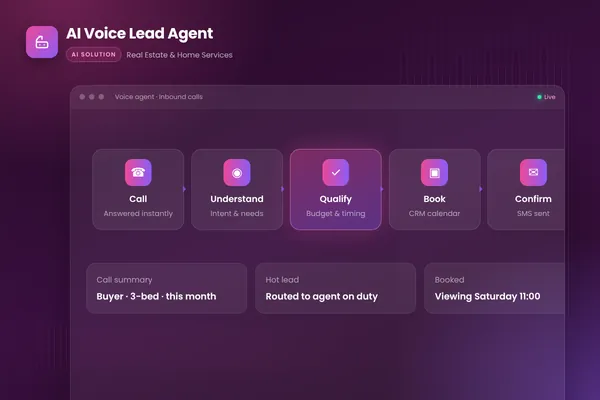
Deepgram (October 2026), a vendor that sells a voice agent API, puts the idea in one line: a voice agent should escalate "whenever it hits deterministic handoff triggers in your orchestration code." Parloa (October 2026), which sells AI agents for contact centers, adds the staffing side: "The calls left for humans are exceptions, and exceptions cluster less predictably than routine volume." BufferSol built this pattern in its AI voice lead agent case study, where hot leads are routed to a human immediately.
- 011 AnswerPick up at once, say it is an AI and give the recording notice
- 022 UnderstandIdentify the reason for the call from what the caller says
- 033 VerifyCheck identity in your system, not in the model
- 044 Resolve or routeFinish supported calls, or pick the queue by written rules
- 055 Warm transferPass summary, intent and actions taken with the call
- 066 LogWrite transcript, outcome and trigger reason to the CRM
BufferSol Technologies · buffersoltech.com
Which six rules decide who takes the call?
Each rule below is a decision you write down before launch, with the evidence for it and a "choose it if" line. The rules are ordered from what the AI may do alone to how many people you still need. The table sets out the short version first.
| Rule | Decision | Who owns it | Evidence |
|---|---|---|---|
| 1 | List the calls the AI may finish alone | You and BufferSol | Amazon Connect escalates when "a business rule prevents automation" |
| 2 | List the calls a person always takes | You | Twig: some topics "should always involve a human" |
| 3 | Put triggers in code, not in the prompt | BufferSol build | Deepgram: "deterministic handoff triggers" |
| 4 | Hand off early and say why | Agent plus a named reviewer | Twig: "The timing of escalation matters enormously." |
| 5 | Make every handoff warm | Agent plus your CRM | Amazon Connect: context "reduces repeat questions" |
| 6 | Staff a buffer for the handoffs | Your operations lead | Parloa: "Containment never reaches 100%" |
1. Which calls can an AI call center agent finish alone?
Calls where the answer is in a system, the action is reversible and a rule says yes. Examples are order status, booking and rescheduling, opening hours and simple account lookups. Amazon Connect's escalation page frames the boundary as a design choice: "Use escalations when a task requires an agent, a business rule prevents automation, the user asks for a person, or the flow needs to transfer the conversation into a Connect Customer queue."
That sentence gives you four tests for each call type. Does the task need an agent? Does a business rule block automation? Might the user ask for a person? Does the flow need a queue? If every answer is no, the AI can finish the call. Our AI call center overview has a first-candidates table, and our AI appointment setter post covers booking calls.
Choose it if the call has a lookup, a clear rule and an action you can undo. Skip it if the caller is disputing a charge or describing a problem that has no script. For order-status calls, the closest ready-made version is our order status automation, and our WISMO automation post explains the pattern.
2. Which calls should always go to a person?
Calls that need human authority, whatever the AI's confidence. Twig (published March 31, 2026, updated June 10, 2026) says "Some conversation topics should always involve a human, regardless of the AI's confidence level." For billing it says "Financial transactions often require human authority and judgment", and it lists account security, legal or compliance matters and cancellation risk as other always-human topics.
Deepgram lists out-of-scope requests such as refunds above the approval limit, contract changes and formal complaints, and high-risk situations such as emergency symptoms and fraud reports, "routed on first mention." Twilio's sample prompt escalates for an explicit request for a human, unresolved issues after two attempts, billing or account-security matters, and customer frustration.
Write your own list and name the owner of each item. As a BufferSol view, the matrix below is a starting point. It is not a standard, and your industry rules come first.
| Call type | Who takes it | Why |
|---|---|---|
| Order, delivery or booking status | AI alone | Lookup, no judgment |
| Reschedule or cancel an appointment | AI alone, after identity check | Rule-based, reversible |
| Opening hours, policies, how-to | AI alone | Approved content only |
| Payment arrangement or small refund | AI collects, person approves | Money moves |
| Refund above the limit, contract change | Person | Out of scope for the AI |
| Complaint or distressed caller | Person, at once | Judgment and care |
| Emergency symptoms, fraud report | Person, on first mention | High risk |
| Caller asks for a person | Person | No confidence check in between |
Twig also lists account security, legal or compliance matters and cancellation risk, and says a direct request for a person should be honored promptly, and Twilio makes billing and account security part of the same prompt. Deepgram and Amazon Connect agree on the principle, if not the wording.
Choose a person if a wrong answer costs money, safety or trust. Skip the human queue if the call is a repeat lookup, which wastes a trained agent.
3. Who decides to hand off: the model or a rule?
A rule decides, and the model adds a signal. Deepgram says to "Encode business rules as deterministic checks in the orchestration layer", and lists explicit requests, repeat failures, out-of-scope requests, high-risk situations and business rules as triggers. On an explicit request it is blunt: "When a caller asks for a person, transfer them without a confidence check in between."
Twig describes the other half. It says "Confidence scoring is the primary mechanism AI uses to decide whether to answer or escalate", and gives an example setting of answering on its own when confidence is above 0.8. The two pages differ in emphasis, and both are vendor pages. Twig's own summary names three triggers, while its body describes five kinds of signal, so read the body. Twig also says "the system logs exactly which signals triggered the handoff", which is the audit trail you want.
| Written rule in code | Model confidence | |
|---|---|---|
| Best used for | Explicit requests, repeat failures, refunds, fraud, business rules | Ambiguous calls that no rule covers |
| Source | Deepgram: deterministic handoff triggers in orchestration code | Twig: confidence scoring is the primary mechanism |
| Risk | Rules miss new situations | A confident wrong answer never escalates |
| Our view | Always on, first in line | A second signal, never the only one |
Source: Deepgram and Twig vendor pages as read in November 2026; the last row is BufferSol view.
BufferSol Technologies · buffersoltech.com
Choose rules first if a wrong call is costly. Add confidence as a second signal if callers say unexpected things. Our human-in-the-loop AI agents post and AI agent architecture post show where the gates sit.
4. How early should the AI hand a call to a person?
Early, and before the caller is angry. Twig says "The timing of escalation matters enormously" and that "customers who are transferred to a human agent before reaching peak frustration report significantly higher satisfaction." It attributes that to Forrester without a date, and we did not open the Forrester research, so treat it as a vendor's report of a rule of thumb.
Deepgram says "Those transferred callers rate their satisfaction 12% lower than callers who never change hands", and says the figure comes from a benchmark by SQM Group. We did not open that benchmark, so it is a vendor-cited number, and we do not rely on it. The practical point stands without it: a transfer is a risk, so make it quick and well briefed. As BufferSol view, count two failed attempts as a hard stop, as Twilio's sample prompt does, and never ask the caller to repeat a request a third time.
Choose an early handoff if the call is already off script. Skip it if the AI is one step from finishing a routine task.
5. What should travel with the call in a warm handoff?
Everything the person would otherwise ask again. Deepgram says "A warm transfer keeps the story attached to the call", while on a cold transfer "everything the caller said travels nowhere unless your application persists it." It says to hand off "verified identity, intent, entities, actions taken", plus an escalation code and a two-sentence summary, "as structured fields."
The platforms differ in what they name. The table sets out what each page lists, nothing more.
| Platform page | What it says travels with the handoff | What the page does not show |
|---|---|---|
| Twilio Agent Connect | Conversation ID, memory store ID, profile ID, custom attributes you define | A full schema; handoff failure behaviour |
| Amazon Connect | Examples: transfer summary, customer intent, sentiment, authentication status, callback number, claim number, reason for escalation | Voice audio handling; a date |
| Deepgram guide | Verified identity, intent, entities, actions taken, escalation code, summary | A product-specific setup |
| Genesys Virtual Agent | Chat transcript (excluding sensitive data) and a summary in the agent desktop | How voice calls are handled |
Two details matter. Twilio's page (updated July 17, 2026) says custom attributes surface in Flex "as TaskRouter task attributes", and Twilio's TaskRouter Task page says "Every Task has attributes, allowing you to pass along whatever data is required." And Genesys says "The summary is surfaced in the interaction panel", though its use-case page writes the handoff for chat and does not say how it works for calls. We did not open the Five9, NICE or Google contact center pages, so we say nothing about their handoffs.
Amazon Connect gives a four-line example summary: the customer wants to update a billing address, the change needs agent verification, and the customer gave an account email and confirmed they are the account holder. That is the standard to build to: a person can read it in five seconds and start with the real question. A verb-first check, as BufferSol view:
- Verify identity in your own system before the transfer, and pass the result, not the answers.
- Pass intent and the reason for escalation in plain words.
- List actions the AI already took, so nothing is done twice.
- Attach a callback number in case the call drops.
- Show the person the summary on screen before they say hello.
- Test by transferring ten recorded calls and asking staff what they still had to ask.
Our AI voice agents service builds this payload on your CRM, and our AI agent evaluation post shows how to score the test.
6. How many people do you still need when the AI answers first?
More than the AI's "contained" figure suggests. Parloa says "Containment never reaches 100%, and on average 39% of AI-handled interactions still reach human agents." That 39% is a vendor-run figure, and the page links it to another site and gives no sample size, period or definition. The same page advises "Size the buffer from your own escalation rate by intent, and use that share as the starting assumption until live data replace it."
A second risk: "when an AI platform degrades, every interaction in that pool is affected at once", Parloa says, so keep a fallback path to people if the AI fails. Here is the arithmetic, as a BufferSol calculation with assumed numbers, not results. Take 1,000 calls a day, all answered by the AI first. At the vendor's 39%, 390 calls reach people. If you had planned for 20% (200 calls), you would be 190 calls over, about one call in five waiting for a person who is not there. Your own rate by call type replaces both numbers after the first two weeks of live data.
Twilio's TaskRouter page adds a routing detail: "Tasks with higher priority values will be assigned before Tasks with lower values", so an urgent handoff can jump the human queue. Amazon Connect routes on a returned intent to the right queue instead.
Choose a buffer if the AI answers first and the hand-over rate is unknown. Skip the cut in headcount if you have not measured your own escalation rate by intent. Our AI customer service agent post and AI customer service post cover the support side.
What would a day of calls look like with the split?
It looks like a routing table with numbers next to it. As a BufferSol estimate with assumed shares, not results, take 1,000 calls a day: 450 status and booking calls for the AI alone, 250 information calls from approved content, 200 calls where the AI collects details and a person approves, and 100 calls that go to a person on first mention. The AI finishes 700, which is 70%, and people handle 300.
Now check that against the vendor figure. Parloa's 39% claim would put 390 of the AI-handled calls with people, so the table above is more optimistic and needs your own call data to stand. Twilio's sample prompt escalates after two failed attempts, and Deepgram calls that a repair loop, so some of the 700 will move to the human column in practice. Amazon Connect lets a flow route on a returned value such as customerIntent=billingSupport, which is how each row can reach its own queue.
How do you test the split before go-live?
Test on recorded calls, one call type at a time. Twig says the system should log "exactly which signals triggered the handoff", so the test log doubles as your audit trail. A verb-first plan, as BufferSol view:
- Sort 200 recorded calls into your call types, with the real outcome.
- Replay them through the agent in test mode, with no live transfers.
- Count calls the AI would have finished, handed over and wrongly finished, per type.
- Check each handoff for Deepgram's four fields: identity, intent, entities and actions taken.
- Ask two staff to read ten summaries and list what they would still ask. Genesys says its summary is "surfaced in the interaction panel", and yours should be visible in the same way.
- Compare the human queue with the Parloa advice to "Size the buffer from your own escalation rate by intent."
- Repeat after every change to the trigger list, and monthly after launch.
Our AI agent evaluation post and single agent versus multi-agent post show how to organise the test.
Which consent rules apply to AI voice calls in the US?
For outbound calls, the FCC says AI voices count as artificial voices. The FCC's declaratory ruling 24-17 (adopted February 2, 2024, released February 8, 2024) says "They are “artificial” voice messages because a person is not speaking them", and that "callers must obtain prior express consent from the called party." This is not legal advice.
The rule text is in 47 CFR 64.1200. Paragraph (a)(1) covers calls "using an automatic telephone dialing system or an artificial or prerecorded voice", with exceptions for calls made "with the prior express consent of the called party" and for "a call made for emergency purposes." Paragraph (b)(1) requires prerecorded messages to "state clearly the identity of the business, individual, or other entity that is responsible for initiating the call." A TransNexus summary (February 2024), a telecom compliance vendor, notes the FCC headline was imprecise: such calls are illegal only if they fail the same TCPA requirements as other artificial-voice calls.
Thoughtly (May 2026), a vendor of AI voice agents, says "12 states require all-party consent for call recordings" and "Recording-consent notices must come at the start of the call, before any qualification or data collection." Its own page carries several uncited claims and cites a survey last reviewed in September 2024, so we use it only as a pointer: verify each state with a lawyer. Our TCPA and AI calls post has a pre-dial gate for outbound calls, and our AI outbound calls post covers outbound design.
What does an AI call center agent not do?
It does not replace judgment, and it can be wrong with confidence. It does not know that a caller is a new VIP, in distress or about to leave unless your systems tell it. It does not make legal calls on consent. It can fail as a platform, and then every call in its pool is affected at once.
Genesys says the transcript at handoff excludes "sensitive data", and its page does not define what counts as sensitive, so the rule is yours to write. Twig says "Financial transactions often require human authority and judgment", which is the reason payment changes stay with people. Plan a named owner for the trigger list, a weekly review of ten transferred calls and a kill switch that sends every call to the human queue. Our workflow exception handling post shows how exceptions get an owner.
What do the sources not show about splitting calls?
They show vendor documentation and no independent benchmark. Twilio, Amazon Web Services and Genesys describe their own products. Parloa, Deepgram, Twig and Thoughtly sell AI voice or contact center software, so their advice has an interest behind it.
None of the pages gives a split by call type with measured shares, a handoff cost, a build cost or a time to build. None states a price. The Amazon Connect page shows no date, and Genesys shows a version and a 2026 copyright but no date. Our AI receptionist post and AI lead qualification post show how we weigh vendor claims.
What changes in 2027 for AI call center agents?
No source we opened forecasts call centers in 2027, so this section is BufferSol view, written as reasoning.
We expect buyers to ask for the trigger list and the handoff payload in writing, because pages such as Amazon Connect's already treat context as a designed field. We expect staffing plans to carry an escalation buffer, since Parloa says containment never reaches 100%. And we expect compliance to stay a lawyer's question: the FCC ruling is from 2024, and state rules move. Plan the 2027 budget around a pilot on two or three call types, not the whole queue.
Which questions should you ask an AI call center vendor in writing?
Ask these before you sign and keep the answers:
- Which triggers hand a call to a person, and can we add our own as code, not as prompt text?
- What does the human agent see at the moment of transfer: summary, intent, identity result, actions taken?
- What happens if the AI platform is down? Does every call go to a person, to voicemail or nowhere?
- Can we see why each call was escalated, as Twig says a good system logs?
- How do you handle recording consent and the AI disclosure at the start of the call?
- What does your vendor-run containment figure count, and over which period and sample?
- Where does our call data go? Our AI vendor security questionnaire and data processing agreement post cover data handling.
When should you build your own AI call center agent?
Build when your triggers, queues and CRM do not fit a vendor's settings. Stay with a platform's own flow when your calls are standard and one platform holds all of them. For a software comparison, see our AI call center software post.
No source we opened covers custom builds, so this is BufferSol view:
- You need your own trigger list in code, with a named owner for each rule.
- You need handoffs into your own CRM or helpdesk, with the payload you define.
- You need approvals in your own tools, such as a manager approving a refund during the call.
- You need an audit log of every trigger, transfer and override.
BufferSol's AI voice agents service and AI agents service build these. See also how long it takes to build an AI agent, AI agent versus chatbot and our AI voice lead agent case study.
What would a 30-day pilot deliver?
In 30 days you get a working AI call center agent on your real calls, with a person on every call it hands over. The plan:
- You bring: your telephony or call-routing access, a sample of recorded calls with outcomes, your call-type list, your escalation rules and a named reviewer on the human team.
- We build, in about two weeks: a prototype that answers, identifies the reason, checks identity in your system, resolves the first two or three call types, and hands the rest over with a written summary and structured fields, tested on your recorded calls.
- We launch, in the final stretch: a live pilot on one number or one call type, with a log of every trigger and transfer and a weekly review of transferred calls.
Success is measured by calls finished without a person, handoffs that needed no repeat question, transfers that should not have happened, wait time for the human queue and reviewer overrides. The closest ready-made versions are our missed-call capture and job booking automation, built for home service firms, and our patient intake and scheduling automation. See also the Done For You catalogue, the property lead response automation and the speed-to-lead automation. Our AI receptionist for medical practices post shows a regulated example.
Is this right for you?
Check how many describe your team:
- Callers wait in a queue for questions with a clear answer.
- Staff transfer calls and callers repeat their story.
- You can name the call types that must stay with people.
- You can pull a sample of recorded calls with outcomes.
- You have a human team that can take a handoff within a minute.
If few apply, write the call-type list and the escalation rules first, then pilot. Our AI readiness assessment checks your data, our AI help desk post covers the ticket side, and our intelligent invoice processing guide shows the same human-approval pattern in finance.
Facts checked November 2026 on the Twilio escalation and TaskRouter pages, Amazon Connect, Genesys, Parloa, Deepgram, Twig, Thoughtly, 47 CFR 64.1200, the FCC ruling and the TransNexus summary; vendor pages are marketing and nothing here is legal advice. Facts we did not re-check: Five9, NICE and Google contact center handoff features (no official page opened, so not described), the SQM Group benchmark behind Deepgram's satisfaction figure, the Forrester research Twig cites, Parloa's 39% source, state-by-state recording laws and any price.
If calls are bouncing between the AI and your team, ask BufferSol for a scoped estimate for an AI call center agent on your call types now, so the 2027 budget includes it and the pilot can start in Q1 2027.
Frequently asked questions
What is an AI call center agent?
An AI call center agent is a voice agent that answers phone calls, understands the request, does routine tasks in your systems such as order lookups or bookings, and hands other calls to a human agent with context. BufferSol builds these as agents connected to your telephony, CRM and helpdesk, with people approving the sensitive steps.
Which calls should an AI call center agent never handle alone?
Calls that need human authority or judgment. Twig, a vendor, says 'Some conversation topics should always involve a human, regardless of the AI's confidence level', and Deepgram lists refunds above the approval limit, contract changes, formal complaints, emergency symptoms and fraud reports. Decide your own list in writing before launch.
What is a warm handoff in an AI call center?
A warm handoff transfers a call to a person together with what the AI learned. Deepgram says 'A warm transfer keeps the story attached to the call', while a cold transfer makes the caller repeat a name, an account number and the whole story. Good handoffs pass verified identity, intent, actions taken and a short summary.
How do you decide when the AI hands a call to a person?
Use written triggers: the caller asks for a person, the AI fails twice, the request is out of scope, the situation is high risk or a business rule applies. Deepgram says to encode business rules as deterministic checks. Model confidence can add a signal, as Twig describes, but should not be the only one.
Do AI call center agents need consent to call people?
For outbound calls in the US, the FCC's February 2024 ruling says AI-generated voices are artificial under the TCPA, so the consent rules for artificial or prerecorded voices apply. 47 CFR 64.1200 sets the detail. Recording consent varies by state. This is not legal advice, so check your own calls with a lawyer.
Sources
- Escalate to a human agent, Twilio Docs
- Task Resource, Twilio Docs
- Managing escalations, Amazon Web Services
- Call center workforce management: the complete guide, Parloa
- AI voice agent to human handoffs: Warm transfer guide, Deepgram
- How AI Escalates to Humans (3 Real Triggers), Twig
- Genesys Virtual Agent, Genesys Cloud Resource Center
- Call Recording Consent for AI Voice Agents: A State-by-State Guide, Thoughtly
- 47 CFR 64.1200 - Delivery restrictions, Cornell Legal Information Institute
- FCC 24-17 Declaratory Ruling (AI-generated voices under the TCPA), Federal Communications Commission
- FCC issues ruling on AI-generated voice calls, TransNexus
Cite this article
BufferSol Editorial Team (2026). AI Call Center Agent in 2027: 6 Rules to Split Calls With Human Agents. BufferSol Technologies. https://buffersoltech.com/blog/ai-call-center-agent-2027
BufferSol Editorial Team
AI & software engineering team
Senior engineers, AI specialists and product leads at BufferSol Technologies who design, build and run AI agents, autonomous workflows and custom software for companies in the US, UK and Europe.
Reviewed by Sufyan K., Senior Writer, BufferSol Technologies.