Key takeaways
- Seven numbers show whether an AI sales agent works: sender health, speed to first reply, reply rate, meetings booked, meeting-to-qualified-opportunity rate, cost per qualified opportunity, and a human review score with compliance flags.
- Apollo says high-performing deployments measure pipeline quality and stage velocity, not just emails sent or meetings booked. Instantly's own benchmark page says its numbers are not an AI sales agent specific study.
- Google says to keep spam rates in Postmaster Tools below 0.10% and to avoid ever reaching 0.30%. Yahoo's sender page says to keep the spam rate below 0.3% and to honor unsubscribes within 2 days.
- The TCPA allows $500 in damages for each violation, whichever is greater than actual loss. The FCC says AI-generated voices are 'artificial' under the Act, so telemarketing calls need prior express written consent.
- Run a 30-day pilot with the stop rules written first, a pre-pilot baseline from your own team, and a person approving every first message.
AI sales agent metrics in 2027 should answer one question: is the agent producing qualified pipeline without damaging your sender reputation or breaking consent rules? Seven numbers answer it: sender health, speed to first reply, reply rate, meetings booked, meeting-to-opportunity rate, cost per qualified opportunity, and a human review score. This post gives a stop rule for each and the consent rules in four markets.
This is a cluster post under our AI sales platform guide. It sits beside our posts on best AI SDR tools and AI lead qualification. Those help you pick and run an agent. This one covers how to know whether it is working.
What do AI sales agent metrics need to prove?
They need to prove three things in order: the system runs, the output earns replies, and the replies become pipeline at an acceptable cost. Futern puts it in layers: "Execution metrics answer one question: is the system running correctly?" The next layer asks whether the output generates "meaningful prospect interaction", and the last asks whether "the investment" is "delivering strong returns."
Apollo warns that "efficiency gains that don't improve quality don't drive revenue." A busy agent is not a working agent, and Futern makes a related point about engagement quality.
How do the seven metrics fit together?
Each number depends on the one before it. If sender health fails, reply rate means nothing. If replies are fine but meetings do not become opportunities, the problem is fit, not volume. MarketScale says "the same conversion metric can support different corrective actions."
| # | Metric | What it tells you | Stop or change rule (BufferSol view unless sourced) | Source |
|---|---|---|---|---|
| 1 | Spam rate and delivery | Whether you can keep sending | Pause at 0.10% (Google's ceiling), never reach 0.30% | |
| 2 | Speed to first reply | Whether leads are answered while warm | Escalate any lead with no reply inside your own target | Apollo |
| 3 | Reply rate | Whether the message earns attention | Pause a template that falls under your own baseline for two weeks | Instantly |
| 4 | Meetings booked per 1,000 contacts | Whether replies turn into meetings | Review the handoff if replies rise and meetings do not | Instantly |
| 5 | Meeting to qualified opportunity | Whether the right people are booked | Tighten the target list if it drops below your human baseline | MarketScale |
| 6 | Cost per qualified opportunity | Whether it pays | Stop if it exceeds your human cost per opportunity | Instantly |
| 7 | Review score and compliance flags | Whether quality and consent hold | Return to full approval on any complaint or consent gap | Salesforce |
- 01Send safelySpam rate and delivery.
- 02Reply fastSpeed to first reply.
- 03Earn repliesReply rate.
- 04BookMeetings per 1,000 contacts.
- 05QualifyMeeting to opportunity.
- 06Pay backCost per qualified opportunity.
- 07ReviewScore and compliance flags.
BufferSol Technologies · buffersoltech.com
1. Sender health: spam rate and delivery
Sender health is the gate. If your domain is damaged, nothing else on the dashboard is real. Apollo says "deliverability metrics are now gating constraints for scale" and that "programs that ignore sender health see inbox placement collapse before pipeline does."
The thresholds come from the mailbox providers. Google says to "keep spam rates reported in Postmaster Tools below 0.10% and avoid ever reaching a spam rate of 0.30% or higher." Yahoo says to "keep your spam rate below 0.3%" and to "honor unsubscribes within 2 days." Futern adds that "email delivery rates below 90 percent suggest deliverability issues that need technical attention."
One reported figure, with a caution. Digital Applied states that domain reputation collapse "now caps 47% of attempted AI SDR deployments inside the first 90 days." It attributes this to Smartlead and Instantly sender data, which we did not open, so read it as a warning, not a measured rate.
Stop rule: the agent's sending volume is capped by the spam rate, not by the plan. Reaching Google's 0.10% figure pauses new sends until a person has looked at the cause.
2. Speed to first reply
Speed matters most on inbound leads. Apollo says "speed-to-lead is a top separator: qualification outcomes drop sharply when response time extends beyond minutes." It gives no number of minutes, and neither do we. Measure the median time from form submission to first reply, and the share of leads with no reply at all.
Our speed to lead automation post covers the build. The ready-made version is the Instant Lead Response and Qualification automation.
3. Reply rate, and which replies count
Count replies by type: positive, neutral, negative and out of office. A reply asking you to stop is a result to act on, not a win. Instantly reports a platform average reply rate of 3.43%, with 5.5% or more at the top quartile and 10.7% or more in the top 10%.
Read that carefully. The same page says "these numbers draw from Instantly's wider cold email benchmark dataset, not an AI sales agent specific study" and that "all figures reflect platform-wide performance, not a controlled market-wide experiment." Use the figures as context for cold email in general, never as your target.
4. Meetings booked per 1,000 contacts
Count meetings per 1,000 contacts, not per month, so the number does not move with list size. Instantly's own arithmetic "assumes 15% reply-to-meeting conversion," which works out at about 5, 8 and 16 meetings per 1,000 sends at the average, top-quartile and top-10% reply rates. We checked the math: 3.43% times 15% is 5.1 per 1,000.
Do not read Instantly's "12 to 15 meetings per month" as a promise. Its meeting-booking page calls it "a planning assumption, not a published benchmark" and says to "treat this as a working target rather than a guaranteed floor." It adds that you should "track your own rate to set a baseline."
5. Meeting to qualified opportunity
A meeting is not pipeline. MarketScale says "converting booked meetings into qualified opportunities is a key B2B metric," and shows a worked example where "a software company spends $100,000 to generate 50 first meetings." The point of the page is that this single rate separates a fit problem from an execution problem.
Our reading, a BufferSol view: if replies and meetings look healthy but few meetings qualify, the agent is reaching the wrong people. Fix the target list and the qualification questions before adding volume. Our AI lead qualification post covers the questions.
6. Cost per qualified opportunity
The formula is simple. Instantly gives "cost per meeting = (monthly platform cost + monthly credits cost) / meetings set per month." We extend it one step, to qualified opportunities, and add the cost of the person who reviews drafts.
The worked example below is a BufferSol estimate with invented inputs. Only the 3.43% and 15% come from the Instantly page, and as above, they are cold-email platform figures. Everything else is assumed.
| Line | Agent | Human SDR | Basis |
|---|---|---|---|
| Monthly cost | $1,000 (platform $600 plus credits $400) | $6,000 loaded | Invented |
| Contacts per month | 5,000 | Not applicable | Invented |
| Replies | 172 (3.43% of 5,000) | Not applicable | Instantly rate |
| Meetings | 26 (15% of replies) | 43 (10 a week times 52 over 12) | Apollo benchmark for human SDRs |
| Cost per meeting | $38.87 | $138.46 | Calculated |
| Qualified at 40% of meetings (invented) | 10 | 17 | Invented rate |
| Cost per qualified opportunity | $97 | $346 | Calculated |
Apollo's benchmark is "8-12 meetings per SDR per week for mid-market targets, 4-6 for enterprise accounts," for human SDRs, so we used the middle of the mid-market range. If you sell to enterprise accounts, use 4 to 6 and the human cost per meeting rises.
Do not conclude that an agent is always cheaper. The inputs are invented, the human line has no review cost, and the agent line has no review cost either. Add both before you decide. Our free AI agent ROI calculator lets you use your own numbers.
| Item | Value |
|---|---|
| AI sales agent | 97USD |
| Human SDR | 346USD |
Source: BufferSol estimate; reply rate and reply-to-meeting rate from Instantly, human meetings from Apollo; costs and the 40% qualification rate are invented
BufferSol Technologies · buffersoltech.com
7. Review score and compliance flags
A person should score a sample of what the agent sends. Salesforce describes one method: "scoring them on a scale of one to five," where "a score of one to two means your agent needs improvement." That is Salesforce's service-agent method, not a sales benchmark, so we adapt it: a person scores 20 sent messages a week for accuracy, tone and whether the offer matches the lead.
Add four compliance counts to the same sample, as the ICO and CASL pages suggest by their consent rules: opt-out requests honored within the time limit, complaints, messages sent without a consent basis on record, and calls or chats where the agent did not tell the person it is software. Any non-zero count in the last two returns the agent to full approval.
Our AI agent evaluation guide, the AI sales outreach personalization post and the post on human-in-the-loop agents cover how to design the review.
What changes in 2027 for AI sales agent metrics?
Three dated items, then a BufferSol view.
- Mailbox rules. Google says marketing and subscribed messages "must support one-click unsubscribe", and Yahoo's page sets a two-day unsubscribe window. These are provider rules, not law, and providers can change them.
- EU AI disclosure. The European Commission says providers of AI systems that interact with people "must design and develop those systems in such a way that the individuals concerned are informed that they are interacting with an AI system, unless this is obvious." The same page says "people must be notified when they are interacting with an AI system from the start of the first interaction."
- Review quality. Salesforce already scores agent work on a five-point scale.
BufferSol view: in 2027, buyers will ask for the stop rules and the consent record before the benchmark. A vendor that can show both is easier to trust than one that quotes a reply rate.
What applies in the US, UK, Canada and the EU?
Metrics and consent meet at one place: you cannot count a meeting as a win if the contact never agreed to hear from you. This table maps each market to its source and to the metric it affects. It is not legal advice.
| Market | Rule we found | Metric it affects | Source |
|---|---|---|---|
| US | The FCC says AI-generated voices are "artificial" under the TCPA and telemarketers need prior express written consent before robocalling consumers | Compliance flags on calls | FCC |
| US | The statute allows $500 in damages for each violation, whichever is greater than actual loss | Cost of a bad call list | Cornell LII |
| UK | You will often need specific consent for unsolicited direct marketing; screen calls against TPS and CTPS | Consent record, opt-outs | ICO |
| UK | The rules are generally stricter for individuals than for companies | Target list design | ICO |
| Canada | Businesses must obtain consent before sending commercial electronic messages; consent may be express or implied | Messages without a consent basis | ISED, CASL |
| EU | Where personal data are processed for direct marketing, the data subject has the right to object at any time | Opt-out handling | GDPR Art. 21 |
| EU | AI systems that interact with people must tell them, unless obvious | AI disclosure rate | European Commission |
Two cautions. We found the CASL timing rules for unsubscribe only through a search snippet, so we do not state them. The Canadian CRTC pages returned a block and were not read. Currency: the figures in this post are US dollars; no source we opened gave pound, euro or Canadian dollar figures for these metrics.
Our sales forecasting accuracy post, CRM data automation mistakes and posts on AI cold email compliance and TCPA rules for AI calls go deeper on the consent side.
Source: Google Workspace Admin Help; Yahoo sender best practices
BufferSol Technologies · buffersoltech.com
What would a one-page dashboard show?
One row per metric, with the number, the baseline, the threshold and the last action. Keep it to seven rows. Futern says "metrics are only valuable if they inform decisions", so every row should name who acts when it turns red.
| Metric | Number | Baseline | Threshold | Owner who acts |
|---|---|---|---|---|
| Spam rate | From Postmaster Tools | Your last 30 days | 0.10% pause | Sending lead |
| Speed to first reply | Median minutes | Human team | Your target | Sales ops |
| Reply rate | Positive and total | Your last campaign | Two weeks under baseline | Campaign owner |
| Meetings per 1,000 | Count | Human SDR | Replies up, meetings flat | Sales manager |
| Meeting to opportunity | Percent | Human SDR | Below baseline | Sales manager |
| Cost per qualified opportunity | Currency | Human cost | Above human | Sales lead |
| Review score and flags | Score, count | Not applicable | Any consent gap | Compliance owner |
How do you set a baseline before the pilot?
Document what you do today. Apollo says "start with a pre/post baseline" and "before activating any new AI feature, document your current time-to-draft, conversion rate, and quota attainment." It also advises to "run a four-to-six week pilot with a subset of reps or campaigns" and a controlled comparison "for at least one full sales cycle before drawing conclusions."
BufferSol view: take 30 days of your own numbers for metrics 2 to 6 from your team, then run the agent on one segment while a human team keeps the other. Compare like with like.
Can the agent report on itself?
It can log and count, but a person should check the sample. The agent can compute spam rate, reply rate and meetings from its own logs. It should not score its own message quality. Keep the review score human, as in step 7.
Are vendor benchmarks safe to use as targets?
No. Treat them as a sanity check. Instantly says "reply-to-meeting conversion depends on response speed and lead temperature." Apollo's KPI page gives human SDR benchmarks and says nothing about agents. Digital Applied reports that an AI SDR seat reaches a first meeting in "24 days mean versus 142 days for a new human SDR hire," a figure it attributes to a survey we did not open. We do not use it as a fact.
What should the agent never do on its own?
Six hard stops, our view:
- Send to a contact with no consent basis on record.
- Continue after an opt-out or a complaint.
- Place a call without saying it is an AI.
- Raise its own sending volume.
- Change its own message templates.
- Edit a CRM record's consent field.
What do the top results say, and what do they leave out?
We read the pages that rank for the query. Ranking is from search order, not confirmed Google positions.
| Page | What it covers | What it leaves out |
|---|---|---|
| Futern | Four layers of metrics | Sourced benchmarks, regulators |
| Apollo, AI features | Baseline and control group | Sales-agent specifics, thresholds |
| Instantly | Reply benchmarks, cost formula | Meeting to opportunity |
| Apollo, sales KPIs | Human SDR benchmarks | AI-specific figures |
| Salesforce | Agent evaluation scores | Sales meeting metrics |
What every winner covers: a layered model, a baseline, meetings booked, deliverability, cost per meeting. What none has: a stop rule for each number, a four-market consent check, and a cost per opportunity set beside a human from the same inputs.
What should I read next in our library?
| If you want | Read | Why |
|---|---|---|
| The whole sales picture | AI sales platform guide | Pillar page |
| Tool choices | Best AI SDR tools | Vendors compared |
| Build or buy | Build vs buy an AI sales platform | When custom wins |
| Time to set up | How long to set up an AI sales platform | Timelines |
| Booking | AI meeting booking agent | Handoff design |
| Basics | AI SDR | Definitions |
How does BufferSol build a measured sales agent?
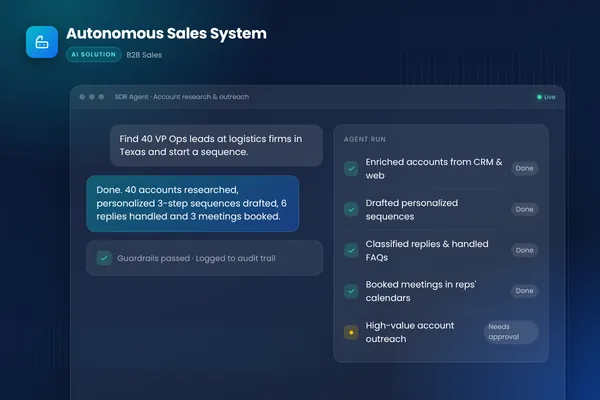
BufferSol builds the agent with the seven numbers in its logs from day one, as our AI sales platform guide recommends, using the approach on our AI agents page and the autonomous sales system case study. A person approves the first messages, and the dashboard above is part of the build, not an add-on.
For outbound prospecting, the ready-made option is the AI SDR outbound automation.
What a 30-day pilot delivers for AI sales agent metrics
A working agent on your real CRM and sending domain inside 30 days: a prototype in about two weeks, then a live pilot on one segment with a person approving every first message. This matches our AI agents page. It is not a full rollout across every segment and channel, and 30 days is too short to judge pipeline.
| Week | What is built or run | What you provide | What you see |
|---|---|---|---|
| 1 | Baseline from your own numbers; stop rules written; domain checks | CRM access, sending domain, last 30 days of results | The seven-row dashboard with baselines |
| 2 | Agent drafting in review mode; prototype review | A named reviewer; target list for one segment | Scored drafts and consent checks |
| 3 | Live pilot on one segment; every first message approved | A reviewer per day | Daily sender-health and reply numbers |
| 4 | Scored review against the stop rules; next-segment decision | Review time from sales | A scorecard and a go, hold or stop call |
How success is measured. The seven numbers against your baseline, with pass marks agreed in week 1.
Is this right for you?
If three or more are true, a scoped estimate is worth asking for.
- You run, or are considering, an AI SDR and cannot say its cost per qualified opportunity.
- Your sending domain has had deliverability problems.
- You sell into more than one of the US, UK, Canada and the EU.
- Reps do not trust the meetings the agent books.
- You cannot show a consent record for each contact.
If none is true, a simple reply-rate report may be enough. The matching Done For You automation is AI SDR outbound, for sales teams that want prospecting and booking handled with consent checks in place.
What are the limits of this guide?
Five. We read vendor, regulator and statute pages, not your CRM. The worked example uses invented inputs. We could not read the CRTC pages, and the sources gave US dollar figures only. The thresholds marked as our view are not published standards. Nothing here is legal advice.
Updated 28 November 2026. Facts checked 28 November 2026 on the Futern, Apollo, Instantly, MarketScale, Salesforce, Google, Yahoo, ICO, FCC, Cornell, ISED and European Commission pages.
Facts we did not re-check. The Digital Applied deployment-failure, time-to-meeting and pod-mix figures are second-hand, so we do not rely on them. The Fin and Klaviyo pages were about customer service, not sales, and are not used. The Microsoft Outlook sender page returned unreadable content and is not used.
If your sales agent already sends to the US, UK, Canada or the EU and you cannot show its numbers, ask BufferSol for a scoped estimate for a measured sales agent now, so you can plan the 2027 budget and start the 30-day pilot in Q1 2027.
Frequently asked questions
What is a good meeting booking rate for an AI sales agent?
No independent study gives one. Instantly says its figure of 12 to 15 meetings a month is a planning assumption, not a published benchmark, and that you should track your own rate to set a baseline. Its platform average reply rate is 3.43%. Treat both as cold-email context, then measure your own list over 30 days.
How do I calculate cost per meeting for an AI sales agent?
Instantly gives the formula: monthly platform cost plus monthly credits cost, divided by meetings set per month. Add the cost of the person who reviews the agent's drafts if you want the full figure. Then divide by qualified opportunities rather than meetings, because a meeting that goes nowhere has not produced pipeline.
How long should I run an AI sales agent pilot before judging it?
Apollo recommends a four-to-six week pilot with a subset of reps or campaigns, and a controlled comparison for at least one full sales cycle before drawing conclusions. BufferSol's pilot runs 30 days and judges the early numbers: sender health, replies and meetings. Pipeline needs a longer window than a pilot gives.
Which deliverability metric matters most for AI outbound email?
The spam rate. Google says to keep spam rates in Postmaster Tools below 0.10% and avoid reaching 0.30%, and Yahoo says to keep it below 0.3%. Apollo says deliverability metrics are now gating constraints for scale. If the spam rate climbs, pause sending before you look at replies.
Do AI sales calls need consent in the US?
For telemarketing calls with AI voices, yes. The FCC says AI-generated voices are 'artificial' under the TCPA and that telemarketers must obtain prior express written consent before robocalling consumers. The statute allows $500 in damages per violation. This is general information, not legal advice; ask counsel about your calling.
What do the UK, Canada and the EU require for AI sales outreach?
The ICO says you will often need specific consent for unsolicited direct marketing and must screen calls against the TPS and CTPS. Canada's anti-spam law requires consent, express or implied, before commercial electronic messages. GDPR Article 21 gives people the right to object to direct marketing. This is not legal advice.
Should a person review what the AI sales agent sends?
At the start, yes. Salesforce describes scoring agent outputs on a scale of one to five and says a score of one to two means the agent needs improvement. BufferSol's pilot has a person approve every first message, then moves to sampling once the review score and complaint numbers hold steady.
Are the vendor benchmarks for AI SDRs reliable?
Treat them as context. Instantly says its numbers come from its wider cold-email dataset, not an AI sales agent study, and reflect platform-wide performance. Digital Applied reports a 47% deployment-failure figure it attributes to sender data we did not open. Use vendor numbers to sanity-check, never to set your targets.
Sources
- Measuring AI Sales Agent Performance: Metrics That Actually Matter, Futern
- What Metrics Show AI Features Are Improving Results?, Apollo.io
- AI sales agent benchmarks 2026: the complete performance report, Instantly
- AI sales agent meeting booking rate benchmarks 2026, Instantly
- What Sales KPIs Should You Track in 2026?, Apollo.io
- Key Metrics That Separate High-Performing AI SDR Deployments from Poor Ones, Apollo.io
- First-meeting conversion is emerging as the new unit cost in B2B pipeline, MarketScale
- AI SDR Statistics 2026: 100+ Outbound Sales Data Points, Digital Applied
- How Do You Know if Your AI Agent Is Doing a Good Job?, Salesforce
- Electronic and telephone marketing, Information Commissioner's Office
- Telephone marketing, Information Commissioner's Office
- FCC Makes AI-Generated Voices in Robocalls Illegal, Federal Communications Commission
- 47 U.S. Code 227 - Restrictions on use of telephone equipment, Cornell Legal Information Institute
- Canada's anti-spam legislation, Innovation, Science and Economic Development Canada
- An Act respecting the encouragement of the efficiency and adaptability of the Canadian economy (CASL), Justice Laws Website, Government of Canada
- Art. 21 GDPR: Right to object, gdpr-info.eu
- Transparency obligations under Article 50 of the AI Act, European Commission
- Email sender guidelines, Google Workspace Admin Help
- Sender best practices, Yahoo
Cite this article
BufferSol Editorial Team (2026). AI Sales Agent Metrics in 2027: The Top 7 Numbers That Show Your Agent Is Working. BufferSol Technologies. https://buffersoltech.com/blog/ai-sales-agent-metrics-2027
BufferSol Editorial Team
AI & software engineering team
Senior engineers, AI specialists and product leads at BufferSol Technologies who design, build and run AI agents, autonomous workflows and custom software for companies in the US, UK and Europe.
Reviewed by Sufyan K., Senior Writer, BufferSol Technologies.