Key takeaways
- BLS projects accountant and auditor jobs to grow 5% from 2025 to 2035, and bookkeeping, accounting and auditing clerk jobs to decline 6% over the same window: the two roles move differently.
- An AI agent in finance is software that does a task through your ledger, bank feed and inbox, and sends exceptions to a person; it is not a replacement for the sign-off.
- Five tasks are moving to agents first: bank reconciliation, transaction coding, invoice approval prep, payment follow-up and routine data entry.
- Time-saving figures such as Xero's 50% on monthly bank reconciliation are vendor claims; no independent time-use study was found.
- The Eloundou study measures tasks exposed to language models, not jobs lost, and it dates from 2023.
Will AI replace accountants? The evidence we found says it is reshaping the work more than removing the role: an AI agent in finance is software that does a task through your ledger, bank feed and inbox and passes exceptions to a person. For 2027, this post lists five tasks agents take over first, five decisions that stay human, and how to test both in a 30-day pilot.
For the wider picture of finance automation, read our finance IT solutions guide. For a tool-level view, see our post on AI accounting software.
What does the data say about AI and accountant jobs?
The most reliable public numbers split accountants from clerks. The US Bureau of Labor Statistics (BLS) projects accountant and auditor employment to grow 5% from 2025 to 2035, adding 79,400 jobs on a base of 1,595,200 in 2025, with median pay of $83,680 in May 2025. For bookkeeping, accounting and auditing clerks, it projects a 6% decline over the same window.
Both pages say why. The accountants page says "The automation of routine tasks, such as data entry, will instead make accountants' advisory and analytical duties more prominent." The clerks page says "Software innovations have automated many of the tasks performed by bookkeeping, accounting, and auditing clerks," yet still lists about 144,100 openings each year, because people leave and retire. The pages were last modified on 29 October 2026 and 27 August 2026. These are projections, and BLS does not model AI agents by name.
An academic paper adds a second angle, with limits. Eloundou, Manning, Mishkin and Rock found that around 80% of the US workforce could have at least 10% of their tasks affected by large language models, and about 19% of workers could see at least half of their tasks affected. That is an exposure estimate from 2023 (revised August 2023), written before today's agent products. It counts tasks touched, not jobs removed, so we do not read it as a forecast of job loss.
| Item | Value |
|---|---|
| Accountants and auditors | 5% |
| Bookkeeping, accounting and auditing clerks | -6% |
Source: U.S. Bureau of Labor Statistics, Occupational Outlook Handbook, pages modified Oct and Aug 2026
BufferSol Technologies · buffersoltech.com
The 5 finance tasks AI agents take over in 2027
These five are chosen because a source we opened describes the task being automated, and each one keeps a person on the exception. Time savings below are vendor claims, and no independent time-use study turned up. Vendor facts are as of November 2026.
1. Can an agent reconcile the bank feed?
Yes for the routine matches, with a person on the rest. Xero's August 2026 release says its agent matches high-confidence transactions to bank feeds and surfaces the exceptions, and it claims a saving of around 50% of monthly bank reconciliation time. That is Xero's own figure, not a measured result.
The Xero release says the tool automates "one of the most time consuming manual tasks in bookkeeping," that "JAX helps to handle the routine and tells you exactly why it matched every single transaction," and that it surfaces "any exceptions that require human expertise." It also reports "more than 100 million transactions auto-reconciled since launch." The useful design point is the explanation: a match with a stated reason can be reviewed in seconds.
Our comparison of account reconciliation software and AI agents shows what to ask a vendor. Choose an agent if most of your lines are routine and your pain is the exceptions queue.
2. Can an agent code and categorize transactions?
Yes, under review. Accounting Today reported in June 2025 that Intuit's Accounting Agent "Automates bookkeeping and transaction categorization, and helps with reconciliation of the books." The rollout to QuickBooks Online customers in the US began on 1 July 2025. The article gives no hours-saved figure for any agent, so we give none either.
Coding is where the BLS clerk projection bites hardest, because it is the repetitive data entry the handbook describes. It is also where a wrong guess spreads quietly: a miscoded vendor misstates every report built on it. Sample the agent's coding each week and track the correction rate. Our posts on AI bookkeeping and AI for accounting firms cover the set-up. Choose an agent if your chart of accounts is stable and a reviewer can sample the output.
3. Can an agent prepare invoice approvals?
It can read the invoice, check it and recommend a decision, and a person approves. Ramp's page says its agent "recommends approvals and flags what needs review so teams make faster, fully informed decisions", and that "your team retains visibility and control over approvals, exceptions, and payment decisions." Vic.ai goes further and says its system "can handle the entire AP workflow from receipt to payment," while also saying it approves routine invoices automatically and escalates unusual cases for human review.
Note the difference in claims. Ramp describes a recommendation with a person in control; Vic.ai describes automatic approval of routine invoices (a 13 June 2025 vendor blog). Which is right depends on your approval limits. Our invoice approval workflow post shows where thresholds sit. Choose automatic approval if your policy already allows low-value invoices through without a human. Choose recommendations if every approval needs a name.
4. Can an agent chase late payments?
It can predict and prompt, and the collector still owns the relationship. Intuit's Payments Agent, per the same Accounting Today report, helps businesses "get paid an average of five days faster by predicting late payments." That is an Intuit figure with no sample or period given in the article.
An agent in collections reads the ageing report, ranks accounts by lateness risk, drafts the reminder and logs the reply. A person handles the dispute, the payment plan and the call to a key customer. Our post on accounts receivable automation software compares the options, and our accounts receivable questions post lists what to ask. Choose an agent if most of your late invoices are forgotten rather than disputed.
5. Can an agent take over routine data entry?
Yes, and this is the task the BLS calls out by name. The handbook says automating routine tasks "such as data entry" will make advisory and analytical work "more prominent" for accountants. In practice that means reading documents, keying fields into the ledger and checking them against a rule, with the exceptions routed to a reviewer.
The risk is speed without control. COSO describes its internal control framework as meant to "help ensure that organizational objectives related to operations, reporting, and compliance are achieved." An agent that enters data faster than anyone reviews it works against that goal, so keep a log of what was entered, from which document, and who approved. Our workflow exception handling post shows how exceptions are routed. Choose an agent if your documents arrive in a few predictable formats.
| Task | What the agent does | What a person still does | Source and status |
|---|---|---|---|
| 1. Bank reconciliation | Matches high-confidence transactions, explains each match | Clears exceptions | Xero, vendor claim |
| 2. Transaction coding | Categorizes and helps reconcile | Samples and corrects | Intuit via Accounting Today |
| 3. Invoice approval prep | Reads, checks, recommends or approves routine | Approves unusual and high-value | Ramp and Vic.ai, vendor claims |
| 4. Payment follow-up | Predicts late payers, drafts reminders | Handles disputes and key accounts | Intuit via Accounting Today |
| 5. Routine data entry | Reads documents, keys and checks fields | Reviews exceptions and samples | BLS handbook |
- 01ReadPull the bank line and the matching ledger entries
- 02MatchMatch when confidence is high and record the reason
- 03FlagSend anything uncertain to a person with the cause stated
- 04ApproveA named person clears the exception and the log keeps the record
BufferSol Technologies · buffersoltech.com
What stays with a person in 2027?
Judgment, sign-off and accountability stay with named people. This is BufferSol view, based on how the vendor pages describe escalation: Vic.ai says it escalates "unusual cases for human review," Xero says it surfaces "exceptions that require human expertise," and Ramp says teams retain "control over approvals, exceptions, and payment decisions." No page we opened addresses audit sign-off, licensing or professional liability, so we make no claim about them.
Five decisions we would keep with a person: approving a journal that changes reported results, signing an audit or review, agreeing a payment plan with a customer, deciding a tax position, and explaining the numbers to a board or lender. The agent prepares the evidence for each. It does not own the outcome.
What changes for accountants and finance teams in 2027?
No source we opened forecasts 2027 headcount, so everything in this section is BufferSol view, written as reasoning. We do not invent job-loss numbers.
First, we expect the first hour of the month-end to move from keying to reviewing, because the agent works overnight and the reviewer starts with the exceptions. Second, we expect clerk-style roles to shift toward exception review, in line with the BLS note that routine tasks are automated while it still projects openings. Third, we expect buyers to ask for logs and approval trails, because speed without evidence does not pass an audit. Finance teams that pilot one task in Q1 2027 will know their own numbers by the time budgets close.
What does an AI agent not do?
An agent does not hold a licence, take responsibility or fix a messy chart of accounts. It can mis-code a transaction, match a payment to the wrong invoice or miss a duplicate that looks different. Set limits on what it may post, require a person to approve anything that moves money or changes reported results, and review a sample of its decisions weekly.
Vendor figures need the same care. The Xero 50%, the Intuit five days faster and the Vic.ai claims come from vendor pages and a trade report on a launch. Vic.ai also says companies can reduce close cycles by up to 50% citing "several industry studies" without naming one, so we do not use that figure. Our human-in-the-loop post explains where to place approvals.
When should you build your own finance agent?
Build when your rules, ledger and approval limits are your own, or when per-seat and per-transaction fees grow with volume. Buy when a packaged agent already fits your accounting platform. A build needs design, testing and upkeep that a packaged product handles for you.
Build when:
- Your approval limits are specific. The agent applies your thresholds and names the approver.
- Your systems are mixed. The agent works across your ERP, bank feed and inbox with one log.
- Exceptions are your cost. The agent states the cause and proposes the fix.
- Volume is growing. You pay model and hosting costs, not a fee on every line.
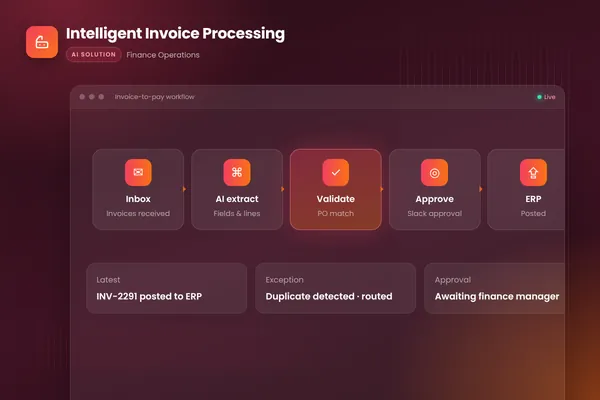
BufferSol's intelligent invoice processing agent is the pattern: it watches the invoices inbox, extracts every field, matches lines to purchase orders, flags mismatches or duplicates, routes clean invoices to the approver in Slack and posts to the ERP once approved, while exceptions land in a review queue with the reason already explained.
What would a 30-day pilot deliver?
In 30 days you get a working agent on one finance task with your real data, and a person approving what matters. The plan:
- You bring: one task to start with (bank reconciliation or invoice approvals work well), three months of history, your approval limits and read access to the ledger or bank feed.
- We build, in about two weeks: a prototype that does the task, explains each decision and flags exceptions, scored against a test set made from your own records.
- We launch, in the final stretch: a live pilot on one entity or one account group, with a review queue and a log of every decision.
Success is measured by lines handled without a correction, exceptions cleared per day, corrections found in review and time to close. The closest ready-made version for month-end is our month-end close and reconciliation automation, which suits teams closing the books by hand. For payments, see collections and accounts receivable. Other teams get a custom build from our autonomous workflows team.
Is this right for you?
Check how many of these describe your finance team:
- Month-end starts with hours of matching and keying.
- Your reviewers spend more time on routine lines than on exceptions.
- You can export three months of transactions with their supporting documents.
- You have written approval limits.
- You want an audit trail for every automated decision.
If few do, start with the features already in your accounting platform and measure them for a month.
Facts checked November 2026. BLS figures are projections for 2025 to 2035, vendor figures are vendor claims, and the Eloundou paper measures exposure, not job loss. This post is not professional or legal advice.
If your finance team spends its month-end matching and keying, ask BufferSol for a scoped estimate for a finance agent on your first task now, so the 2027 budget includes it and the pilot can start in Q1 2027.
Frequently asked questions
Will AI replace accountants?
The US Bureau of Labor Statistics projects employment of accountants and auditors to grow 5% from 2025 to 2035, and says automating routine tasks such as data entry will make accountants' advisory and analytical duties more prominent. Bookkeeping, accounting and auditing clerks are projected to decline 6%. Projections are not guarantees, and no source we read measures job cuts after agents arrived.
Will AI replace bookkeepers?
Bookkeeping work is more exposed than accounting work. The BLS projects clerk employment to decline 6% from 2025 to 2035 and says software innovations have automated many of those tasks, though it still projects about 144,100 openings a year. Bookkeepers who review exceptions and explain the numbers are doing the part agents hand back to a person.
What do AI agents actually do in accounting?
As of November 2026, vendors describe agents that categorize transactions, match bank feeds to the ledger, prepare invoice approvals and predict late payments. Intuit's Accounting Agent automates bookkeeping and transaction categorization, and Xero's agent surfaces exceptions that need human expertise. These are vendor descriptions, not independent audits.
Can an AI agent sign off an audit or post journals on its own?
None of the sources we read says an agent can or should sign off. Vendor pages describe escalation to people: Vic.ai says its system escalates unusual cases for human review. Treat sign-off, licensing and liability as questions for your professional body and insurer, and set the agent up so a named person approves anything that posts.
Sources
- Accountants and Auditors: Occupational Outlook Handbook, U.S. Bureau of Labor Statistics
- Bookkeeping, Accounting, and Auditing Clerks: Occupational Outlook Handbook, U.S. Bureau of Labor Statistics
- GPTs are GPTs: An Early Look at the Labor Market Impact Potential of Large Language Models, arXiv
- Agentic AI is taking over accounting, here's what teams need to know, Vic.ai
- Intuit debuts AI agents for QuickBooks, Accounting Today
- Xero announces new AI innovations for small businesses and accountants at Xerocon Denver, Xero
- Internal Control, COSO
- Ramp Bill Pay: Accounts Payable Automation Software, Ramp
Cite this article
BufferSol Editorial Team (2026). Will AI Replace Accountants? 5 Finance Tasks AI Agents Take Over in 2027. BufferSol Technologies. https://buffersoltech.com/blog/will-ai-replace-accountants-2027
BufferSol Editorial Team
AI & software engineering team
Senior engineers, AI specialists and product leads at BufferSol Technologies who design, build and run AI agents, autonomous workflows and custom software for companies in the US, UK and Europe.
Reviewed by Sufyan K., Senior Writer, BufferSol Technologies.