Key takeaways
- Ask five questions before you buy accounts receivable software: how big your late-payment problem is, what it automates, how it is priced, who approves what, and whether it reaches your ERP and rules.
- According to Atradius (September 2026), late payments affect an average of 22% of US B2B receivables, so size your own exposure before you shop.
- None of the five vendor pages we opened showed a price list; HighRadius shows $0 implementation and go-live fees with a gain share it leaves blank (as of November 2026).
- Accuracy claims such as Tesorio's '95%+ auto-match rate across 200+ customers' are vendor figures, so test on your own remittances.
- Build a custom AI agent when your credit rules, ERP and approvals are specific to you; buy when a vendor's workflow already fits.
Accounts receivable software helps a business collect what customers owe, and the right choice in 2027 comes down to five questions: how big your late-payment problem is, what the tool automates, how it is priced, who approves what, and whether it reaches your ERP and rules. A custom AI agent is the alternative when those rules are specific to you. We checked five vendors on their own pages in November 2026.
For the basics of reminders, disputes and cash application, read our post on accounts receivable automation software vs an AI collections agent. For the wider finance picture, see our finance IT solutions guide.
1. How big is your late-payment problem?
Size the problem before you shop, because the software only earns its fee on money you would otherwise collect late or lose. According to Atradius (17 September 2026), US suppliers "conduct, on average, 45% of their business-to-business (B2B) sales on credit, with the remainder paid upfront," and "late payments affect an average of 22% of B2B receivables." The same report says "US companies often report losing 1% to 2% of their B2B invoices as bad debt."
Those are averages for US suppliers, not your numbers. A BufferSol calculation shows how to use them: of every $100,000 in receivables, 22% late is $22,000 waiting past its due date, and 1% to 2% bad debt on $100,000 of invoices is $1,000 to $2,000 (BufferSol calculation using the Atradius figures). Replace the examples with your own aging report.
Atradius does not say which type of tool reduces these numbers, and neither do the vendor pages we opened. Do not buy on the assumption that software closes the gap; test whether it does.
2. What does the software actually automate?
Read the verbs on each vendor's own page, because the five describe quite different jobs. All of the following is as of November 2026.
| Vendor | What its own page says it does | Choose it if |
|---|---|---|
| HighRadius | AI agents that auto-match transactions, surface exceptions and generate corrective journals | You are a large finance team with intercompany and reconciliation work |
| Billtrust | AI tuned to each buyer's behavior to focus your team on accounts that grow the cash forecast | You want collections prioritised by buyer behavior |
| Tesorio | AI agents across the full order-to-cash lifecycle, with drafted follow-ups and dunning | You want one tool from invoice to payment matching |
| Versapay | Automates collections, predicts delinquencies and prioritises high-risk accounts | You want collaboration with customers on invoices and payments |
| Chaser | Automatically chases outstanding invoices and forecasts cash flow | You want a simpler reminder tool |
The quotes behind the table: HighRadius says its agents are "auto-matching transactions, surfacing exceptions for review" and "match IC AR/AP data, generate corrective journals, and update ledgers." Tesorio says "AI drafts personalized follow-up emails, extracts payment promises, and manages your dunning pipeline." Versapay says it will "automate collections, predict delinquencies, prioritize high-risk accounts, and maintain visibility." Chaser says it will "automatically chase outstanding invoices."
Accuracy is a vendor claim. Tesorio's page says "95%+ auto-match rate across 200+ customers," which is Tesorio's figure with no independent test behind it on that page. Billtrust's page says "AI tuned to each buyer's behavior puts your team on the accounts that actually grow the cash forecast" (Billtrust). Test every claim on your own remittances.
3. How is it priced?
Expect to ask for a quote, because none of the five vendor pages showed a price list. The nearest thing to a price in our check was on HighRadius's home page, which says "you will only pay when the AI Agents deliver value basis improvement in KPIs," lists "Implementation fees: $0" and "Fees until go-live: $0," and leaves the post-go-live gain share percentage blank.
A gain-share model sounds attractive, but it moves the question: what counts as value, and who measures it? Ask for the KPI definitions, the baseline and the cap in writing. Tesorio's page offers an ROI calculator and a demo request and lists no prices. Chaser's page links to a separate pricing page that we did not open, so we make no price claim for it.
Ask every vendor for a written annual quote that lists:
- fees per user, per invoice or per customer
- implementation, training and integration
- payment processing fees, if any
- the gain-share or contract term, if any
- what happens at renewal
Compare quotes on the same invoice volume and the same ERP.
4. Who approves what?
Decide the approval rules before you choose a tool. Reminders are low risk. Credit holds, payment plans, write-offs and messages to sensitive accounts are not.
No source we opened sets a standard for what an AI collections agent may do alone, so this is BufferSol's view. A safe default is that the agent sends reminders on your schedule, logs promises to pay and matches clear payments, and a person approves everything that changes the customer's terms or your books. Our post on human-in-the-loop AI agents shows where to put approvals.
Ask each vendor: Can I set limits by customer segment and amount? Is every automated action logged with the reason? Can a person see and override what the agent will send tomorrow? A tool that cannot answer yes to all three is not ready for your credit team.
5. Does it reach your ERP and follow your rules?
Check the connection to your ERP and bank feeds first, because cash application only works when it can read open invoices and post receipts. HighRadius's page says its agents "match IC AR/AP data, generate corrective journals, and update ledgers," which shows the kind of ledger access to ask about (HighRadius).
Then check your rules. Do your payment terms vary by customer? Do you have credit limits that depend on a parent account? Do disputes need to go to a named owner by product line? A packaged tool handles the standard cases; the unusual ones are where a custom agent earns its place.
- 011. Size the problemLate share, bad debt and days overdue from your own aging report.
- 022. Read the verbsMatch each vendor's own words to the job you need done.
- 033. Get a quoteWritten annual price on your volume and ERP.
- 044. Set approvalsReminders alone, holds and write-offs by a person.
- 055. Test the fitRun your own remittances and rules through each tool.
Source: BufferSol process
BufferSol Technologies · buffersoltech.com
What changes for accounts receivable teams in 2027?
No analyst or regulator source loaded for this post, so every forward claim here is BufferSol view.
We expect vendors to keep adding AI agents to their platforms, so the label will tell you less than the approval design does. We expect gain-share and outcome-based pricing to become more common, as HighRadius's page already shows, which makes KPI definitions part of the contract. And we expect buyers to want agents that act in their own ERP with logs they control. Budget for a test in Q1 2027 and sign only after your own remittances have run through it.
When does a custom AI collections agent beat accounts receivable software?
A custom agent beats packaged software when your credit rules, ERP and approvals are the hard part. Packaged tools are strong at standard reminders and matching. A custom agent works inside your own ERP, inbox and bank feeds and follows your rules.
Build your own if:
- Your terms are unusual. Payment terms, credit limits or parent accounts do not fit a template.
- You run several entities or ERPs. The agent reads and posts to each.
- Your disputes need your routing. Product, region or contract decides the owner.
- You want ownership. Prompts, rules and logs stay in your environment, with no per-seat fees.
A custom agent has limits too. It needs clean customer and invoice data, a credit team that approves sensitive actions, and an owner after launch. None of the sources we opened gives a build cost or maintenance figure for a custom agent, so we make no cost claim; the pilot below is how you find out on your own data.
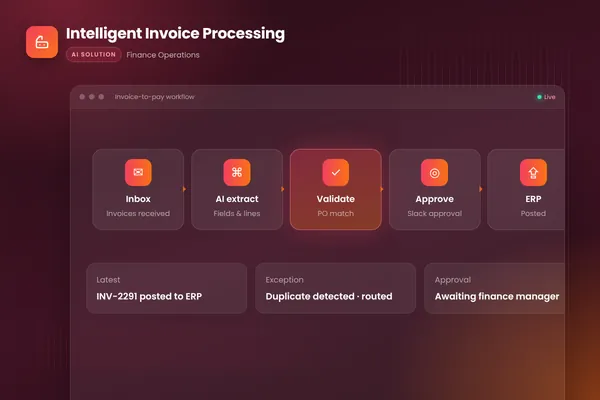
BufferSol's intelligent invoice processing project shows the same pattern on the payable side: it reads documents, validates them against your records, routes approvals and posts to the ERP with an audit trail. Our autonomous workflows team applies that design to collections. If you are comparing wider tools first, read our best accounting automation software post and our guide to AI accounting software. For the payable side, see AP automation software vs a custom AI agent, and for what comes after collection, financial close automation.
Source: Atradius, B2B payment practices trends in the US 2026 (17 September 2026)
BufferSol Technologies · buffersoltech.com
What would a 30-day pilot deliver?
A pilot is a working agent on your real receivables inside 30 days. We would plan it like this:
- Week 1: you provide your aging report, a sample of past customer replies and remittances, read access to your ERP and inbox, and your collection rules.
- Weeks 2 and 3: a prototype drafts reminders in your tone, reads replies, logs promises to pay and proposes payment matches, scored against your sample.
- Week 4: a live pilot on a first slice, such as one customer segment, with your credit team approving what matters.
Success is measured by the share of reminders approved without edits, payments matched without a person, disputes routed to the right owner and days overdue on the slice. The ready-made version is our collections and accounts receivable automation, built for B2B finance teams with too few people to follow up on every account.
Is this right for you?
A custom pilot fits if most of these are true:
- Your aging report is reviewed weekly but only the largest balances get a call.
- Your payment terms or credit rules vary by customer.
- Your ERP exports open invoices and receipts you can share.
- A credit lead can approve sensitive actions each day.
- A packaged tool did not follow your rules or reach your systems.
If none of that applies yet, buy a tool for the one job you need and test it first.
Facts checked November 2026. Vendor pages carry no dates and offers change, so re-check each vendor before you sign.
If late payments are tying up cash in your business, ask BufferSol for a scoped estimate for a collections agent, so the 2027 budget includes it and the pilot can start in Q1 2027.
Frequently asked questions
What is accounts receivable software?
Accounts receivable software helps a business collect what customers owe. It sends invoices and reminders, tracks overdue balances, matches incoming payments to open invoices and reports on collections. AI versions add predicted late payers and drafted follow-up emails. Packaged tools such as HighRadius, Billtrust, Tesorio, Versapay and Chaser sell these features; a custom AI agent does the same work inside your own systems.
How much does accounts receivable software cost?
None of the five vendor pages we opened listed a price list in November 2026. HighRadius shows implementation fees of $0 and fees until go-live of $0, with payment tied to results through a gain share whose percentage the page leaves blank. Chaser links to a separate pricing page we did not open. Ask each vendor for a written annual quote.
Is a custom AI agent better than accounts receivable software?
A custom AI agent is better when your credit rules, approvals and ERP are the hard part: unusual payment terms, several entities, or customer-specific dispute rules. Packaged accounts receivable software is better when its standard reminders and cash application already fit and you want it live quickly. Many teams buy for one job, such as reminders, and build only the steps they cannot get.
What should an AI collections agent approve without a person?
No source we opened sets a standard, so this is BufferSol's view. An AI collections agent can send reminders on your schedule, log promises to pay and match clear payments on its own. A person should approve credit holds, payment plans, write-offs and any message to a sensitive account. Set limits in writing and log every action.
Sources
- HighRadius homepage, HighRadius
- HighRadius AI Agents, HighRadius
- Billtrust homepage, Billtrust
- Tesorio homepage, Tesorio
- Versapay homepage, Versapay
- Chaser homepage, Chaser
- B2B payment practices trends in the US 2026, Atradius
Cite this article
BufferSol Editorial Team (2026). Accounts Receivable Software in 2027: 5 Questions to Ask Before You Buy, or Build a Custom AI Agent. BufferSol Technologies. https://buffersoltech.com/blog/accounts-receivable-software-questions-2027
BufferSol Editorial Team
AI & software engineering team
Senior engineers, AI specialists and product leads at BufferSol Technologies who design, build and run AI agents, autonomous workflows and custom software for companies in the US, UK and Europe.
Reviewed by Sufyan K., Senior Writer, BufferSol Technologies.