Key takeaways
- An AI voice sales agent answers an inbound call, asks a few qualifying questions, writes the answers to the CRM and then transfers the caller, books a meeting or sends the lead to a nurture list. The plan below has five steps and puts a person at the points where judgment matters.
- In the US, 47 U.S.C. 227 prohibits calls using an artificial or prerecorded voice without prior express consent, and the statute allows $500 per violation, up to three times that for a willful or knowing one. Close's $1,500 per call figure is that ceiling.
- In the UK, the ICO says you must not make an automated marketing call unless the person has specifically consented, and that live calls must be screened against the TPS and CTPS.
- In Canada, telemarketers and their clients must register with the National Do Not Call List operator. CASL section 6(8) carves out interactive two-way voice communication between individuals, but whether an AI call counts is a question for counsel.
- In the EU, the Commission says Article 50 of the AI Act applies from 2 August 2026, and people must be informed they are interacting with an AI system unless it is obvious.
An AI voice sales agent in 2027 answers an inbound call, asks a few qualifying questions, writes the answers to your CRM and then transfers the caller, books a meeting or sends the lead to a nurture list. A five-step plan gets one live on your real calls: choose the questions, write the routing rule, connect the tools, set the call rules per market and run a pilot with a person taking transfers.
Read our AI voice agents guide first if the terms are new. This post is a cluster page under that guide. It sits beside our posts on the CRM contract for voice agents and TCPA and AI calls, and it adds what they leave out: the routing rule itself, worked on ten invented calls, and the call rules of the US, UK, Canada and the EU side by side.
What is an AI voice sales agent?
It is software that talks to callers on the phone and handles the first part of a sales conversation. CloudTalk describes its version this way: "It makes and answers calls, updates CRMs, books meetings, and loops in a human only when needed." For inbound calls the page says the agent "Answers calls, qualifies, routes, or solves issues instantly."
The word that matters is routes. A voice agent that only talks is a novelty. One that decides what happens next is a sales tool. CloudTalk's page frames the decision: "The AI determines what happens next: Does the lead need more nurturing? Should it escalate to a rep?" This post is about writing that decision down so you can test it, and about the call rules that apply around it.
Who decides what in an inbound voice sales workflow?
The agent talks, scores and logs; a person takes the transfers and owns every promise on price, terms or dates. The table sets the split across ten steps. The approval points are BufferSol's starting proposal, not a rule from any regulator.
| Step | What the agent does | Tool it uses | Who approves | What gets logged |
|---|---|---|---|---|
| 1. Answer | Picks up and says it is an AI assistant for the company | Phone line, voice platform | Compliance owner sets the opening text | Call ID, opening version |
| 2. Ask | Asks four qualifying questions in a natural order | Language model, speech tools | Sales lead owns the questions | Answers, timestamps |
| 3. Check | Looks the caller up by number in the CRM | CRM search | Nobody | Match or no match |
| 4. Score | Adds up the points from the four answers | Rules table | Sales lead owns the weights | Score, each component |
| 5. Route | Picks transfer, booking or nurture by score | Routing rules | Sales lead owns the thresholds | Route, reason |
| 6. Transfer | Warm-transfers with a short spoken summary | Phone transfer | Rep accepts or declines | Rep, time, outcome |
| 7. Book | Offers meeting slots when no rep is free | Calendar API | Rep owns the calendar | Slot, owner |
| 8. Write | Saves the answers and the call summary as CRM fields | CRM API | Nobody | Record ID, request key |
| 9. Consent | Records any promise to call back or text | Consent field | Compliance owner | Wording, time, channel |
| 10. Review | Lists transfers, bookings, holds and calls to review | Daily email or dashboard | Sales lead | Counts, ages |
- 01AnswerSay it is an AI assistant and who runs it.
- 02QualifyAsk four questions: budget, timeline, use case, buying role.
- 03ScoreAdd the points with weights your sales lead set.
- 04RouteTransfer, book or nurture. A caller who asks for a person gets one.
- 05LogWrite answers, score and route to the CRM.
BufferSol Technologies · buffersoltech.com
| Score | Route | |
|---|---|---|
| 70 to 100, or the caller asks for a person | Transfer | Warm transfer to a named rep with a spoken summary |
| 40 to 69 | Book | Meeting slot with a rep within one business day |
| Under 40 | Nurture | Added to a follow-up list with the answers logged |
BufferSol Technologies · buffersoltech.com
Which five steps does this plan cover?
Five, each a numbered section below. They run in the order you build them. Each says what to do, what the sources say, and where the step stops working. The table is the short version.
| Step | What you decide | Supporting source | Where it stops working |
|---|---|---|---|
| 1. Choose the questions | What the agent must learn on the call | Murf, Fireflies | Callers who will not answer |
| 2. Write the routing rule | Score, thresholds, hard overrides | JustCall, ElevenLabs | A rule nobody has tested |
| 3. Connect CRM and calendar | Where answers and bookings land | Voiceflow, Aircall | Duplicate or missing records |
| 4. Set the call rules per market | Disclosure, consent, registers | Cornell LII, ICO | Rules that change after launch |
| 5. Pilot and measure | Pass marks and the stop rule | CloudTalk, Retell | A sample too small to trust |
1. Choose the four questions the agent must ask
The first step is a short list of what the agent has to learn before it can route. Vendor pages agree on the list. Murf says its agent "asks the right discovery questions around budget, timeline, company size, use case, buying role, and urgency." Fireflies says its agent "Runs BANT, highlights objections and competitor mentions." Aircall's UK page says "Your AI SDR confirms budget, timeline, and use case on the call, so reps only pick up leads that are ready to buy."
BufferSol's version has four questions, because every extra question costs callers. Budget: is money set aside for this? Timeline: when do they want it live? Use case: does what they describe fit what you sell? Buying role: are they the decision maker or a user? The agent asks them in a natural order, accepts "not sure" as an answer and never presses. ElevenLabs says "Speed matters as much as accuracy here", and a caller who feels interrogated hangs up.
Choose four, write each as a plain question, and write down what counts as a yes. The limit: a caller may not know the budget, and the agent should record "unknown" without penalty beyond the points. Our AI lead qualification post covers the same questions for web and email leads.
2. Write the routing rule as numbers a person can read
The second step turns the answers into a decision. JustCall's page says its agent can "Apply qualification rules to prioritize leads and route them to the right sales team", "Trigger the next step once qualification is complete" and "Decide when a human takes over." None of the pages we read shows the rule itself. Here is BufferSol's, with invented weights that your sales lead should change.
Score out of 100: budget confirmed 30, timeline within 90 days 30, use case fits 25, decision maker 15. Route at 70 or more to a warm transfer to a rep. Route 40 to 69 to a booked follow-up with a rep within one business day. Route under 40 to a nurture list. One override sits above the score: a caller who asks for a person gets a person, and an angry or distressed caller does too, whatever the score.
| Call | Budget 30 | Timeline 30 | Use case 25 | Decision maker 15 | Score | Route |
|---|---|---|---|---|---|---|
| 1 | Yes | Yes | Yes | Yes | 100 | Warm transfer |
| 2 | Yes | Yes | Yes | No | 85 | Warm transfer |
| 3 | No | Yes | Yes | Yes | 70 | Warm transfer |
| 4 | Yes | No | Yes | No | 55 | Booked follow-up |
| 5 | No | No | Yes | No | 25 | Nurture |
| 6 | No | Yes | No | Yes | 45 | Booked follow-up |
| 7 | Yes | Yes | No | No | 60 | Booked follow-up |
| 8 | No | No | No | No | 0 | Person (asked for one) |
| 9 | No | No | Yes | Yes | 40 | Booked follow-up |
| 10 | Yes | No | No | No | 30 | Nurture |
The ten calls are invented, and the arithmetic was checked by script. Three go to a rep now, four to a follow-up, two to nurture and one to a person because the caller asked. The edge cases show why the thresholds matter: call 3 sits exactly on 70 and call 9 exactly on 40. In a pilot, review every call within five points of a threshold, because that is where the rule is wrong most often.
Choose numbers your reps agree with, and keep them in a table the sales lead can edit without a rebuild. The limit: no source we found gives a standard weight or threshold, so these are BufferSol's view until your pilot measures them. CloudTalk's lead-qualification guide advises to "Keep people in the loop where judgment matters: edge cases, leads the AI flagged as low-confidence, and your key accounts."
3. Connect the CRM and the calendar so the route actually happens
The third step is plumbing. A route that exists only on a call recording is not a route. Voiceflow's page says "Qualification answers land in the CRM as structured fields on a new or matched record" and "Qualified buyers get a live handoff or a booked meeting on the spot." Aircall's page says leads are created "The moment a lead lands in HubSpot, typically inside a minute, while they are still on the page", and that "If nobody answers, it makes one more attempt and then hands the lead to a rep."
Three rules keep the plumbing honest. Search the CRM by phone number before creating a record, to avoid duplicates. Write each answer to its own field, not a free-text note, so the sales lead can report on it. And give each write a request key so a retry cannot create two records; our CRM integration post sets out the contract, limits and retry rules in detail. For delay and timing on the line itself, see voice AI latency.
The warm transfer needs a decision about who picks up. Name a rep per shift, set a ring time, and decide what happens when nobody answers: book a slot and tell the caller. Choose the fallback before launch. The limit: a transfer to an empty desk is the worst experience of all, worse than no agent.
4. Set the call rules for each market before the first call
The fourth step is the one most guides skip. The agent's first sentence and what it records depend on where the caller is. This post is about inbound calls, where most rules bite less. They bite harder the moment the agent calls back, texts or runs outbound, so the rules below cover both. It is not legal advice.
In the US, 47 U.S.C. 227 prohibits any call made using "an artificial or prerecorded voice" other than one "made with the prior express consent of the called party". The statute lets a person recover "$500 in damages for each such violation, whichever is greater", and a court may increase the award to "not more than 3 times the amount" for a willful or knowing violation. That is where Close's line comes from: "Penalties might be up to $1,500 per violating call." Three times $500 is $1,500; Close names the TCPA, though not the arithmetic. The ABA Banking Journal reported on 8 February 2024 that the FCC ruled "speech generated by artificial intelligence falls under the Telephone Consumer Protection Act's restriction" and that the call must offer opt-out methods when it includes or introduces an advertisement.
In the UK, the ICO says "You must not make an automated marketing call" "unless the person has specifically consented to receive this type of call from you", and that general marketing consent does not cover automated calls. For live calls the ICO's guidance says "you must check phone numbers against these registers before you make the calls", meaning the TPS and CTPS, and "You must not withhold your number when making direct marketing calls." The live calls page also says "Due to changes made by the Data (Use and Access) Act, this guidance is under review and may be subject to change."
In Canada, the National Do Not Call List operator's terms page says telemarketers who make unsolicited calls on their own behalf, and their clients, must register. CASL section 6 requires consent for commercial electronic messages, and section 6(8) excludes "interactive two-way voice communication between individuals" and "a voice recording sent to a telephone account". Whether a call with an AI voice is a communication between individuals is not something these pages answer, so ask a lawyer. The CRTC pages returned a 403 and are not used.
In the EU, the Commission's Article 50 FAQ says Article 50 "applies as from 2 August 2026" and that people must be informed "that they are interacting with an AI system", with an exception when it is obvious that should be read narrowly.
Choose one opening line for every market: "Hello, I'm an AI assistant for this company." It costs nothing and removes the argument about what is obvious. The limit: every rule above can change, and several pages say so themselves.
5. Run a pilot with pass marks written before the first call
The fifth step is a measured pilot. Run the agent on part of your inbound traffic, with a rep taking every transfer, for two weeks of real calls. Write four pass marks first: calls the agent routed the same way a rep would have, calls where a caller asked for a person and did not get one (target none), CRM records with missing fields, and transfers a rep declined.
Review a sample. Listen to 30 calls, including every call near a threshold, and score the route as right, wrong or arguable. The numbers are BufferSol's view, since no source gives a standard pass mark. CloudTalk gives one campaign as an example, with "the agent called 6,531 leads and held 997 conversations averaging three minutes each", which is the company's own report and not an independent test.
Set the stop rule with the pass marks. Any call where a caller asked for a person and did not get one pauses the pilot until the cause is fixed. Our agent evaluation guide and human-in-the-loop guide cover how to build the sample and the approval design. The limit: two weeks of calls will not show rare cases or seasonal peaks.
What changes in 2027 for AI voice sales agents?
Three dated facts shape the plan, followed by one BufferSol view. The European Commission says Article 50 of the AI Act applies from 2 August 2026, so EU-facing voice agents are already inside the disclosure rule. The ICO says its live calls guidance is under review because of the Data (Use and Access) Act. And the ABA Banking Journal reports the FCC's February 2024 ruling that AI voices are covered by the TCPA, which many vendor pages now repeat as settled.
BufferSol view: through 2027 the useful question moves from "can the agent sound human" to "can you show why each call went where it did". Budget for the rules table, the call log and the weekly review, because those decide whether the sales team trusts the transfers. Pilot in Q1 2027 on one number and one market, then widen. This is a view, not a forecast.
What applies in the US, UK, Canada and the EU?
Each market adds a different duty at a different moment. The table lists what the pages we read say, as of November 2026, and what each means for the agent. It is a map for building the agent, not legal advice.
| Market | What the page says | What it means for the agent | Source |
|---|---|---|---|
| US | Calls with an artificial or prerecorded voice need prior express consent; $500 per violation, up to three times for willful | Get and record consent before any outbound AI call | 47 U.S.C. 227 |
| US | The FCC treats AI-generated voices as artificial; telemarketing calls must offer opt-out | Include an opt-out in any call that includes an advertisement | ABA Banking Journal |
| UK | Automated marketing calls need specific consent; live calls need TPS and CTPS checks | Screen numbers and keep consent wording | ICO telephone marketing, ICO live calls |
| Canada | Telemarketers and their clients must register with the National DNCL operator | Register before any unsolicited outbound call | DNCL terms |
| Canada | CASL s.6(8) excludes two-way voice between individuals and voice recordings to a telephone account | Ask counsel how an AI voice call is classed | CASL |
| EU | People must be informed they interact with an AI system, unless obvious; from 2 August 2026 | Say it is an AI in the first sentence | Commission FAQ |
Currency: the UK plan prices below are Aircall's, in pounds. We found no Canadian dollar or euro price on the pages we read, so the worked example is in pounds and other readers should substitute their own rates.
What does a worked cost per qualified lead look like?
Take an invented UK sales team: 400 inbound calls a month at three minutes each, so 1,200 minutes. Aircall's UK page lists "1,000 minutes" at "£180 / month", "3,500 minutes" at "£595 / month" and "10,000 minutes" at "£1,400 / month", as of November 2026, and says to treat customer results as "directional, not as commitments". The 1,000-minute plan is too small, so assume the £595 plan. Assume a rep spends 10 hours a month reviewing calls at £25 an hour (£250) and that 25% of calls score 70 or more. This is a BufferSol estimate with invented inputs; use your own.
| Line | Input (BufferSol estimate) | Result |
|---|---|---|
| Inbound calls | 400 a month | 400 |
| Average call length | 3 minutes | 1,200 minutes |
| Plan | Aircall UK, 3,500 minutes | £595 |
| Review time | 10 hours at £25 | £250 |
| Total monthly cost | £595 plus £250 | £845 |
| Cost per call | £845 divided by 400 | £2.11 |
| Calls scoring 70 or more | 25% of 400 | 100 |
| Cost per qualified lead | £845 divided by 100 | £8.45 |
The number depends most on the qualified rate. The table holds the £845 and changes that one input. All rows are BufferSol estimates, which is the point: measure the rate first in your pilot.
| Scenario (BufferSol estimate) | Qualified rate | Qualified leads | Cost per qualified lead |
|---|---|---|---|
| Weaker | 15% | 60 | £14.08 |
| Base | 25% | 100 | £8.45 |
| Stronger | 35% | 140 | £6.04 |
| Item | Value |
|---|---|
| 15% qualify | 14.08£ |
| 25% qualify | 8.45£ |
| 35% qualify | 6.04£ |
Source: BufferSol estimate: £845 a month, 400 calls, Aircall UK plan price as of November 2026
BufferSol Technologies · buffersoltech.com
For comparison, Retell's page works an example at "$0.07/min with a 3-minute average call and a 12% qualification rate," giving "approximately $1.75" in AI cost per qualified lead, and says "The 12% rate is an assumption for the example, so replace it with your own." That counts the AI minutes. Our example adds the plan floor and review time, which is why it is higher. Fireflies says "Most sales teams doing real volume pay under $2 per call", a vendor claim we did not test.
How do AI voice agents qualify leads?
They ask a short set of questions, score the answers and apply a rule. The common set is budget, timeline, use case and buying role, which Murf and Aircall both describe. The part that varies is the rule: some agents use a fixed script and some adapt follow-up questions, as JustCall describes, though we quote only its routing lines.
How do AI voice agents route leads?
By score and by override. A high score goes to a warm transfer, a middle score to a booked follow-up and a low one to nurture. ElevenLabs says the agent "Sends each prospect straight to a meeting, a rep, or a nurture sequence the moment the call ends, no manual handoff required." Our override rule sits above the score: a caller who asks for a person gets one.
When should a human take over an AI sales call?
On a high score, a request, or a topic that needs judgment such as price, terms or a dispute. ElevenLabs says human reps fit "Complex enterprise deals, strategic accounts, and later-stage sales conversations." CloudTalk's advice is to keep people involved for "edge cases, leads the AI flagged as low-confidence, and your key accounts." Warm-transfer with a spoken summary so the caller does not repeat themselves.
Is an AI voice sales agent legal to use?
For inbound calls the main duties are disclosure and recording rules, and for outbound calls they are consent and registers. The sources above set out the US, UK, Canadian and EU positions, and each has gaps we name. It is not legal advice, and a lawyer should check the opening line, the consent wording and any recording notice for each market you serve. See our AI outbound calls guide for the outbound side.
What does an AI voice sales agent cost?
It depends on minutes, plan floors and review time. Aircall's UK page lists three plans in pounds, and Retell lists "Pay-as-you-go starting at $0.07/min". Prices change, so quote none without a date, and compare on cost per qualified lead, not per minute. Our worked example above shows how a plan floor and review time change the answer.
How long does an AI voice sales agent take to set up?
Sources differ by scope. Close says a basic implementation "might be live in 2-4 weeks" and a complex one "can take 2-3 months". ElevenLabs says "A baseline, template-based setup can take less than an hour." These are vendor statements about different things: a template is not a routing rule tested on your calls. See our build-time guide for the clocks.
Why does a half-second delay matter on a sales call?
Because callers notice. Close says "Even a 0.75-second conversation delay feels strange to us." Delay is a design problem, not a rule problem, and our latency post gives a method for measuring it on your own line. Test with real calls, not a demo.
What should I read next in our library?
Start with the pillar, then the post that matches your biggest gap. Each link is one we already publish.
| If your gap is | Read | Why |
|---|---|---|
| CRM writes fail or duplicate | Voice agent CRM integration | Contract, limits, retries |
| Calls feel slow | Voice AI latency | A measurement method |
| You need a day-by-day plan | Voice agent implementation | A 30-day schedule |
| You book meetings | AI appointment setter | Calendar rules |
| You answer every call | AI receptionist | Front-desk design |
| You run a call center | AI call center | Queue design |
| You worry about call consent | TCPA and AI calls | The US rule in depth |
| You call prospects out | AI outbound calls | Outbound rules |
What do the top results say, and what do they leave out?
The pages that rank are vendor pages and one CRM vendor's guide. They agree on the job: answer, qualify, route or book, log to the CRM and hand off to a person. We read two: Fireflies and Close. ElevenLabs' sales-calls page was read only by our researcher and is not assessed. Two freelancer marketplace listings in the results are not comparable and were not read.
What they leave out is the rule and the market. None shows the routing rule with numbers. None puts the US, UK, Canadian and EU call rules side by side. None names a human approval point for each call type, though Close says "AI augments humans, it doesn't replace them." None gives an independent accuracy measure. This post fills the first three gaps and says plainly that the fourth is still open. See also our AI receptionist and AI call center guides.
What do the vendor pages we read claim?
The table lists the claims, the page that makes them and how we treat each. We did not test any product, so every row is a vendor's description of itself, and rows we could not read are named in the closing line.
| Vendor | Claim, in its own words | Page | How we treat it |
|---|---|---|---|
| CloudTalk | "AI sales agents answered 100% of inbound calls, completed 96% of conversations without human involvement" | CloudTalk | Its own field experiment, not independent |
| JustCall | "75–80%" "of inbound calls handled by AI" | JustCall | A customer quote on the page, untested |
| Voiceflow | "Sanlam runs on Voiceflow (45% offer-to-lead conversion)" | Voiceflow | A vendor-cited customer figure |
| Fireflies | "Most sales teams doing real volume pay under $2 per call." | Fireflies | A price claim, untested |
| Retell | "I measured first-response latency across 300+ calls per platform." | Retell | A vendor ranking that includes itself |
| Aircall | "Treat as directional, not as commitments." | Aircall | A caveat we share |
How does BufferSol build an inbound voice sales agent?
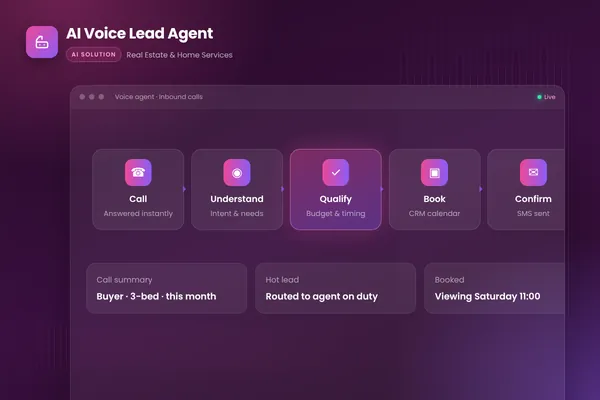
We build it as the ten steps above, on your own phone line, calendar and CRM, with the rules table in your hands. Our AI voice agents service describes the process, and the AI voice lead agent case study shows a live build. The agent answers, scores, routes and logs, and a person takes every transfer. Its limits are the ones above: it cannot invent a rule you did not write, and it does not settle price or terms.
What a 30-day pilot delivers for an AI voice sales agent
A working agent on your real phone line and CRM inside 30 days: a prototype in about two weeks, then a live pilot on part of your inbound traffic with a rep taking every transfer. This matches BufferSol's service description on the AI voice agents page. It is not a full rollout across every number, market and language, and it cannot prove rare calls or seasonal peaks.
| Week | What is built or run | What you provide | What you see |
|---|---|---|---|
| 1 | Question list; scoring weights; routing rule; opening line per market; 30 past enquiries as a test set | Phone access on a test number, a CRM sandbox, rep names | The ten-call table run on your own enquiries |
| 2 | Steps 1 to 10 working on a test number; test calls scored for route and tone | Calendar access, call-rule sign-off from your lawyer | Scored test calls with the route and score beside each |
| 3 | Live pilot on part of your inbound traffic; every transfer taken by a named rep | A named rep per shift | Daily list of transfers, bookings, holds and ages |
| 4 | Scored review of 30 calls against pass marks; threshold check; decision on widening | Review time from sales | A scorecard and a go, hold or stop call |
How success is measured. Four numbers from your own sample: calls routed as a rep would route them, calls where a caller asked for a person and did not get one, CRM records with missing fields and transfers a rep declined. Our implementation plan describes the day-by-day detail, and the Done For You instant lead response automation is the ready-made path for teams that want a shorter route.
Is this right for you?
Use this short checklist. If three or more are true, a scoped estimate is worth asking for.
- Inbound sales calls go to voicemail or wait in a queue outside office hours.
- Reps spend time on calls that were never a fit.
- Your CRM holds call notes as free text that nobody can report on.
- You serve callers in more than one of the US, UK, Canada and the EU.
- You cannot say within two minutes why a given call was sent to a given rep.
If none is true, a good receptionist and a clear routing sheet may be enough. The matching Done For You automation is instant lead response, built for sales teams that want inbound leads answered, qualified and booked without building the agent themselves. For outbound follow-up, see the AI SDR outbound automation.
What are the limits of this guide?
Five, and we name them. First, we read law, regulator and vendor pages, not your phone system, CRM or lawyer's advice, so settings differ. Second, we found no source for a standard score weight or threshold, so ours are BufferSol views. Third, we could not read the CRTC pages, and we say so. Fourth, the calls, weights and costs in the worked examples are invented. Fifth, nothing here is legal advice.
Updated 27 November 2026. Facts checked 27 November 2026, with the Close, Retell, ElevenLabs, Aircall, Voiceflow, Fireflies, CloudTalk, Cornell LII, ICO, DNCL, Justice Laws and Commission pages re-opened.
Facts we did not re-check. The CRTC pages returned a 403, so no Canadian telemarketing hours or penalties are stated. The FCC order and press page were not readable, so the FCC ruling comes from the ABA Banking Journal's report of it. Murf's, JustCall's and Voiceflow's figures are the vendors' own and untested. A Qualified survey figure that CloudTalk cites was not opened and is not used. Retell's page lists its own product among the tools it ranks.
If you take inbound sales calls from the US, UK, Canada or the EU and want a voice agent built around your phone line and CRM, ask BufferSol for a scoped estimate for an AI voice sales agent now, so you can plan the 2027 budget and start the 30-day pilot in Q1 2027.
Frequently asked questions
What is an AI voice sales agent?
An AI voice sales agent is software that talks to callers by phone, asks qualifying questions, records the answers in your CRM and routes the call to a person, a calendar or a nurture list. CloudTalk describes its agent as one that answers calls, updates CRMs, books meetings and loops in a human only when needed.
How does an AI voice agent qualify an inbound lead?
It asks a short set of questions, usually budget, timeline, use case and buying role, scores the answers and applies a routing rule. Murf's page lists discovery questions around budget, timeline, company size, use case, buying role and urgency. BufferSol's worked example scores four questions out of 100 and routes at 70 and 40.
When should the agent transfer a call to a person?
When the score is high, when the caller asks for a person, or when the topic needs judgment. ElevenLabs says human reps fit complex enterprise deals, strategic accounts and later-stage conversations. BufferSol's rule is that a caller who asks for a person always gets one, whatever the score.
Do I need consent before an AI voice agent calls a prospect?
For outbound calls in the US, yes in most cases. The FCC ruled that AI-generated voices are artificial under the TCPA, which requires prior express consent. In the UK, the ICO requires specific consent for automated marketing calls. This post covers inbound calls first. It is not legal advice, so ask your counsel.
Does an AI voice agent have to say it is an AI?
In the EU, mostly yes. The Commission's FAQ says Article 50 of the AI Act applies from 2 August 2026 and that people must be informed when they interact with an AI system, unless that is obvious. We found no equivalent rule on the US, UK or Canadian pages we read, but BufferSol's agents say so in the first sentence everywhere.
How much does an AI voice sales agent cost per qualified lead?
It depends on minutes, call length and your qualified rate. Retell's example uses $0.07 a minute, a 3-minute call and a 12% rate for about $1.75 in AI cost per qualified lead. BufferSol's worked example uses Aircall's UK plan and review time and gets 8.45 pounds at a 25% rate. Both use assumed rates.
How long does it take to set up an AI voice sales agent?
Sources differ. Close says a basic set-up might be live in 2 to 4 weeks and a complex one can take 2 to 3 months. BufferSol's 30-day pilot puts a working agent on your real calls and CRM: a prototype in about two weeks, then a live pilot on part of your traffic with a person taking transfers.
Is an AI voice agent better than a human SDR?
Neither is better everywhere. The agent answers every call in seconds and logs every answer. Close says AI augments humans and does not replace them, and CloudTalk says to keep people in the loop where judgment matters. Use the agent for screening and speed, and keep people for trust, negotiation and closing.
Sources
- Understanding AI Voice Agents in Sales: Challenges and Best Practices, Close
- 7 Best AI Voice Agents for Sales Teams in 2026 (Tested and Ranked), Retell AI
- AI lead qualification: How AI agents screen and route leads at scale, ElevenLabs
- AI Sales Agent (UK), Aircall
- AI lead qualification and routing, Voiceflow
- Voice Agents for Sales, Fireflies.ai
- AI Lead Qualification: How to Automate It in 5 Steps (2026), CloudTalk
- What Is an AI Sales Agent & Top Tools for 2026, CloudTalk
- AI Lead Qualification | JustCall AI Voice Agent, JustCall
- AI Sales Agent - Prospect, Nurture and Qualify Leads, Murf AI
- FCC rules that consent is required for AI-generated voices in outbound calls, ABA Banking Journal
- 47 U.S.C. 227: Restrictions on use of telephone equipment, Legal Information Institute, Cornell Law School
- What are the rules on live direct marketing calls?, Information Commissioner's Office
- Telephone marketing, Information Commissioner's Office
- Terms and Conditions for Telemarketer Registration, National Do Not Call List operator, Government of Canada
- Canada's Anti-Spam Legislation (S.C. 2010, c. 23), Justice Laws Website, Government of Canada
- Transparency obligations under Article 50 of the AI Act, European Commission
Cite this article
BufferSol Editorial Team (2026). AI Voice Sales Agent in 2027: A 5-Step Plan to Qualify and Route Inbound Calls. BufferSol Technologies. https://buffersoltech.com/blog/ai-voice-sales-agent-2027
BufferSol Editorial Team
AI & software engineering team
Senior engineers, AI specialists and product leads at BufferSol Technologies who design, build and run AI agents, autonomous workflows and custom software for companies in the US, UK and Europe.
Reviewed by Sufyan K., Senior Writer, BufferSol Technologies.