Key takeaways
- AI receptionist prices use different units: Smith.ai bills per call, Goodcall per unique customer, Retell per minute and Ruby in minute bundles with human staff (as of November 2026).
- For 100 calls of 4 minutes, the cheapest listed Smith.ai plan comes to $915, Goodcall's Starter to $79 and a Retell build to roughly $34 to $130 before build work (BufferSol calculation).
- Ruby is a human-staffed service, so it is a comparison point, not a pure AI product.
- The FCC ruled that AI-generated voices are artificial under the TCPA, so AI callbacks and outbound calls need consent first. This post is not legal advice.
- Build your own when the receptionist must book into your calendar and write to your CRM during the call.
The best AI receptionist in 2027 is the one that answers your real calls correctly and costs what you expect, and the most common mistakes are in how people compare prices and ignore consent. An AI receptionist is a voice agent that answers business calls, takes messages, answers questions and, in better setups, books appointments. We checked five vendors on their own pages in November 2026.
For how an AI receptionist works, read our AI receptionist explainer. For the full technology picture, see our AI voice agents guide.
Why do AI receptionist buyers go wrong?
Buyers go wrong because the five vendors count different things. One counts calls, one counts customers, one counts minutes and one sells human staff with optional AI. A price that looks low in one unit can be high in another, so the mistakes below start with the price and end with the law.
This is not a ranking. Each mistake names a vendor as an example, and every fact is as of November 2026. None of the vendor pages we read shows a publication date, so re-check them before you buy. Our companion post on AI call center software covers the larger platforms.
The 5 AI receptionist mistakes to avoid in 2027
1. Comparing per-call, per-customer and per-minute prices as if they matched
Each vendor bills a different unit, so a sticker price tells you nothing until you run your own month through it. Smith.ai bills per call: Starter is "30 calls $300 / month" with overage at "$11.50/call over 30", Basic is 90 calls for $810 and Pro is 300 calls for $2,100, as of November 2026.
Goodcall bills per unique customer: Starter is "$79 a month" for 100 unique customers, then 79 cents each, and the page says "No per-minute charges". Retell AI bills per minute: "$0.07-$0.31 / min" for AI voice agents, plus "$0.015/min" for US telephony through Twilio. Synthflow is "sold as an annual enterprise agreement" with no tier prices (Synthflow), so we quote none.
Put one month through all of them. For 100 calls of 4 minutes (400 minutes), a BufferSol calculation from the listed prices on Smith.ai, Goodcall and Retell gives: Smith.ai Starter $1,105 ($300 plus 70 calls at $11.50), Smith.ai Basic $915 ($810 plus 10 calls at $10.50), Goodcall Starter $79 if the 100 calls come from 100 different people, and Retell about $34 to $130 (400 minutes at $0.085 to $0.325 including telephony).
Choose Smith.ai if you want a per-call bill with a clear plan ladder. Choose Goodcall if your callers are mostly unique people. Skip both if you need the call to end in an action inside your own systems.
2. Forgetting overage and add-ons
The plan price is rarely the bill. Smith.ai lists add-ons: "Book appointments — $1.50", "Complex call routing — $1.50", "Accept payments — $1.00" and "Call recording & transcription — $0.25" (Smith.ai). The page states these as per-call add-ons in its own list, so a booking-heavy business pays more than the plan suggests.
Retell lists add-ons too, for example "PII Removal add-on: +$0.01/min" (Retell AI). Its headline is "Retell starts at $0, pay only for what you use", which is true of the platform and not of a finished receptionist: the call script, the testing and the integrations are your work or someone else's.
A BufferSol calculation shows how add-ons move a month. If every one of the 100 calls books an appointment, Smith.ai adds $150 ($1.50 times 100, from the add-on list), which takes Basic from $915 to $1,065. List every add-on you need before you compare.
Choose it if you price the whole call flow before you sign. Skip it if you plan to compare plan prices only.
3. Treating a human service as if it were software
Ruby is a staffed virtual receptionist service with optional AI, so it is a comparison point. Its pricing page shows plans by minutes: "50 minutes per month" for "$250/month", "200 minutes per month" for "$720/month" and "500 minutes per month" for "$1,725/month". It says "optional AI enhancements are available in all our plans, at no extra cost!"
For 400 minutes you would need the 500-minute plan at $1,725 (BufferSol calculation from the listed plans, assuming every minute counts). That buys a person, not a model, which suits callers who want a human voice. Goodcall's page claims a live answering service "runs about $1.50 to $1.90 a minute", a vendor claim we did not verify (Goodcall).
Choose Ruby if your callers expect a human and you value that over price. Skip it if you want a fully automated agent that books and logs by itself.
4. Skipping the consent check for callbacks and outbound calls
Answering a call is one thing; calling back is another. In the US, an AI receptionist that returns missed calls, confirms appointments or follows up is making outbound calls, and the FCC has addressed AI voices directly. This is not legal advice; get it from a lawyer who knows your markets.
The FCC's release says its ruling "recognizes calls made with AI-generated voices are 'artificial' under the Telephone Consumer Protection Act (TCPA)". It says the TCPA "requires telemarketers to obtain prior express written consent from consumers before robocalling them", and that the ruling "ensures AI-generated voices in calls are also held to those same standards".
We could not read the FCC's full ruling in text form, so we also used a secondary source. Mayer Brown, a law firm, wrote in February 2024 that "calls made with AI-generated voices are 'artificial' under the Telephone Consumer Protection Act". Read this as AI voices falling under the existing TCPA consent rules, not as a ban.
Limits of what we checked: this ruling concerns calls made with AI voices. We found no rule on answering inbound calls in the sources we read, and call-recording consent differs by US state and by country, which we did not research. UK rules need an ICO or Ofcom source we did not gather. Our post on TCPA and AI calls goes through the checklist, and our guide to AI outbound calls covers campaigns.
Choose it if your receptionist logs consent per number before any callback. Skip it if your vendor cannot show you where consent is stored.
5. Buying a bundle when the job lives inside your systems
A receptionist that takes messages is useful. One that books into your calendar, checks your CRM and sends a confirmation is a different product. Smith.ai sells booking as a $1.50 add-on and Synthflow says enterprise deployments go "live in weeks" depending on complexity (Synthflow), but the pages we read do not describe writing to your own CRM or job system.
Retell's page says "SOC 2 certified, HIPAA-ready, with SSO and custom compliance terms" (Retell AI), which matters if you handle sensitive calls. The build route also puts the call logic in your hands, which is where the real work sits.
Choose a bundle if message-taking and simple booking cover your calls. Skip it if the call must end in a change inside your systems.
| Option | What it bills (as of Nov 2026) | Same 100-call month |
|---|---|---|
| Smith.ai | Per call, with overage and add-ons | $915 on Basic |
| Goodcall | Per unique customer | $79 on Starter, if 100 unique callers |
| Retell AI | Per minute, plus telephony | About $34 to $130, before build work |
| Ruby | Minute bundles with human staff | $1,725 on the 500-minute plan |
| Synthflow | Annual enterprise agreement | No price shown |
Source: BufferSol calculation from vendor pricing pages, November 2026
BufferSol Technologies · buffersoltech.com
What does an AI receptionist not do?
An AI receptionist does not replace judgement on hard calls. It answers, collects details, books and transfers, but it can mishear, miss context and fail on unusual requests. Plan a warm transfer to a person, review transcripts weekly and keep a short list of calls it must never handle alone, such as emergencies and complaints.
Our guide to AI call center walkthroughs shows how one inbound call flows from greeting to handoff.
| Bills | Still to add | |
|---|---|---|
| Smith.ai | Per call | Add-ons such as booking |
| Goodcall | Per unique customer | How repeat callers are counted |
| Retell AI | Per minute | Call script, testing and integrations |
| Ruby | Minute bundles | Pure AI service, as it is staffed |
| Synthflow | Enterprise agreement | A written price |
Source: Vendor pricing pages, checked November 2026
BufferSol Technologies · buffersoltech.com
What changes for AI receptionist buyers in 2027?
No source we opened forecasts the AI receptionist market in 2027, and every roundup we saw was titled 2026. Everything here is BufferSol view, written as reasoning, not fact.
We expect per-call, per-customer and per-minute pricing to coexist, so the 100-call test will stay useful. We expect receptionists to move from taking messages to completing tasks such as booking and rescheduling. And we expect consent and disclosure rules for AI voices to draw more attention, so a vendor that records consent per number will be easier to defend. Plan a test in Q1 2027 and compare cost per resolved call.
When should you build your own AI receptionist?
Build your own when the call must end in an action inside your systems, or when per-call fees climb with your volume. Buy when message-taking and standard answers already cover the job. A build also has limits: it needs call design, testing and upkeep that a packaged service handles for you.
Build when:
- The call books into your calendar. The agent writes the appointment while the caller is still on the line.
- Your CRM needs the record. Each call is logged, summarised and routed to the right person.
- Volume is climbing. Per-call or per-customer fees rise with calls, while a build pays telephony and models directly.
- You need control over consent. A pre-dial gate sits in your system, not a template.
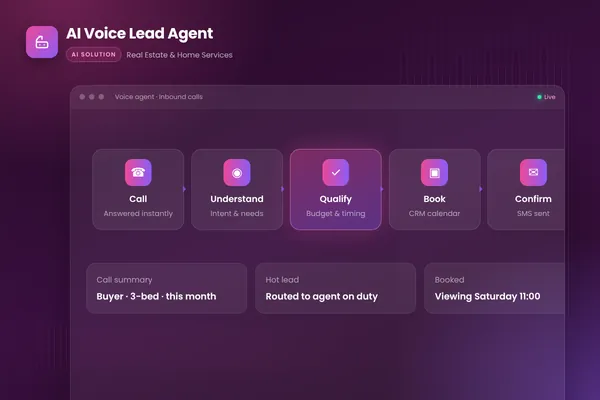
BufferSol's AI voice lead qualification agent is the pattern: it answers inbound calls, asks the qualification questions, books into the CRM calendar and sends an SMS confirmation, with transcripts, summaries and hot-lead routing to a person. See our AI appointment setter post for the booking side.
What would a 30-day pilot deliver?
In 30 days you get a working receptionist on your real calls, with a person ready to take over. The plan:
- You bring: call recordings or scripts for your top call types, calendar and CRM access and your phone line details.
- We build, in about two weeks: a prototype on a test number that answers, books and logs, scored on test calls.
- We launch, in the final week: a live pilot on part of your calls, with warm transfer, monitoring and daily tuning.
Success is measured by calls handled without a transfer, bookings made, correct transfers and caller complaints. The closest ready-made version is our missed-call capture and job booking automation, built for service businesses. Other businesses get a custom build from our AI voice agents team.
Is this right for you?
Check how many of these describe your business:
- Calls go to voicemail and some of those callers never call back.
- Your top few call types are easy to name.
- Your calendar or CRM has an API a voice agent can use.
- A person can take over when the agent cannot help.
- A packaged answering service did not reach your systems.
If few do, start with a packaged service and measure its calls for a month.
Facts checked November 2026. Pricing pages carry no date and change often, so re-check each vendor before you sign.
If missed calls are costing your business bookings, ask BufferSol for a scoped estimate for a custom AI receptionist now, so the 2027 budget includes it and the pilot can start in Q1 2027.
Frequently asked questions
What is the best AI receptionist in 2027?
No single AI receptionist is best for every business. As of November 2026, Smith.ai prices per call, Goodcall per unique customer, Synthflow by enterprise contract and Retell AI per minute for teams that build their own. Choose by call volume, how calls are counted and whether the receptionist must act in your systems, then test two on your own calls.
How much does an AI receptionist cost?
It depends on the unit. Smith.ai lists 30 calls for $300 a month, Goodcall lists $79 a month for 100 unique customers, and Retell lists $0.07 to $0.31 a minute for voice agents plus $0.015 a minute for US telephony, as of November 2026. Synthflow shows no tier prices. Add overage and add-on fees before you compare.
Do AI receptionists need consent to call people back?
In the US, outbound calls with AI-generated voices generally need prior consent. The FCC ruled in February 2024 that AI voices are artificial under the Telephone Consumer Protection Act, and its release says telemarketers must obtain prior express written consent before robocalling. A callback or follow-up is outbound, so check consent first. This is not legal advice.
When should a business build its own AI receptionist?
A business should build its own AI receptionist when the call must end in an action inside its systems, such as booking into its own calendar or writing to its CRM, or when call volume makes per-call fees costly. A packaged service fits when standard answering and message-taking already cover the job.
Sources
- Smith.ai Plans & Pricing for 24/7 Sales & Support, Smith.ai
- Goodcall Pricing, Goodcall
- Ruby Receptionist Pricing, Ruby
- AI Voice Agent Pricing for Enterprise, Synthflow
- AI Phone Agent Pricing, Retell AI
- FCC Makes AI-Generated Voices in Robocalls Illegal, Federal Communications Commission
- FCC Declares Authority and Intent to Regulate AI-Generated Calls under the TCPA, Mayer Brown
Cite this article
BufferSol Editorial Team (2026). The Best AI Receptionist in 2027: 5 Mistakes to Avoid Before You Choose One. BufferSol Technologies. https://buffersoltech.com/blog/ai-receptionist-mistakes-2027
BufferSol Editorial Team
AI & software engineering team
Senior engineers, AI specialists and product leads at BufferSol Technologies who design, build and run AI agents, autonomous workflows and custom software for companies in the US, UK and Europe.
Reviewed by Sufyan K., Senior Writer, BufferSol Technologies.