Key takeaways
- A conversational IVR understands what callers say but follows a designed flow; an AI voice agent decides its own next step and can act in your systems (BufferSol definition, in line with Anthropic's workflow and agent split).
- Retell AI writes: IVR can route, a conversational agent can resolve. That is a vendor statement, so test it on your own calls.
- For 3,000 minutes a month, listed voice prices run from about $114 (Amazon Connect voice only) to $930 (Retell at its top rate), and the figures cover different things (BufferSol calculation, as of November 2026).
- The FCC ruled in February 2024 that AI technologies that generate human voices fall under the TCPA's artificial or prerecorded voice rules, so outbound AI calls need prior express consent. This post is not legal advice.
- Move one call type first and keep the old menu as the fallback.
A conversational IVR lets callers say what they want instead of pressing keys, then sends them down a designed flow. An AI voice agent goes further and decides its own next step, so it can finish the call by acting in your systems. For 2027, the question is which call types to move first. This post gives six, with prices checked in November 2026.
For the technology behind this, read our AI voice agents guide. For a worked call from greeting to handoff, see our AI call center walkthrough.
What is the difference between a conversational IVR and an AI voice agent?
A conversational IVR understands speech and follows a flow that someone designed in advance. An AI voice agent chooses its own steps and uses tools. The split matches Anthropic's definitions: workflows are "orchestrated through predefined code paths", while in agents the "LLMs dynamically direct their own processes and tool usage".
Retell AI, a voice agent vendor, put it this way in October 2026: "IVR can route. A conversational agent can resolve." Read that as a vendor's pitch, not a measurement. The same post makes containment claims that cite no outside source, so we leave them out. Amazon Connect describes the agent side as "AI agents resolve issues autonomously - processing returns, updating accounts, rebooking flights" (AWS).
The 6 call types to move from press-1 menus to an AI voice agent in 2027
We ordered these from the easiest and safest to move to the one that needs the most care. The order and the fit are BufferSol view, drawn from how each call type behaves, not from a published benchmark. Vendor facts are as of November 2026.
1. Do opening hours and simple questions need an AI agent?
These calls have one correct answer and no system to change, so they are the safest first move. A caller who wants hours or an address gets the answer in a sentence instead of pressing 1, then 3, then 2. A menu handles this poorly because the caller must guess which key matches the question.
A conversational IVR is enough here. A full agent is more than the call needs, and Anthropic advises "finding the simplest solution possible, and only increasing complexity when needed." Choose a conversational IVR if the answers rarely change. Skip a full agent if it adds cost without closing anything the menu could not.
2. Can a voice agent look up order and account status?
The caller wants a fact that sits in one of your systems, such as where an order is or when a payment cleared. A menu can only read out what its builders connected; an agent can ask for the order number, look it up and answer follow-ups in the same call.
Amazon Connect says its AI agents can "work across voice and screen at the same time, so a customer talks through a request", which is the pattern for a lookup that also sends a link. The page text is cut off at that point in the version we read, so we quote only the part shown. For the same job in text, see our order status automation post.
Choose an agent if the lookup needs follow-up questions. Choose a conversational IVR if callers only ever enter one number and hear one status.
3. Can a voice agent book, reschedule and cancel?
Appointment calls end in a change to a calendar, which is where a menu runs out. A voice agent can ask for a time, check the calendar, offer slots, write the booking and confirm by text. This is the call type where a voice agent most clearly earns its cost.
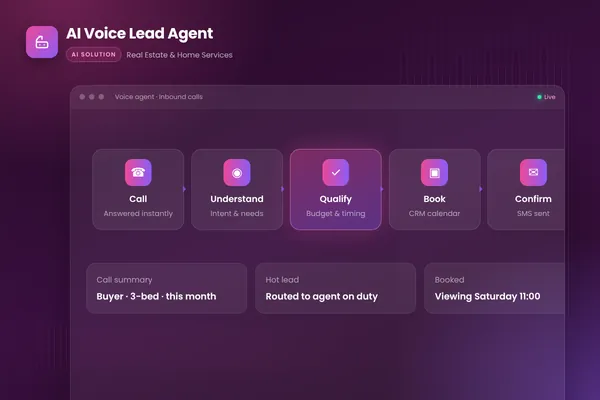
BufferSol's AI voice lead qualification agent works this way: it answers inbound calls, asks the qualification questions and books appointments directly into the CRM calendar, then sends confirmations by SMS. Our AI appointment setter post goes through the booking side.
Choose an agent if the call ends in a calendar write. Skip a menu if callers hang up when asked to press a key for a time slot.
4. Returns, refunds and policy-bound requests
These calls need rules: a return window, a refund limit, a proof requirement. An agent can apply the rule, take the action within your limit and send the rest to a person. A menu cannot hold a conversation about an exception.
Set the limit before launch and log every decision. Amazon Connect lists "processing returns, updating accounts, rebooking flights" among what its AI agents do, which shows the category exists on a major platform. Our returns automation post covers the policy side, and human-in-the-loop AI agents shows where a person should approve.
Choose an agent if a rule decides the outcome. Keep a person in the loop if the amount is above your approval limit.
5. Triage and routing to the right team
Routing is the classic IVR job, and a conversational IVR does it well: the caller says "billing question", the call goes to billing. An agent adds value only when it collects details first, such as account number and reason, so the person who picks up starts informed.
Retell's line, "IVR can route. A conversational agent can resolve," fits here: if routing is all you need, a conversational IVR is the lower-risk choice (Retell AI). Our guide to AI call center software compares the larger platforms that bundle both.
Choose a conversational IVR if the job is to get the caller to the right person. Choose an agent if the summary it collects saves your team minutes on every call.
6. Callbacks, reminders and anything the agent dials out
Here the agent starts the call, and the law changes. Outbound calls with AI voices fall under US consent rules, as the FCC ruled in 2024, so this is the last call type to move and the one that needs a written consent record first. We cover the rules in a separate section below, and our guide to AI outbound calls covers campaigns.
Choose an outbound agent if you hold consent per number and can show it. Skip it if your consent records are scattered across systems.
| Call type | Conversational IVR | AI voice agent |
|---|---|---|
| 1. Hours and simple questions | Fits | More than needed |
| 2. Status lookups | Fits one-number lookups | Fits when follow-up is needed |
| 3. Booking and rescheduling | Runs out | Fits |
| 4. Returns and policy requests | Runs out | Fits within a set limit |
| 5. Triage and routing | Fits | Fits when it collects details |
| 6. Outbound callbacks | Not applicable | Fits after consent is recorded |
| Conversational IVR | AI voice agent | |
|---|---|---|
| Designed by | A call-flow builder, in advance | A model that picks its own next step |
| Best at | Routing and one-answer questions | Calls that end in a change in your systems |
| Main risk | Callers stuck in a flow | A wrong action without a limit or a log |
Source: BufferSol view, definitions in line with Anthropic's workflow and agent split
BufferSol Technologies · buffersoltech.com
How much does an AI voice agent cost per minute?
Vendors price per minute, but each one bills a different slice, so the headline numbers do not compare directly. As of November 2026, Retell AI lists "$0.07-$0.31 / min for AI Voice Agents", Twilio lists "Conversation Relay: $0.07 / minute" on a page "current as of October 2026", and Amazon Connect lists "$0.038 per voice min (standard telephony rates apply)".
Vapi shows separate lines instead of one total: hosting at "$0.05/min", a transcriber at "$0.0095 - $0.0099/min", a model at "$0.0077 - $0.0452/min" and a voice at "$0.0146 - $0.0238/min", plus Twilio inbound transport at "$0.008 / min". Amazon Connect shows no per-minute price for AI self-service on the page we read, and it says "Pricing may vary by region, communication type, and third-party provider."
A BufferSol calculation for 1,000 calls of 3 minutes (3,000 minutes), from the Amazon Connect, Twilio, Retell and Vapi pages:
- Amazon Connect voice: about $114 at $0.038 a minute, with telephony and any AI charge extra (BufferSol calculation).
- Twilio Conversation Relay: about $210 at $0.07 a minute, with voice minutes extra (BufferSol calculation).
- Retell AI: about $210 to $930, at $0.07 and $0.31 a minute (BufferSol calculation).
- Vapi: about $269 to $411, adding the hosting, transcriber, model, voice and inbound lines at their low and high ends (BufferSol calculation).
These figures cover different things, so they rank nothing. Ask each vendor for the all-in cost per minute of a finished call, including telephony, and add build work, which none of the pages price.
Source: BufferSol calculation from vendor pricing pages, November 2026; the figures are not like-for-like
BufferSol Technologies · buffersoltech.com
Do AI voice agents need consent to call people?
For outbound calls in the US, generally yes. This is not legal advice. In the FCC's Declaratory Ruling 24-17, released on 8 February 2024, the Commission wrote that it "confirm[s] that the TCPA's restrictions on the use of 'artificial or prerecorded voice' encompass current AI technologies that generate human voices."
The ruling says calls using such technologies "require the prior express consent of the called party to initiate such calls absent an emergency purpose or exemption", and that where a call introduces an advertisement or contains telemarketing, the rules require "prior express written consent." Its identification requirements are "applicable to any AI technology that initiates any outbound telephone call using an artificial or prerecorded voice to consumers." The FCC's news release says the ruling "takes effect immediately".
What we did not check: the ruling is about calls an AI voice initiates, and we read nothing in it about a caller who dials your number and reaches an agent. We did not research call-recording consent, which differs by US state and country, or UK rules from Ofcom and the ICO. Take advice from a lawyer who knows your markets. Our post on TCPA and AI calls goes through a consent checklist.
What does a conversational IVR or voice agent not do?
Neither one replaces a person on a hard call. Both can mishear, lose context or send a caller in a loop, and a voice agent can act wrongly with real consequences. Give every caller a way to reach a person, set limits on what the agent may change, review transcripts weekly and keep emergency calls off the agent entirely.
We found no source on how a conversational IVR should handle emergency or life-safety calls, so we make no claim on it. Treat that as a design decision to settle with your own risk team before launch.
How do you move from a press-1 menu to an AI voice agent?
Replace one call type at a time and keep the menu as the fallback. The plan below is BufferSol view, built from how we scope voice pilots.
- Record a month of calls and label each by call type.
- Rank the types by volume and by how often a person completes the call in a system.
- Pick one type from the six above, starting with the easiest that has real volume.
- Route that type to the agent, with a clear option to reach a person and a spoken disclosure that it is an AI.
- Compare resolved calls, transfers and complaints against the menu for four weeks, then move the next type.
What changes for IVR buyers in 2027?
No source we opened forecasts IVR replacement in 2027, and the pricing pages we read carry no roadmaps. Everything here is BufferSol view, written as reasoning, not fact.
We expect "press 1" menus to survive as a fallback while spoken flows take the front door, so the migration above stays useful. We expect per-minute prices to stay split across telephony, speech and model lines, which makes the all-in cost per finished call the number to track. We expect consent records to be a purchase criterion: a vendor that stores consent per number will be easier to defend. Run a first test in Q1 2027 on one call type and compare cost per resolved call.
When should you build your own AI voice agent instead of buying a conversational IVR?
Build when the call must end in an action inside your own systems, or when per-minute fees climb with your volume. Buy a conversational IVR when routing and simple answers cover the job. A build has limits: it needs call design, testing and upkeep that a packaged IVR handles for you.
Build when:
- The call books into your calendar or writes to your CRM. The agent acts while the caller is still on the line.
- Your rules decide the outcome. Refund limits and escalation live in your system.
- Volume is climbing. You pay telephony, speech and model costs directly.
- You need control over consent. A pre-dial gate sits in your system, not a template.
What would a 30-day pilot deliver?
In 30 days you get a working voice agent on your real calls, with a person ready to take over. The plan:
- You bring: recordings or scripts of your top call types, calendar and CRM access, and your phone line details.
- We build, in about two weeks: a prototype on a test number that handles one call type end to end, scored on test calls for accuracy and tone.
- We launch, in the final stretch: a live pilot on part of your traffic with warm transfer to your team, monitoring and daily tuning.
Success is measured by calls resolved without a transfer, correct transfers, bookings made and caller complaints. The closest ready-made version is our missed-call capture and job booking automation, built for service businesses. Other businesses get a custom build from our AI voice agents team.
Is this right for you?
Check how many of these describe your phone line:
- Callers press keys and still end up asking for a person.
- Your top three call types are easy to name.
- Many calls end in a booking, lookup or update.
- Your calendar or CRM has an API a voice agent can use.
- A person can take over when the agent cannot help.
If few do, start with a conversational IVR for routing and measure it for a month.
Facts checked November 2026. Pricing pages carry no reliable effective dates and change often, so re-check each vendor, and the FCC text, before you sign.
If your callers are stuck in press-1 menus, ask BufferSol for a scoped estimate for a voice agent on your first call type now, so the 2027 budget includes it and the pilot can start in Q1 2027.
Frequently asked questions
What is the difference between a conversational IVR and an AI voice agent?
A conversational IVR lets callers speak instead of pressing keys, then routes them through a designed flow. An AI voice agent goes further: it decides its next step, asks follow-up questions and acts in connected systems, such as booking or updating an account. Anthropic's workflow and agent split is a useful lens: predefined code paths versus a model directing its own process and tool use.
How much does an AI voice agent cost per minute?
As of November 2026, Retell AI lists $0.07 to $0.31 per minute for AI voice agents, and Twilio lists Conversation Relay at $0.07 per minute, with its page current as of October 2026. Amazon Connect lists $0.038 per voice minute with standard telephony extra. Vapi lists separate lines for hosting, speech and model. These are not like-for-like totals.
Do AI voice calls need consent in the US?
For outbound calls, generally yes. In FCC 24-17, released on February 8, 2024, the FCC confirmed that the TCPA's restrictions on artificial or prerecorded voices encompass current AI technologies that generate human voices, so callers need the prior express consent of the called party absent an emergency purpose or exemption. Telemarketing needs prior express written consent. This is not legal advice.
Can I keep my old IVR while I test an AI voice agent?
Yes, and it is the safer way to start. Send one call type to the voice agent, keep the existing menu for everything else, and give callers a clear route to a person from the agent. Compare resolution, transfers and complaints for that call type against the menu before you move a second one.
Sources
- Amazon Connect Customer - AWS, Amazon Web Services
- Amazon Connect Customer Pricing - AWS, Amazon Web Services
- Conversational AI solutions pricing, Twilio
- AI Phone Agent Pricing, Retell AI
- Voice AI vs. IVR: Why Conversational Agents Are Replacing Phone Trees, Retell AI
- Vapi pricing, Vapi
- Declaratory Ruling, FCC 24-17 (CG Docket No. 23-362), Federal Communications Commission
- FCC Makes AI-Generated Voices in Robocalls Illegal, Federal Communications Commission
- Building effective agents, Anthropic
Cite this article
BufferSol Editorial Team (2026). Conversational IVR in 2027: 6 Call Types to Move From Press-1 Menus to an AI Voice Agent. BufferSol Technologies. https://buffersoltech.com/blog/conversational-ivr-vs-ai-voice-agent-2027
BufferSol Editorial Team
AI & software engineering team
Senior engineers, AI specialists and product leads at BufferSol Technologies who design, build and run AI agents, autonomous workflows and custom software for companies in the US, UK and Europe.
Reviewed by Sufyan K., Senior Writer, BufferSol Technologies.