Key takeaways
- Five tools cover most small and mid-sized needs: Puzzle and Zeni for startups, Botkeeper for accounting firms, Rillet for scaling SaaS finance teams and Xero for small businesses (all as of November 2026).
- Only some vendors publish prices. Puzzle lists $30 to $360 a month and Xero $27 to $97 after a promotional period; Zeni, Botkeeper and Rillet publish none on the pages we checked.
- Buy the ledger and the close, which must stand up to an audit. Build the narrow workflow your tool does not handle, such as one exception queue on your own data.
- Test every option on last quarter's real transactions, including the messy ones, before you sign.
- BufferSol view: in 2027 the buying question moves from 'does it have AI' to 'can my team check what the AI did'.
The best accounting automation software in 2027 depends on who you are: Puzzle or Zeni for startups, Botkeeper for accounting firms, Rillet for scaling SaaS finance teams, Xero for small businesses. Accounting automation software is a system that categorizes transactions, reconciles accounts and drafts reports with a person approving the result. Build your own only for one narrow job the tool misses. Facts below were checked in November 2026.
For the wider picture of what finance teams can automate, start with our finance IT solutions guide. This post is about choosing: five tools, what each costs and suits, and a clear rule for when to build.
Which accounting automation tools made the list, and how were they picked?
Every tool here is a real product whose own website we opened in November 2026. We recorded what the vendor says it does, who it targets and what it publishes about price. We did not use ratings, review scores or rankings from other roundups, because most roundups are written by vendors who rank themselves first.
The list is not a ranking. It is a shortlist for five different buyers. Large ERPs such as NetSuite and Sage Intacct are left out, because their vendor pages did not load for our research and we will not describe a product we could not read.
| Tool | Built for | Public price (as of November 2026) |
|---|---|---|
| Puzzle | Startups and small teams | $30 to $360 a month, software only |
| Zeni | Startups at any funding stage | Not shown on the home page |
| Botkeeper | Accounting firms | Not shown on the home page |
| Rillet | Scaling SaaS finance teams | Demo request, no price |
| Xero | Small businesses | $27, $59 and $97 a month after the intro period |
1. Puzzle
Puzzle is the clearest on price. Its pricing page lists four software-only plans: Starter at $30 a month, Core at $72, Complete at $120 and Scale at $360, as of November 2026. The Starter plan automatically categorizes 85 to 90 percent of transactions, according to Puzzle. Higher plans add AI reconciliations and an accuracy review.
Its own summary of the model is a good rule for any tool in this category: "AI does the categorizing, reconciling, and drafting. You review and approve." A $171 a month tier adds a bookkeeper who reviews the work, but it requires one entity and no payroll, AP, AR or inventory.
Choose it if you are a startup with a simple structure and want a published price. Skip it if you run many entities or complex AP and AR, which the bookkeeper tier excludes.
| Item | Value |
|---|---|
| Starter | 30$ |
| Core | 72$ |
| Complete | 120$ |
| Scale | 360$ |
Source: Puzzle pricing page, checked November 2026
BufferSol Technologies · buffersoltech.com
2. Zeni
Zeni's home page describes "An AI Accountant and AI CFO, backed by finance experts." It lists transaction categorizing, reconciliation, receipt matching, reporting, bill payments and reimbursements, and also offers fractional CFO, tax and payroll services. It names startups from pre-seed to Series C and beyond as its audience. The page shows no subscription prices and links to a separate pricing page.
The combination of software and finance staff is the point. Zeni suits a founder who wants someone else to own the books, not a finance lead who wants a tool to run the close.
Choose it if you want software plus people and have no finance hire yet. Skip it if you need to keep control of every entry in-house.
3. Botkeeper
Botkeeper is the odd one out because it is not sold to the business itself. Its headline reads "AI Accounting, Built for Accounting Firms." It says its AI "posts directly to the GL only when confidence is high—delivering 97% accuracy on those entries." That is a vendor claim about its own entries, so test it on your clients' data. Lower-confidence items go to staff for review, which is the right design for any finance agent. The page shows no prices.
Choose it if you run a firm that wants more client capacity per accountant. Skip it if you are a single company looking for your own bookkeeping.
4. Rillet
Rillet calls itself an "AI-native ERP built by Big Four CPAs." It is a ledger replacement rather than an add-on, with continuous close, multi-entity accounting and revenue recognition. Its home page says "Checklists, reconciliations, and flux drafts run continuously to shave days off the close." Pricing is by demo request only.
Choose it if you are a scaling SaaS company with a controller and you are weighing a move off a basic ledger. Skip it if you only need to automate one process, because replacing the ledger is a big project.
5. Xero
Xero's US pricing page lists Early at $27 a month, Growing at $59 and Established at $97 after a three-month introductory price. Bank reconciliation is in every plan. Auto-reconciliation is a $5 a month add-on on Early and included on the two higher plans, as of November 2026.
Choose it if you are a small business that wants a mainstream ledger with a wide app marketplace. Skip it if you need deep multi-entity consolidation or heavy workflow automation out of the box.
What changes in 2027 for accounting automation buyers?
No source we opened makes a reliable 2027 forecast for this market, so treat the following as BufferSol view, not fact.
First, expect every vendor to claim AI. The useful question becomes whether the tool shows its work: which entries it posted on its own, at what confidence, and which a human approved. Second, expect your own exceptions to matter more than the feature list. Third, budget separately for the ledger, which you buy, and for the narrow automations around it, some of which you will build.
Plan the 2027 budget on these three lines rather than on a single "accounting AI" purchase.
When should you build your own accounting automation?
Numeric, a vendor that sells accounting software, frames it well: "The real build vs. buy question is no longer 'can I build this?' It's now 'do I want to own this?'" Its authors suggest building narrow, low-stakes tools on your own data and buying systems that must withstand audit scrutiny. We agree, with one addition: build where the exceptions are.
Kognitos, an agentic automation vendor, describes the gap in packaged tools: exceptions such as "the lump-sum remittance covering forty invoices" often fall back to manual work. That is where a custom agent earns its keep.
Building a whole ledger is a different matter. Bacancy Technology, a software services firm, says that creating a basic accounting system could take 6 to 12 months. We do not recommend it.
| Build or buy | Buy | Build |
|---|---|---|
| General ledger, close, audit trail | Yes | No |
| Standard bank feeds and categorizing | Yes | No |
| Your own exception queue (odd remittances, unusual vendors) | Rarely fits | Yes |
| Reconciliation across systems the tool cannot reach | Often no | Yes |
| Collections follow-up in your tone and rules | Partly | Yes |
A custom agent does not replace the tool. It reads your documents and bank data, matches and drafts, then hands clean results to your ledger. Our post on AI accounting software explains what AI handles well today, and accounts receivable automation covers one common build.
What does a custom accounting agent do in practice?
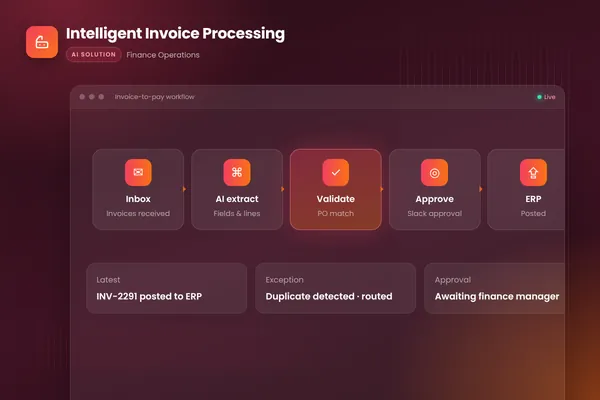
BufferSol's intelligent invoice processing build shows the pattern. It watches an inbox, extracts every field with document AI, matches lines to purchase orders, routes approvals in Slack and posts approved invoices to QuickBooks, with exceptions in a review queue. The same shape fits reconciliation and the month-end close, covered in our financial close automation guide.
- 011. ReadPulls bank lines, invoices and remittances from your inbox and feeds.
- 022. MatchPairs each item with the right invoice or entry using your rules.
- 033. DraftProposes entries and explains every mismatch in plain words.
- 044. ApproveA person approves anything outside your thresholds before it posts.
- 055. LogEvery action is recorded for your auditors.
Source: BufferSol intelligent invoice processing build
BufferSol Technologies · buffersoltech.com
What would a 30-day pilot deliver?
A pilot is a working agent on your real data inside 30 days, not a slide deck. We would plan it like this:
- Week 1: you give us read-only access, last quarter's transactions with their correct treatment, and your approval rules.
- Weeks 2 and 3: a prototype handles one workflow, for example reconciliation of a bank account or an exception queue, and we measure it against your known answers.
- Week 4: a live pilot on a first slice, such as one entity or one account, with your team reviewing every output.
Success is measured by the share of items handled without a human edit and by how long the exception queue takes to clear. Full rollout of every edge case takes longer. The ready-made version is our month-end close and reconciliation automation, which suits finance teams who want a fixed scope. The custom version is built by our autonomous workflows team around your ledger.
Is this right for you?
Build a pilot if most of these are true:
- Your team still clears the same exceptions by hand every month.
- Your tool handles the standard flow but not your odd cases.
- You need approvals and logs your auditors can follow.
- You would rather own the rules than rent a longer feature list.
Buy and stop there if your process is standard and a single tool already fits.
Facts checked November 2026. Re-check prices and plan limits on each vendor's site before you buy, because they change often.
If one of your recurring accounting jobs fits that description, ask BufferSol for a scoped estimate for that automation now, so the 2027 budget includes it and the pilot can start in Q1 2027.
Frequently asked questions
What is the best accounting automation software in 2027?
There is no single best tool. As of November 2026, Puzzle and Zeni target startups, Botkeeper targets accounting firms, Rillet targets scaling SaaS finance teams and Xero targets small businesses. The best choice is the one that fits your entity count, volume and audit needs. Test two or three on your own transactions before you commit.
How much does accounting automation software cost?
It varies widely. As of November 2026, Puzzle lists software-only plans from $30 to $360 a month, and Xero lists $27, $59 and $97 a month after its introductory period. Zeni, Botkeeper and Rillet did not show prices on the pages we checked. Ask each vendor for a written quote at your transaction volume.
Should I build my own accounting automation instead of buying?
Build the whole ledger rarely. A custom build makes sense for one narrow workflow your software handles badly, such as a specific exception queue or a reconciliation your tool cannot reach. Keep the general ledger and close in audited software, and let a custom agent prepare work that your team approves.
Can an AI agent replace accounting software?
No. An AI agent does not replace the ledger. Accounting software remains the system of record, and an agent acts through it: reading documents, matching transactions, drafting entries and flagging exceptions for a person to approve. BufferSol builds agents that work inside your existing accounting system and keep a full log of every action.
Sources
- Puzzle pricing, Puzzle
- Zeni: AI Accountant and AI CFO, Zeni
- Botkeeper: AI Accounting, Built for Accounting Firms, Botkeeper
- Rillet: AI-native ERP, Rillet
- Xero pricing plans (US), Xero
- Build vs. Buy Accounting Software in the AI Era, Numeric
- Accounts Receivable Automation: Build vs Buy vs Agentic AI (2026), Kognitos
- Build vs. Buy Accounting Software: Which Is the Best Choice for Your Business?, Bacancy Technology
Cite this article
BufferSol Editorial Team (2026). Best Accounting Automation Software in 2027: Top 5 Picks, and When to Build Your Own. BufferSol Technologies. https://buffersoltech.com/blog/best-accounting-automation-software-2027
BufferSol Editorial Team
AI & software engineering team
Senior engineers, AI specialists and product leads at BufferSol Technologies who design, build and run AI agents, autonomous workflows and custom software for companies in the US, UK and Europe.
Reviewed by Sufyan K., Senior Writer, BufferSol Technologies.