Key takeaways
- Anthropic defines workflows as systems where LLMs and tools are orchestrated through predefined code paths, and agents as systems where the model directs its own process and tool use.
- Test a support tool by what it can change: a tool that only answers is a chatbot, and a tool that refunds, updates accounts or books is acting as an agent (vendor pages, November 2026).
- Tidio lists Lyro at $0.5 per conversation, so 1,000 conversations a month come to $500 before any plan fee (BufferSol calculation, as of November 2026).
- Under EU AI Act Article 50, people must be told they are interacting with an AI system, unless it is obvious. This applies to chatbots and agents alike and is not legal advice.
- Start with the simplest tool that works, as Anthropic advises, and add an agent only when answers alone fail to close tickets.
An AI chatbot for business answers customer questions from your content, while an AI agent also takes action in your systems, such as issuing a refund or updating an account. For 2027, the right choice depends on whether your tickets end in an answer or in a change. Below are five tests that sort the two, checked against vendor pages in November 2026.
For the longer definitions, read our AI agent vs chatbot explainer and the AI customer support agent guide.
What is the real difference between an AI chatbot and an AI agent?
A chatbot gives an answer; an agent finishes a job. The clearest definition comes from Anthropic, which wrote in December 2024 that "Workflows are systems where LLMs and tools are orchestrated through predefined code paths," while in agents the "LLMs dynamically direct their own processes and tool usage".
That is a definition about how software is built, not about a product label. Vendors do not agree on names. Zendesk contrasts its AI agents with "task-based bots that follow predefined scripts", Tidio calls Lyro a "Customer Service Agent", and Botpress calls itself "The AI-native customer support platform". So test what a tool does, not what it is called.
The 5 tests to run before you choose a chatbot or an AI agent in 2027
Each test is a yes-or-no question about your own tickets. Score your top ten ticket types against all five. Mostly "no" points to a chatbot; mostly "yes" points to an agent. Facts about vendors are as of November 2026.
1. Does the ticket end in a change inside your systems?
If the right outcome is a refund, an address change or a rebooking, the tool needs write access, and that makes it an agent. If the right outcome is an explanation, a chatbot can close it. This is the single most useful test, and most vendor comparisons skip it.
Fin by Intercom says "Fin updates accounts, processes payments and refunds, troubleshoots technical issues, and much more." Botpress says its agents take "real action on refunds, account updates, and multi-step workflows." Tidio takes a narrower line: "Lyro works only with the content and guidance you provide." That is an answers-first design, and for many shops it is the right one.
Choose a chatbot if most tickets are "how do I" and "where is" questions. Choose an agent if a human currently opens the order system to finish the ticket.
2. Can the tool hand off to a person with the full context?
Every tool fails sometimes, so the handoff matters as much as the answer. A chatbot that drops a customer into an empty queue forces the person to ask everything again. An agent should pass the whole conversation and what it already tried.
Fin says it "hands off to your human team effortlessly, maintaining full customer context no matter which helpdesk you use." That is the standard to ask every vendor about, chatbot or agent. Our post on human-in-the-loop AI agents shows where approvals sit, and workflow exception handling covers the failure paths.
Choose either if it can show you a real handoff in a demo. Skip it if the vendor describes the handoff only in a slide.
3. Is a fixed script enough for your ticket types?
A script-driven flow works when your tickets repeat. Tickets that vary, or that mix two problems in one message, need a model that reasons across steps. Zendesk says "Unlike task-based bots that follow predefined scripts, agentic AI makes it possible for AI agents to reason across problems."
Botpress makes a similar point about hard tickets: "Most AI support tools fall apart when a ticket gets complicated." Both are vendor statements, not tests, so run your own. Take 50 real tickets, remove the five easiest, and see what the tool does with the other 45.
Choose a chatbot if your top five ticket types cover most of your volume. Choose an agent if the long tail is where your team spends its time.
4. Does the billing unit match how you work?
The same job costs different amounts under different units. Tidio says "Pay just $0.5 per conversation" for Lyro, and adds that Lyro "can handle multiple questions in one customer conversation without extra costs." Fin says "Fin is priced at $0.99 per outcome" and counts an outcome when "A customer confirms their issue is resolved", when "They don't ask for more help after Fin responds", or when "Fin completes a workflow (Procedure), including handoffs". We found no prices on the Voiceflow home page.
A BufferSol calculation from the Tidio price: 1,000 conversations a month at $0.5 each is $500 for the month, before any plan fee. That figure covers a billed conversation, which is not the same as a resolved ticket, so ask each vendor in writing what counts as billable. Fin's definition shows why: a completed workflow that ends in a handoff still counts as an outcome. The same 1,000 conversations at Fin's $0.99 would be $990 if every one counted as an outcome, which is the upper bound, not a forecast (BufferSol calculation).
Choose per-conversation pricing if your volume is low and steady. Choose a custom build if volume climbs and you want to own the cost curve.
5. Can you test it on your own tickets before you pay?
A demo on the vendor's sample data proves little. Voiceflow describes the right habit for builders: "Simulate real conversations against every change before customers see it." It says its platform lets teams "build, test and ship chat and voice agents" (Voiceflow).
Apply that to any option. Export 100 recent tickets, remove names, and run them through the tool. Count how many it closed correctly, how many it handed off and how many it got wrong. Our guide to AI agent evaluation explains how to score a test set.
Choose a tool if it lets you run your own tickets in a trial. Skip it if it only lets you watch a scripted demo.
| Test | A chatbot fits when | An AI agent fits when |
|---|---|---|
| 1. Change in your systems | The answer is the outcome | A refund, update or booking is the outcome |
| 2. Handoff | Context passes to the person | Context and actions tried pass to the person |
| 3. Script or reasoning | Top tickets repeat | The long tail takes the time |
| 4. Billing unit | Low, steady volume | Volume rises and cost control matters |
| 5. Test on your tickets | A trial runs your data | A trial runs your data and your systems |
| Answer-first | Action-first | |
|---|---|---|
| Tidio Lyro | Works only with the content and guidance you provide | Billed per conversation |
| Zendesk AI agents | Not task-based bots that follow predefined scripts | Reason across problems until resolution |
| Fin | Hands off to your human team | Updates accounts, processes payments and refunds |
| Botpress | Built to handle the tough tickets | Takes real action on refunds and account updates |
Source: Vendor pages for Tidio, Zendesk, Fin and Botpress, read November 2026
BufferSol Technologies · buffersoltech.com
Do chatbots and AI agents have to say they are AI?
In the EU, yes in most cases, and the rule treats chatbots and agents alike. Article 50 of the AI Act says people must be informed that they are interacting with an AI system, unless it is obvious to a reasonably well-informed person. A clear line at the start of every conversation satisfies the habit, whatever the law says in your market.
We read the article on an independent site that reproduces the regulation, which says it "Comes into force 2 August 2026, according to Article 113." We did not check the official EUR-Lex text, so treat this as a pointer, not legal advice. Check the rules for the countries where your customers live.
What does an AI agent not do?
An AI agent does not replace policy, and it does not remove the need for people. It can pick the wrong rule, misread a long message or act on bad data from a connected system. Set a refund limit, log every action it takes, review a sample of closed tickets each week and keep a short list of cases a person always handles.
Vendor averages do not change that. Fin says it has "industry leading resolution rates, averaging 76% across 12,000+ customers, with many seeing over 85%." That is a vendor claim from its own page, with no definition of "resolution" and no outside test, so read it as a reason to run your own trial, not as a benchmark. Our AI customer service software buyer guide compares the platforms side by side.
- 01Start with answersConnect the help centre and measure which tickets close without a person.
- 02List the tickets that still need a personGroup them by the system a person opens to finish them.
- 03Add one actionGive the agent one tool, such as an order lookup, with a limit and a log.
- 04Widen only on evidenceAdd the next action when the first one closes tickets correctly.
BufferSol Technologies · buffersoltech.com
What changes for AI chatbot buyers in 2027?
No source we opened forecasts chatbot or agent adoption in 2027, and the vendor pages we read carry no roadmap. What follows is BufferSol view, written as reasoning, not fact.
We expect the word "chatbot" to fade from vendor pages and "agent" to take its place, so the five tests above matter more than the label. We expect billing to keep moving toward outcomes and conversations, which makes a written definition of a billable unit the most useful line in a contract. And we expect disclosure to be a standing part of every deployment: the EU article is listed as applying from 2 August 2026, so a 2027 pilot should already carry it. Anthropic's own advice fits the plan: add multi-step agentic systems "only when simpler solutions fall short."
When should you build a custom AI agent instead of buying a chatbot?
Build when the ticket must end in an action inside your own systems, or when per-conversation fees climb with your volume. Buy when answers already close most tickets. A custom build has limits too: it needs design, testing and upkeep that a packaged tool handles for you.
Build when:
- The ticket ends in your order, billing or booking system. The agent acts through your tools, within your rules.
- Policy is specific to you. Refund limits, return windows and escalation rules live in your code, not a template.
- Volume is growing. You pay for model use and hosting directly, not a fee on every conversation.
- You need an audit trail. Every action is logged where your team can read it.
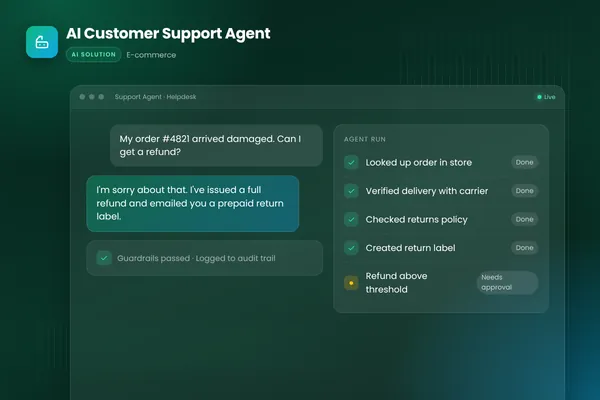
BufferSol's AI customer support agent is the pattern: it is connected to the store, the helpdesk and the shipping provider, understands the request, acts through secure tools such as checking an order or creating a return label, and sends refunds above a threshold and unusual cases to a person with a ready summary. Our AI customer service agent post and the AI help desk explainer show the same flow, and the returns automation post covers one common action.
What would a 30-day pilot deliver?
In 30 days you get a working support agent on your real tickets, with a person ready to take over. The plan:
- You bring: a sample of past tickets, your policy documents, and read access to your helpdesk and order system.
- We build, in about two weeks: a prototype that answers and takes one or two actions, scored against a test set made from your tickets.
- We launch, in the final stretch: a live pilot on a first slice of tickets, with handoff to your team, monitoring and daily tuning.
Success is measured by tickets closed correctly without a person, wrong answers found in review, handoffs with full context and the time to first reply. The closest ready-made version is our support ticket triage and resolution automation, which suits teams whose tickets repeat across a few categories. Other teams get a custom build from our AI agents team. Related ready-made flows are order status automation and the wider AI customer service guide.
Is this right for you?
Check how many of these describe your support team:
- Most tickets are one of five or six types.
- A person opens an order, billing or booking system to close many tickets.
- Wrong answers cost you refunds or repeat contacts.
- You can export a few hundred past tickets for a test.
- Someone on the team can review a sample each week.
If few do, start with an answers-first chatbot and measure what it cannot close for a month.
Facts checked November 2026. Vendor pages carry no reliable dates and change often, so re-check each one, and the EU text on EUR-Lex, before you sign.
If your support team is closing tickets by hand in your order or billing system, ask BufferSol for a scoped estimate for a custom support agent now, so the 2027 budget includes it and the pilot can start in Q1 2027.
Frequently asked questions
What is the difference between an AI chatbot and an AI agent?
An AI chatbot answers questions from your content, while an AI agent completes tasks in your systems. Anthropic describes agents as systems where the model directs its own process and tool use, unlike workflows that follow predefined code paths. In support terms, an agent looks up an order, issues a refund or books a visit, and hands off to a person when a rule says so.
Do I need an AI agent or is a chatbot enough?
A chatbot is enough when most tickets are questions that your help centre already answers. You need an AI agent when the ticket ends in a change, such as a refund, an address update or a booking. Anthropic recommends finding the simplest solution possible, so start with a chatbot, measure what it cannot close, and add actions only for those tickets.
How much does an AI chatbot for business cost?
It depends on the billing unit. As of November 2026, Tidio lists its Lyro AI agent at $0.5 per conversation, Fin lists $0.99 per outcome, and the Voiceflow page we read shows no prices. Compare vendors on your own monthly conversation volume, and ask each one in writing what counts as a billable conversation.
Do chatbots and AI agents have to tell customers they are talking to an AI?
In the EU, Article 50 of the AI Act requires that the people concerned are informed that they are interacting with an AI system, with exceptions such as when it is obvious. The article is listed as applying from 2 August 2026. A chatbot and an agent are treated alike, so add a clear disclosure line to both. This is not legal advice.
Sources
- Building effective agents, Anthropic
- Lyro - AI Customer Service Agent for Better CX, Tidio
- AI Agents for Customer Service, Zendesk
- Botpress: the enterprise-grade AI agent platform for customer support, Botpress
- Voiceflow: Enterprise Conversational AI Platform, Voiceflow
- Fin: the highest performing Customer Agent, Intercom (Fin)
- Fin AI Agent Pricing, Intercom (Fin)
- Article 50: Transparency Obligations for Providers and Deployers of Certain AI Systems, EU Artificial Intelligence Act (independent site)
Cite this article
BufferSol Editorial Team (2026). AI Chatbot for Business in 2027: 5 Tests to Decide Between a Chatbot and an AI Agent. BufferSol Technologies. https://buffersoltech.com/blog/ai-chatbot-for-business-vs-ai-agent-2027
BufferSol Editorial Team
AI & software engineering team
Senior engineers, AI specialists and product leads at BufferSol Technologies who design, build and run AI agents, autonomous workflows and custom software for companies in the US, UK and Europe.
Reviewed by Sufyan K., Senior Writer, BufferSol Technologies.