Key takeaways
- An AI customer service agent can be GDPR compliant, but Twig says compliance is not automatic. Seven ways cover it: disclose the AI, test for Article 22 decisions, keep a person who can change the outcome, minimize data, sign the contract, run a DPIA, and be ready for requests and breaches.
- The European Commission says Article 50 of the AI Act applies from 2 August 2026 and that people must be notified they are interacting with an AI system from the start of the first interaction, unless it is obvious.
- GDPR Article 22 gives people the right not to be subject to a decision based solely on automated processing with legal or similarly significant effects. A routine FAQ answer is not that. A refund denial or an account closure may be.
- Maximum fines: up to EUR 20,000,000 or 4% of worldwide turnover under GDPR Article 83, up to GBP 17.5 million or 4% under the UK GDPR per the ICO, and $15,000 to $25,000,000 or 4% under Quebec's private-sector act.
- Run a 30-day pilot with the disclosure, the decision test and the approver map written first, and a person approving anything the test flags.
AI customer service GDPR compliance in 2027 comes down to seven habits: tell people they are talking to an AI, test whether the agent makes Article 22 decisions, keep a person who can change the outcome, minimize the data it sees, sign the processor contract, run a DPIA, and be ready for requests and breaches. This post gives each way, the approver, and the rules in the EU, UK, US and Canada.
This is a cluster post under our AI customer support agent guide. It sits beside our posts on AI support agent hallucinations and support escalation. Those cover accuracy and handoff. This one covers privacy law. It is not legal advice.
What does GDPR mean for an AI customer service agent?
GDPR applies whenever the agent processes personal data, which a support agent does in nearly every chat. CM.com puts it plainly: "If you process personal data, GDPR compliance remains fully mandatory." Twig adds that "AI customer support can be GDPR compliant, but compliance is not automatic."
The agent adds three things a plain helpdesk lacked: a model provider that sees conversations, the chance of automated decisions, and a duty to say it is an AI. The seven ways below cover those.
Who decides what in a GDPR-ready support agent?
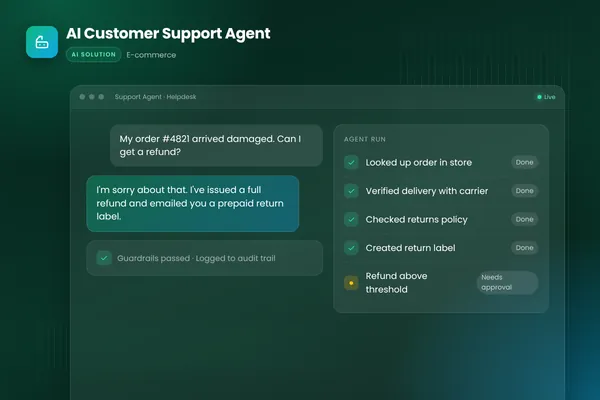
The agent answers and drafts, in line with our AI customer service agent post. A named person owns anything with legal or financial effect. The table is the design we start from.
| Step | What the agent does | Data it touches | Who decides |
|---|---|---|---|
| 1 | Says it is an AI in the first message | None | Product owner sets the wording. |
| 2 | Classifies the request: answer, action or decision | Message text | The rule list, signed off by the privacy lead. |
| 3 | Fetches facts from the order or account system | Order and account fields only | None; read-only. |
| 4 | Drafts a reply or proposes an action | Same fields | Agent for answers; support agent for actions. |
| 5 | Holds any decision for a person | The case file | A named reviewer. |
| 6 | Logs the request time and routes data requests | Request details | The privacy owner. |
| 7 | Alerts the security owner to a suspected breach | Incident details | Security owner decides on notification. |
- 01DiscloseSay it is an AI from the first message.
- 02TestSort every action: answer, action or decision.
- 03ReviewA person who can change the outcome.
- 04MinimizeOnly the fields the answer needs.
- 05ContractProcessor terms and sub-processor list.
- 06AssessA DPIA before launch.
- 07RespondRequest clock and breach alert.
BufferSol Technologies · buffersoltech.com
1. Tell people they are talking to an AI
Say it in the first message. The European Commission's FAQ says "people must be notified when they are interacting with an AI system from the start of the first interaction." It also says people "do not need to be informed when it is obvious they are interacting with an AI system." It says Article 50 "applies as from 2 August 2026."
CM.com states the same rule for support: "users must be informed when they are interacting directly with an AI system." The FAQ says the exception "should be interpreted in a restrictive manner," so do not rely on "obvious." One plain sentence at the start costs nothing.
Approver: the product owner signs the wording. Stop rule: no first message without it.
2. Test whether the agent makes Article 22 decisions
Article 22 is about decisions, not answers. Ireland's DPC says "you have the right to not be subject to a decision based solely on automated processing," and that processing is "automated" where it is carried out "without human intervention" and "produces legal effects or significantly affects you." The GDPR text says "the data subject shall have the right not to be subject to a decision based solely on automated processing."
CM.com draws the line for support teams: "this changes if you allow an agent to make decisions regarding eligibility for services, credit, or employment." Typewise says "evaluate whether your AI system makes decisions that significantly affect individuals." Neither gives a worked test. Here is ours, labelled BufferSol view and not legal advice.
| Support action | Our view: Article 22 risk | Why | Design |
|---|---|---|---|
| Answer a shipping or hours question | Low | No effect on rights | Agent answers. |
| Show order status | Low | Information only | Agent answers. |
| Reset a password after verification | Low | Routine, reversible | Agent acts, logged. |
| Approve a refund inside a published policy | Medium | Money moves, rule is public | Agent drafts; person approves at first. |
| Deny a refund | High | Adverse money outcome | Person decides. |
| Cancel or downgrade a contract | High | Changes the legal relationship | Person decides. |
| Close or suspend an account | High | Loss of service | Person decides. |
| Flag a customer as fraud | High | Significant effect | Person decides, with evidence. |
| Offer a credit limit or payment plan | High | Credit decision | Person decides. |
| Route a ticket to a team | Low | Internal handling | Agent acts. |
| Routine answer | Decision with effect | |
|---|---|---|
| Example | Order status, opening hours | Refund denial, account closure |
| Article 22 risk | Low | High |
| Who acts | Agent, logged | A named person |
| Notice | AI disclosure | AI disclosure plus the right to a review |
BufferSol Technologies · buffersoltech.com
Approver: the privacy lead signs the rule list. Stop rule: any action rated high goes to a person, and an unrated action defaults to high.
3. Keep a person who can actually change the outcome
A rubber stamp is not a review. The Irish DPC says the safeguards "may include the right to obtain human intervention on the controller's part, the right to present your point of view, and the right to challenge the decision." The text of Article 22 lists "at least the right to obtain human intervention on the part of the controller" and the right "to express his or her point of view and to contest the decision."
In the UK, the Data (Use and Access) Act 2025 replaces Article 22 with Articles 22A to 22D and defines the test: "a decision is based solely on automated processing if there is no meaningful human involvement in the taking of the decision." The ICO's guidance refers to "articles 22A-22D of the UK GDPR" and says it is "consulting on the Data (Use and Access) Act updates to this guidance."
Quebec is explicit. Section 12.1 says a business using personal information for a decision "based exclusively on an automated processing" must inform the person "not later than at the time it informs the person of the decision." SecurePrivacy summarizes it as "a notice, a short explanation on request and a chance to be heard," and adds that "a decision with a human actually weighing the evidence is outside the section."
Design: the reviewer sees the facts, the policy and the agent's draft, can change the result, and the log shows what they changed. Approver: the support lead names the reviewers, as in our AI help desk guide.
4. Minimize what the agent sees and keeps
Give the agent only the fields the answer needs. Typewise says "only provide models with the minimum data necessary." In practice that means order status without payment details, and a masked email unless the task needs it.
Purpose matters too. Twig says "using that data to train AI models or for marketing without separate consent violates this principle." Chatbase reports that "Intercom says the fine-tuning data is deleted within 30 days after an opt-out." That is one vendor's statement on one page; check your own vendor's terms.
Approver: the privacy lead signs the field list. Stop rule: a new data field needs a written reason before the agent can read it. Our AI knowledge base post covers the content side.
5. Sign the processor contract and map the sub-processors
If a vendor processes customer data for you, Article 28 says "processing by a processor shall be governed by a contract." Ask for the sub-processor list. Twig says "vendors that lack transparency about their sub-processor chain are a compliance liability."
Do not accept badges as proof. Chatbase says "a GDPR claim by itself is not enough" and "SOC 2 does not make a product GDPR compliant." Our data processing agreement guide for AI vendors and the AI vendor security questionnaire list what to ask.
Approver: legal signs the contract. Stop rule: no production data until the contract and sub-processor list are on file.
6. Run a DPIA before launch
Article 35 requires a data protection impact assessment where processing is "likely to result in a high risk to the rights and freedoms of natural persons." Twig says "AI-driven processing of customer data at scale generally qualifies as high-risk." That is a vendor's view, not a regulator's ruling.
BufferSol view: do one for any agent that reads customer histories, and keep it short: what data, why, who sees it, what could go wrong, what stops it. The ICO's AI guidance has a chapter titled "How do we ensure lawfulness in AI?", though the page says it "is under review and may be subject to change."
Approver: the privacy lead signs the DPIA, and the workflow exception handling post covers what happens to flagged cases. Stop rule: scope changes reopen it.
7. Be ready for requests and breaches
Two clocks run. Typewise says "all requests must be handled within one month." Article 33 says to notify the supervisory authority "not later than 72 hours after having become aware of it," where feasible.
The agent never decides either one. It logs the time, tags the case and alerts the named owner. A request received on 3 November has a one-month clock that ends on 3 December; a breach noticed on Friday at 17:00 has a 72-hour clock that ends on Monday at 17:00. Both examples are our arithmetic, not a source's.
Approver: the privacy owner and the security owner. Our escalation design post covers the handoff.
What are the fines in euros, pounds and Canadian dollars?
The ceiling matters for the business case, not as a forecast. These are maximums, read from the statute or regulator.
| Market | Maximum | Source |
|---|---|---|
| EU | Up to EUR 20,000,000, or up to 4% of total worldwide annual turnover of the preceding financial year, whichever is higher | GDPR Art. 83. |
| UK | Up to £17.5 million, or 4% of total worldwide annual turnover, whichever is higher, for the highest tier | ICO. |
| Quebec | $15,000 to $25,000,000, or if greater 4% of worldwide turnover for the preceding fiscal year, in other cases than natural persons | Private-sector act. |
| US | No fine figure on a page we opened | CPPA. |
Quebec's statute is written in dollars; we read them as Canadian dollars. The Article 83 text uses "20 000 000 EUR" and "4 % of the total worldwide annual turnover of the preceding financial year, whichever is higher."
Source: European Commission; California Privacy Protection Agency; GDPR Art. 83; ICO
BufferSol Technologies · buffersoltech.com
What changes in 2027 for AI customer service GDPR?
Four dated items, then a BufferSol view.
- EU disclosure. Article 50 applies from 2 August 2026, so 2027 is the first full calendar year in which it applies.
- California. The CPPA says "businesses that use ADMT to make significant decisions must comply with the ADMT requirements beginning January 1, 2027." The page does not say whether a support chatbot is covered, so we do not claim it is.
- UK. The ICO is consulting on updated guidance for the new Articles 22A to 22D.
- Canada. The Privacy Commissioner's principles say to "ensure legal authority for collecting and using personal information" and that "when consent is the legal authority, it should be valid and meaningful." They also say the principles "do not exhaustively reflect all compliance requirements."
BufferSol view: the safest design for 2027 is one rule that works everywhere: disclose the AI, let it answer, and let people decide anything that changes someone's rights. That covers more than one law with one build.
What applies in the EU, UK, US and Canada?
| Market | What we found | What the agent does | Source |
|---|---|---|---|
| EU | AI disclosure from the first interaction, unless obvious | First-message notice | Commission. |
| EU | Right not to be subject to solely automated decisions with legal or significant effects | Holds decisions for a person | Irish DPC. |
| UK | No meaningful human involvement means solely automated | Reviewer who can change the outcome | legislation.gov.uk. |
| US | California ADMT requirements from 1 January 2027 for significant decisions | Flags high-risk actions | CPPA. |
| Canada | Quebec: inform the person of a decision based exclusively on automated processing | Notice and an observations route | LegisQuebec. |
| Canada | Federal: valid and meaningful consent where consent is the authority | Consent record | OPC. |
Caution: we found no US federal rule on AI support chatbots on a page we opened, and the Canadian federal page is guidance from 2023, not a statute.
Does GDPR require customer data to stay in Europe?
No page we opened says it does as a flat rule. Chatbase uses the question as a heading and notes that data storage and AI inference may happen in different places. Ask your vendor where each happens and put it in the contract. This is a question for your counsel, because transfer rules are not covered by the pages we read.
Can we use customer chats to improve the agent?
Only with a lawful basis you can name. Twig says using data to train models without separate consent violates purpose limitation. The safe default is no training on customer chats, and a written yes only if your counsel agrees.
What should the agent never do on its own?
Six hard stops:
- Deny a refund or close an account.
- Reveal personal data to an unverified caller.
- Accept or close a data request or complaint.
- Decide whether a breach is reportable.
- Read fields outside its list.
- Edit its own consent or retention settings.
Our human-in-the-loop agent guide explains how to design these approvals.
What do the top results say, and what do they leave out?
We read the pages that rank for the query. Ranks come from search order, not confirmed Google positions.
| Page | What it covers | What it leaves out |
|---|---|---|
| Typewise | A checklist for European teams | Worked Article 22 example; non-EU rules |
| Chatbase | A vendor ranking and residency questions | The business's own legal duties |
| Twig | Requirements, rights, pitfalls | When a chatbot is an Article 22 decision |
| CM.com | AI disclosure, minimization | A four-market table |
What every winner covers: lawful basis, processor contract, minimization, rights, breach notice, DPIA. What none has: a case-by-case Article 22 test, the AI Act disclosure beside the decision rules, and a fines table across markets.
Which source answers which question?
| Question | Source | What it says |
|---|---|---|
| Must it say it is an AI? | Commission | Yes, unless obvious |
| What is an automated decision? | Irish DPC | Without human intervention, with legal or significant effects |
| What counts as human involvement in the UK? | legislation.gov.uk | Meaningful human involvement |
| Do I need a contract with the vendor? | Article 28 | Yes, governed by a contract |
| How fast to report a breach? | Article 33 | 72 hours, where feasible |
| What is the top fine? | Article 83 | EUR 20,000,000 or 4% |
What should I read next in our library?
| If you want | Read | Why |
|---|---|---|
| The whole support picture | AI customer support agent guide | Pillar page |
| Accuracy | AI support agent hallucinations | Controls |
| Handoff | AI support escalation | Design |
| Vendor choice | AI customer service software | Options |
| Evaluation | AI agent evaluation | Scoring |
| Vendor questions | AI vendor security questionnaire | Due diligence |
How does BufferSol build a GDPR-ready support agent?
BufferSol builds it on your helpdesk with the seven steps above, using the approach on our AI agents page and the AI customer support agent case study. The disclosure, the decision list and the approver map are part of the build, not an add-on. Our AI customer service post and AI customer service savings calculator helps size the business case.
For teams that want a ready-made path, the Support Ticket Triage and Resolution automation answers routine tickets from your own content and leaves decisions with agents.
What a 30-day pilot delivers for AI customer service GDPR
A working agent on your real helpdesk inside 30 days: a prototype in about two weeks, then a live pilot on one ticket type with a person approving anything the decision test flags. This matches the description on our AI agents page. It is not a full rollout across every language and channel, and it is not a legal opinion.
| Week | What is built or run | What you provide | What you see |
|---|---|---|---|
| 1 | Disclosure wording; decision list; field list; processor and sub-processor check | Helpdesk access, your privacy lead | A signed rule list and data map. |
| 2 | Agent drafting in review mode; DPIA draft; prototype review | Policies, a sample of 100 resolved tickets | Drafts with the rule that applied. |
| 3 | Live pilot on one ticket type; reviewers approve flagged actions | A named reviewer per shift | Daily list of answers, holds and decisions. |
| 4 | Scored review; DPIA update; next-ticket-type decision | Review time from support and privacy | A scorecard and a go, hold or stop call. |
How success is measured. Four numbers from your own sample: first messages with the AI notice, high-risk actions held for a person, requests logged within the clock, and wrong sends.
Is this right for you?
If three or more are true, a scoped estimate is worth asking for.
- Your support agent or vendor bot already talks to customers and you cannot show the AI notice.
- It can refund, cancel or close accounts without a person.
- You serve customers in more than one of the EU, UK, US and Canada.
- You cannot name the vendor's sub-processors.
- No one has written a DPIA for it.
If none is true, a clear privacy notice and a human-only decision rule may be enough. The matching Done For You automation is Support Ticket Triage and Resolution; for shared inboxes see Shared Support Inbox Automation.
What are the limits of this guide?
Five. We read vendor, regulator and statute pages, not your contracts or your helpdesk. The Article 22 test is BufferSol's view and is not legal advice. We found no US fine figure and no federal rule on AI support chatbots. The Canadian federal page is guidance, not law. We could not read the EDPB report on a language-model taskforce.
Updated 28 November 2026. Facts checked 28 November 2026 on the Commission, Irish DPC, ICO, legislation.gov.uk, CPPA, LegisQuebec, OPC, Typewise, Twig, CM.com and Chatbase pages.
Facts we did not re-check. The Hunton Andrews Kurth page returned unreadable content, so we used the CPPA's own announcement instead. The EDPB and an OPC page returned errors earlier and are not used. The SecurePrivacy page is a vendor summary, and we cite it only beside the statute. Vendor claims about data deletion are as stated on the pages cited.
If your support agent answers customers in the EU, UK, US or Canada and you want it built with disclosure, decision rules and approvers from day one, ask BufferSol for a scoped estimate for a GDPR-ready support agent now, so you can plan the 2027 budget and start the 30-day pilot in Q1 2027.
Frequently asked questions
Is AI customer support GDPR compliant?
It can be, but not automatically. Twig says AI customer support can be GDPR compliant but compliance is not automatic. Compliance depends on how you set it up: disclosure, lawful basis, minimal data, a processor contract, a DPIA and a way to handle requests. Chatbase adds that a vendor's GDPR claim by itself is not enough.
Must a chatbot tell customers it is an AI?
In the EU, mostly yes. The Commission's FAQ says people must be notified when they are interacting with an AI system from the start of the first interaction, and that they do not need to be told when it is obvious. Article 50 applies from 2 August 2026. BufferSol's agents say so in the first message everywhere.
Does Article 22 apply to a support chatbot?
Only when the bot makes a decision based solely on automated processing that has legal effects or similarly significantly affects the person. Answering a shipping question is not that. Denying a refund or closing an account may be. Ireland's DPC explains the right and the safeguards, including human intervention. Ask counsel about your cases.
Can a customer ask for a person to review an AI decision?
Where Article 22 applies and an exception is used, safeguards must be in place. Ireland's DPC says this may include the right to obtain human intervention, to present your point of view and to challenge the decision. Quebec's section 12.1 gives an opportunity to submit observations to a person able to review the decision.
Do we need a DPIA before launching an AI support agent?
Article 35 requires one where processing is likely to result in a high risk to people's rights and freedoms. Twig says AI-driven processing of customer data at scale generally qualifies as high-risk. BufferSol's view is to do one for any agent that reads customer histories, then keep it updated when scope changes.
Does our AI vendor train its model on our customer conversations?
Ask in writing. Twig says using customer data to train AI models or for marketing without separate consent violates the purpose limitation principle. Chatbase reports that Intercom says fine-tuning data is deleted within 30 days after an opt-out. Put the answer in the processor contract, not only in marketing pages.
How fast must we answer a customer's data request or report a breach?
Typewise says all requests must be handled within one month, and Article 33 says to notify the supervisory authority not later than 72 hours after becoming aware of a breach, where feasible. The agent should log the request time, route it to a named owner and never close a request on its own.
What do the UK, US and Canada require for AI customer service?
The UK has new Articles 22A to 22D in the UK GDPR after the Data (Use and Access) Act 2025. California's ADMT rules apply to businesses using ADMT for significant decisions from 1 January 2027. Quebec's section 12.1 requires telling people about decisions based exclusively on automated processing. This is not legal advice.
Sources
- AI Customer Service and GDPR: A Compliance Checklist for European Teams, Typewise
- Is AI Customer Support GDPR Compliant?, Twig
- AI in customer service: 4 things to have in place for privacy, security, and compliance, CM.com
- 7 Best GDPR-Compliant AI Customer Service Platforms in 2026, Chatbase
- Guidance on AI and data protection, Information Commissioner's Office
- Automated decision-making and profiling, Information Commissioner's Office
- A guide to the data protection principles, Information Commissioner's Office
- Data (Use and Access) Act 2025, section 80, legislation.gov.uk
- Transparency obligations under Article 50 of the AI Act, European Commission
- Your rights in relation to automated decision making, including profiling (Article 22 of the GDPR), Data Protection Commission (Ireland)
- Article 22 GDPR: Automated individual decision-making, including profiling, legislation.gov.uk
- Art. 83 GDPR: General conditions for imposing administrative fines, gdpr-info.eu
- Art. 28 GDPR: Processor, gdpr-info.eu
- Art. 35 GDPR: Data protection impact assessment, gdpr-info.eu
- Art. 33 GDPR: Notification of a personal data breach to the supervisory authority, gdpr-info.eu
- California Privacy Protection Agency announces approval of regulations on ADMT, risk assessments and cybersecurity audits, California Privacy Protection Agency
- Act respecting the protection of personal information in the private sector (CQLR c P-39.1), LegisQuebec
- Principles for responsible, trustworthy and privacy-protective generative AI technologies, Office of the Privacy Commissioner of Canada
- Quebec Law 25 Automated Decision Making and AI Hiring, SecurePrivacy
Cite this article
BufferSol Editorial Team (2026). AI Customer Service GDPR in 2027: 7 Ways to Keep a Support Agent Compliant. BufferSol Technologies. https://buffersoltech.com/blog/ai-customer-service-gdpr-2027
BufferSol Editorial Team
AI & software engineering team
Senior engineers, AI specialists and product leads at BufferSol Technologies who design, build and run AI agents, autonomous workflows and custom software for companies in the US, UK and Europe.
Reviewed by Sufyan K., Senior Writer, BufferSol Technologies.